Replenishment time refers to
a. the time lag from the inception of an idea until its initial commercialization.
b. the time lag from ordering an item until it is received and ready for use or sale.
c. the time between the commercialization of a product and general acceptance of the
product as no longer “new.”
d. the time lag between a new product entering the market and the market entry of the
product’s first competitor.
e. the time between when a new product is first promoted to its target market and when
the product actually comes to the marketplace.
Answer:
Figure 1.
In Figure 1. shown above, SBUs found in quadrant “D” would be called __________.
a. cash cows
b. stars
c. question marks
d. dogs
e. hedgehogs
Answer:
A cost leadership strategy refers to one of Porter’s generic business strategies that
a. involves controlling expenses and, in turn, lowering product prices targeted at a
narrow range of markets segments.
b. focuses on reducing expenses and, in turn, lowers product prices, while targeting a
broad array of market segments.
c. requires products to have significant points of difference to target one or only a few
market segments.
d. requires products to have significant points of difference to charge a higher price
while targeting a broad array of market segments.
e. seeks opportunities by finding the optimum balance between marketing efficiencies
versus R&D”manufacturing efficiencies.
Answer:
Specifying the role of price in an organization’s marketing and strategic plans is referred
to as
a. choosing a pricing plan.
b. defining a profit mission.
c. developing pricing constraints.
d. setting pricing objectives.
e. determining the list or quoted price.
Answer:
During the implementation phase of an IMC program, a firm will pretest the promotion
and __________.
a. posttest the promotion
b. design the promotion
c. state the mission
d. carry out the promotion
e. identify possible advertising or promotional firms
Answer:
Customers report many benefits of direct marketing, including the following: (1) they
don”t have to go to a store; (2) they can usually shop 24 hours a day; (3) buying direct
saves time and money; (4) they avoid hassles with salespeople; (5) it’s fun and
entertaining; (6) __________ and (7) many customers believe direct marketing provides
great customer service.
a. there is more privacy than in-store shopping
b. there are fewer product returns
c. there are usually better product warranties
d. there are a greater number of additional incentives from sellers to retain customer
loyalty
e. products are generally bundled with other products to offer buyers greater value
Answer:
Model E is a new type of car manufacturer that relies on the Internet to build new car
designs from prototypes to marketable vehicles much faster than ever before. “Think of
Model E as the Dell of the auto industry. We design just a few products that consumers
truly want, leveraging best-in-class components and micro-factory approaches for rapid
design, launch, and direct delivery,” said William Santana Li, president and CEO of
Model E. Model E manufactures a car only when there is an order from a customer.
Model E relies on

a. order customization.
b. a one product one market segment strategy.
c. build-to-order.
d. mass customization.
e. specialty customization.
Answer:
Another name for an extreme value retailer is a(n) __________.
a. specialty outlet
b. single-price retailer
c. hypermarket
d. outlet store
e. warehouse club
Answer:
Best Buy has approximately what amount of sales per square foot according to the
Sales per Square Foot Marketing Dashboard above?
a. $500
b. $800
c. $1,000
d. $2,000
e. $4,000
Answer:
Managers who have the authority and responsibility to issue orders to people who
report to them are referred to as __________.
a. executive marketing officers
b. staff positions
c. stakeholders
d. line positions
e. program champions
Answer:
Gatorade is MOST LIKELY in which stage of its product life cycle?
a. introduction
b. growth
c. maturity
d. decline
e. fad
Answer:
Offering a product for sale in a small geographic area to help evaluate potential market
actions is called a(n) __________.
a. micro market
b. test market
c. experimental market
d. simulated market
e. trial market
Answer:
Traditional media use one-way communication to advertise their products. The
consumers are therefore referred to as __________.
a. one-way consumers
b. passive receivers
c. end-receivers
d. traditional consumers
e. traditional receivers
Answer:
Copyrights, trademarks, and patents are

a. public goods.
b. intellectual property.
c. rights granted to individuals or organizations by the WTO for a period of five years.
d. limited to books, music, and software.
e. subject to ISO 14000 requirements.
Answer:
The World Trade Organization (WTO) refers to
a. the world’s largest banking institution responsible for establishing and maintaining
equitable exchange rates for all member nations.
b. the world’s largest licensing institution responsible for the certification of products
distributed to a global market.
c. a permanent institution that sets rules governing trade between its members through
panels of trade experts who decide on trade disputes between members and issue
binding decisions.
d. a multinational trade organization composed of the world’s wealthiest nations whose
primary purpose is to aid in the economic growth of developing nations.
e. a multinational trade organization comprised of the world’s wealthiest nations whose
primary purpose is to promote free trade economies.
Answer:
The company name Zappos was chosen because it
a. was the founder’s family name.
b. conveyed in Spanish the type of product sold.
c. inferred how quickly you could access the product.
d. contained letters from the names of the three founders.
e. reflected the brand name of the first line of shoes they sold.
Answer:
All markets ultimately are composed of __________.
a. people
b. brands
c. products
d. organizations
e. reference groups
Answer:
The three major types of vertical marketing systems are corporate, contractual, and
__________.
a. administered
b. integrated
c. cooperative
d. delegated
e. manufacturer-dominated
Answer:
A buying situation can involve comparing the costs and benefits of substitute itemssuch
as real sugar to the sugar substitute Splenda, which, although more expensive than
sugar, is purchased by many consumers because it contains no calories. This situation
involves the consumer considering
a. a marginal analysis.
b. a profit equation.
c. a break-even analysis.
d. price elasticity of demand.
e. a reference value.
Answer:
A generic business strategy refers to a strategy that
a. seeks opportunities by finding the optimum balance between marketing efficiencies
versus R&D”manufacturing efficiencies.
b. can be adopted by any firm, regardless of the product or industry involved, to achieve
a competitive advantage.
c. describes an organization’s long-term course of action designed to deliver a unique
customer experience while achieving its goals.
d. states the organization’s function in society, often identifying its customers, markets,
products, and technologies.
e. helps a firm search for growth opportunities from among current and new markets as
well as current and new products.
Answer:
Procter & Gamble, which launched its Tide Pods laundry innovation in 2012,
reorganized itself around an innovation strategy that

a. revitalized previously failed products.
b. involved consumers earlier in its innovation activities.
c. switched its traditional channels of distribution.
d. retargeted its products to a completely new market segment.
e. gave more decision-making power to middle management.
Answer:
When Thelma got her drive-thru order at the fast-food restaurant, she thought Louise,
the employee who took her money and gave her order, was cold and unfriendly. The
food tasted good but was overshadowed by Louise’s demeanor. Every time she has the
opportunity, Thelma says something derogatory about the restaurant because she does
not distinguish the service deliverer (Louise, the employee who prepared her food and
gave it to her) from the service (the fast-food restaurant). Thelma is having a problem
with which unique characteristic of services?
a. intangibility
b. impressionability
c. incongruity
d. inseparability
e. inflexibility
Answer:
Brand loyalty refers to
a. the group of brands that a consumer would consider acceptable from among all the
brands in the product class of which he or she is aware.
b. a favorable attitude toward and consistent purchase of a single brand over time.
c. a formalized agreement of a vendor to carry one brand over another because it views
the quality of that brand to be superior to all others.
d. the willingness of consumers to try a new product in a product line based upon their
satisfaction with other products in the line.
e. the faith that other products manufactured by the same company with the same brand
name will be of the same quality.
Answer:
Campbell’s found that its canned nacho cheese sauce, which could be heated and poured
directly onto nacho chips, was too hot for Americans in the East and not hot enough for
those in the West and Southwest. Today, Campbell’s plants in Texas and California
produce a hotter nacho cheese sauce than what is produced in the other plants.
Campbell’s is using __________ segmentation.
a. demographic
b. behavioral
c. economic
d. geographic
e. psychographic
Answer:
Xerox uses a __________ compensation plan to compensate its salesforce.
a. sales response
b. combination
c. straight salary
d. straight commission
e. sales function
Answer:
Utility refers to

a. the number of alternative uses or benefits that can be provided by a single product or
service.
b. the adaptability of a marketing program to adjust to changes in the marketing
environment.
c. the benefits or customer value received by users of the product.
d. the fixed costs associated with the production of a single unit of a product within a
product line.
e. the variable costs associated with the production of a single unit of a product within a
product line.
Answer:
Which of the following is a consumer demographic segmentation variable?
a. personality
b. gender
c. usage rate
d. needs
e. metropolitan statistical area
Answer:
L”Oral created an advertisement for its Visible Lift makeup. Glamour magazine, in
which the ad for the L”Oral Visible Lift makeup appeared, is an example of (a)
__________.
a. message
b. noise
c. feedback loop
d. source
e. channel of communication
Answer:
Marketing research refers to
a. the process of systematically collecting and analyzing information in order to define
a marketing problem.
b. the use of information technology to find objective solutions to a marketing problem.
c. the process of defining a marketing problem and opportunity, systematically
collecting and analyzing information, and recommending actions.
d. the use of subjective data such as interviews and observation to complement
empirical data obtained through the use of information technology.
e. the science of using observable human behavior in order to identify and solve
marketing problems.

Answer:
Two former sales representatives of Amgen, a biotech company, alleged the company
strongly encouraged its sales force to search confidential medical records in physician’s
offices in an attempt to find names of patients that would benefit from the use of
Amgen’s drug Enbrel, a treatment for psoriasis. After reporting this practice, these two
people sued Amgen, claiming they did not go along with the scheme because they
objected to it as being unethical. Soon after, one of the reps was fired and the other
resigned after receiving a poor performance review. These two people are
a. scabs.
b. cronies.
c. whistle-blowers.
d. contrarians.
e. ombudsmen.
Answer:
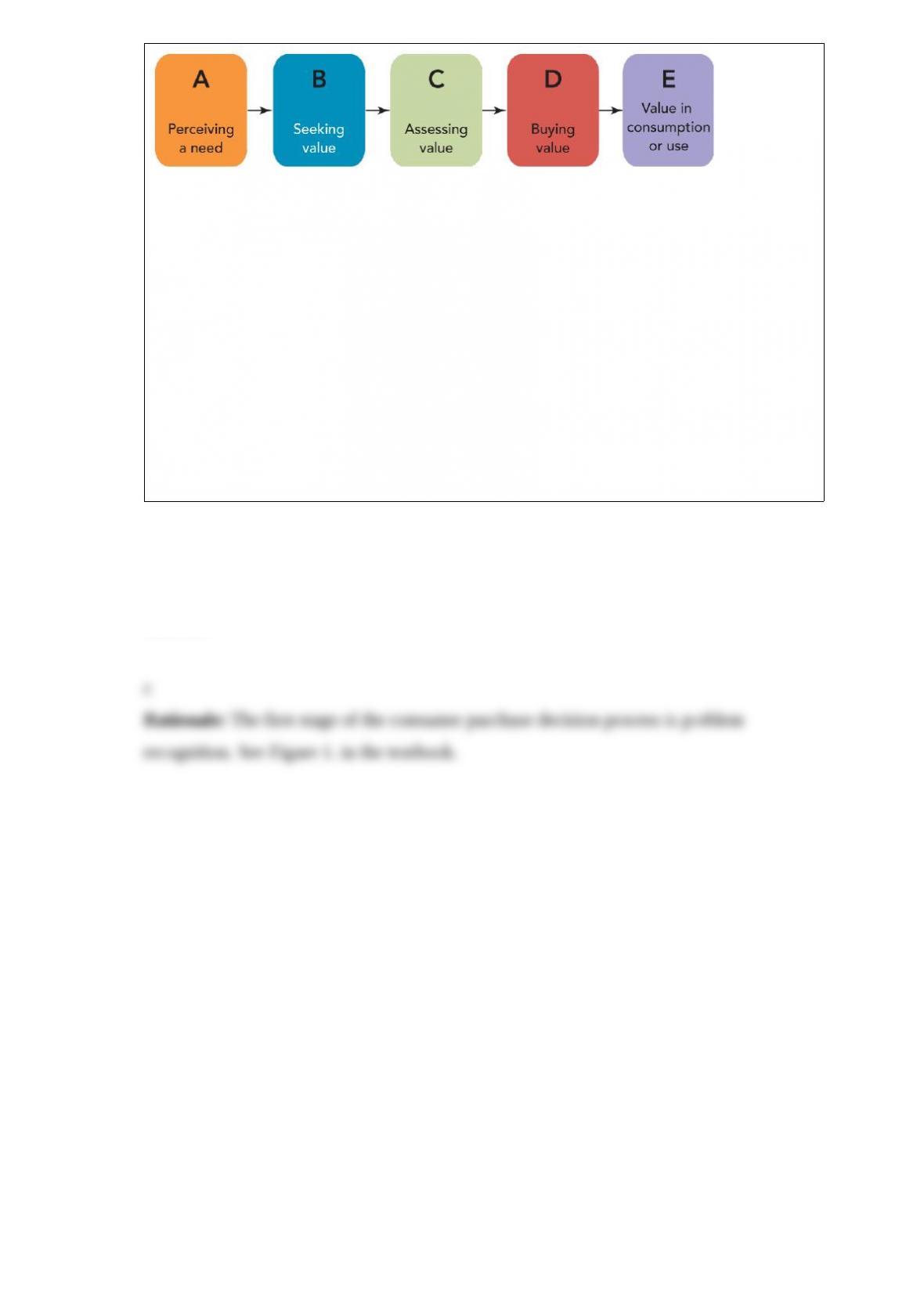
Figure 1.
In Figure 1. above, “A” represents which stage of the consumer purchase decision
process?
a. purchase decision
b. information search
c. problem recognition
d. alternative evaluation
e. postpurchase behavior
Answer: