One of the many lean techniques that have been successfully applied in service firms is
the eliminating of unnecessary activities.
Answer:
A matrix project structure is often referred to as a ‘skunkworks.”
Answer:
Issues of product mix and capacity are strongly interconnected to the facility location
decision.
Answer:
In practice, achieving a perfectly balanced plant is usually desirable but impossible.
Answer:
The goal of JIT production is to drive all inventory queues lower.
Answer:
The master production schedule states the number of items to be produced during
specific time periods.
Answer:
Facility location analysis considers the competitive imperative of locating near the
appropriate labor pool to take advantage of high technical skills.
Answer:
In inventory models, high holding costs tend to favor low inventory levels and frequent
replenishment.
Answer:
In a services organization strategic capacity planning follows process planning.
Answer:
Capacity can be defined as the amount of available resource inputs relative to
requirements for output over a particular period of time.
Answer:
The objective of the aggregate operations plan is to insure that the marketing and sales
plans are realistic.
Answer:

You have just determined the actual number of workstations that will be used on an
assembly line to be 6 using the assembly-line balancing procedure. The cycle time of
the line is 5 minutes and the sum of all that tasks required on the line is 25 minutes.
Which of the following is the correct value for the resulting line’s efficiency?
A. 0.500
B. 0.833
C. 0.973
D. 0.990
E. None of the above
Answer:
A project can be subdivided into which of the following?
A. Job orders
B. Sub-jobs
C. Work Packages
D. Sub-paths
E. Events and decisions
Answer:
Which of the following is not a lot sizing technique used in MRP systems?
A. Lot-for-lot (L4L)
B. Economic order quantity (EOQ)
C. Least total cost (LTC)
D. Least unit cost (LUC)
E. Warehouse loading factor (WLF)
Answer:

In the service-system design matrix, a face-to-face total customization service
encounter is expected to have which of the following?
A. Low sales opportunity
B. Low production efficiency
C. High production efficiency
D. Low degree of customer/server contact
E. None of the above
Answer:
In order to determine the standard deviation of usage during lead time in the reorder
point formula for a fixed-order quantity inventory model which of the following must
be computed first?
A. Standard deviation of daily demand
B. Number of standard deviations for a specific service probability
C. Stockout cost
D. Economic order quantity
E. Safety stock level
Answer:

A company has recorded the last five days of daily demand on their only product. Those
values are 120, 125, 124, 128, and 133. The time from when an order is placed to when
it arrives at the company from its vendor is 5 days. Assuming the basic fixed-order
quantity inventory model fits this situation and no safety stock is needed, which of the
following is the reorder point (R)?
A. 120
B. 126
C. 630
D. 950
E. 1,200
Answer:
A company has recorded the last six days of daily demand on a single product they sell.
Those values are 37, 115, 93, 112, 73, and 110. The time from when an order is placed
to when it arrives at the company from its vendor is 3 days. Assuming the basic
fixed-order quantity inventory model fits this situation and no safety stock is needed,

which of the following is the reorder point (R)?
A. 540
B. 270
C. 115
D. 90
E. 60
Answer:
One of the main purposes of a MRP system is which of the following?
A. Track inventory levels
B. Create productive capacity
C. Decrease layers of management
D. Develop schedules specifying when each component should be ordered or
produced.
E. Upgrade manufacturing’s professionalism
Answer:
Heavy sales of umbrellas during a rain storm is an example of which of the following?
A. A trend
B. A causal relationship
C. A statistical correlation
D. A coincidence
E. A fad
Answer:
The centroid method for plant location uses which of the following data?
A. Volume of goods to be shipped between existing points
B. Inbound transportation costs
C. Transport times between facilities

D. Correlation matrix of existing facilities
E. Probabilities and payoffs
Answer:
Applicants for the Baldrige Award for total quality management must submit an
application of up to 50 pages that details the processes and results of their activities
under seven major categories. Which of the following is one of those categories?
A. DMAIC
B. Analysis and Remember management
C. Standardization
D. Control
E. Inspection protocols
Answer:
In implementing a lean production system you should work with suppliers to do which
of the following?
A. Open facilities near your factory
B. Focus workstation capacities
C. Backflush
D. Provide quality at the source
E. Reduce lead times
Answer:
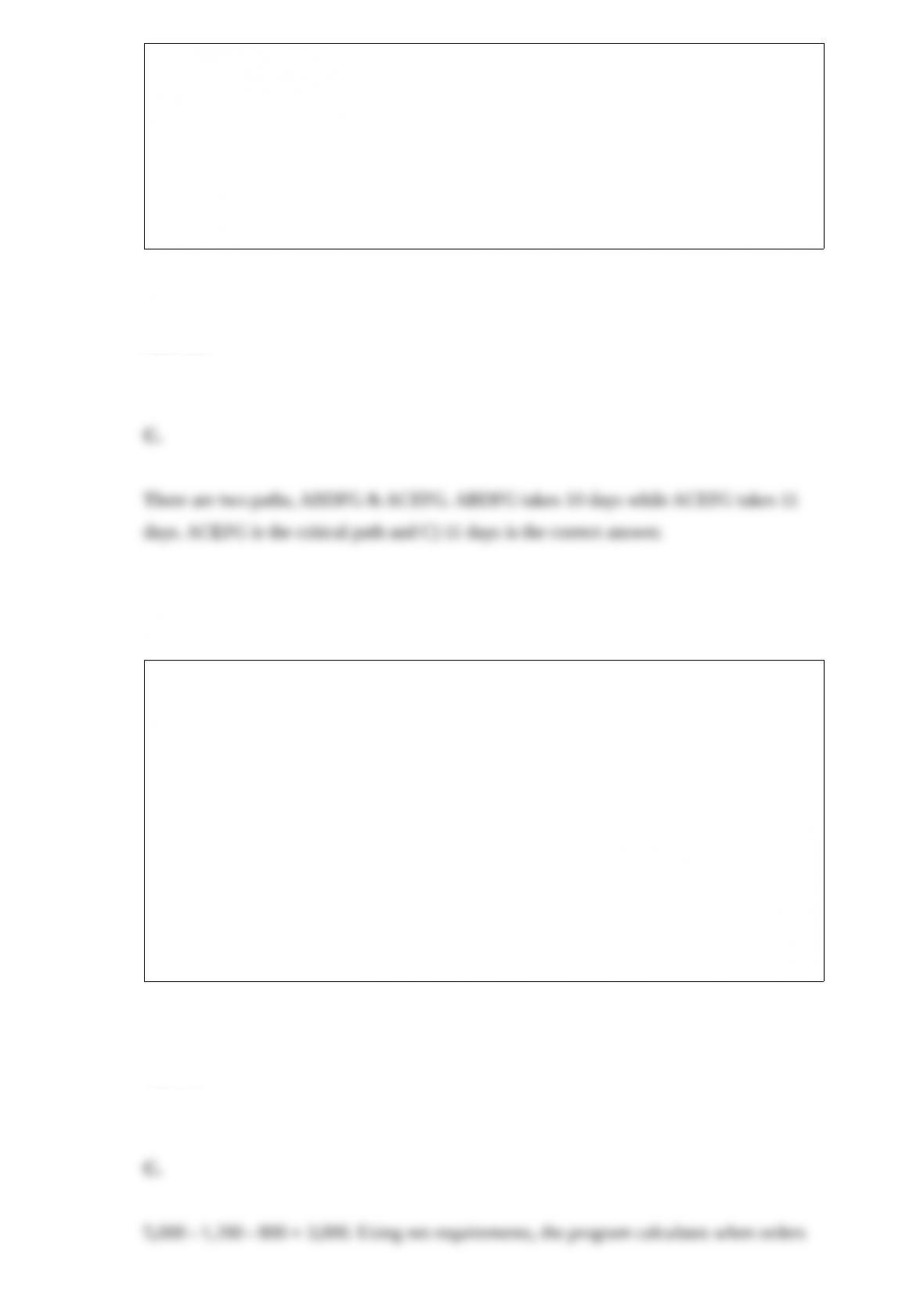
A company must perform a maintenance project consisting of seven activities. The
activities, their predecessors, and their respective time estimates are presented below:
Using CPM, what is the Latest Finish Time for the last activity in this project (i.e., the
total time to complete the project)?
A. 9 days
B. 10 days
C. 11 days
D. 12 days
E. 13 days
Answer:
Which of the following is the planned-order release using an MRP program if the gross
requirement is 5,000, inventory on hand is 1,200 and planned receipts are 800?
A. 7,000
B. 4,200
C. 3,000
D. 2,000
E. 1,200
Answer:

The main purpose of aggregate operations planning is to specify the optimal
combination of which of the following?
A. Workforce levels and inventory on hand
B. Inventory on hand and financing costs for that inventory
C. The strategic plan and the products available for sale
D. The workforce level and the degree of automation
E. Operational costs and the cash flow to support operations
Answer:
In a typical inventory status record which of the following would you not expect to see?
A. Scrap allowance
B. Order quantity
C. Gross requirements
D. Planned-order releases
E. Lost items
Answer:
Which of the following are not listed in the text as jobs in OSCM?
A. Department store manager
B. Project manager
C. Hospital administrator
D. Data Center manager
E. Call center manager
Answer:

If annual demand is 35,000 units, the ordering cost is $50 per order and the holding cost
is $0.65 per unit per year, which of the following is the optimal order quantity using the
fixed-order quantity model?
A. 5,060
B. 2,320
C. 2,133
D. 2,004
E. 1,866
Answer:
Which of the following is the cost of quality classification for costs such as inspection,
testing, and other tasks to ensure that the product or process is acceptable?
A. Appraisal costs
B. Prevention costs
C. External failure costs
D. Internal failure costs
E. Checking costs

Answer:
According to Little’s law, which of the following can be used to estimate
work-in-process inventory?
A. Process time/Cycle time
B. Throughput rate times Flow time
C. Process velocity/Flow time
D. Set up time/Throughput rate
E. Value added time/Process velocity
Answer:
There are many applications of poka-yokes in service organizations. Which of the

following is one of the three-T’s used to classify poka-yokes?
A. Task
B. Time
C. Teamwork
D. Trust
E. Talent
Answer:
A company has had actual unit demand for four consecutive years of 100, 110, 125, and
150. The respective forecasts using exponential smoothing were 120 for each of those
four years. What value of alpha, the smoothing constant, was the firm using?
____________________________________
Answer:
When a customer allows their supplier to manage an item or group of items for them it
is called ________________________
Answer:
Name four methods of quantitative analysis that are useful in informing the facility
location decision.
1) ____________________
2) ____________________
3) ____________________
4) ____________________
Answer:
Lots are defined as low quality when the percentage of defective units is greater than
what? ________________________________________
Answer:
What is the effect of the lack of synchronization among supply-chain members called?
________________________
Answer:
If demand for product “A” were forecast at 1,000,000 units for the coming year and
your factory has trained labor and equipment sufficient to produce 150,000 units per
month, is the capacity cushion positive or negative? ____________________
Answer:
People who provide capital to the firm through stock purchases are called:
_____________________
Answer:
The time-phased plan specifying how many and when the firm plans to build each end
item is called what? ___________________________________________
Answer:

Explain the difference between producer’s risk and consumer’s risk in acceptance
sampling.
Answer: