
Central to the concept of operations and supply strategy is the notion of operations
focus and trade-offs.
Answer:
A doctor completes a surgical procedure on a patient without error. The patient dies
anyway. In operations management terms, we could refer to this doctor as being
efficient but not effective.
Answer:
In facility location decision-making matching the educational and skill levels of the
labor pool to a company’s needs is even more important than the labor pool’s
willingness and ability to learn.
Answer:
Using the ABC classification system for inventory, which of the following is a
Answer:
Complex consulting engagements that require a great deal of innovation and creativity
are sometimes called “gray hair” projects because they require a great deal of
experience on the part of the consultants.
Answer:
Project management software available today combines CPM and other scheduling
aids, like Gantt charting, to aid in tracking progress of project completion.
Answer:

Rather than try to adjust the master production schedule to change resource loads, it is
more practical to control the flow at each bottleneck or CCR to bring capacities in line.
Answer:
Simulation models are classified as continuous if the simulation occurs at specific event
points, like a piece of machinery in a factory breaking down.
Answer:
Because of the high Level of control that ERP software brings to business processes,
cost over-runs are rare when implementing ERP.
Answer:
One characteristic of a well-designed service system is that it is cost-effective.
Answer:

JIT requires vendors to be located nearby. When compared to synchronous
manufacturing this is viewed as an advantage of JIT.
Answer:
An important aspect of service products is that they can not be inventoried.
Answer:
LTPD in acceptance sampling stands for “lots of tolerance for parts defective”.
Answer:
Excel Solver solutions include a sensitivity report. This report gives information on
making changes in objective function coefficients.
Answer:
The value chain provides a structure to capture the linkage of organizational activities
that create value for the customer and profit for the firm.
Answer:
Projected available balance is the amount of inventory that is expected as of the
beginning of a period.
Answer:
The computation of a firm’s inventory position is found by taking the inventory on hand
and adding it to the on-order inventory and then subtracting back-ordered inventory.
Answer:

Maximum practical capacity is defined by the federal Bureau of Economic Analysis as
“That output attained within the normal operating schedule of shifts per day and days
per week including the use of high-cost inefficient facilities”.
Answer:
Plant A is located at the (X, Y) coordinates of (100, 200) and has a volume of shipping
of 500 units a day. Plant B is located at the (X, Y) coordinates of (150, 400) and has a
volume of shipping of 200 units a day. Using the centroid method, which of the
following is the X coordinate for the new plant location?
A.About 100
B.About 115
C.About 130
D.About 150
E.X coordinate can not be computed from the data given
Answer:

How many free trade zones are there in the United States?
A.Less than 50
B.Less than 100
C.About 260
D.More than 412
E.About 310
Answer:
Which of the following is most closely related to the reason a firm might implement
MRP?
A.So they can order the right parts
B.So they can order parts sufficient for immediate use
C.So they can insure that parts to arrive prior to when they are needed
D.To assure appropriate quality Levels
E.To keep process costs between the LCL and the UCL
Answer:

The total output from a production system in one day is 500 units and the total labor
necessary to produce the 500 units is 350 hours. Using the appropriate productivity
measure, which of the following numbers represents the resulting productivity ratio?
A.1.000
B.1.428
C.0.700
D.0.411
E.None of the above
Answer:
A reason for studying operations and supply management (OSM) is which of the
following?
A.OSM is essential for understanding organizational behavior
B.Most business graduates do OSM work regardless of their job title
C.The concepts and tools of OSM are used in managing other business functions
D.OSM is a required course in all business degree programs
E.OSM is the most rigorous business discipline
Answer:
In a typical inventory status record which of the following would you not expect to see?
A.Scrap allowance
B.Order quantity
C.Gross requirements
D.Planned-order releases
E.Lost items
Answer:
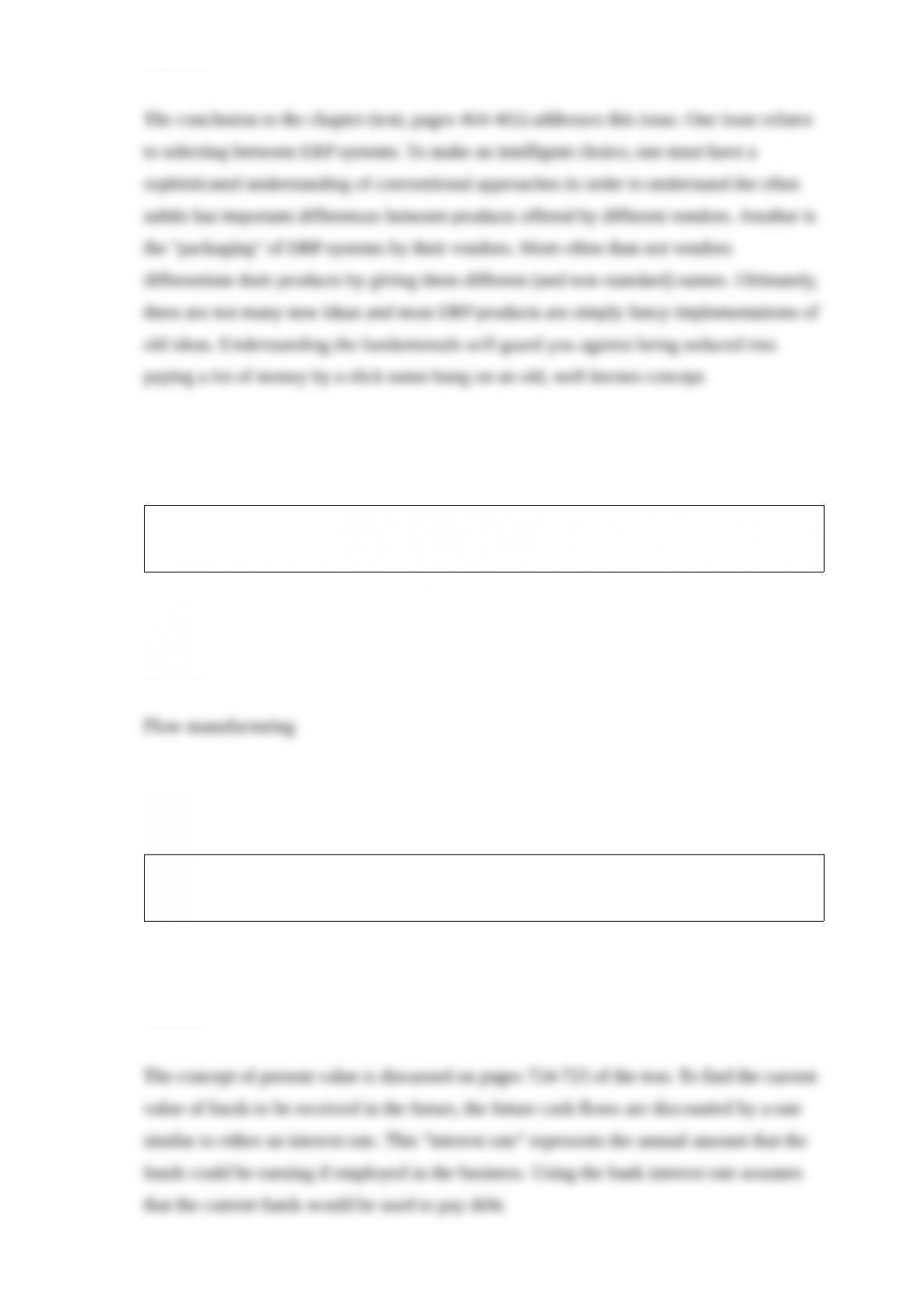
You have collected the data for a Time-Cost CPM Scheduling model analysis. The time
is in days and the project “direct costs” are given below.
The indirect costs for the project are determined on a daily duration basis. If the project
lasts 16 days the total indirect costs are $400, 15 days they will be $250, 14 days they
will be $200 and 13 days they will be $100. If you crash this project by one day what is
the total (i.e., direct and indirect) project cost?
A.$2,150
B.$2,300
C.$2,400
D.$2,450

E.$2,500
Answer:
Which of the following should we use an “R” chart to monitor process quality?
A.Weighing trucks at a highway inspection station to determine if they are overloaded
B.Deciding whether an airliner has sufficient fuel for its trip
C.Student grades measured from 1 to 100
D.Determining whether vehicles from a motor pool will run
E.Determining the accuracy of a forecast of ‘snow”
Answer:
Which of the following are key inventory reduction targets under lean production?
A.FIFO inventory
B.Hidden inventory
C.Safety stock
D.Lost inventory

E.Ladder inventory
Answer:
When a company seeks to match the benefits of a successful position while maintaining
its existing position in offering customers a variety of differing services, what is this
process called?
A.Operations capability analysis
B.Straddling
C.Order qualifier
D.Order winners
E.Inter-functional analysis
Answer:
Which of the following is not one of the categories in a Rapid Plant Assessment tour?
A.Customer satisfaction
B.Teamwork and motivation
C.Productivity incentives

D.Level of inventory
E.Commitment to quality
Answer:
Which of the following is not considered an operations consulting tool kit category?
A.Problem definition
B.Data gathering
C.Cost impact and payoff analysis
D.Optimizing operations output
E.Implementation
Answer:
Which of the following is an assumption made in using CPM analysis?
A.Project activities flow together without distinct boundaries
B.Project activity times can be estimated accurately and do not vary
C.Project management should focus on crashing activities

D.There is never a work stoppage in any activity until it is complete
E.There are no learning curve effects in setting activity time
Answer:
Which of the following is not a suggestion for managing queues presented in the
textbook?
A.Try to divert your customer’s attention when waiting
B.Segment the customers
C.Encourage customers to come during the slack periods
D.Train your people to be friendly
E.Periodically close the service channel to temporarily disperse the line
Answer:
Buying food at a large food store with multiple checkout counters features which type
of queuing system line structure?
A.Single channel, single phase
B.Single channel, multiphase

C.Multichannel, single phase
D.Multichannel, multiphase
E.None of the above
Answer:
A company can produce a small lot of products the first time at a cost of $2,000. If their
85 percent learning curve allows them to reduce their costs on each lot, what is the total
cost of producing 5 lots?
A.$10,000.00
B.$9,376.50
C.$8,062.00
D.$4,031.00
E.$1,191.20
Answer:
Why does one have to thoroughly understand conventional approaches to problems
when they can be solved by ERP computer programs?
Answer:
What is the name given to the manufacturing software that combines MRP and JIT
logic?
Answer:
Why is the net present value of a stream of payments less than the sum of the same
stream of payments?
Answer:
What seven design principles guide the design of lean supply chains?
Answer:
In discussing batch size on an assembly line the text makes the point that “one” and
“infinity” are equally correct Answers. How can this be?
Answer:

A work center has five jobs assigned to it. They are labeled, in the order of their arrival
in the shop, as jobs A, B, C, D and E. The work center may work on only one job at a
time and must complete any job it starts before starting another job. Job A has a
processing time of 6 days and is due to the customer in 9 days. Job B has a processing
time of 2 days and is due in 16 days. Job C has a processing time of 4 days and is due in
10 days. Job D has a processing time of 3 days and is due in 7 days. Job E has a
processing time of 5 days and is due in 12 days. Using the slack time remaining priority
rule, in what order should these jobs be undertaken?
Answer:
In finite queuing theory, the average number in the waiting line divided by the average
arrival rate yields what measure of waiting line performance?
Answer: