1) Transformations may be used when nonlinear relationships exist between variables.
2) Errors are also called residuals.
3) All decisions that result in a favorable outcome are considered to be good decisions.
4) Despite the power of simulation, less than 20% of the largest U.S. corporations use
simulation in corporate planning.
5) Assume that you have an urn containing 10 balls of the following description:
4 are white (W) and lettered (L)
2 are white (W) and numbered (N)
3 are yellow (Y) and lettered (L)
1 is yellow (Y) and numbered (N)
If you draw a numbered ball (N), the probability that this ball is white (W) is 0.667.
6) The dependent variable is also called the response variable.
7) Purchasing department supplies comprise one of the “carrying cost factors.”
8) Management resources that need control include machinery usage, labor volume,
money spent, time used, warehouse space used, and material usage.
9) A basic feasible solution to a system of n equations is found by setting n variables
equal to 0 and solving for the other variables.
10) We cannot multiply an n x 1 matrix by an n x m matrix.
11) The dual problem formulation can be solved using the same simplex process used
for the primal formulation.
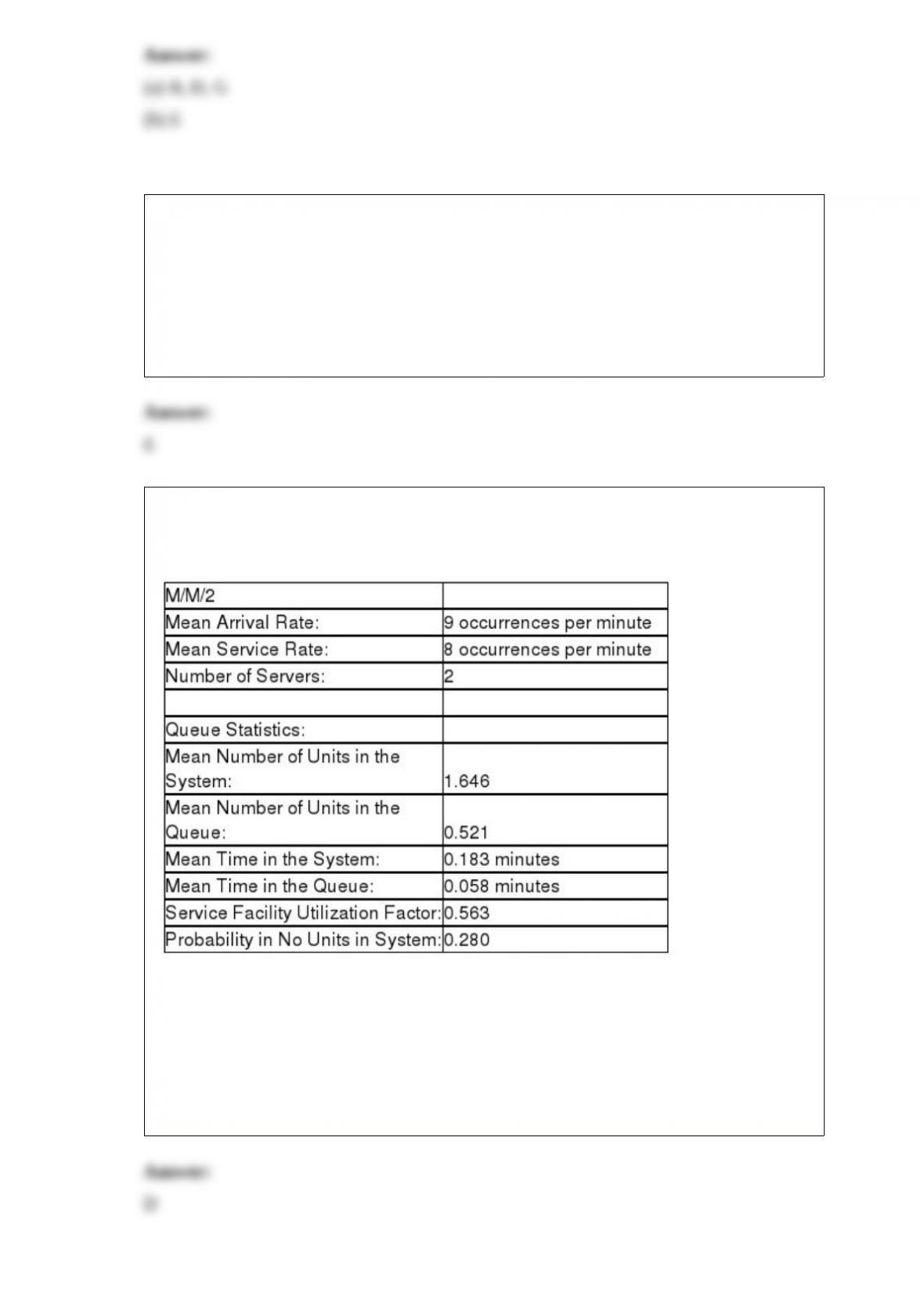
12) Consider the following project schedule:
(a) Which activities are critical?
(b) Which activity has the most slack?
13) The condition when there is no solution that satisfies all the constraints
simultaneously is called
A) boundedness.
B) redundancy.
C) optimality.
D) dependency.
E) None of the above
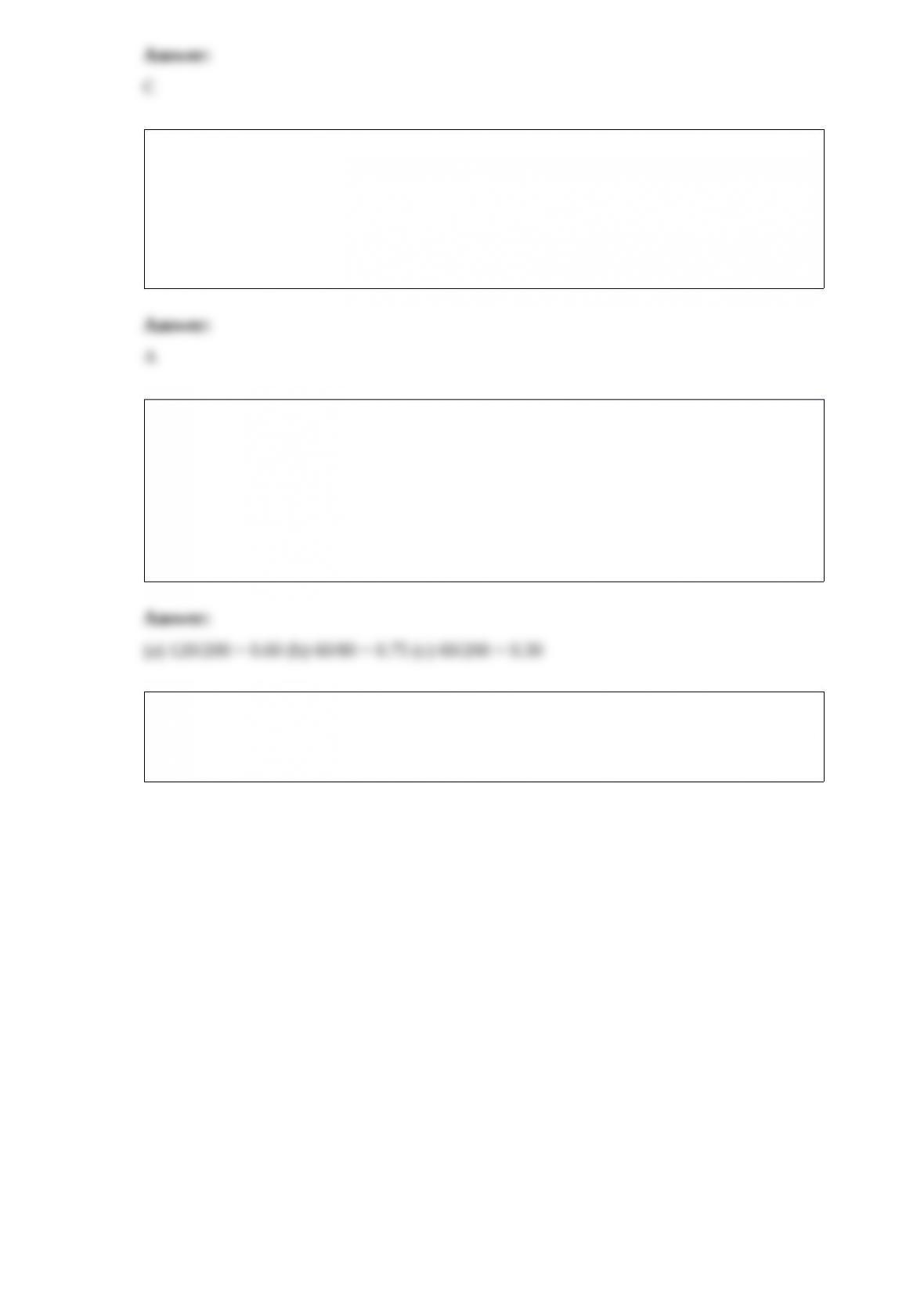
14) Table 12-1
According to the information provided in Table 12-1, what is the average time spent by
a person in this system?
A) 0.058 minute
B) 1.646 minutes
C) 0.521 minute
D) 0.183 minute
E) None of the above

15) A suburban specialty restaurant has developed a single drive-thru window.
Customers order, pay, and pick up their food at the same window. Arrivals follow a
Poisson distribution, while service times follow an exponential distribution. What type
of queuing model is exhibited in this problem?
A) M/M/1
B) M/M/2
C) M/D/2
D) M/D/1
E) M/G/1
16) Which Excel feature is an optimization technique that can maximize or minimize a
quantity given a set of limitations or constraints?
A) Optimizer
B) Goal Seek
C) Analysis Tool-Pak
D) Algorithm Builder
E) Solver
17) Your company is considering submitting a bid on a major project. You determine
that the expected completion time is 100 weeks and the standard deviation is 10 weeks.
It is assumed that the normal distribution applies. You wish to set the due date for the
project such that there is an 85 percent chance that the project will be finished by this
time. What due date should be set?
A) 108.0
B) 110.4
C) 89.6
D) 85.0
E) 100
18) The annual demand for a product is 1,000 units. The company orders 200 units each
time an order is placed. The lead-time is 6 days. There are 250 working days per year. If
the reorder point is 50, what safety stock are they using?
A) 22
B) 4
C) 26
D) 28
E) None of the above
19) Which of the following methods is used only with the assignment problem?
A) the Hungarian method
B) stepping-stone method
C) MODI method
D) Vogel’s approximation method
E) the simplex method
20) A new television program was viewed by 200 people (120 females and 80 males).
Of the females, 60 liked the program and 60 did not. Of the males, 60 of the 80 liked
the program.
(a) What is the probability that a randomly selected individual liked the program?
(b) If a male in this group is selected, what is the probability that he liked the program?
(c) What is the probability that a randomly selected individual is a female and liked the
program?
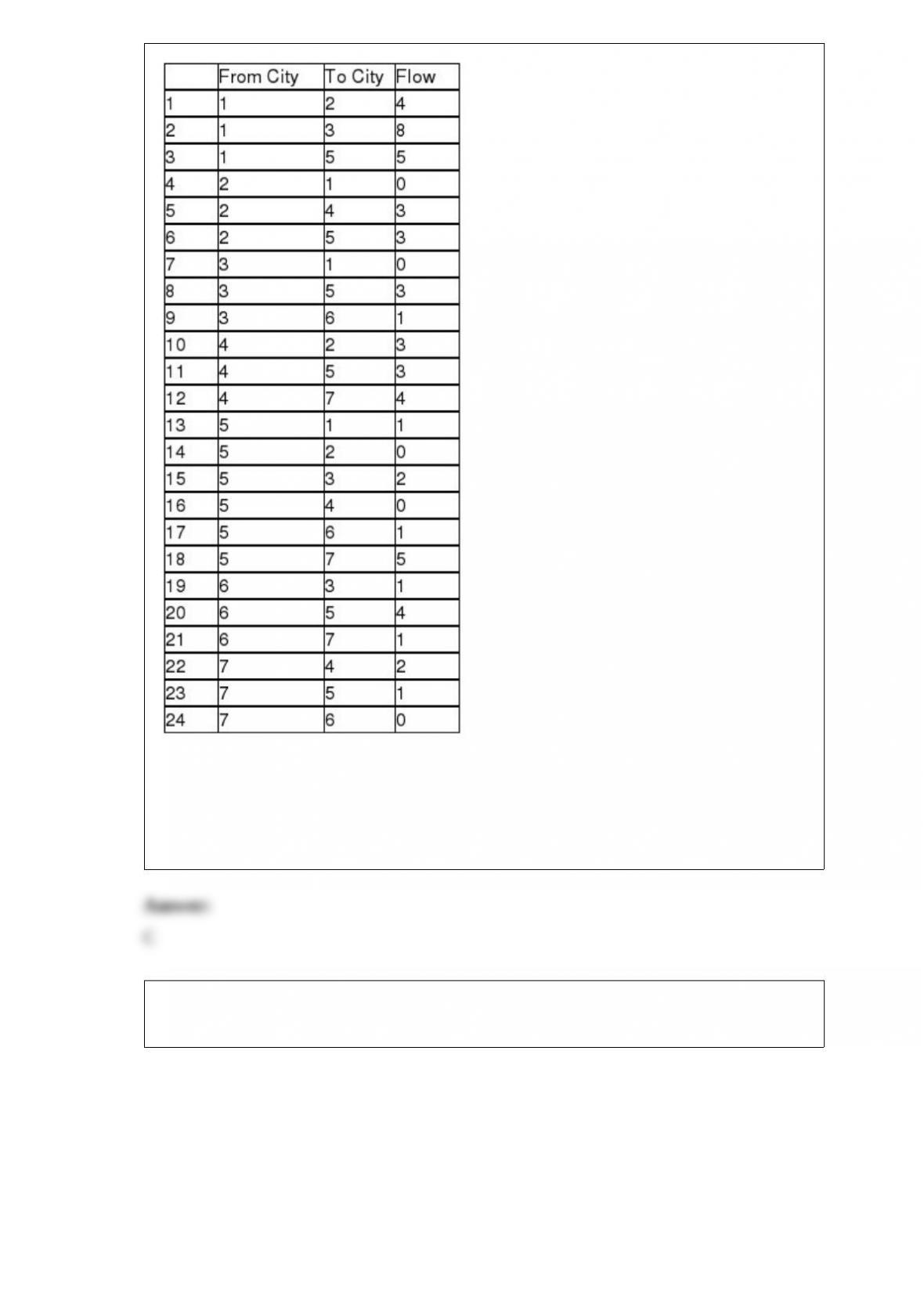
21) Given the following traffic flows, in hundreds of cars per hour, what is the
maximum traffic flow from City 1 to City 7?
A) 1200
B) 1400
C) 900
D) 800
E) None of the above
22) Given a network with the following distances:
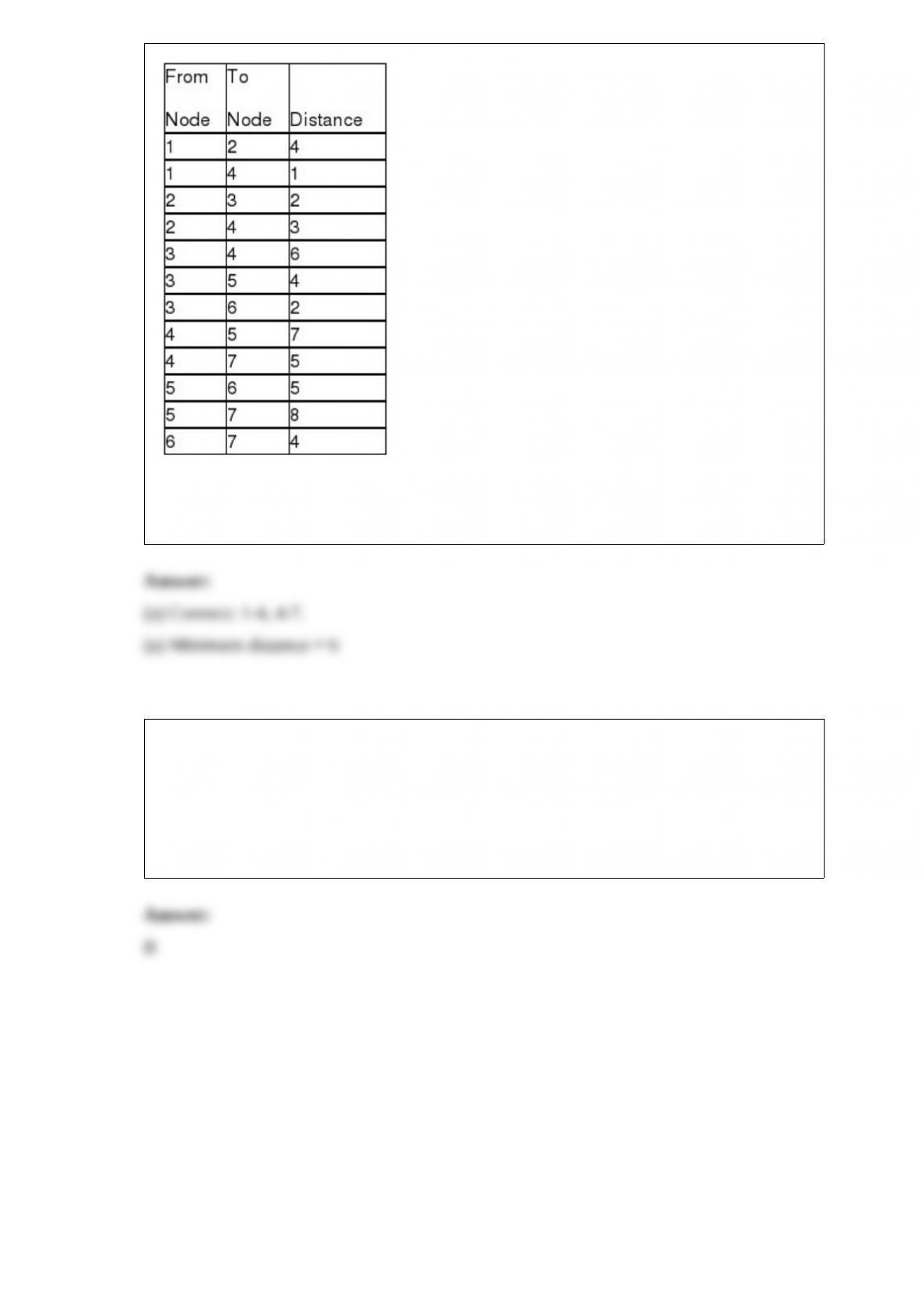
(a) Determine which nodes should be connected to get the minimum distance flowing
from Node 1 through Node 7.
(b) Determine the minimum distance.
23) The break-even point is an example of a
A) postoptimality model.
B) quantitative analysis model.
C) schematic model.
D) sensitivity analysis model.
E) None of the above