
Therbligs are
A) the smallest unit of time used in methods time measurement exercises
B) the largest unit of time used in methods time measurement exercises
C) the smallest unit of basic motion used in methods time measurement exercises
D) the largest unit of basic motion used in methods time measurement exercises
E) the smallest amount of time required to complete a job
Which part of a waiting line has characteristics that involve statistical distribution?
A) arrivals or inputs
B) waiting line itself
C) service facility
D) A and C
E) A, B, and C
A waiting line model meeting the assumptions of M/M/1 has an arrival rate of 2 per
hour and a service rate of 6 per hour; the utilization factor for the system is
approximately
A) 0.25

B) 0.33
C) 0.50
D) 0.67
E) 3.00
Labor standards can help a firm determine expected production, which in turn enables
A) crew sizes to be determined
B) managers and workers to know what constitutes a fair day’s work.
C) labor cost to be calculated
D) work cells and assembly lines to be balanced
E) work sampling to take place
A transportation problem has an optimal solution when
A) all of the improvement indices are greater than or equal to zero
B) all demand and supply constraints are satisfied
C) the number of filled cells is one less than the number of rows plus the number of
columns
D) all the squares are used

E) all origin-destination combinations have been made equally low in cost
Plots of sample ranges indicate that the most recent value is below the lower control
limit. What course of action would you recommend?
A) Since there is no obvious pattern in the measurements, variability is in control.
B) One value outside the control limits is insufficient to warrant any action.
C) Lower than expected dispersion is a desirable condition; there is no reason to
investigate.
D) The process is out of control; reject the last units produced.
E) Variation is not in control; investigate what created this condition.
Which one of the following statements about purchasing is true?
A) The cost of purchases as a percent of sales is often small.
B) Purchasing provides a major opportunity for price increases.
C) Purchasing is always more efficient than making an item.
D) Purchasing has an impact on the quality of the goods and services sold.
E) Competitive bidding is a major factor in long-term cost reductions.

Response-based competitive advantage can be
A) flexible response
B) reliable response
C) quick response
D) all of the above
E) none of the above
In time studies, normal time is
A) average observed time multiplied by a performance rating factor
B) larger than standard time
C) determined by historical experience
D) converted to standard time by the performance rating factor
E) one hour later during the summer months

E-procurement
A) works best in long-term contract situations, and is not suited for auctions
B) is the same thing as Internet purchasing
C) represents only the auction and bidding components of Internet purchasing
D) is illegal in all states except Nevada and New Jersey
E) All of the above are true of e-procurement.
Which of the following is not one of The Ten Critical Decisions of Operations
Management?
A) layout strategy
B) maintenance
C) process and capacity design
D) mass customization
E) supply-chain management
Frito-Lay uses aggregate planning to match capacity with demand because of the
__________ associated with its specialized processes.
A) high variable cost and high fixed cost

B) high variable cost and low fixed cost
C) low variable cost and high fixed cost
D) low variable cost and low fixed cost
E) none of the above
Which one of the following statements about learning curves is true?
A) A learning curve assumes that the direct labor requirements per unit will
DECREASE at an INCREASING rate as cumulative production increases.
B) A larger learning curve rate implies faster (greater) learning.
C) A learning curve graph usually follows a negative exponential curve.
D) Learning curves can be used only for individuals, not for the whole organization
E) None of the above is true.
Which choice best describes level scheduling?
A) Daily production is variable from period to period.
B) Subcontracting, hiring, and layoffs manipulate supply.
C) Price points are calculated to match demand to capacity.
D) Inventory goes up or down to buffer the difference between demand and production.

E) Seasonal demand fluctuations are matched without hirings or layoffs.
Which of the following is a limitation of the use of learning curves?
A) Change in personnel, design, or procedure leave the learning curve unchanged.
B) Learning curves are applicable to services as well as to manufacturing.
C) The culture of the workplace may alter the learning curve.
D) Direct labor and indirect labor follow the same learning curves.
E) Applications of learning curves are of tactical, not strategic, importance.
Which of the following statements is true?
A) Manufacturing now constitutes the largest economic sector in postindustrial societies
B) The number of people employed in manufacturing has increased since 1950
C) Each manufacturing employee now produces about 20 times more than in 1950
D) All of the above are true.
E) None of the above is true.
When solving decision trees, what phrase represents the act of dropping an alternative
from consideration because it is less favorable than another available option?
A) cut the leaf
B) open the hatch
C) shake the tree
D) punt the ball
E) prune the branch
Identify the typical elements in a process control system.
How is source inspection related to employee empowerment?
General Grant must send orders to General Butler. Carrier pigeons are the medium of
choice. A single pigeon has a .7 probability of arriving at the proper destination in a
timely fashion. How many pigeons, each carrying an identical set of orders, must Grant
send in order for him to have 98% confidence that the orders reached General Butler?
What are the advantages and the disadvantages of the employment-stability policy
“holding employment constant?”
__________ is that element of balancing a work cell that superficially resembles cycle
time.
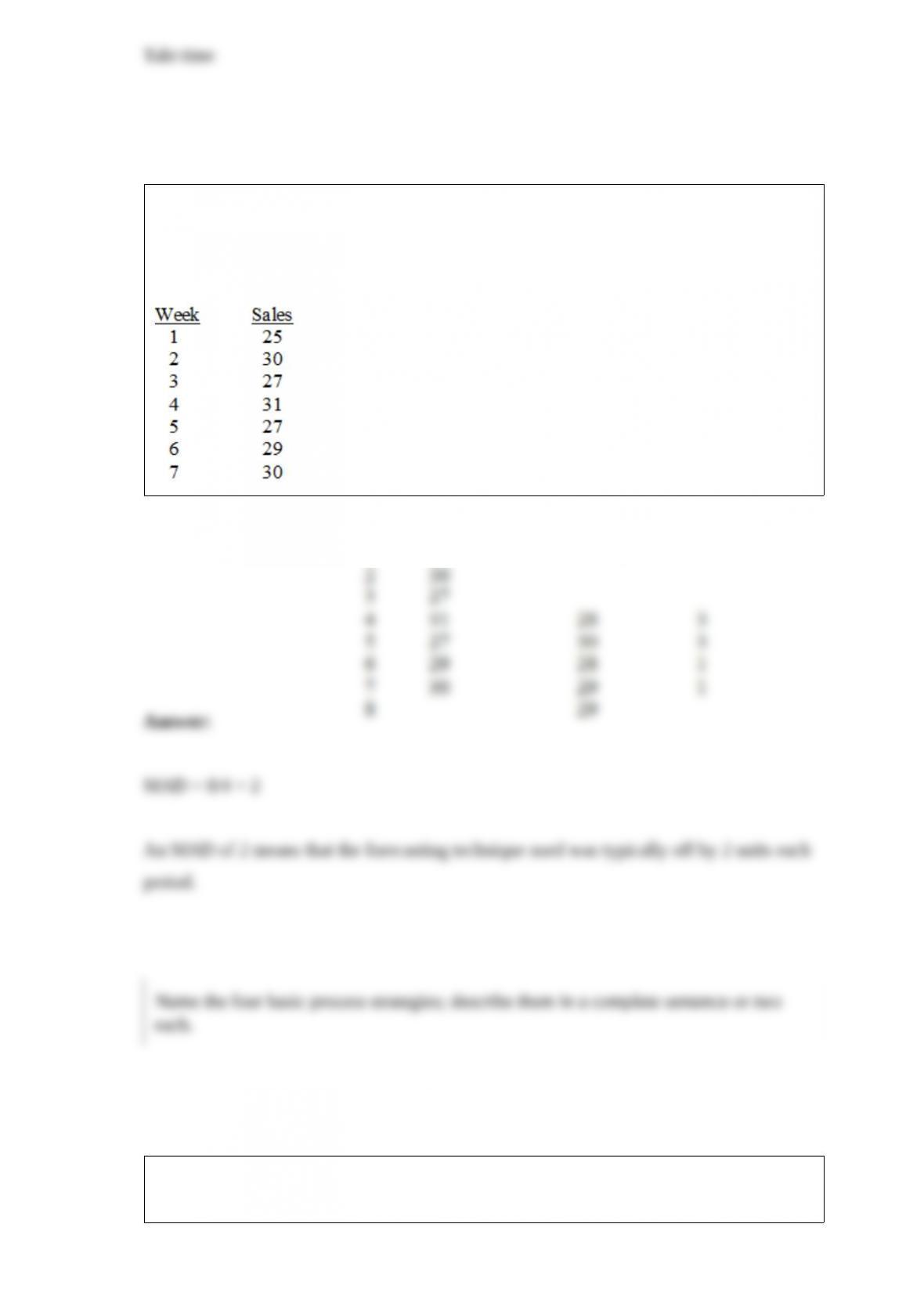
The last seven weeks of demand at a new car dealer are shown below. Use a
three-period weighted-moving average to determine a forecast for the 8th week using
weights of 1, 2, and 3. Calculate the MAD for this forecast. What does the MAD
indicate?
Name the four basic process strategies; describe them in a complete sentence or two
each.
Most people would argue that a service firm must follow chase or mixed strategies. On
the other hand, most state agencies, which are clearly service-oriented, are not at all
able to “chase” demand. Discuss how they manipulate demand to allow the level
strategy to be used.