Which of the following is NOT an advantage of simulation?
a. It provides a convenient experimental laboratory.
b. It can perform “what-if” studies.
c. It does not disrupt the current process.
d. It guarantees accuracy of outputs.
Answer:
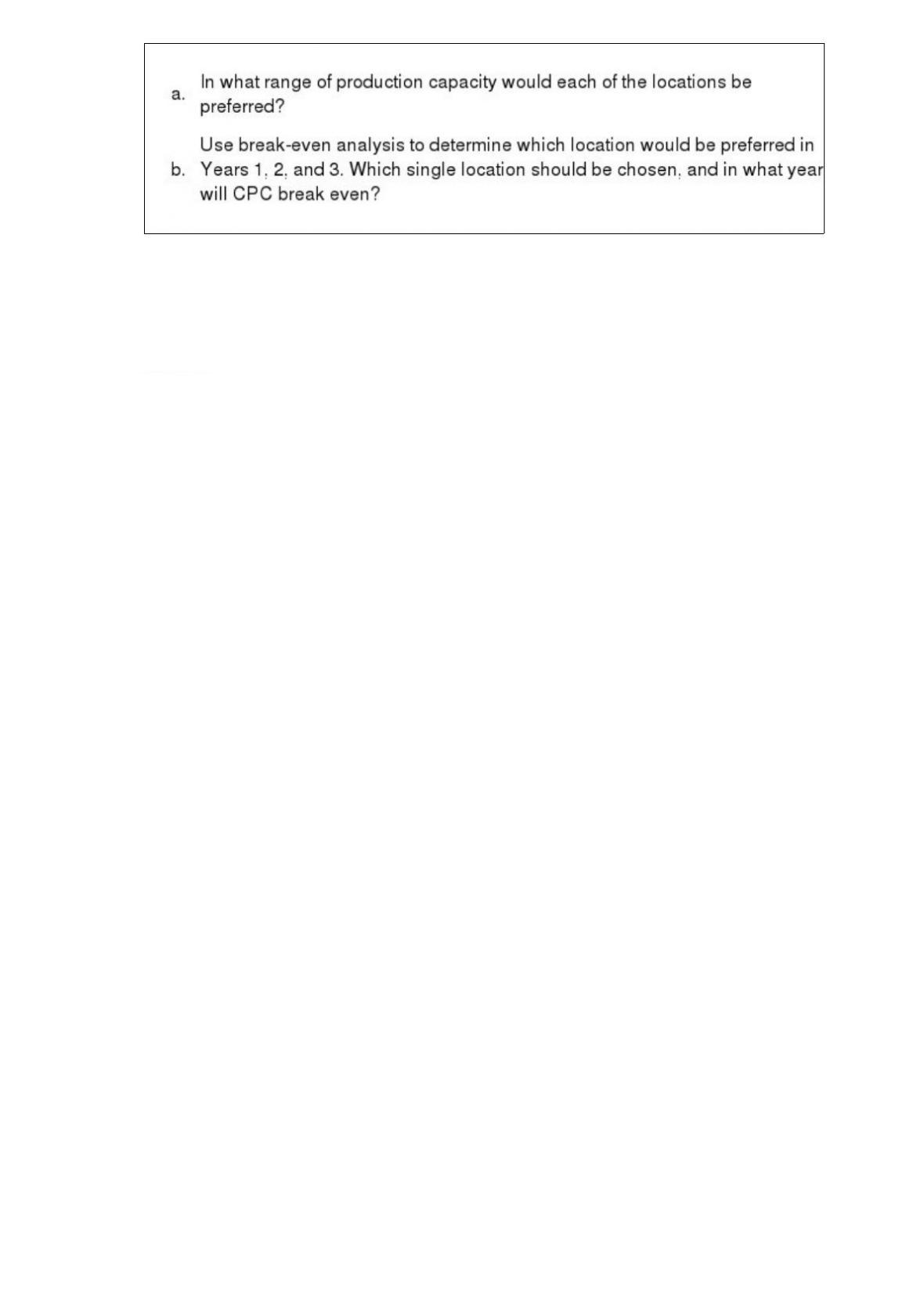
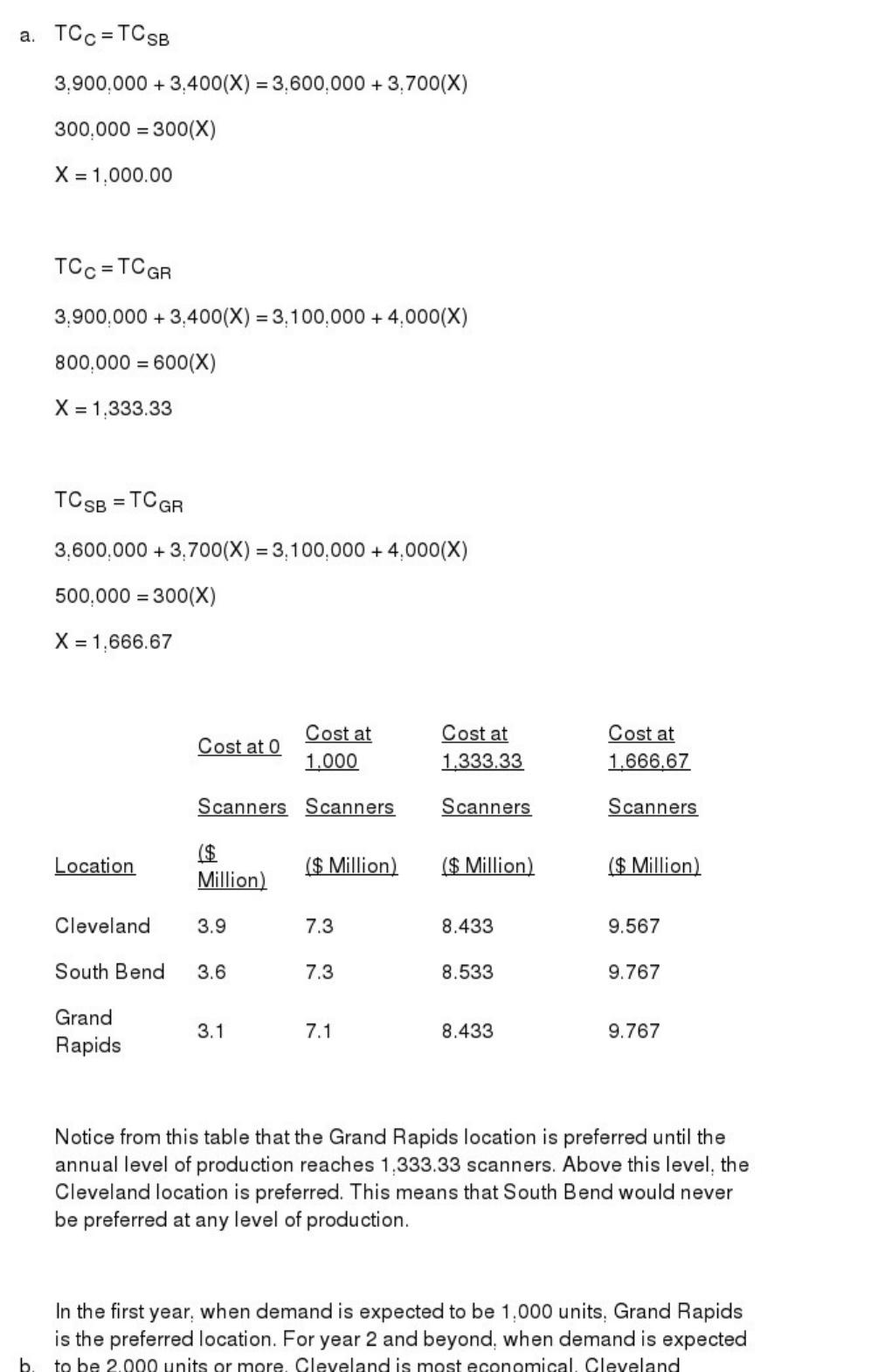
William Green, vice president of manufacturing for Computer Products Corporation
(CPC), and his staff are studying three midwestern alternative locations for a new
production facility for producing high-resolution scanners. His staff analysts predict
that the scanners will be a growing market over the next ten years, and the analysis
group shares marketing’s enthusiasm for planning facilities for producing this new
product line. The analysts have developed these estimates for the three locations:
The marketing department at CPC estimates sales for the scanners will be 1,000
scanners in the first year, 2,000 in the second year, and 4,000 in the third year.
Answer:
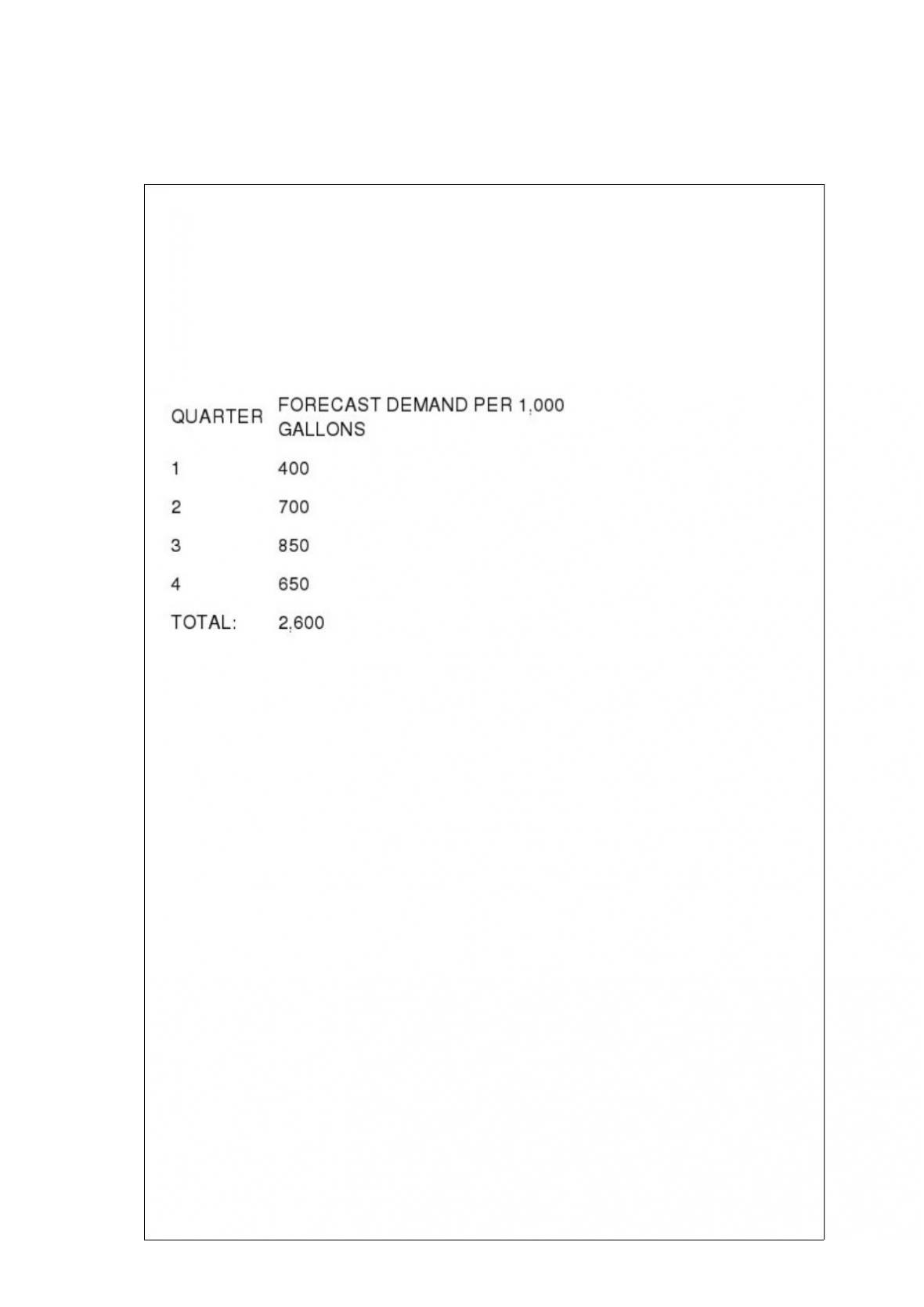
The Academic Company mixes and bottles a high-energy beverage in various container
types and sizes for college students. The aggregate forecast for the next four quarters (1
year) in thousands of gallons is as follows:
Table 1
Academic’s management makes the following assumptions:
Each employee works 550 standard hours of regular time each quarter.
On average, it takes 27 hours to produce and package 1 unit (1,000 gallons).
Regular-time labor costs $6.00/hour; overtime labor costs $9.00/hour.
Inventory-holding cost is approximately $4.50/unit (1,000 gallons) per quarter based
upon the ending inventory per quarter.
Because of extremely hot weather, there is no beginning inventory available to start
Quarter 1.
Management wants a constant work force (no hiring or firing).
Managers have also decided to always round up the number of employees needed to
the next whole integer, i.e., 37.2 yields 38 employees.
______________________________________________________________________
________
Using the data in Table 1and a level schedule of 650 units per quarter, what will be the
annual employee costs?
a. $105,600
b. $554,400
c. $421,200
d. $369,600
Answer:
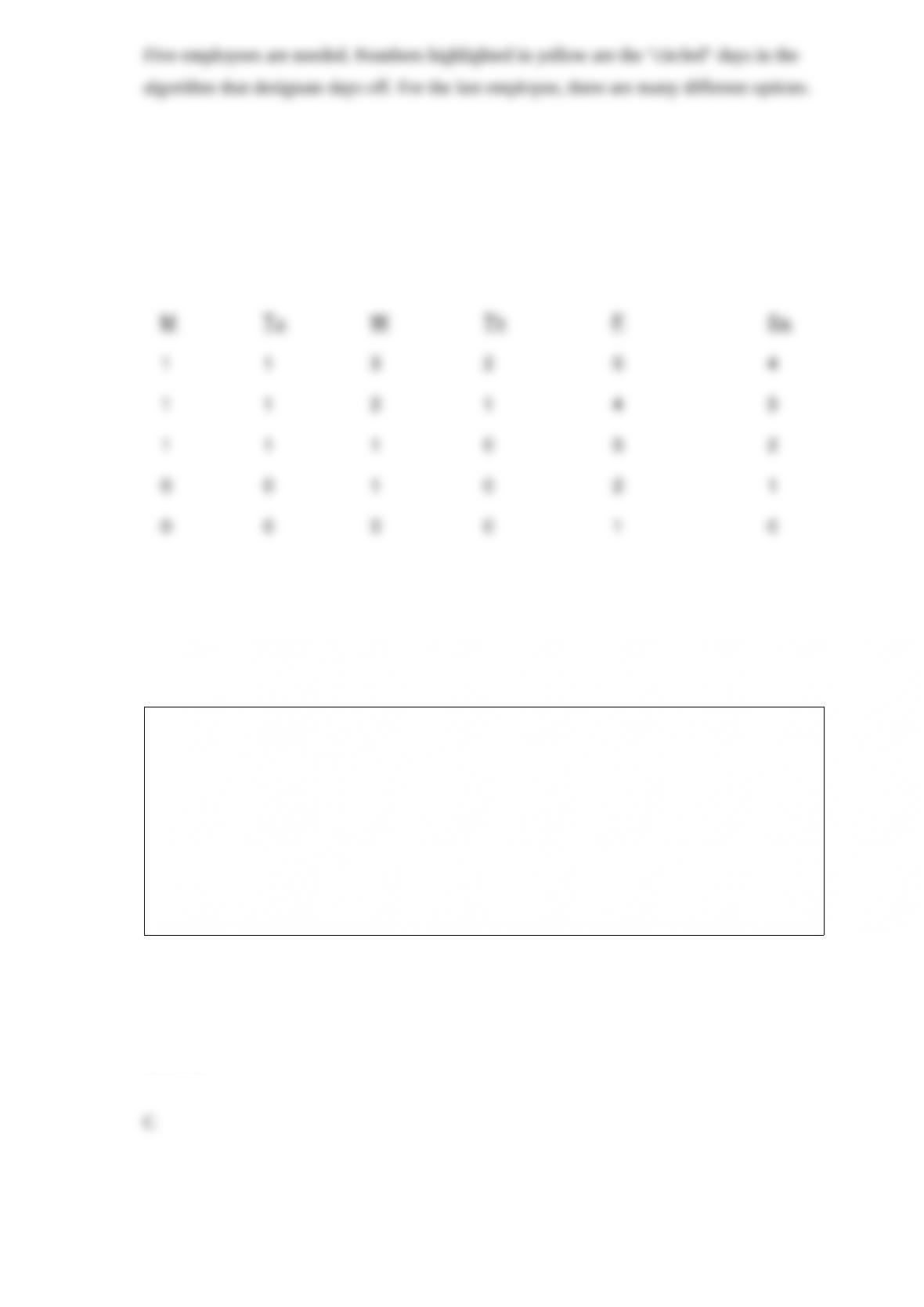
A movie theater requires the following minimum number of employees, each of whom
is required to have two consecutive days off.
Using the staff scheduling method, the solution minimizes the number of employees
required to meet this demand with _____ number of employees.
a. 3 employees
b. 4 employees
c. 5 employees
d. 6 employees
Answer:
Lot-for-lot (LFL):
a. minimizes purchase or setup costs.
b. maximizes the amount of inventory that need to be carried.
c. ignores the cost associated with purchase orders.
d. masks the true nature of dependent demand.
Answer:
A print shop has four jobs that have to be processed through their only five-color press.
They usually use the first come, first served (FCFS) rule of scheduling jobs. However,
the customers are waiting in the lobby for these jobs so the shop wants to minimize the
average waiting time. They are going to use the shortest processing time rule to do so.
Processing times for each job are as follows (assume this is the arrival order): Job A, 30
minutes; Job B, 17 minutes; Job C, 12 minutes; and Job D, 39 minutes.
Using the shortest processing time (SPT) rule to sequence these jobs, the average
waiting (flow) time is _____.
a. less than or equal to 20 minutes
b. more than 20 but less than or equal to 30 minutes
c. more than 30 but less than or equal to 40 minutes
d. more than 40 but less than or equal to 50 minutes
Answer:
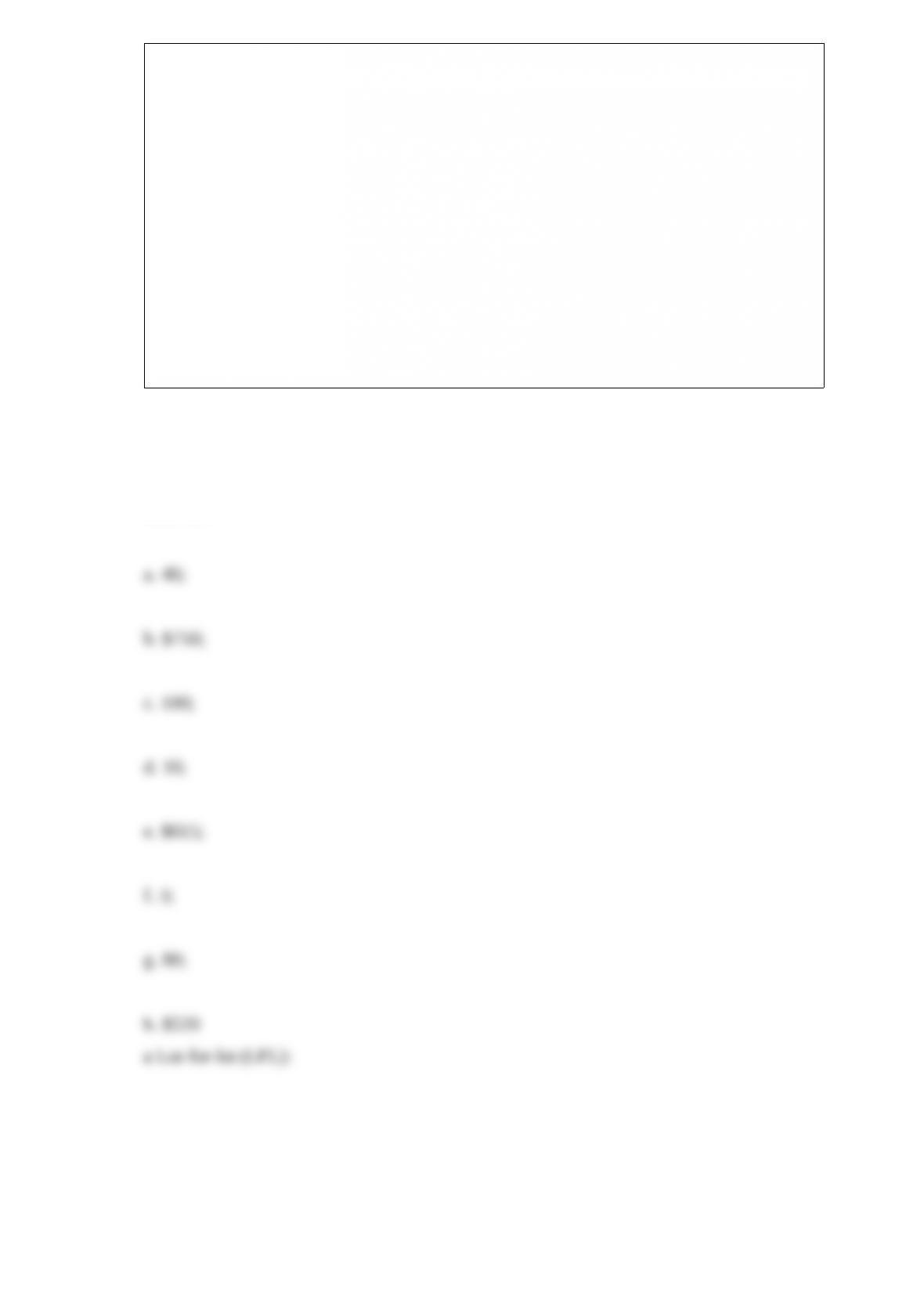
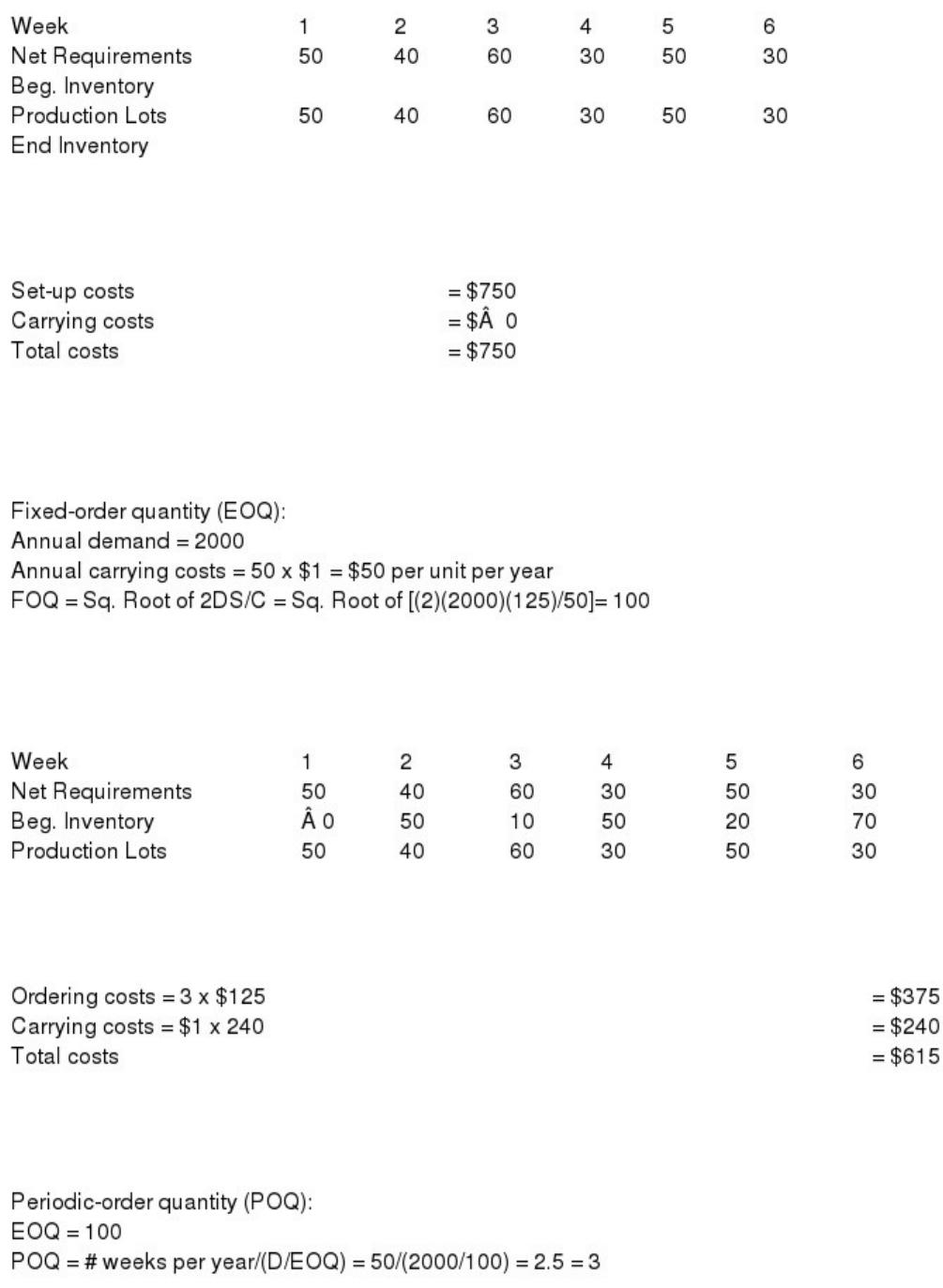
It is time for a company to do its MRP schedule, but they aren’t sure which lot sizing
approach to use: lot-for-lot (LFL), fixed-order quantity (FOQ) using the EOQ approach,
or periodic-order quantity (POQ). They have the following information regarding the
product they wish to produce:
Carrying costs = $1 per unit per week
Setup costs = $125
Annual demand = 2000 units
Work year = 50 weeks
a. What is the production lot size for Week 2 using the LFL method?
b. What is the total cost using the LFL approach?
c. What is the FOQ using the EOQ approach?
d. What is the beginning inventory in Week 3 using the FOQ approach?
e. What is the total cost using the FOQ method?
f. What is the POQ?
g. What is the ending inventory in Week 4 using the POQ approach?
h. What is the total cost using the POQ method?
Answer:
_____ strategy matches the capacity additions with the demand as closely as possible.
a. Capacity lag
b. Capacity straddle
c. Capacity lead
d. Capacity reduction
Answer:
The function of Supply Chain Operations Reference (SCOR) model function that
entails procuring goods and services to meet planned or actual demand is called _____.
a. plan
b. source
c. make
d. deliver
Answer:
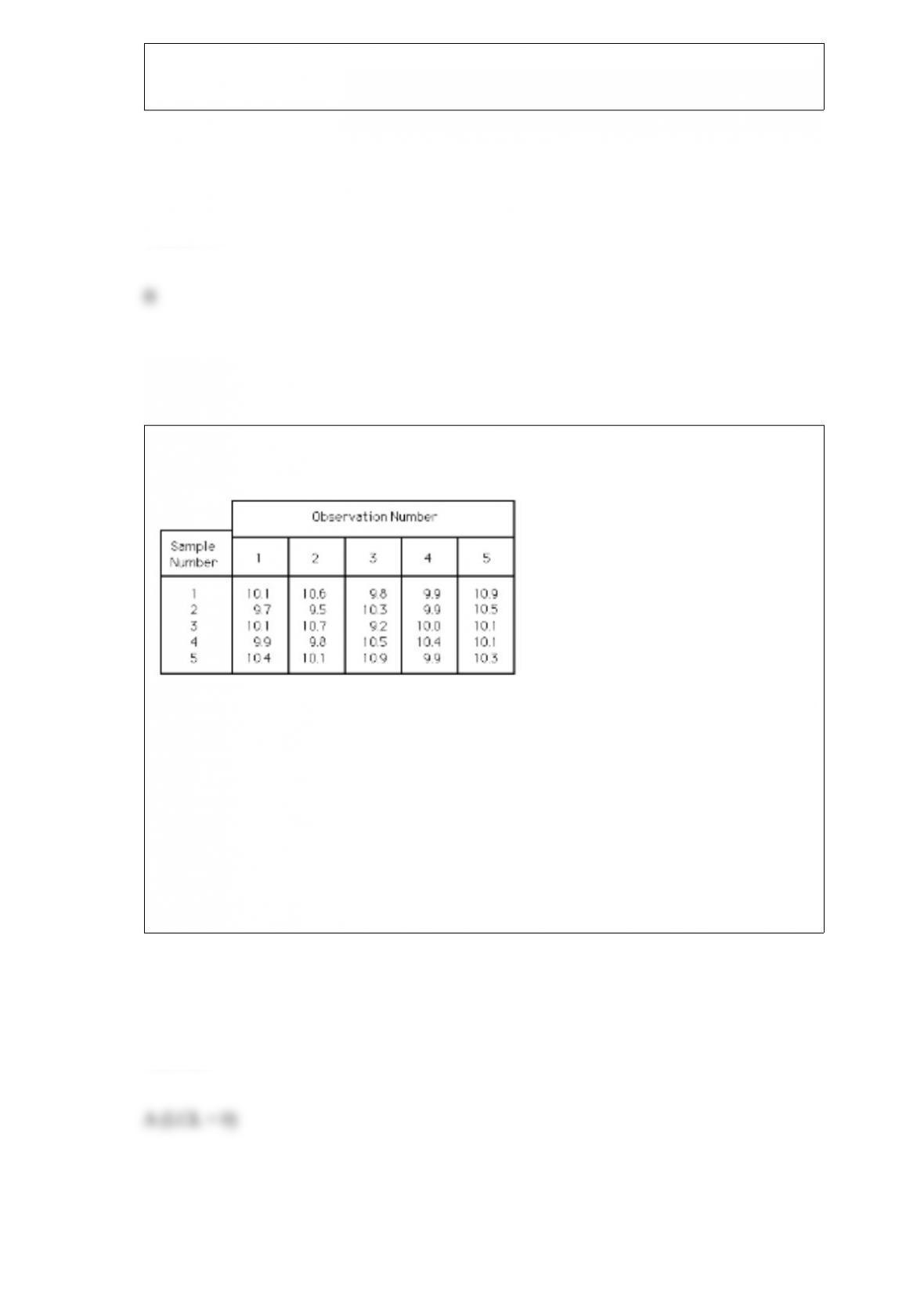
Table 1SPC Problem Data
Using Table 1, for the R-chart, what is the value of LCLR?
a. Less than or equal to 0.01
b. Greater than 0.01 but less than or equal to 0.02
c. Greater than 0.02 but less than or equal to 0.03
d. Greater than 0.03
Answer:

Independent demand:
a. can be calculated.
b. is related to other stock-keeping units (SKUs).
c. is also called finished-goods inventory.
d. needs to be forecasted.
Answer:
A new and improved fertilizer was produced in a fertilizer plant, which consisted of
three stages A, B, and C. Compute the total system reliability (RS), given the individual
reliabilities: A = 0.97, B = 0.99, and C = 0.99.
a. Less than 0.70
b. More than 0.70 and less than 0.80
c. More than 0.80 and less than 0.90
d. More than 0.90
Answer:
The critical path method (CPM) work breakdown structure consists of all of the
following EXCEPT:

a. the number and definition of each project activity.
b. the normal time to complete each activity.
c. the immediate predecessors (i.e., the precedent relationships).
d. the probabilities of completing each activity.
Answer:
Identify an element that is NOT a principal dimension of a servicescape.
a. Spatial layout and functionality
b. Signs, symbols, and artifacts
c. Facility location
d. Ambient conditions
Answer:
The “Xi and Yi” used in the center-of-gravity method are the:
a. transportation costs.
b. x and y coordinates of location i.
c. volume of goods moved to or from location i.
d. x and y coordinates of the center of gravity.
Answer:
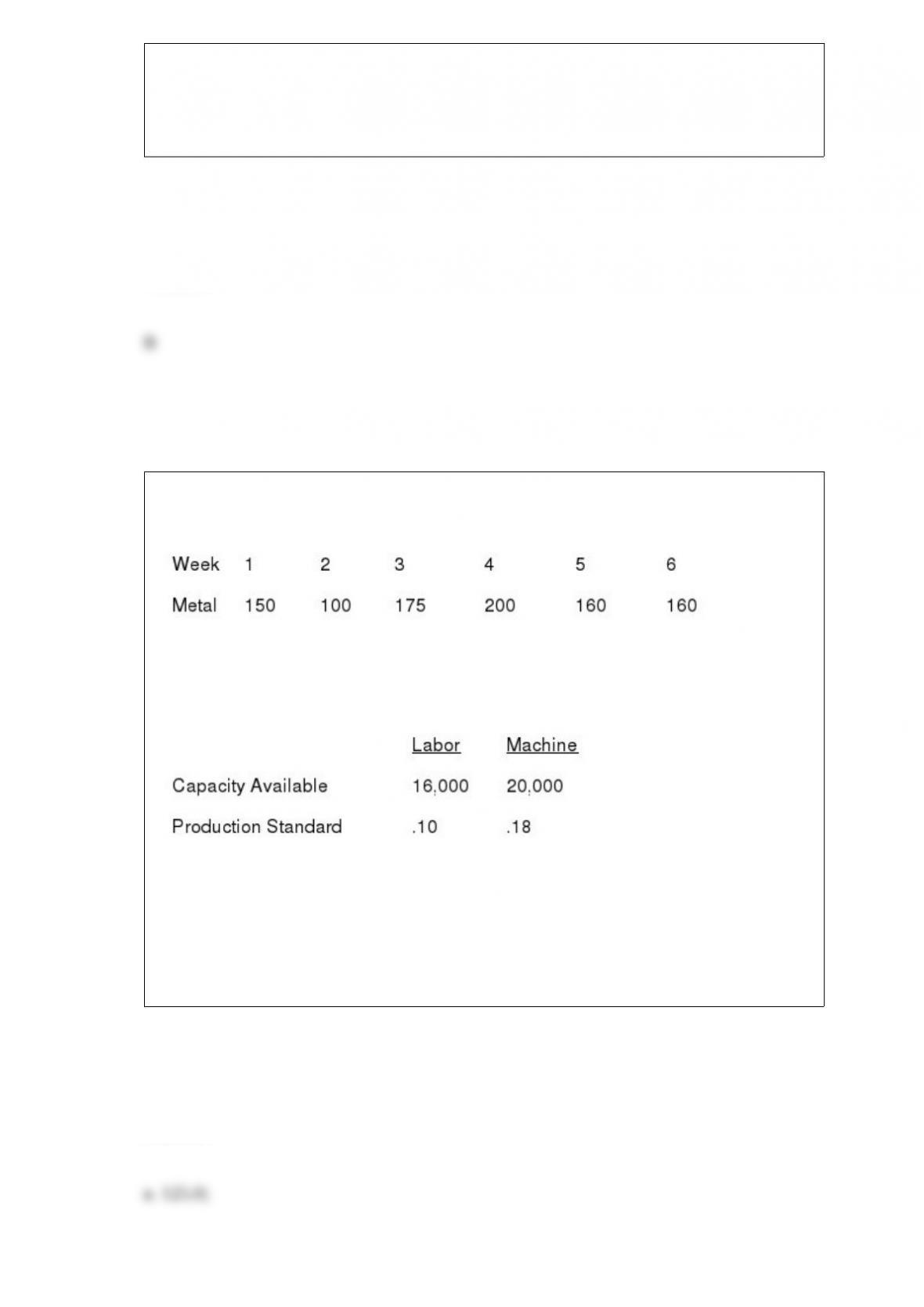
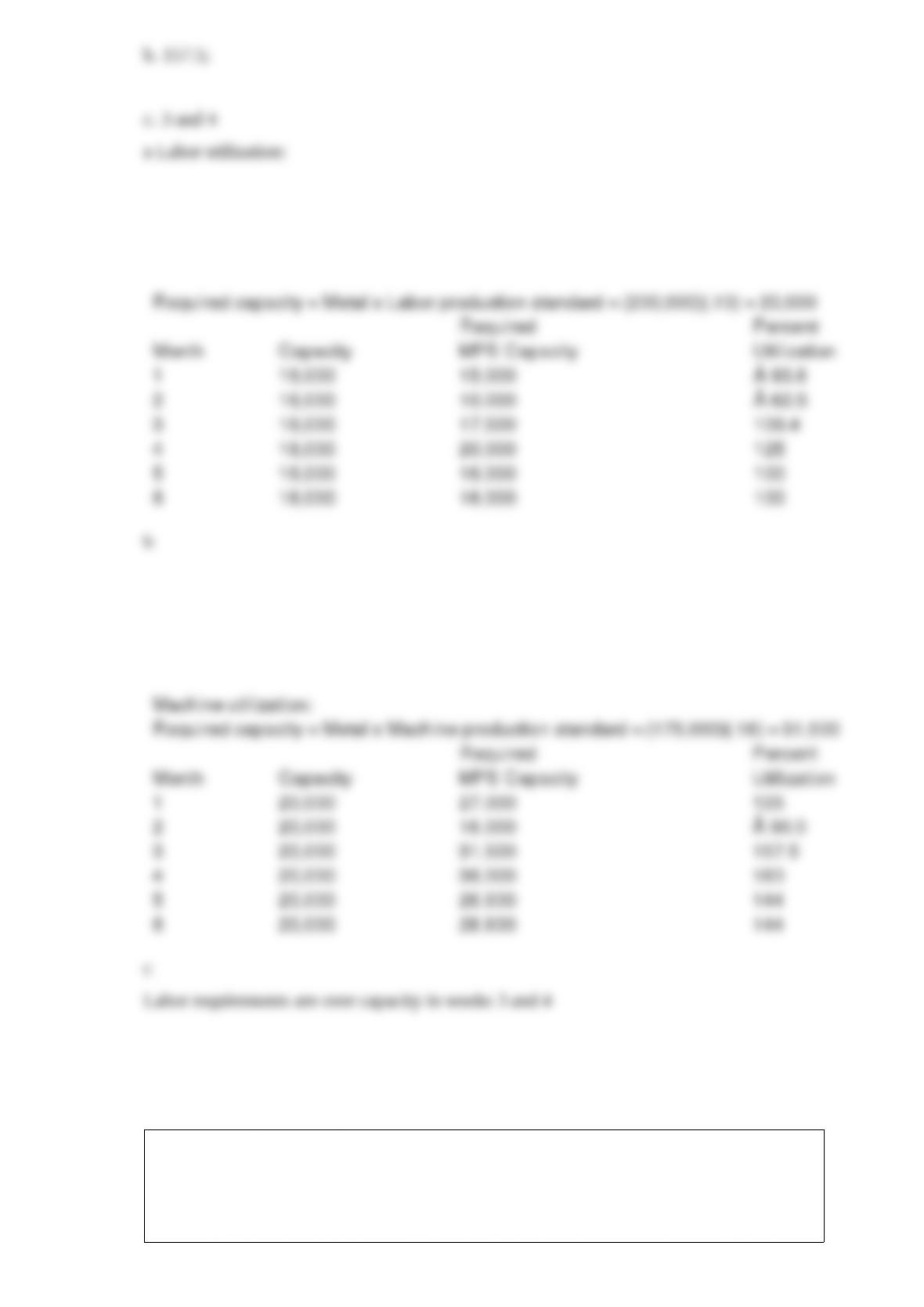
A sheet metal company has developed the following six-month production schedule (in
thousands of square yards):
In addition, their monthly labor and machine capacities (in hours) available, and the
production standards (in hours per square yard) are:
a. What is the percentage utilization of the labor capacity in month 4?
b. What is the percentage utilization of the machine capacity in month 3?
c. In which weeks are the labor requirements over capacity?
Answer:
Queuing models:
a. yield optimal solutions.
b. are generally deterministic.
c. cannot be used in manufacturing.
d. use formulas only when arrivals and service times follow certain distributions.
Answer:
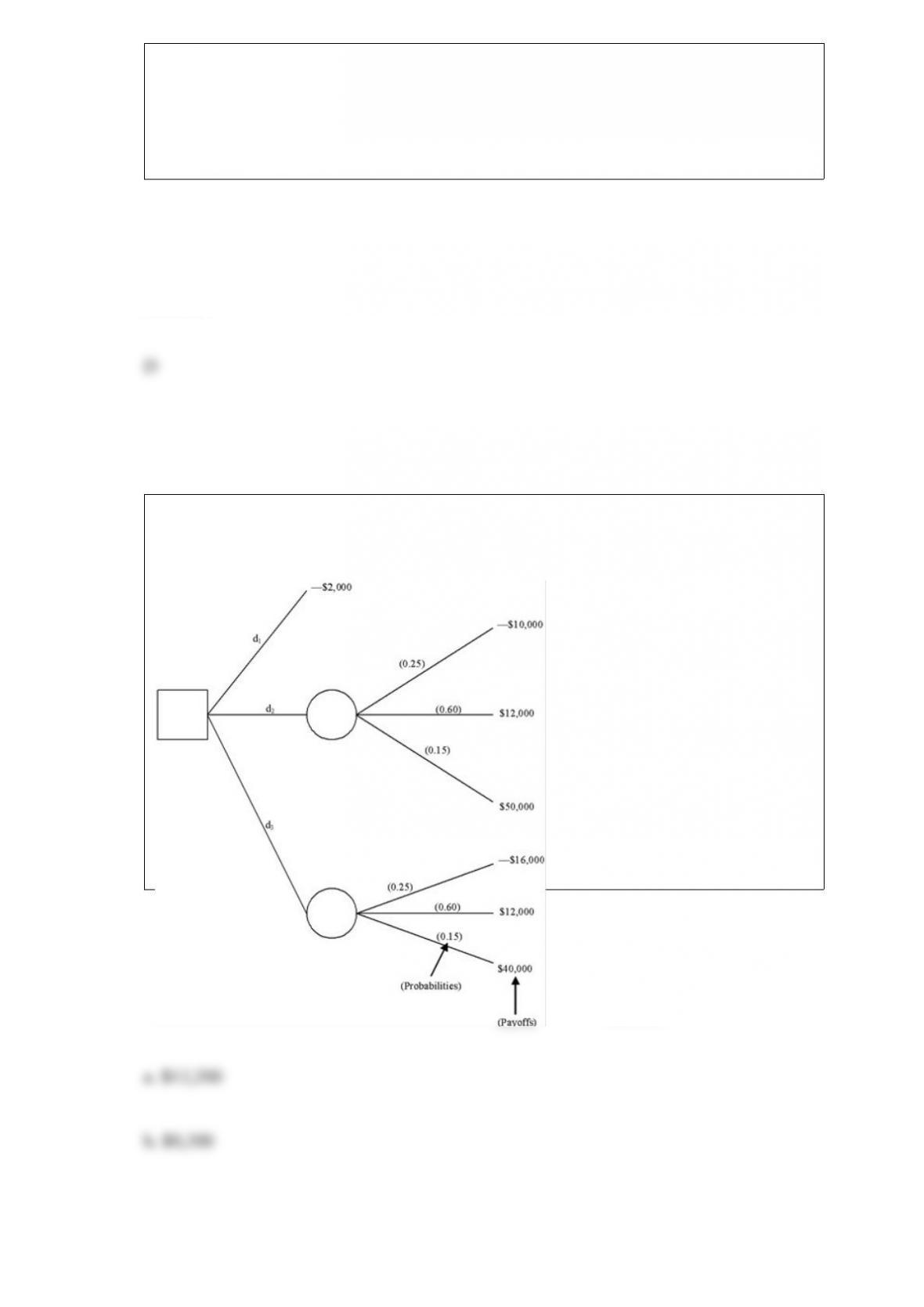
Elizabeth, a decision maker has decided to expand her operations and become more
efficient. She uses 3 decision variablesd1 is to do nothing; d2 is a moderate expansion;
and d3 is a major
expansion.
a. Determine the expected
value of d2 if the states of
nature are S1 = 0.25; S2 =
0.60; and S3 = 0.15.
b. Determine the expected
value for d3 if the states of
nature are S1 = 0.25; S2 =
0.60; and S3 = 0.15.
Answer:

Table 1
Jackson Enterprises uses a fixed order quantity inventory control system. The firm
operates 50 weeks per year and has the following characteristics for an item:
Demand = 20,000 units/year
Ordering cost = $45/order
Inventory-carrying cost as a percent of item value = 25%
Item (Unit) value = $20
Lead time = 5 weeks
Standard deviation in weekly demand = 125 units
Using the information in Table 1, calculate the economic order quantity (EOQ) for this
item?
a. Less than or equal to 500 units
b. Greater than 500 units but less than or equal to 1,000 units
c. Greater than 1,000 units but less than or equal to 1,500 units
d. Greater than 1,500 units
Answer:
Given the diagram below that represents a cell phone circuit, determine the cell phone
system reliability for this part of the total operating system if the individual component
reliabilities are: A = 0.92, B = 0.90, C = 0.88, and D = 0.88.
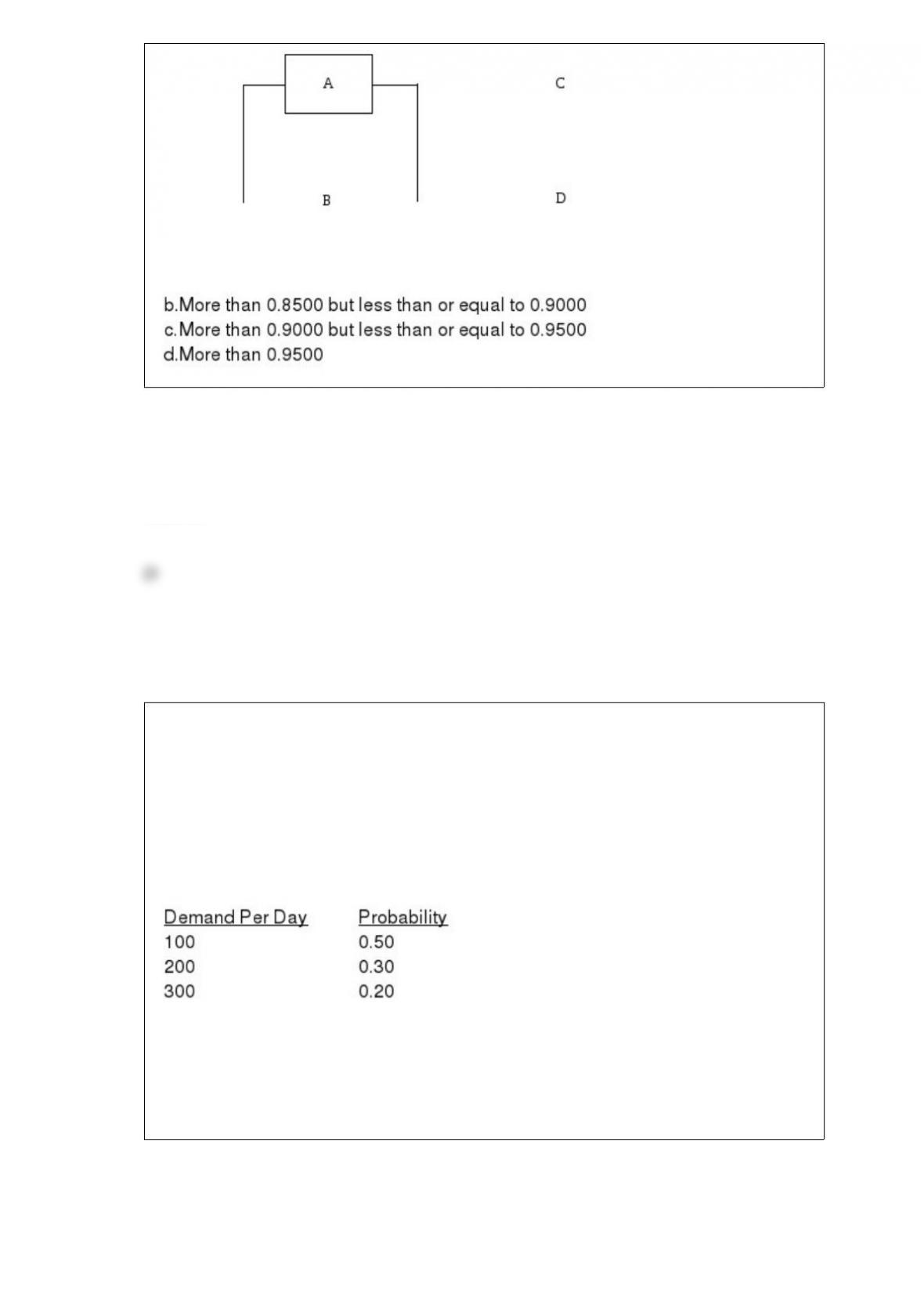
a. More than 0.8000 but less than or equal to 0.8500
Answer:
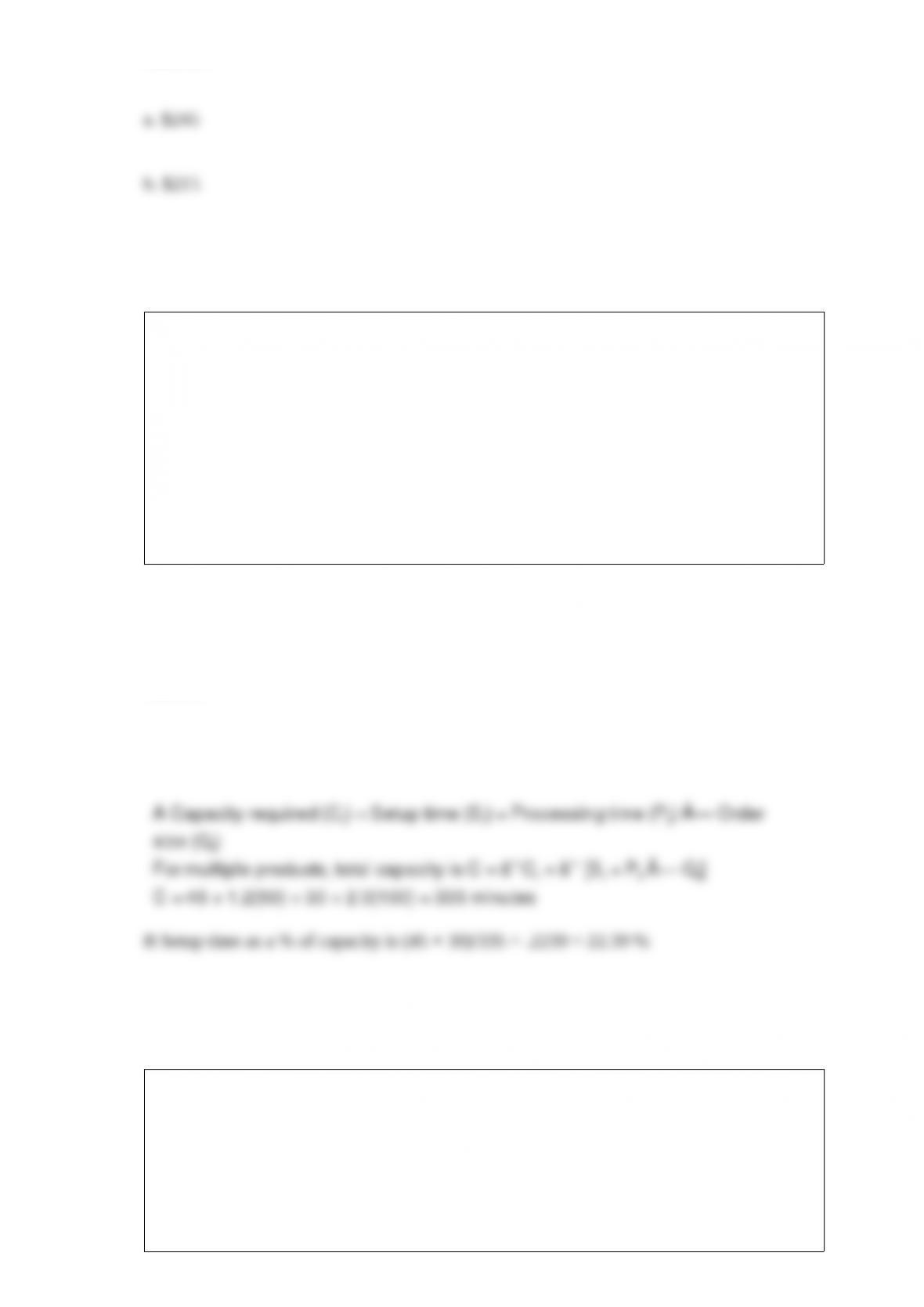
Jumbo James sells hotdogs out of a cart for $3.00 each. The cost to purchase and
prepare the hotdog is $1.15 each. James operates the small business with very few
capital assets and has no place to store unsold hotdogs. For this reason, every evening
he sells the unsold hotdogs to a local homeless shelter for $0.50 each. Jumbo James will
choose one of the following options as a standard stocking plan: d1 = 100; d2 = 150; or
d3 = 200 hotdogs. On any weekday, the demand for hotdogs and the probability of
selling them is estimated as follows:
a. Determine the expected value if Jumbo James stocks 200 hotdogs every day.
b. Determine the expected value if Jumbo James decides to stock 150 hotdogs every
day.
Answer:
Jack’s Ice Cream Parlor produces two types of ice cream on a contract basis for a major
restaurant chain using a large blender. A batch of ice cream A requires a setup time of
45 minutes, a process mixing time of 1.2 minutes per gallon, and 50 gallons are made
per day. Ice cream B requires the same machine to be cleaned and setup which takes 30
minutes, a process mixing time of 2 minutes per gallon, and 100 gallons are produced
per day.
a. Compute the capacity required.
b. What percentage of total capacity required is setup time?
Answer:
Safety capacity or a capacity cushion is _____.
a. needed for processes with little demand variability
b. the amount of capacity reserved for anticipated events
c. the amount of capacity reserved for unanticipated events

d. not appropriate for service organizations
Answer:
The manner in which new arrivals are ordered or prioritized for service is known as
_____.
a. balking
b. reneging
c. queue discipline
d. queue behavior
Answer:
Computer software is an example of a _____.
a. tangible product
b. nondurable good
c. service
d. value creation process
Answer:
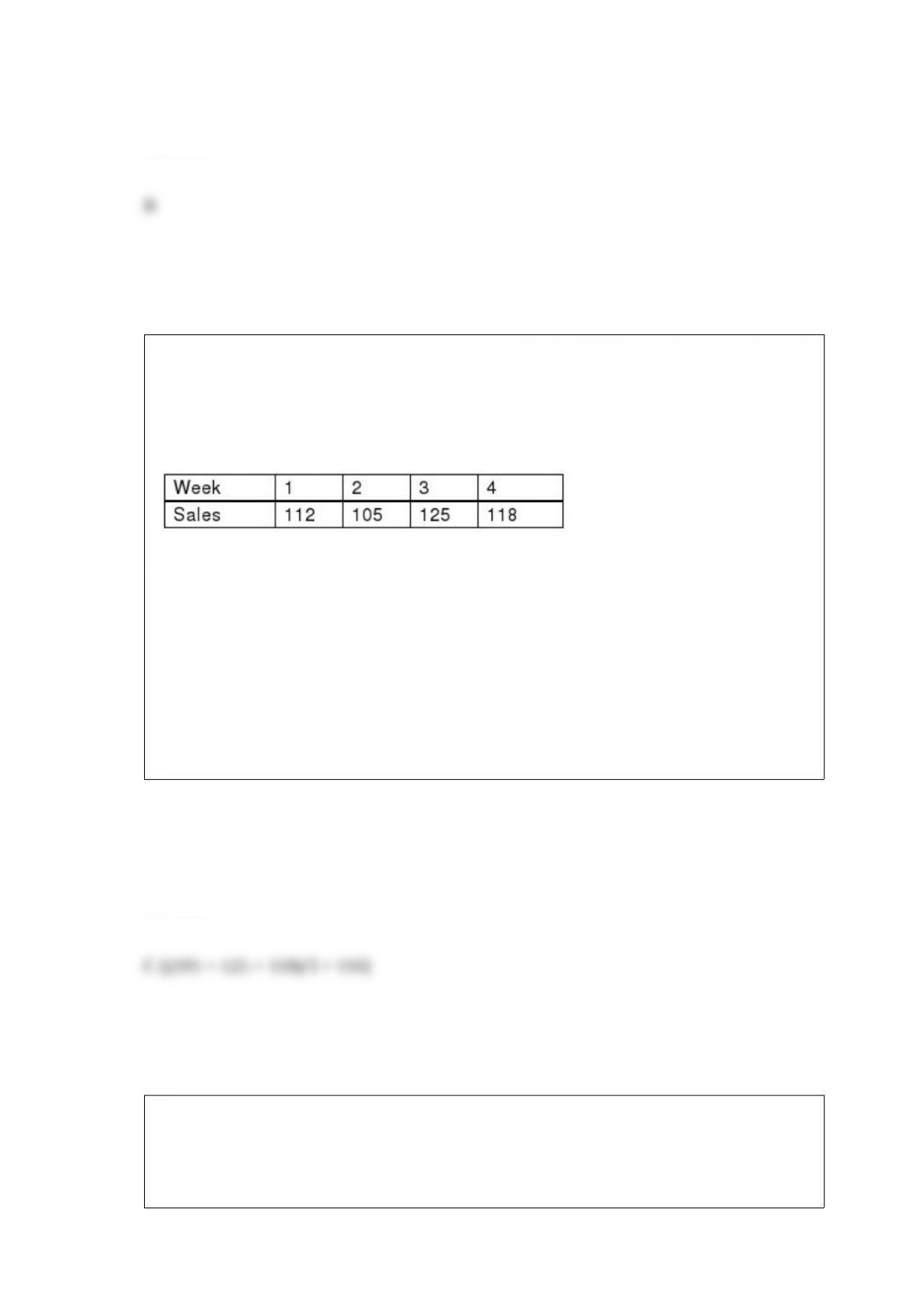
Using the data shown below in Table 3 for the sales of a new CD at a store for the last 4
weeks, answer the questions from #16 to #18.
Table 3
The three-period moving average for the next week (week 5) is:
a. less than or equal to 100.
b. more than 100 but less than or equal to 110.
c. more than 110 but less than or equal to 120.
d. more than 120 but less than or equal to 130.
Answer:
The Pacific Computer Company makes two models of notebook personal computers:
Model 410 with CD-ROM drive, and Model 540 with DVD drive. Profits on each
model are $100 and $150, respectively. Weekly manufacturing data (in minutes) are
given below:
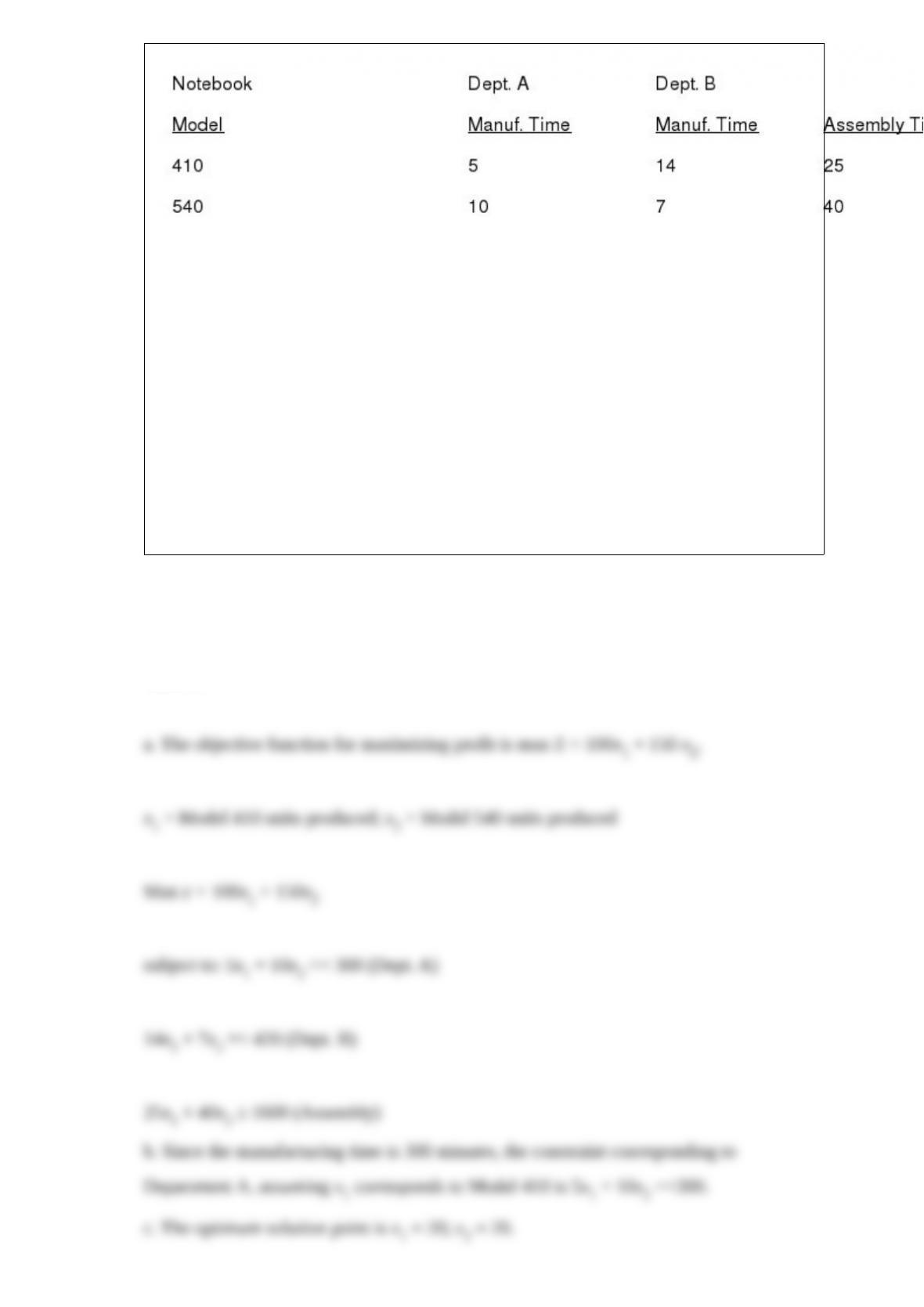
Manufacturing time available in department A for the coming week is 300 minutes, and
for department B, it is 420 minutes. Total time available during the week to assemble
the fabricated units is 1600 minutes.
a. What is the objective function if the company wants to maximize profits?
b. What is the constraint corresponding to Department A assuming x1 corresponds to
Model 410?
c. What is the optimum solution point for this problem?
d. What is the maximum possible total profit?
Answer:
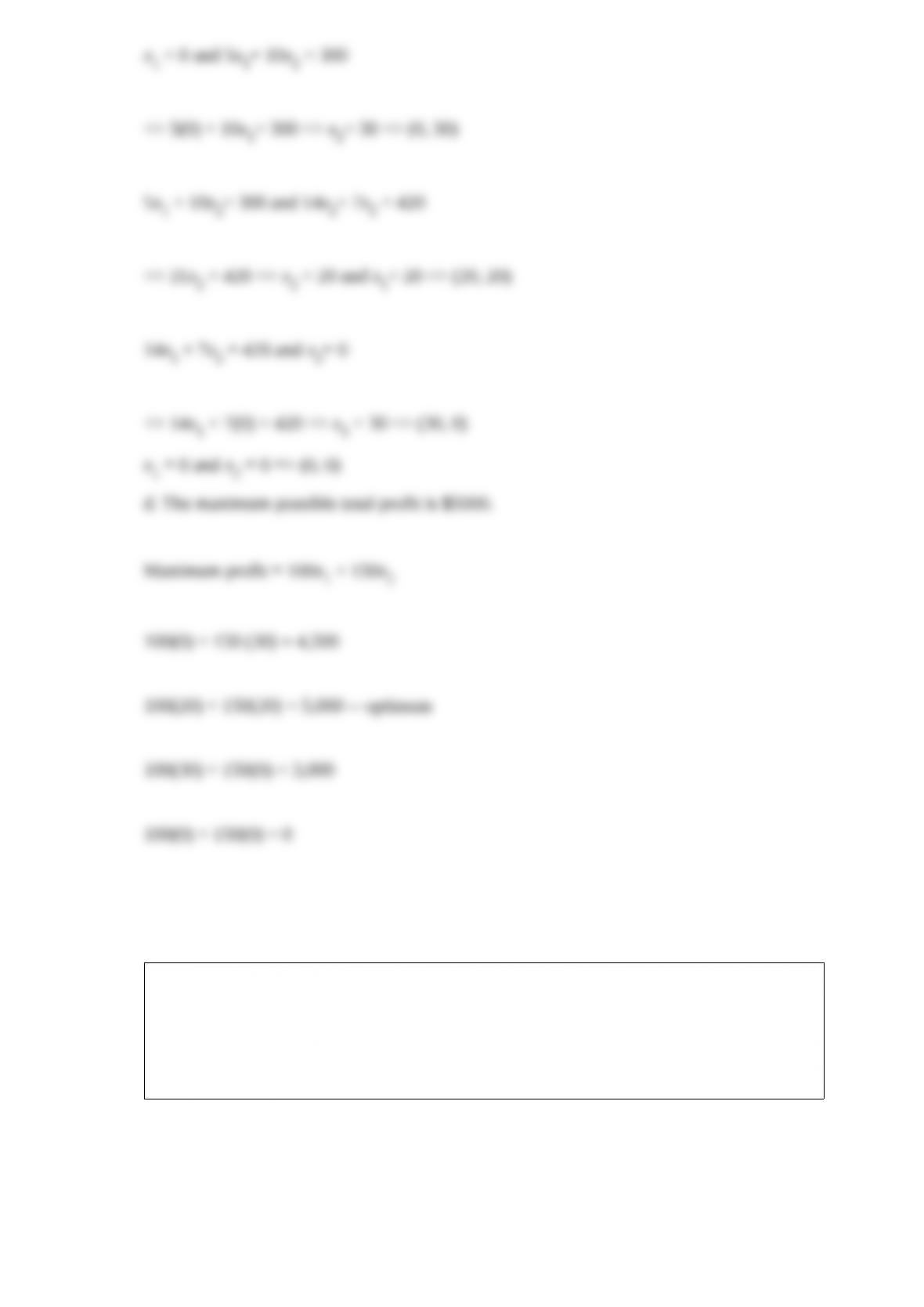
You are responsible for managing an advertising project with the following activities
(times are given in weeks).
Draw the project network here. BLANK SPACES
The project completion time is _____.
a. 12 weeks
b. 13 weeks
c. 14 weeks
d. 15 weeks
Answer:
Identify an advantage of product layouts.
a. Highly flexible
b. Lower work-in-process inventories
c. Higher job satisfaction
d. Easy to add new products
Answer:
A network of processes that creates value for customers is known as a _____.
a. process network
b. value network
c. customer value
d. value chain
Answer:
The eleven tasks defined in Table 1 given below are necessary to assemble an MP3
player along with their time (in seconds) and flow diagram,
Table 1
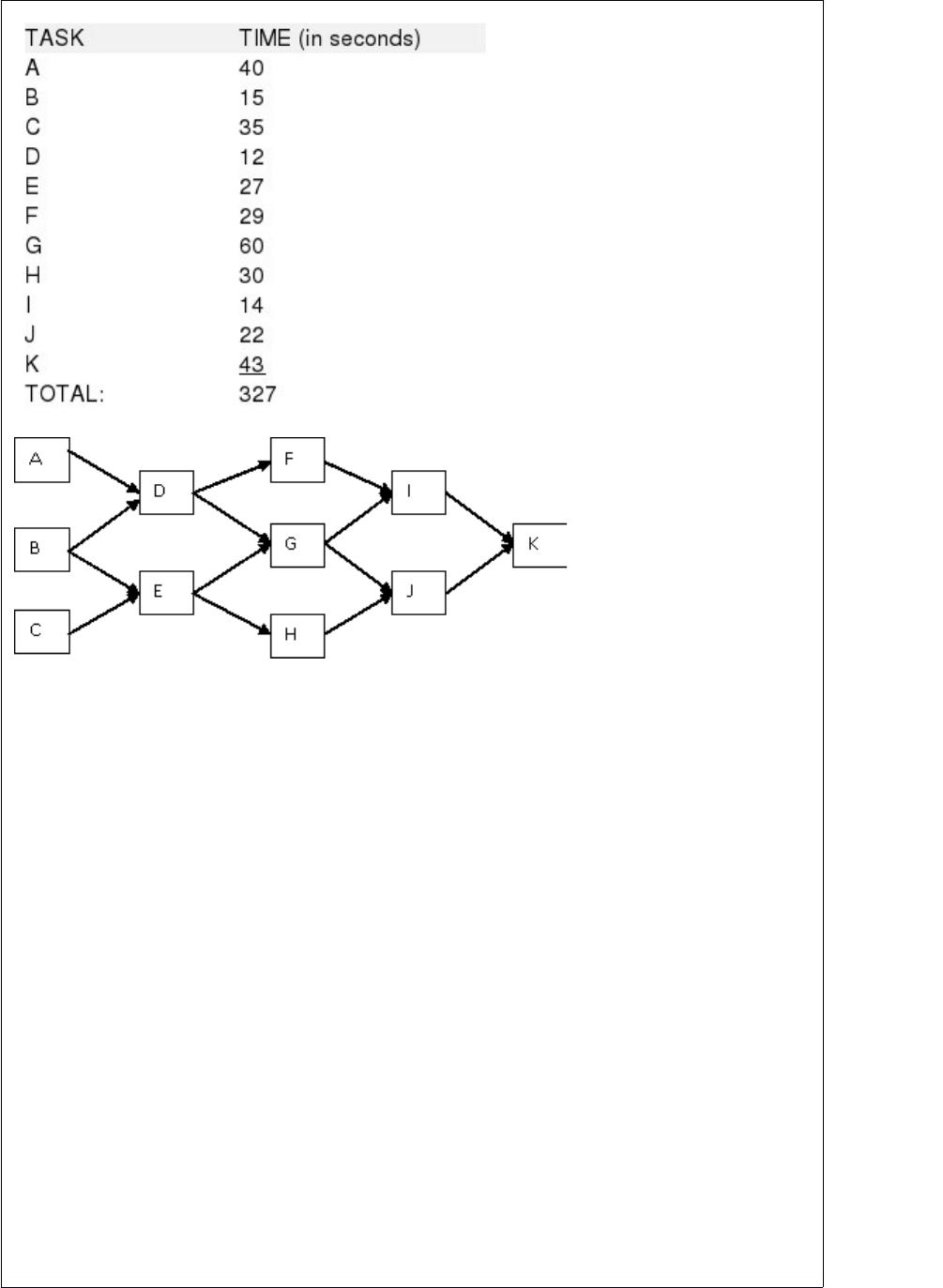
Refer to Table 1. Using this data and a cycle time of 60 seconds, determine an
assembly-line balance by using the longest-task-time rule.
d) Station 1: A, B Station 2: C, D Station 3: E, F Station 4: G Station 5: H, J Station 6: I,
K
b) Station 1: A, B Station 2: C, D Station 3: E, F Station 4: G, H Station 5: J Station 6: I,
K
c) Station 1: A, B Station 2: C, E Station 3: D, F Station 4: G Station 5: H, I Station 6: J,
K
a) Station 1: A, B
Station 2: C, D
Station 3: E, F
Station 4: G, H
Station 5: J, I, K
Answer:
The work activity that effectively limits throughput of a process is known as a _____.
a. process boundary
b. service blueprint
c. bottleneck
d. process map
Answer:
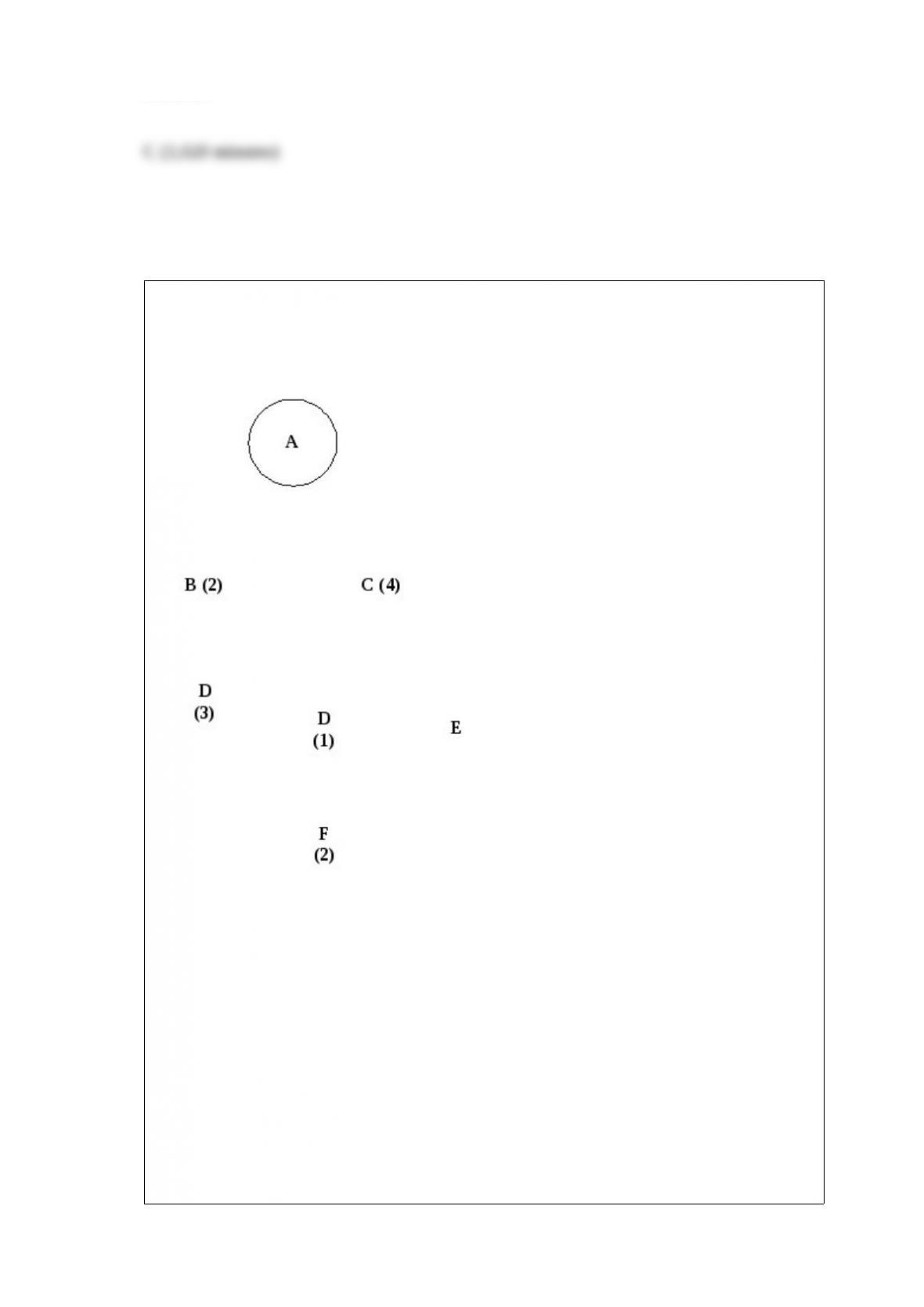
A hospital lab is used for three types of cancer tests, A, B, and C. The time per setup,
processing time, and batch size (in units) is given below. Using the information,
determine the total demand in minutes for this lab.
a. Less than 500 minutes
b. Equal to or greater than 500 but less than 1000 minutes
c. Equal to or greater than 1000 but less than 2000 minutes
d. Greater than 2000 minutes
Answer:
The bill of materials (BOM) for end item A is shown below:
_____________________
Determine the net requirement for E if the gross requirement for A is still 250, and
current on-hand inventory balance for A is 40, D is 200, E is 300, and F is 600.
a. Less than or equal to 1,000 units
b. Greater than 1,000 but less than or equal to 1,500 units
c. Greater than 1,500 but less than or equal to 2,000 units
d. Greater than 2,000 but less than or equal to 2,500 units
Answer:
Short-term changes in facilities and equipment are seldom used in traditional aggregate
planning methods because of the capital costs involved.
Answer:
The decision to offshore or outsource involves a variety of economic and noneconomic
issues.
Answer:
Lean Six Sigma is simply the union of lean approaches with quality improvement
techniques, each of which has been used independently in other applications.
Answer:
Define work sampling. Give examples of both manufacturing and service applications.
Answer:
Work center load reports are used in capacity requirements planning (CRP).
Answer:
Reservations reduce the uncertainty for both the good or service provider and the
customer.
Answer:
Budget variance is a financial performance measure at an organizational level.
Answer:
A lateness measure can only be zero (0) or a positive number.
Answer:
Seasonal patterns can occur over the weeks during a month, over days during a week, or
hours during a day.
Answer:
The balanced scorecard model uses the same categories as the Baldrige Award.
Answer:
The earliest revenue management systems focused solely on overbooking.
Answer:
Crash time is the longest possible time in which the activity can realistically be
completed.
Answer:
Work-in-process inventory is completed products ready for distribution or sale to
customers.
Answer:
When finding the earliest start (ES) time for an activity with two or more predecessor
activities, the largest EF among the predecessor activities is used to calculate the ES for
that activity.
Answer:
The objective of assembly-line balancing is to group tasks among workstations so that
the amount of work assigned to each workstation is highly variable, thus maximizing
flexibility.
Answer:
Vertical integration is a modern method of outsourcing.
Answer:
With vendor-managed inventory (VMI), a manufacturer monitors and managers
inventory for a customer.
Answer: