The Build-Em-Fast Company has agreed to supply its best customer with three widgits
during each of the next 3 weeks, even though producing them will require some
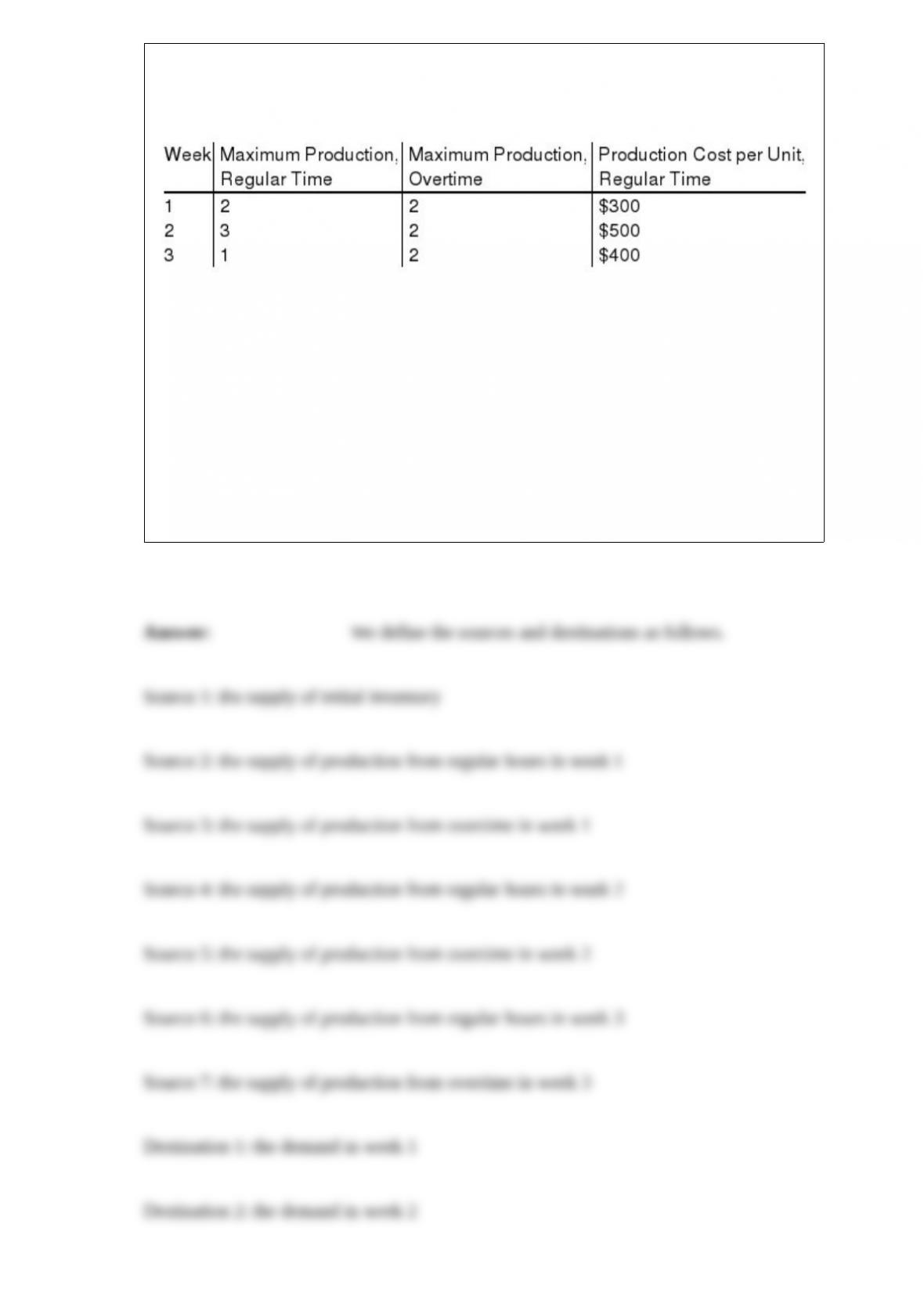
overtime work. The relevant production data are as follows:
The cost per unit produced with overtime for each week is $100 more than for regular
time. The cost of storage is $50 per unit for each week it is stored. There is already an
inventory of two widgets on hand currently, but the company does not want to retain
any widgets in inventory after the 3 weeks.
Management wants to know how many units should be produced in each week to
minimize the total cost of meeting the delivery schedule.
Formulate this problem as a transportation problem by constructing the appropriate
parameter table.
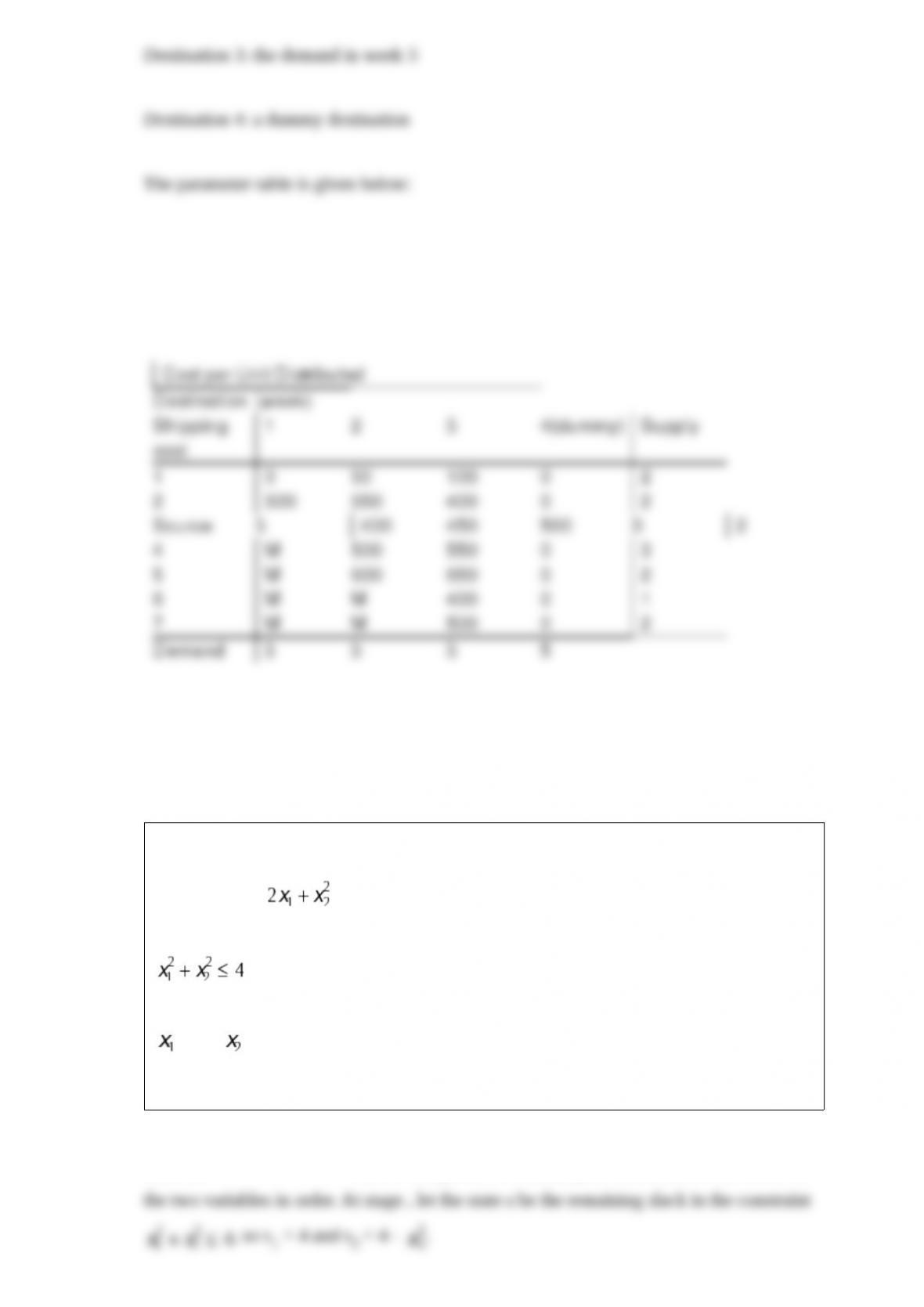
Consider the following nonlinear programming problem.
Maximize Z = ,
subject to
and
>= 0, >= 0.
Use dynamic programming to solve this problem.
Airplanes arrive for take-off at the runway of an airport according to a Poisson process
at a mean rate of 20 per hour. The time required for an airplane to take off has an
exponential distribution with a mean of 2 minutes, and this process must be completed
before the next airplane can begin to take off.
Because a brief thunderstorm has just begun, all airplanes which have not commenced
take-off have just been grounded temporarily. However, airplanes continue to arrive at
the runway during the thunderstorm to await its end.
Assuming steady-state operation before the thunderstorm, determine the expected
number of airplanes that will be waiting to take off at the end of the thunderstorm if it
lasts 30 minutes.
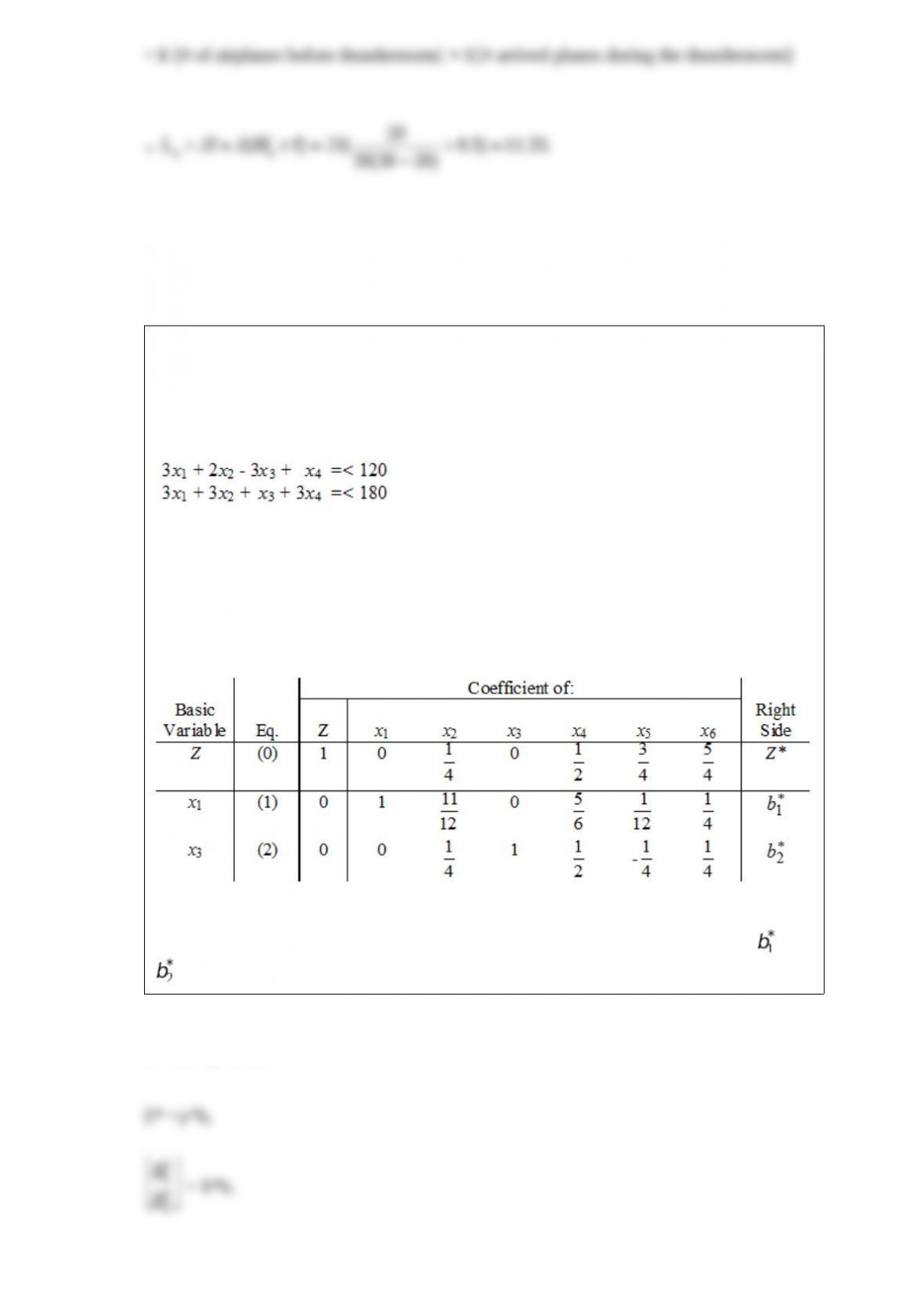
You are using the simplex method to solve the following linear programming problem.
Maximize Z = 6x1 + 5x2 – x3 + 4x4,
subject to
and
x1 >= 0, x2 >= 0, x3 >= 0, x4 >= 0.
You have obtained the following final simplex tableau where x5 and x6 are the slack
variables for the respective constraints.
Use the fundamental insight presented in Sec. 5.3 of the textbook to identify Z*, , and
.
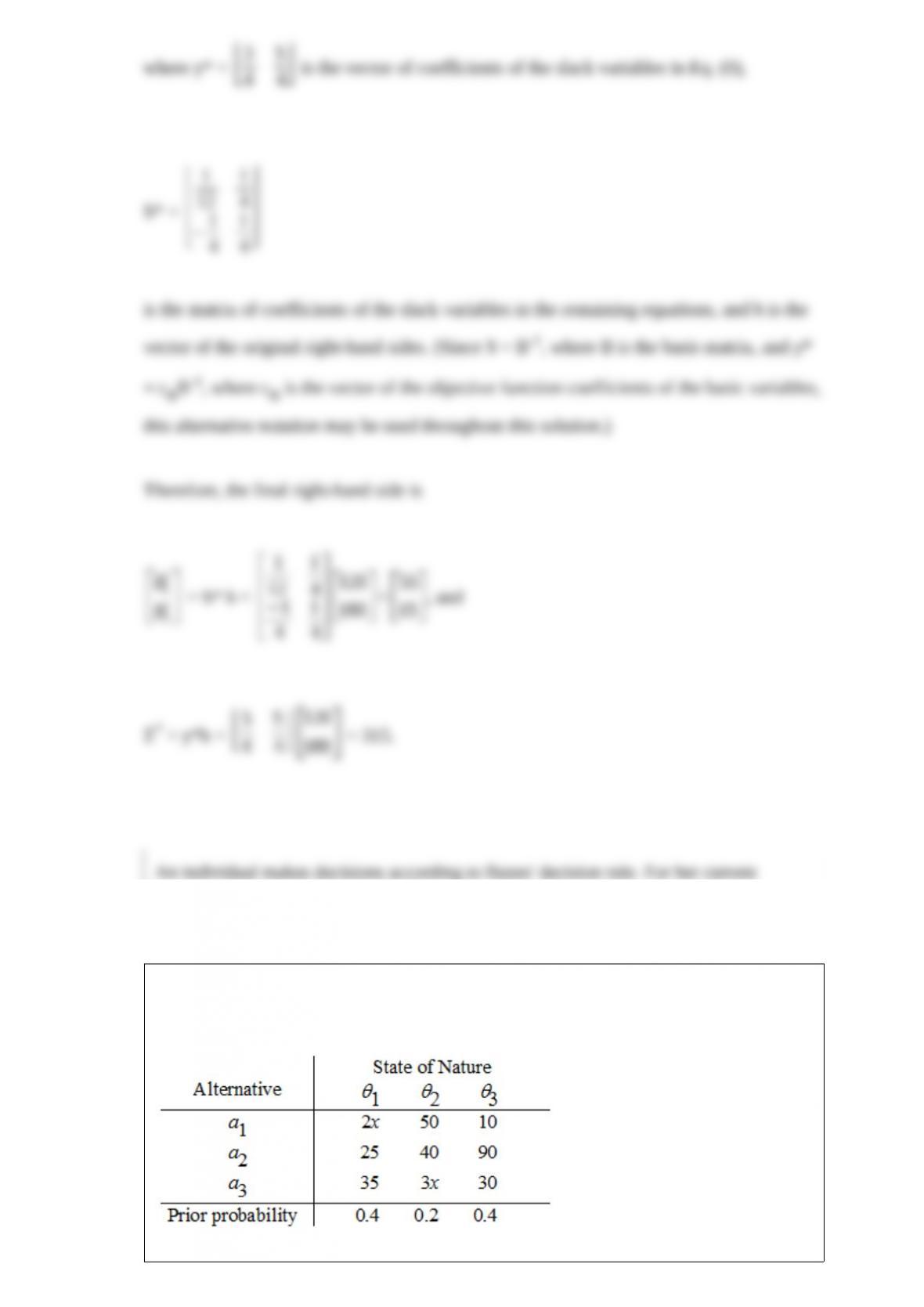
An individual makes decisions according to Bayes’ decision rule. For her current
problem, she has constructed the following payoff table, and she now wishes to
maximize the expected payoff.
The value of x currently is 50, but there is an opportunity to increase x by spending
some money now.
What is the maximum amount that should be spent to increase x to 75?
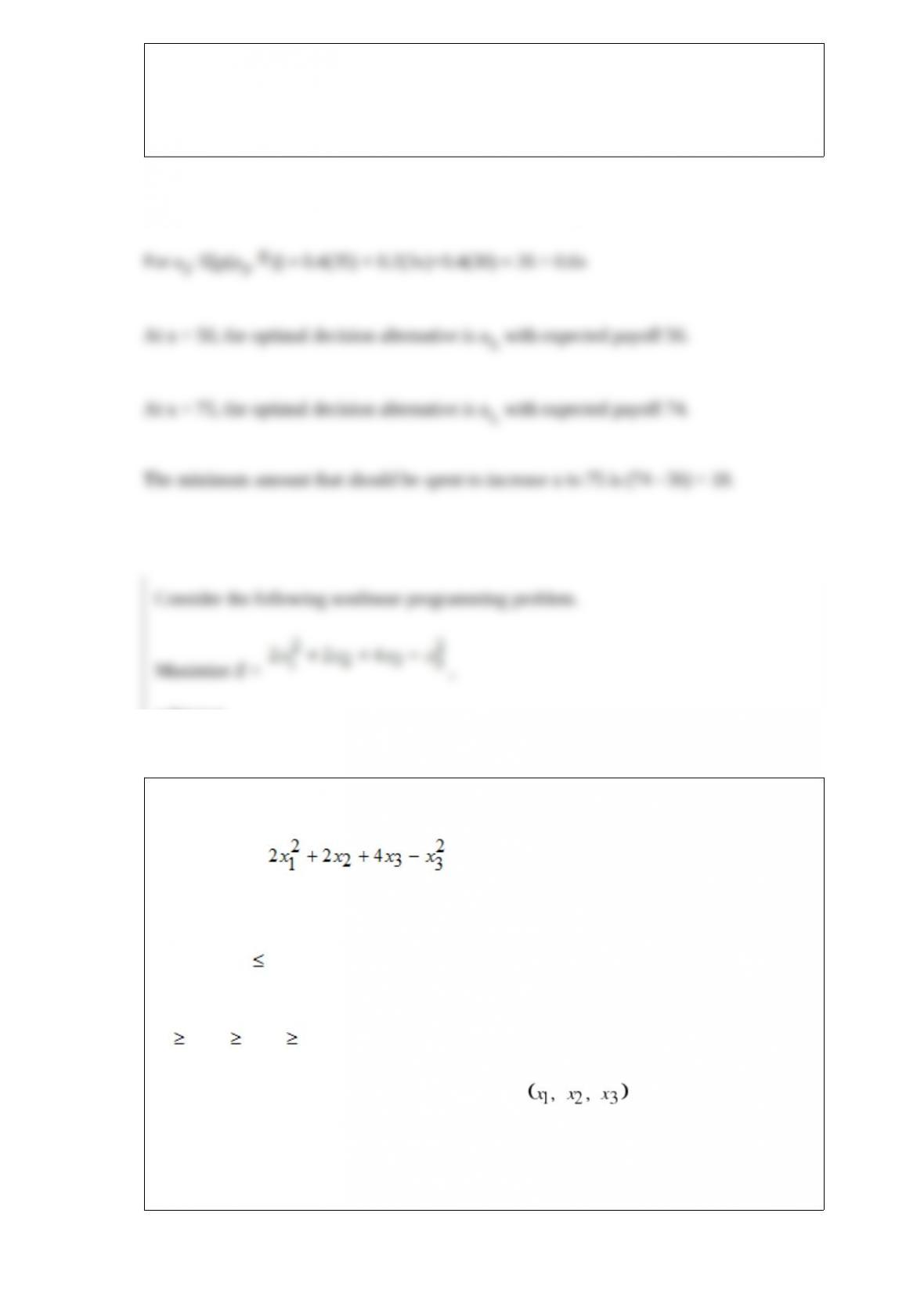
Consider the following nonlinear programming problem.
Maximize Z = ,
subject to
2x1 + x2 + x3 4
and
x1 0, x2 0, x3 0.
(a) Use the KKT conditions to determine whether =(1, 1, 1) can be
optimal.
() If a specific solution satisfies the KKT conditions for this problem, can you draw the
definite conclusion that this solution is optimal? Why?