Jane pays the market price of $69 for a new pair of running shoes, even though she
would be happy to pay a maximum of $100 for the same pair of shoes. This is an
example of the concept of
A. producer surplus.
B. price ceilings.
C. full economic prices.
D. consumer surplus.
By the property of “more is better,” the consumer views the products under
consideration as:
A. goods.
B. bads.
C. inferior goods.
D. normal.
Suppose that sellers value a good car at $10,500 and a bad car at $5,500, and quality is
not observed by the buyers. What is the highest price that risk-neutral buyers will offer
for a used car if they ignore adverse selection when 60 of the cars are good?
A. $5,500
B. $8,000

C. $8,500
D. $10,500
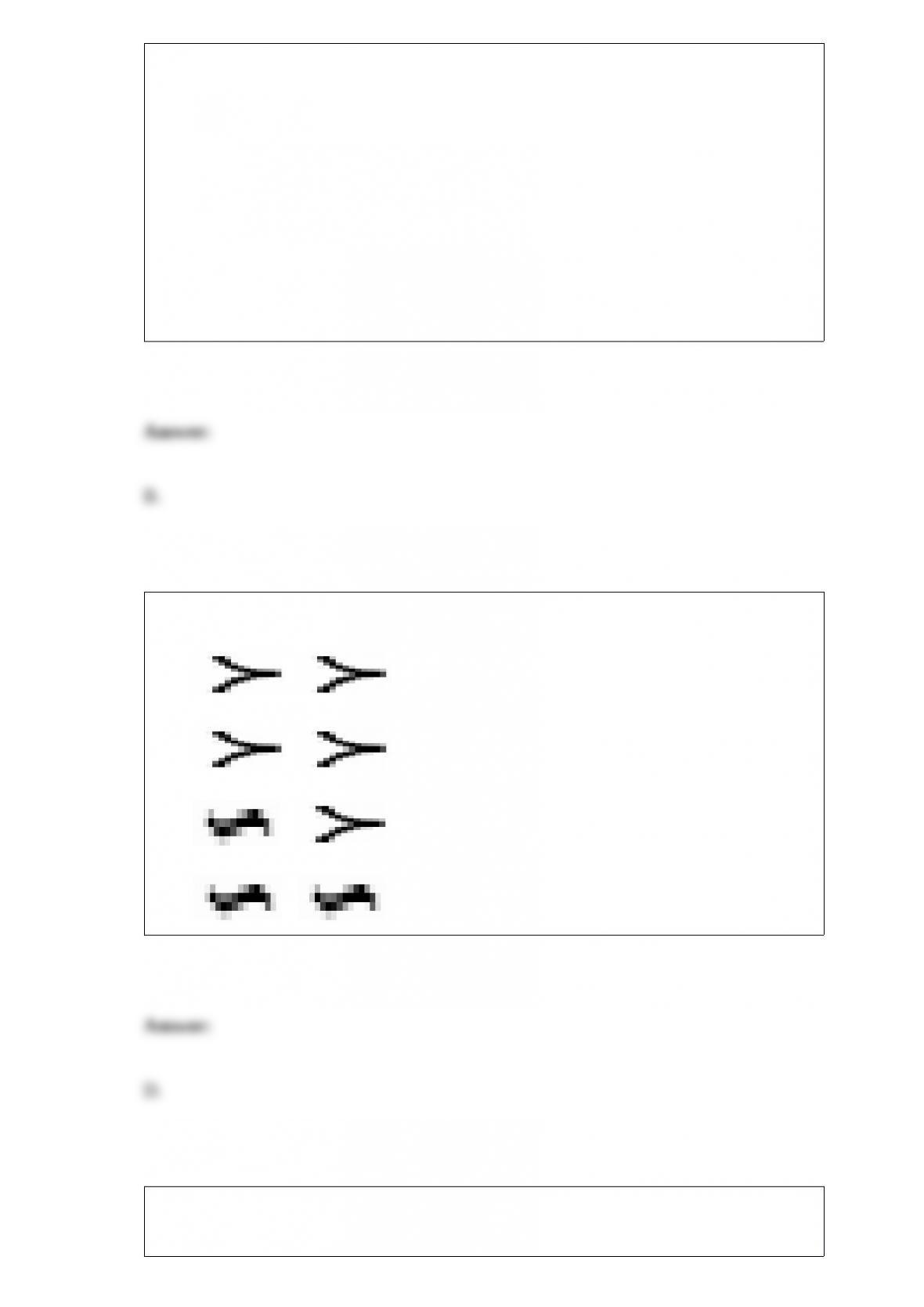
Refer to the normal-form game of price competition shown below.
For what values of x is strategy D strictly dominant for firm B?
A. All x > 450
B. All x < 450
C. x = 450
D. x < 50
Since the end of the war in the Persian Gulf, the world price of oil has fallen. But in
some areas, consumers have seen little relief at the pump. This phenomenon can be
explained by the theory of:
A. perfect competition.
B. monopolistic competition.
C. oligopoly.
D. monopoly.
The LEAST risky payment plan from the viewpoint of the worker is:
A. piece rate.
B. profit sharing.
C. revenue sharing.
D. hourly wage.
Consider a Cournot oligopoly consisting of four identical firms producing good X. If
the firms produce good X at a marginal cost of $7 per unit and the market elasticity of
demand is -2, determine the profit-maximizing price.
A. $6 per unit
B. $8 per unit
C. $10 per unit
D. $12 per unit
A risk-neutral monopoly must set output before it knows the market price. There is a 50
percent chance the firms demand curve will be P = 40 – Q and a 50 percent chance it
will be P = 60 – Q. The marginal cost of the firm is MC = 3Q. The expected
profit-maximizing quantity is:
A. 5
B. 10
C. 25
D. 50
If bundles A, B, and C lie on the same indifference curve, then:
A. A B C.
B. B C A.
C. A B C.
D. A B C.
Suppose market demand and supply are given by Qd = 100 – 2P and QS = 5 + 3P. The
equilibrium quantity is:

A. 92
B. 81
C. 45
D. 62
The law of demand states that, holding all else constant:
A. as price falls, demand will fall also.
B. as price rises, demand will also rise.
C. price has no effect on quantity demanded.
D. as price falls, quantity demanded rises.
The federal government recently decided to raise the excise tax on hard liquor.
a. Graphically illustrate the effects of this tax on the market for hard liquor.
b. Would a $1 increase in the excise tax on liquor increase the equilibrium price of
liquor by $1? Explain.
c. How would the excise tax on hard liquor affect a beer distributor?
A student figured out that the HHI for an industry was 13,000. What is the proper

conclusion?
A. The market is monopolistically competitive.
B. The market is close to perfectly competitive.
C. The market is served by a monopoly.
D. The student made some computational errors.
Fixed costs exist only in:
A. the long run.
B. capital-intensive markets.
C. the short run.
D. labor-intensive markets.
You are the manager of a monopoly firm with (inverse) demand given by P = 50 – 0.5Q.
Your firms cost function is C = 40 + 5Q2. Your firms marginal revenue is:
A. P = 50 – 0.5Q.
B. P = 100 – Q.
C. P = 50 – Q.
D. There is insufficient information to determine the firms marginal revenue.
The threat of a corporate takeover is an _________ incentive that helps to mitigate the
_________ principal-agent problem.
A. internal; manager-worker
B. internal; manager-consumer
C. external; owner-manager
D. external; owner-consumer
Consumer surplus in the unregulated monopoly market in the figure below is:
A. $16.
B. $8.
C. $4.
D. $0.
The price elasticity of demand for senior citizens purchasing coffee from McDonalds is
-5, while non-senior citizens have a price elasticity of demand equal to -1.25. If it costs
McDonalds $0.02 to produce a coffee, the optimal price for a cup of coffee for
non-senior citizens and the resultant marginal cost under third-degree price
discrimination are:
A. $0.004 and $0.02.
B. $0.02 and $0.80.
C. $0.10 and $0.02.
D. $10 and $0.20.
In the late 1990s, Chrysler announced a new incentive program on its minivans that
included subsidized interest rates and cash allowances. Under the plan, consumers
could enjoy financing rates as low as 4.9 percent, as well as a $500 cash allowance
toward the lease or purchase of a new minivan. What changes in sales would you
anticipate if you were the manager of a Dodge/Plymouth franchise, the official dealer of
Chrysler? Why?
A risk-averse manager is considering a project that will cost $100. There is a 10 percent
chance the project will generate revenues of $100, an 80 percent chance it will yield
revenues of $50, and a 10 percent chance it will yield revenues of $500. Should the
manager adopt the project? Explain.
Alpha Industries operates in a highly competitive market. While there are few other
firms in the industry due to the high fixed costs of building plants, rival firms are very
aggressive in their pricing strategies. Of the products sold in the industry, over 80
percent have 10 years of patent protection remaining. Does this industry meet an
economists definition of a perfectly competitive industry?
You run a golf course at a tourist resort. At your resort, there are two distinct groups of
players. One group owns property at the resort and resides there most of the year. On
average, each of these consumers has a monthly inverse demand for golf services of P =
100 – 0.5Q. The other group visits for one week at a time and has a total weekly demand
curve of P = 40 – 0.1Q. What pricing strategy will maximize your profits?
An auto dealer in Chicago recently told his mother that he makes no money on the sales
of his cars but the markup on accessories is 200 percent. Can this possibly be a
profit-maximizing strategy? Explain.