
Consider the monopoly in the figure below with price regulated at $2 per unit. In this
market, ___________ units will be exchanged.
A. 3
B. 4
C. 5
D. 8
Suppose that initially the price is $50 in a perfectly competitive market. Firms are
making zero economic profits. Then the market demand shrinks permanently, some
firms leave the industry, and the industry returns to a long-run equilibrium. What will
be the new equilibrium price, assuming cost conditions in the industry remain constant?
A. $50
B. $45
C. Lower than $50, but exact value cannot be known without more information.
D. Larger than $45, but exact value cannot be known without more information.
Suppose a new contracting environment with an economic environment that looks more
uncertain is considered. This new contract will result in:
A. an increase in the marginal cost and a longer optimal contract.
B. an increase in the marginal cost and a shorter optimal contract.
C. a decrease in the marginal cost and a longer optimal contract.
D. a decrease in the marginal cost and a shorter optimal contract.
Suppose you are a manager of a factory. You purchase five (5) new machines at one
million dollars each. If you can resell two of the machines for $500,000 and three of the
machines for $200,000, what are the sunk costs of purchasing the machines?
A. $5 million
B. $500,000
C. $3.4 million
D. $1.6 million
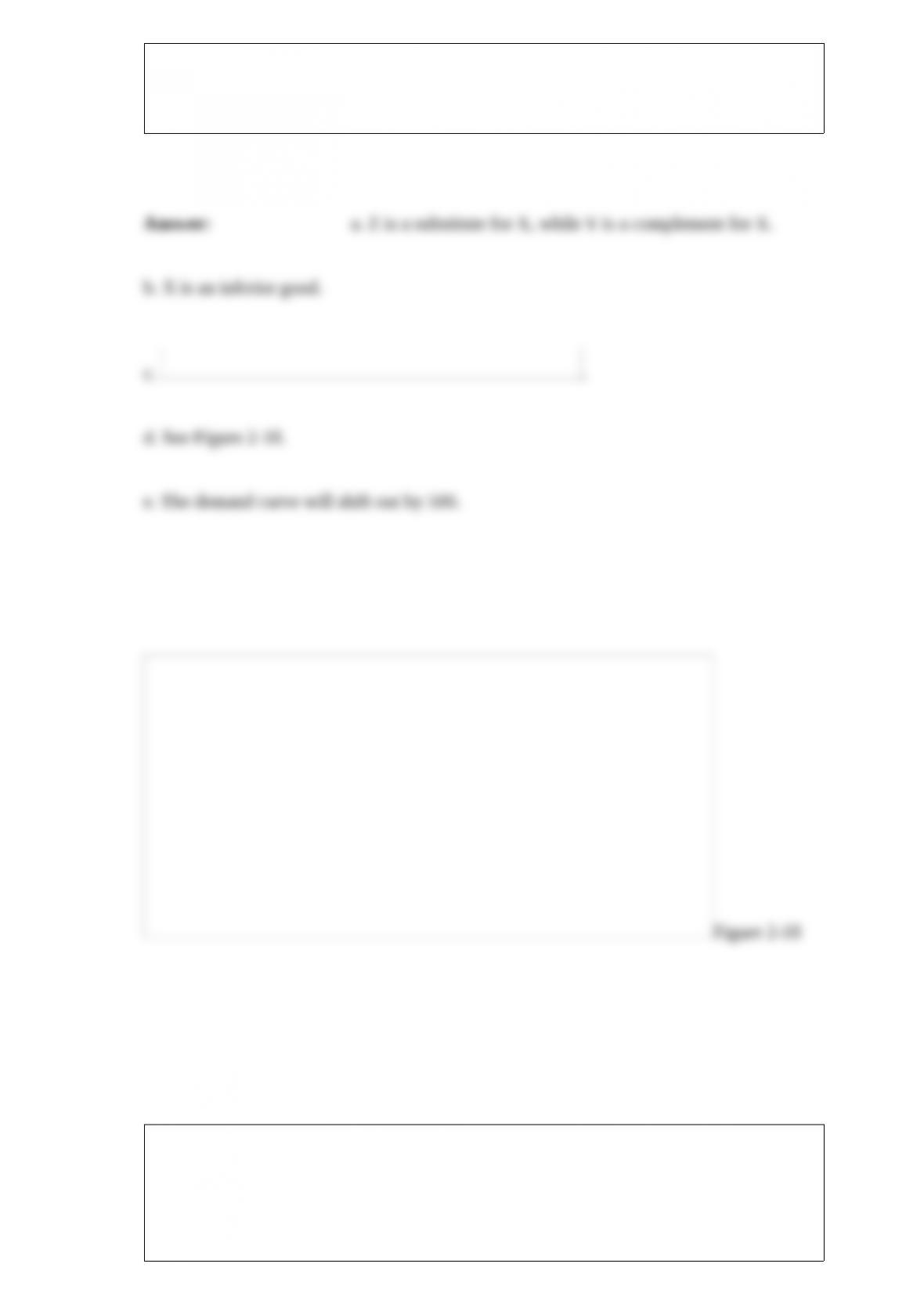
The demand for your product has been estimated to be
. The relevant price and income data are as
follows: .
a. Which goods are substitutes for X? Which are complements?
b. Is X an inferior or a normal good?
c. How much X will be purchased?
d. Graph the demand curve for X given the above information.
e. How will the demand curve change if M falls to 35,000?
Suppose that the duopolists competing in Cournot fashion agree to produce the
collusive output. Given that firm 2 commits to this collusive output, it pays firm 1 to:
A. cheat by producing a higher level of output.
B. cheat by producing a lower level of output.
C. cheat by raising prices.
D. None of the answers is correct.
Which of the following is true?
A. For a finitely repeated game, the game is played enough times to effectively punish
cheaters, and therefore collusion is likely.
B. In an infinitely repeated game with a low interest rate, collusion is unlikely because
the game unravels so that effective punishment cannot be used during any time period.
C. A secure strategy is the optimal strategy for a player no matter what the opponent
does.
D. None of the answers is correct.
Smyth Industries operated as a monopolist for the past several years, earning annual
profits amounting to $50 million, which it could have maintained if Jones Incorporated
did not enter the market. The result of this increased competition is lower prices and
lower profits; Smyth Industries now earns $10 million annually. The managers of
Smyth Industries are trying to devise a plan to drive Jones Incorporated out of the
market so Smyth can regain its monopoly position (and profit). One of Smyths
managers suggests pricing its product 50 percent below marginal cost for exactly one
year. The estimated impact of such a move is a loss of $1 billion. Ignoring antitrust
concerns, is it in Smyth Industries interest to remain as a duopolist or engage in
predatory pricing?

A. Engage in predatory pricing since $210 million is greater than $200 million.
B. Remain as a duopolist since $210 million is greater than $0.
C. Engage in predatory pricing since $1.05 billion is greater than $1 billion.
D. Remain as a duopolist since $210 million is greater than $100 million.
The marginal cost curve:
A. lies always below the average total cost curve (ATC).
B. lies always above the average variable cost curve (AVC).
C. intersects the ATC and AVC at their maximum points.
D. intersects the ATC and AVC at their minimum points.
An industry consists of three firms with equal annual sales. What is the industrys HHI?
A. 2,000
B. 3,300
C. 10,000
D. There is not sufficient information to compute the industry HHI.