
1) Suppose that from a new checkable deposit, First National Bank holds two million
dollars in vault cash, eight million dollars on deposit with the Federal Reserve, and nine
million dollars in excess reserves Given this information, we can say First National
Bank faces a required reserve ratio of ________ percent
A) ten
B) twenty
C) eighty
D) ninety
2) The problem created by asymmetric information before the transaction occurs is
called ________, while the problem created after the transaction occurs is called
________
A) adverse selection; moral hazard
B) moral hazard; adverse selection
C) costly state verification; free-riding
D) free-riding; costly state verification
3) An increase in the expected rate of inflation will ________ the expected return on
bonds relative to the that on ________ assets, everything else held constant
A) reduce; financial
B) reduce; real
C) raise; financial
D) raise; real
4) If ten years ago the prices of the items bought last month by the average consumer
would have been much higher, then one can likely conclude that
A) the aggregate price level has declined during this ten-year period
B) the average inflation rate for this ten-year period has been positive
C) the average rate of money growth for this ten-year period has been positive
D) the aggregate price level has risen during this ten-year period
5) During business cycle expansions when income and wealth are rising, the demand
for bonds ________ and the demand curve shifts to the ________, everything else held

constant
A) falls; right
B) falls; left
C) rises; right
D) rises; left
6) A key factor in producing high economic growth is
A) eliminating foreign trade
B) well-functioning financial markets
C) high interest rates
D) stock market volatility
7) Because many emerging market countries have not developed the political or
monetary institutions that allow the successful use of discretionary monetary policy,
A) they have little to gain from pegging their exchange rate to an anchor country like
the US or Germany
B) they have little to gain from using a nominal anchor, because it would mean a
monetary policy that is overly expansionary
C) they have very little to gain from an independent monetary policy, but a lot to lose
D) they would be better off giving their central bankers the independence to use
discretion, rather than take their discretion away through any nominal anchor
8) The legislation that overturned the prohibition on interstate banking is
A) the McFadden Act
B) the Gramm-Leach-Bliley Act
C) the Glass-Steagall Act
D) the Riegle-Neal Act
9) Keynes was especially interested in explaining movements of ________ because he
wanted to explain why the Great Depression had occurred and how government policy
could be used to increase ________ in a similar economic situation
A) aggregate output; wages
B) aggregate output; employment

C) wage rates; wages
D) wage rates; employment
10) In the figure above, illustrates the effect of an increased rate of money supply
growth at time period 0 From the figure, one can conclude that the
A) Fisher effect is dominated by the liquidity effect and interest rates adjust slowly to
changes in expected inflation
B) liquidity effect is dominated by the Fisher effect and interest rates adjust slowly to
changes in expected inflation
C) liquidity effect is dominated by the Fisher effect and interest rates adjust quickly to
changes in expected inflation
D) Fisher effect is smaller than the expected inflation effect and interest rates adjust
quickly to changes in expected inflation
11) Members of the Board of Governors are
A) chosen by the Federal Reserve Bank presidents
B) appointed by the newly elected president of the United States, as are cabinet
positions
C) appointed by the president of the United States and confirmed by the Senate
D) never allowed to serve more than 7-year terms
12) In the market for reserves, if the federal funds rate is above the interest rate paid on

excess reserves, an open market purchase ________ the ________ of reserves which
causes the federal funds rate to fall, everything else held constant
A) increases; supply
B) increases; demand
C) decreases; supply
D) decreases; demand
13) The interest rate on Treasury Inflation Protected Securities is a direct measure of
A) the real interest rate
B) the nominal interest rate
C) the rate of inflation
D) the rate of deflation
14) Banks engage in regulatory arbitrage by
A) keeping high-risk assets on their books while removing low-risk assets with the
same capital requirement
B) keeping low-risk assets on their books while removing high-risk assets with the
same capital requirement
C) hiding risky assets from regulators
D) buying risky assets from arbitragers
15) The formula for the simple deposit multiplier can be expressed as
A) R = T
B) D = R
C) rr = T
D) R = D
16) Everything else held constant, an increase in the money market fund ratio will mean

________ in the M2 money multiplier and ________ in the M2 money supply
A) an increase; an increase
B) an increase; a decrease
C) a decrease; an increase
D) a decrease; a decrease
17) If, after a deposit outflow, a bank needs an additional $3 million to meet its reserve
requirements, the bank can
A) reduce deposits by $3 million
B) increase loans by $3 million
C) sell $3 million of securities
D) repay its discount loans from the Fed
18) Capital ________ are American purchases of foreign assets, and capital ________
are foreign purchases of American assets
A) inflows; outflows
B) inflows; inflows
C) outflows; outflows
D) outflows; inflows
19) The ________ that required separation of commercial and investment banking was
repealed in 1999
A) the Federal Reserve Act
B) the Glass-Steagall Act
C) the Bank Holding Company Act
D) the Monetary Control Act
20) Everything else held constant, when households save less, wealth and the demand
for bonds ________ and the bond demand curve shifts ________
A) increase; right
B) increase; left
C) decrease; right
D) decrease; left

21) What factors determine the demand for money in the Baumol-Tobin analysis of
transactions demand for money? How does a change in each factor affect the quantity
of money demanded?
22) Your favorite uncle advises you to purchase long-term bonds because their interest
rate is 10% Should you follow his advice?
23) Assume that a fixed exchange rate is overvalued Describe the situation of a
speculative crisis against this currency What can the central bank do to defend the
currency? Why might the alternative of devaluation be preferable?
24) Why does the free-rider problem occur in the debt market?
25) How did the increase in the interest rates in the early 80s contribute to the S&L
crisis?
26) Explain an additional disadvantage for a country undergoing dollarization compared
to a currency board or other exchange-rate targeting regimes
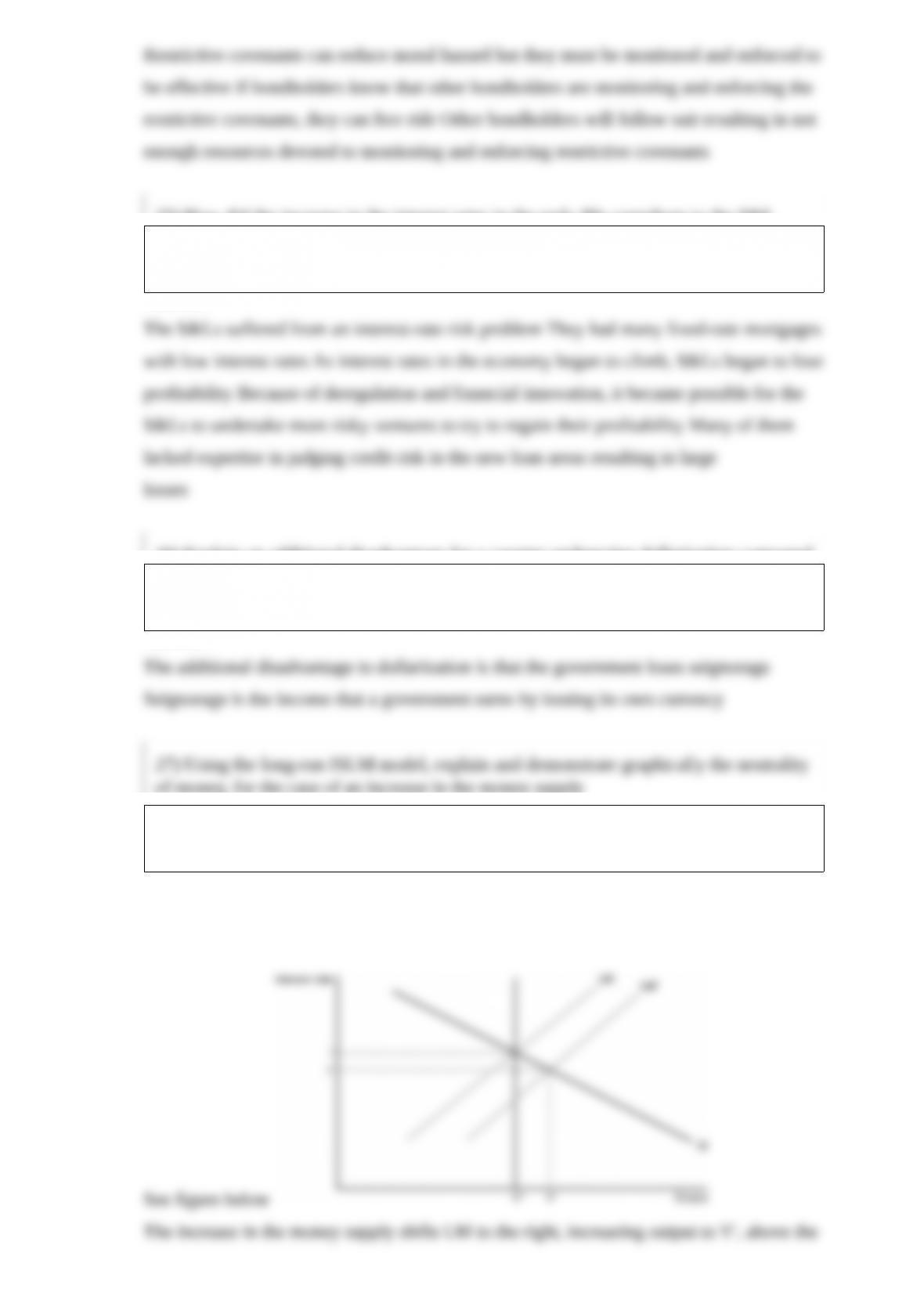
27) Using the long-run ISLM model, explain and demonstrate graphically the neutrality
of money, for the case of an increase in the money supply