The make-buy decision is typically made during which stage of the organizational
buying decision process?
a. information search
b. supplier search
c. alternative evaluation
d. problem recognition
e. purchase decision
Answer:
More than half of all new businesses fail within __________ years of their launch.
a. two
b. three
c. four
d. five
e. ten
Answer:
Synergy analysis incorporates two business analysis tools, which are __________ and
the market-product grid framework.
a. diversification analysis
b. Porter’s generic business strategy framework
c. SWOT analysis
d. Porter’s competitive advantage
e. share point analysis
Answer:
About 60 percent of U.S. companies now include __________ as a behavioral measure
of salesperson performance.
a. the ability to read body language
b. customer satisfaction
c. the ability to form analogies
d. the ability to manage budgets
e. a harnessed need for power or authority
Answer:
Nestl received a lot of bad press and negative customer feedback during Greenpeace’s
campaign because of Nestl’s __________ comments made on its Facebook Page.
a. unresponsive and silent
b. dogmatic and preachy
c. transparent and honest
d. bitter and petulant
e. uninformed and oblivious
Answer:
A seller’s requirement that the purchaser of one product also buy another item in the line
is called __________.
a. exclusive dealing
b. a requirement contract
c. a tying arrangement
d. an exclusive territorial distributorship
e. a selective promotion contract
Answer:
All of the following are factors for deciding when to buy an offering EXCEPT:
a. the manufacturer is currently offering a $25 rebate.
b. the shopping experience is pleasant.
c. the brand is on sale.
d. the retailer is offering $0 down, 5 percent interest financing.
e. the retailer’s return policy.
Answer:
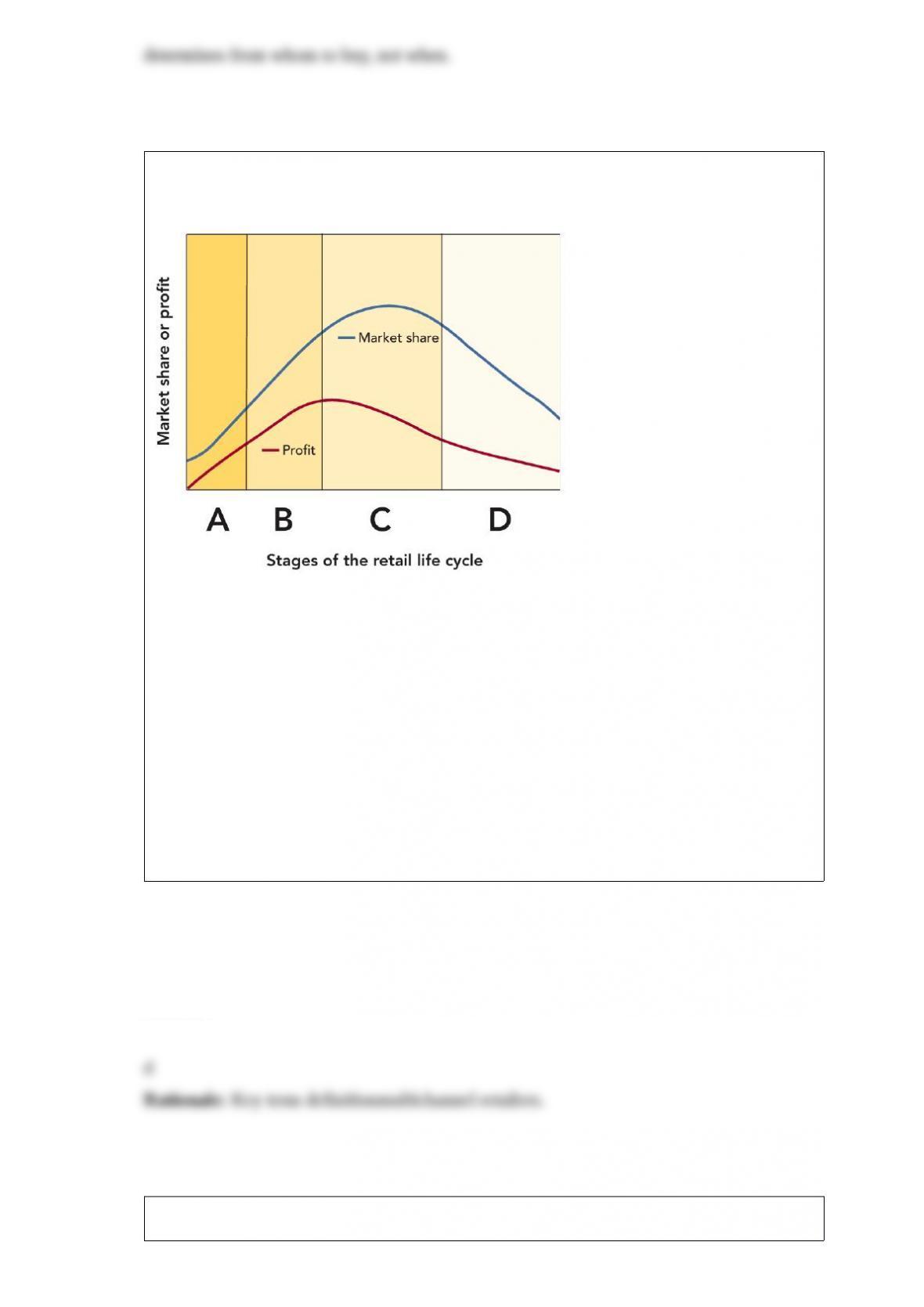
Figure 1.
Multichannel retailers are retailers that
a. sell different products through entirely different channels.
b. sell through different channels under different brand names.
c. utilize strategic and tactical wholesalers.
d. utilize and integrate a combination of traditional store formats and nonstore formats.
e. combine two channels for their offerings: one for products and the other for services.
Answer:
Universal Concerts wants to bring a series of country music concerts to Canada next
year. In general, Western Canadians much prefer country music while Eastern
Canadians prefer rock. Thus, a country music event in eastern Canada is very likely to
have lots of empty seats even though it is more populous than the western part of the
country. If it can book only one venue, Universal Concerts should segment its Canadian
market according to __________ if it hopes to have a sold out concert.
a. geographic characteristics
b. demographic characteristics
c. music format characteristics
d. behavioral characteristics
e. psychographic characteristics
Answer:
The courts see price fixing as per se illegal, which means the courts
a. see price fixing itself as illegal.
b. don”t view price fixing as illegal.
c. only consider price fixing to be illegal if a company is sued.
d. compare the company behavior to behavior typical in its industry.
e. view price fixing as illegal only if it causes destructive competition.
Answer:
The Federal Dilution Act
a. prevents someone from using a trademark on a non-competing product.
b. provides for registration of a company’s trademarks.
c. allows a company to secure rights to a name before its actual use.
d. facilitates the protection of U.S. trademark rights throughout the world.
e. allows language adaptations for trademarks in different parts of the world.
Answer:
Which of the following statements about organizational buying compared to consumer
buying is MOST accurate?
a. Perceived risk is lower in organizational buying.
b. Brand loyalty exists in both organizational and consumer buying.
c. Most organizational buying decisions are low-involvement ones.
d. Organizational buyers are more influenced by lifestyle factors.
e. Derived demand is more important in consumer buying.
Answer:
From an organization’s perspective regarding its new products and innovations, which
of the following new-product strategies has the highest level of risk?
a. a radical invention
b. a brand extension
c. a product line extension
d. a jump in innovation
e. a product deletion
Answer:
Culture includes values, which vary with age. Consumers between the ages of 30-to-39
years old rank __________ as the third most important cultural value.
a. honesty
b. protecting the family
c. friendship
d. self-esteem
e. health and fitness
Answer:
Andrea Arenas is the owner of 2 Places at 1 Time, a concierge company. She and her
staff of 60 perform everyday services such as walking the dog, picking up cleaning,
waiting for the repairman, and going to the post office for people who are too busy to
perform these simple acts. She is often hired by major corporations to perform services
for their harried executives and their spouses. Her clients can evaluate the services that
2 Places at 1 Time provide
a. only before they are purchased or consumed.
b. only after they are purchased or consumed.
c. only at the same time as they are purchased or consumed.
d. before, during, and/or after they are purchased or consumed.
e. only during consumption or after they are purchased.
Answer:
The term truck jobbers refers to wholesalers who
a. furnish the racks or shelves that display merchandise in retail stores, perform all
channel functions, and sell on consignment to retailers.
b. store all the merchandise they sell in their trucks.
c. own the merchandise they sell but do not physically handle, stock, or deliver it.
d. have a small warehouse from which they stock their trucks for distribution to
retailers.
e. work for several producers, carry noncompetitive, complementary merchandise in an
exclusive territory, and use over-the-road transportation for all product deliveries.
Answer:
The final step in the five-step marketing research approach includes making action
recommendations, implementing action recommendations, and __________.
a. evaluating the results
b. doing an environmental scan
c. making sales or profit projections for the coming year(s)
d. increasing or decreasing production based upon research collected
e. identifying possible opportunities for growth
Answer:
When the office of National Drug Control Policy ran an ad with the headline,
“Marijuana Harmless? Didn”t see merging truck.” it was using which type of ad appeal?
a. humor
b. fear
c. sex
d. nostalgic
e. guilt
Answer:
Which of the following is a characteristic of the growth stage of the product life cycle?
a. a switch to primary demand
b. a growing proportion of repeat purchasers to initial purchasers
c. The number of distribution outlets shrinks due to growing inefficiencies.
d. Profit margins increase as sales increase.
e. No new product features are added to maximize profits.
Answer:
The American Red Cross uses marketing to help achieve its goals. As a service, it can
be classified as
a. a nonprofit organization.
b. people-based.
c. equipment-based.
d. a business firm.
e. a governmental agency.
Answer:
Competition for the same or similar type of product or service between very dissimilar
types of retail outlets that results from a scrambled merchandising policy is referred to
as __________.
a. mixed merchandising
b. intertype competition
c. scrambled merchandising
d. multi-service merchandising
e. dual distribution
Answer:
Ethics refers to the
a. religious tenets of a country or ethnic region that shape its culture.
b. social norms of a nation, community, or family.
c. society’s values and standards that are enforceable in the courts.
d. moral principles and values that govern the actions and decisions of an individual or
group.
e. universal laws of man that go beyond individual or a group’s beliefs of nations or
religions.
Answer:
Triple-bottom line refers to
a. the recognition of the need for organizations to improve the state of people, the
planet, and profit simultaneously if they are to achieve sustainable, long-term growth.
b. the obligations an organization has to those who can affect achievement of its sales,
profit, and market share objectives simultaneously.
c. the recognition of the need for organizations to be responsible simultaneously to
shareholders, employees, and customers.
d. the obligations an organization has to practice profit, stakeholder, and societal
responsibility simultaneously.
e. three different financial statements prepared in three different formats: one for
governmental regulators, one for shareholders, and one for internal use.
Answer:
A situation in which a manufacturer grants a distributor the sole rights to sell a product
in a specific geographic area is called __________.
a. exclusive dealing
b. a tying arrangement
c. a selective promotion contract
d. an exclusive territorial distributorship
e. a requirement contract
Answer:
The central business district refers to
a. a suburban mall that contains up to 100 stores and draws customer from 5 to 10 miles
away.
b. the oldest retailing setting, located in a community’s downtown area.
c. a retail location that typically has one primary store and about 20 to 40 smaller
outlets, and serves a population base of about 100,000.
d. a cluster of stores that serves people who are within a five- to ten-minute drive and
serves a population base of under 30,000.
e. a collection of large stores over 100,000 square feet that offers a mix of about 40
percent food products and 60 percent general merchandise items.
Answer:
An oligopoly is a competitive market situation where
a. many sellers follow market price for identical, commodity products.
b. one seller sets the price for a unique product.
c. few sellers are sensitive to one another’s prices.
d. many sellers compete on nonprice factors.
e. one or few sellers compete solely on nonprice factors.
Answer:
Which of the following statements reflects the key elements in developing a marketing
strategy for L. M. Schofield, Inc., a company that produces specialized concrete
surfaces for heavily trafficked areas such as retail outlets and amusement parks?
a. Buy ads in all the major trade journals aimed at businesses in the entertainment
and/or sports industry.
b. Communicate using direct mail about the various walking surfaces Schofield can
create for contractors who are building riding and walking paths.
c. Design a sample ad and test it using visitors at a trade show.
d. Hire six new sales representatives for the Midwest regional office and train them on
all aspects of concrete surfaces.
e. Conduct a focus group to decide on which surface to use for a theme park in Brazil.
Answer:
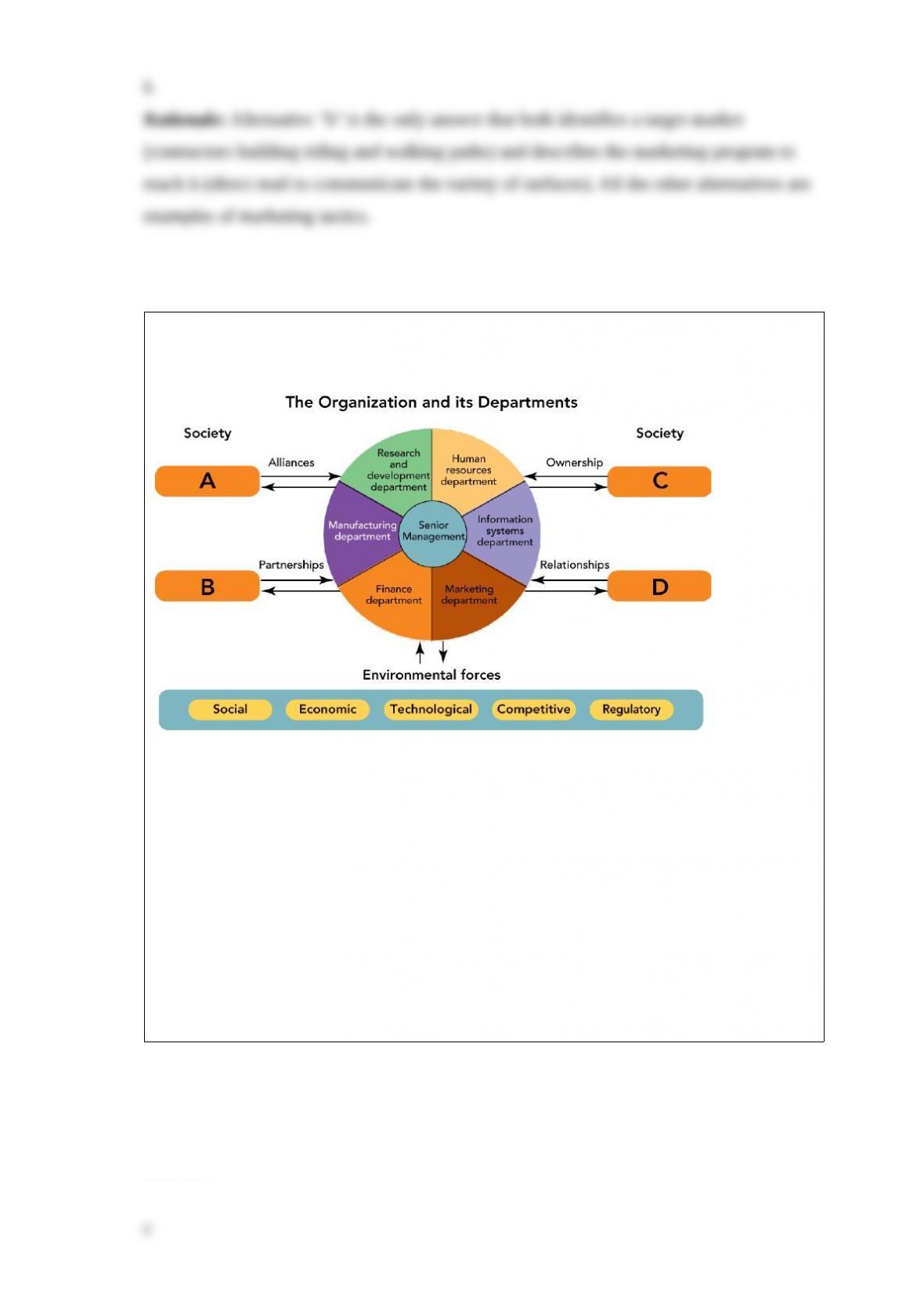
Figure 1.
In Figure 1. above, “C” represents a firm’s ownership with
a. other organizations.
b. suppliers.
c. shareholders.
d. customers.
e. other departments.
Answer:

To select a paper supplier, JCPMedia looks at its capabilities to deliveron-timeselected
grades of paper, the availability of specific types of paper, and price. This examination
would be done during JCPMedia’s __________.
a. procurement analysis
b. break-even analysis
c. value analysis
d. database search
e. social audit
Answer:
While pricing objectives frequently reflect corporate goals, pricing constraints often
relate to
a. stockholder demands.
b. political ideology.
c. conditions existing in the marketplace.
d. an organization’s code of ethics.
e. the financial realities within the organization itself.
Answer:
List the following competitive markets from MOST competitive to least competitive.
a. monopolistic competition, pure monopoly, pure competition, and oligopoly
b. pure competition, monopolistic competition, oligopoly, and pure monopoly
c. pure competition, monopolistic competition, pure monopoly, and oligopoly
d. monopolistic competition, pure monopoly, pure competition, and oligopoly
e. pure monopoly, oligopoly, monopolistic competition, and pure competition
Answer:

Variations of a product within a product class are referred to as a/the _____.
a. product form
b. product item
c. product line
d. product class
e. product mix
Answer: