BMW StreetCarver was a $495 skateboard that featured BMW’s technology in its wheel
suspension, which stabilizes the board’s sleek design and allows for greater control
around sharp curves. BMW wanted its skateboard to be within the consideration set of
potential skateboard buyers. In this case, it most likely focused on
A. reducing the postpurchase dissatisfaction that may result from purchasing its
product.
B. making sure its representatives attend sporting events such as ESPN’s X-Games to
get new product ideas.
C. making appeals directed towards motivational ego needs.
D. explaining the stability and control aspects of the StreetCarver in its advertising
messages.
E. creating personality profiles for skateboarders.
Answer:
A graphic presentation of the break-even analysis that shows when total revenue and
total cost intersect to identify profit or loss for a given quantity sold is referred to as
a(n) __________.
A. Gantt chart
B. demand curve
C. ROI analysis
D. cross-tabulation
E. break-even chart
Answer:
The General Mills-Nestle strategic channel alliance
A. increased the ready-to-eat cereal worldwide market share of these companies.
B. served as a model for Post Cereal and Weetabix, a British firm.
C. increased the hot cereal worldwide market share of these companies.
D. increased the ready-to-eat cereal market abroad but decreased General Mills’ hot
cereal market share in the U.S.
E. resulted in a lawsuit from Kellogg’s, the global leader in the ready-to-eat cereal
market, which cited unfair trade practices.
Answer:
A market-product grid is a framework to relate the __________ to products offered or
potential marketing actions by an organization.
A. market segments of potential buyers
B. marketing objectives of potential products
C. total anticipated revenue
D. total anticipated profit
E. market share of the closest competitor
Answer:
Which promotional element would you most likely use during the growth stage of the
product life cycle to solidify channels of distribution?
A. advertising
B. sales promotion
C. publicity
D. personal selling
E. direct marketing
Answer:
The generation of children born between 1977 and 1994 is sometimes referred to as
A. echo busters.
B. baby busters.
C. the lost generation.
D. the baby boomerang.
E. the millennials.
Answer:
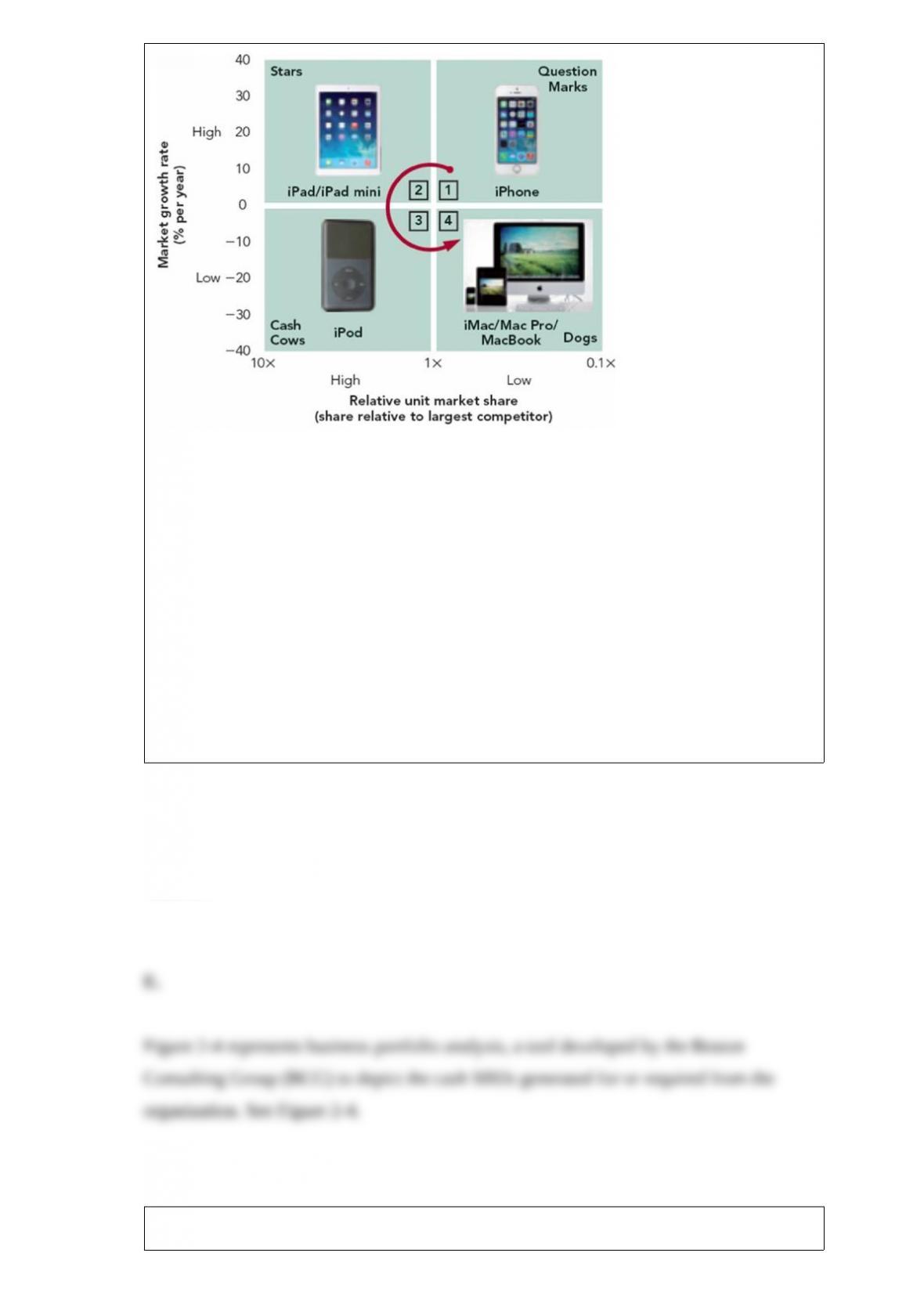
Figure 2-4
Figure 2-4 shown above represents which type of analysis?
A. SWOT analysis
B. synergy analysis
C. marketing audit
D. diversification analysis
E. business portfolio analysis
Answer:
The purpose of the Robinson-Patman Act is to
A. outlaw price discrimination for purchasers of the same product.
B. encourage pure competition.
C. protect inventors from having their intellectual property stolen.
D. repeal the Sherman Antitrust Act.
E. provide incentives for interstate commerce.
Answer:
An extremely large machine for producing sheet metal from steel ingots would be
classified as which kind of business products?
A. installations
B. finished goods
C. supplies
D. industrial services
E. raw materials
Answer:
Choice of media selection is related to the target audience, the type of product, the
nature of the message, campaign objectives, available budget, and __________.
A. the capabilities of the advertising agency
B. audience preferences
C. the costs of alternative media
D. media spending by competitors
E. available air time
Answer:
Large multistore chain retailers such as Sears, Safeway, and Target use a highly
formalized buying center that is referred to as a(n)
A. ad hoc committee.
B. buying committee.

C. merchandise procurement center.
D. purchasing department.
E. purchasing control system.
Answer:
Unfortunately, the NAICS system will not allow marketing managers to gather
information about
A. import competition in domestic markets.
B. geographic distribution of industries.
C. market share in a pure competition environment.
D. demand for products and services.
E. data on industries that are oligopolies.
Answer:
Airlines, hotels, and car rental firms all engage in __________ by varying prices based
on time, day, week, or season to match supply and demand.
A. skimming pricing
B. yield management pricing
C. bundle pricing
D. target pricing
E. prestige pricing
Answer:
What marketing metric determines whether a TV program like American Idol remains
on the Fox broadcast TV network?
A. appeal
B. cost per ad
C. rating
D. poll
E. frequency

Answer:
A(n) __________ website is essentially an electronic storefront with the primary
purpose of converting an online browser into an online, catalog, or in-store buyer.
A. multichannel
B. transactional
C. promotional
D. intermediary
E. direct selling
Answer:
Which of the following is NOT an example of an industry?
A. the computer industry

B. the automobile industry
C. the landscaping industry
D. the government industry
E. the television programming industry
Answer:
What percentage of U.S. product sales is directly tied to word of mouth activity among
friends, family, and colleagues?
A. 10 percent
B. 25 percent
C. 33 percent
D. 50 percent
E. 67 percent
Answer:
3M’s pricing strategy for its Post-it Flag Highlighters was as follows:
A. match its principal competitors’ highlighters’ prices.
B. charge a price that would provide genuine value to the target customer segment.
C. set an initially low price with the intent of bringing down the price even further later
if sales were less than anticipated.
D. place the product in discount office supply retailers to make it easier to purchase.
E. use the same pricing strategy as its 3M’s Post-it Flag and Post-it Note offerings.
Answer:
A(n) __________ is an advertising agency that provides the most complete range of
services, including market research, media selection, copy development, artwork, and
production.
A. limited-service agency
B. full spectrum agency
C. multi-service agency
D. in-house agency
E. full-service agency
Answer:
Many consumers are committed to brands with a strong link to social action. An
example of this would be
A. McDonald’s “I’m Lovin’ It” campaign.
B. Brita’s “Filter for Good” campaign.
C. Diesel’s “Be Stupid” campaign.
D. Liz Claiborne’s “Claiborne for Men” campaign.
E. Samsung’s “The Jitterbug” campaign.
Answer:

Two or more competitors explicitly or implicitly setting prices is referred to as
__________.
A. competitive collusion
B. vertical price fixing
C. horizontal price fixing
D. lateral price fixing
E. price cooperation
Answer:
Most services have a limited capacity due to the __________ of the service from the
service provider and the perishable nature of the service.
A. inventory
B. inconsistency
C. intangibility
D. information
E. inseparability
Answer:
An interactive, Internet-enabled system that allows individual customers to design their
own products by answering a few questions and choosing from a menu of product
attributes, prices, and delivery options, is referred to as a __________.
A. wiki
B. cookie
C. choiceboard
D. bot
E. collaborative filter
Answer:
Products that usually last over many uses, such as cars and appliances, are referred to as
A. endurable goods.
B. nondisposable goods.
C. imperishable goods.
D. reliable products.
E. durable goods.
Answer:
Fran Wilson Creative Cosmetics attributes its success to a top-quality product, effective
advertising, and a novel __________ strategy.
A. joint venture
B. licensing
C. franchising
D. indirect export
E. direct investment
Answer:
In the personal selling process, the stage that includes making certain the customer’s
purchase has been properly delivered and installed and difficulties experienced with the
use of the item are addressed is referred to as the __________ stage.
A. urgency close
B. follow-up
C. assumptive close
D. presentation
E. trial close
Answer:
The owners of Old School Brand Authentic Antique Foods researched Civil War
records to come up with recipes for the old-fashioned products they market. Concern
about the __________ element of the marketing mix would make them eager to be
featured in an upcoming edition of Taste of Home magazine.
A. product
B. price
C. production
D. promotion
E. place
Answer:
A large company produces paint and other home decorating products. Its goal is to
choose the marketing channel arrangement that would give it the most control over
supply sources. Which marketing channel system should this company choose?
A. a contractual vertical marketing system
B. an administered vertical marketing system
C. a corporate vertical marketing system
D. an integrated marketing system
E. a retailer-sponsored cooperative
Answer:

Each strategic business unit has marketing and other specialized activities (e.g., finance,
manufacturing, or research and development) at the __________ level, where groups of
specialists actually create value for the organization.
A. strategic
B. corporate
C. functional
D. business unit
E. compartmental
Answer:
If you watch much television, you have seen the ads that show a controlled crash of a
car containing crash test dummies and the resultant vehicular damage. In the
new-product process, this safety test would occur during the __________ stage.
A. development
B. market testing
C. idea generation
D. screening and evaluation
E. business analysis
Answer:
The National Do-Not-Call Registry was created to give Americans a tool for
maintaining their privacy on home telephone lines. More than __________ of all
households are registered.
A. 95%
B. 90%
C. 80%
D. 70%
E. 30%
Answer:
Selective distribution refers to
A. the density of distribution whereby a firm tries to place its products or services in as

many outlets as possible.
B. the distribution of products or services in markets where there are currently no other
competitors.
C. the distribution of products or services where the producer owns the entire channel
of distribution.
D. the density of distribution whereby a firm tries to place its products or services with
only one retail outlet in a specified geographical area.
E. the density of distribution whereby a firm tries to place its products or services in a
few retail outlets in a specific area.
Answer:
Which of the following statements most likely would account for the shift in the
demand curve from D1 to D2 shown in Figure 11-3B above?
A. The firm increased its prices and consumers perceived the value of the product to be
greater.
B. There were fewer product substitutes available in the marketplace.
C. Competitors in the market raised their prices.
D. A recession occurred that raised consumers’ incomes.
E. The firm’s price remained the same but changes occurred in consumer tastes.
Answer:
Define cross-channel shoppers, explain why they are important to marketers, and list
the three reasons cross-channel shoppers research items online before buying in stores.
Answer:
An inventor designs a scissors that has interchangeable blades that allow the user to
switch from straight cuts to decorative cuts. Identify two possible target markets and
explain your answer.
Answer:
Ruth, who has no children, wants to buy a special baby gift for her best friend’s baby
shower, which is this evening. Since she won’t have any time between work and the
baby shower, she must go today during her lunch break. She is planning on taking her
sister with her to help make the selection. Ruth knows she will be ready to buy every
baby-oriented product she sees because she wishes that she too was having a baby.
Identify each of the situational influences that are described in this scenario. Which
situational influence was not described?
Answer:
Explain the difference between relationship selling and partnership selling.
Answer:
Explain why NOT all products can use test markets.
Answer:
Identify and describe the functions of agents and brokers.
Answer:
List the three steps of the planning phase of the strategic marketing process. Briefly
describe what goes on during each of the three steps.
Answer:
Discuss the process of pretesting and posttesting advertising copy. Include a list of
methods used for pretesting and posttesting in your answer. Be sure to explain why
marketers should pretest and posttest ad copy.
Answer:
Identify and discuss four methods used to set the promotion budget.
Answer:
Why is it a wise idea for global marketers use back translation? Provide an example to
support your answer.
Answer:
Describe the World Trade Organization (WTO) and its purpose.
Answer:
Marketing managers often use break-even analysis to analyze the relationship between
total revenue and total cost to determine profitability at various levels of output. What is
the break-even formula? Use the formula to calculate how many DVD players a dealer
must sell if her fixed costs are $100,000, unit variable costs are $150, and the selling
price is $200.
Answer:
A new sandwich shop has opened just off-campus and would like the university
students to frequent the shop whenever they are hungry. What is the best type of sales
promotion to use to reach them and why?
Answer:
What is environmental scanning? Using the five environmental forces that affect
organizations, describe considerations for conducting environmental scanning for a new
model of automobile.
Answer:
In addition to consumers, what other people, groups, and environmental forces interact
to influence an organization’s marketing activities?
Answer:
Explain the selling model that Xerox uses.
Answer:
Explain the price equation in the context of a new car purchase.
Answer:
What are the three components of a person’s ability to buy an offering?
Answer:
What are the strengths/advantages and weaknesses/disadvantages of using publicity in
the promotional mix?
Answer:
What are the two key objectives of marketing? Define “exchange” and explain how it
supports these objectives.
Answer: