For 18 months, Warner-Lambert Co. was required to include the following statement in
all television advertisements for Listerine: “Listerine will not help prevent colds or sore
throats or lessen their severity.” The FTC imposed this requirement because previous
advertising had caused consumers to believe Listerine was effective against colds. This
is an example of the FTC action of
a. corrective advertising.
b. deceptive advertising.
c. unethical advertising.
d. cease-and-desist advertising.
e. self-regulation.
Answer:
Most consumers realize that the quality of diamonds varies, and most believe the higher
the price of a diamond, the higher its quality. This is an example of price influencing the
perception of overall quality, and therefore __________, to consumers.
a. acceptable cost
b. perceptual investment
c. barter potential
d. return on investment
e. value
Answer:
The growing concern about __________ has led to a decline in direct marketing
response rates among some customer groups.
a. government regulation
b. privacy
c. landfill waste
d. postal rates
e. fraud
Answer:
Which of the following statements about the product life cycle as a pricing constraint is
most accurate?
a. The newer a product is, the higher the price that can usually be charged.
b. The later in the product life cycle a product is, the higher the price that can usually be
charged.
c. Once a product is considered nostalgic, the price will continue to rise indefinitely.
d. Fads will generally have only two price pointshigh and lowbut the values of those
price points will remain basically the same.
e. Prices should not be changed until a product reaches the maturity stage.
Answer:
Loving Care Pets manufactures food for dogs, cats, rabbits, and gerbils specifically
created for pets under three months of age. Assuming it is marketing to a single
segment of “young pet owners,” in terms of the market-product grid framework, Loving
Care Pets is using a __________ strategy.
a. market-product concentration
b. market specialization
c. product specialization
d. selective specialization
e. full coverage
Answer:
Ten general product and service categories dominate online consumer buying today and
in the foreseeable future. One category includes regularly purchased consumer
packaged goods, such as grocery products, where
a. customer value is the most important element.
b. price and delivery time are not key factors.
c. convenience is very important.
d. digital delivery is an important factor.
e. price and speed of delivery are the determinant sales factors.
Answer:
Environmental forces refer to
a. the internal strengths of a company that enable the firm to remain competitive.
b. the marketing manager’s uncontrollable factorsproduct, price, promotion, and
placethat can be used to solve marketing problems.
c. the unpredictable or uncontrollable availability of natural resources that can enhance
or restrain a company’s growth.
d. the marketing manager’s uncontrollable forces in a marketing decision involving
social, economic, technological, competitive, and regulatory forces.
e. the marketing manager’s controllable forces in a marketing decision involving social,
economic, technological, competitive, and regulatory forces.
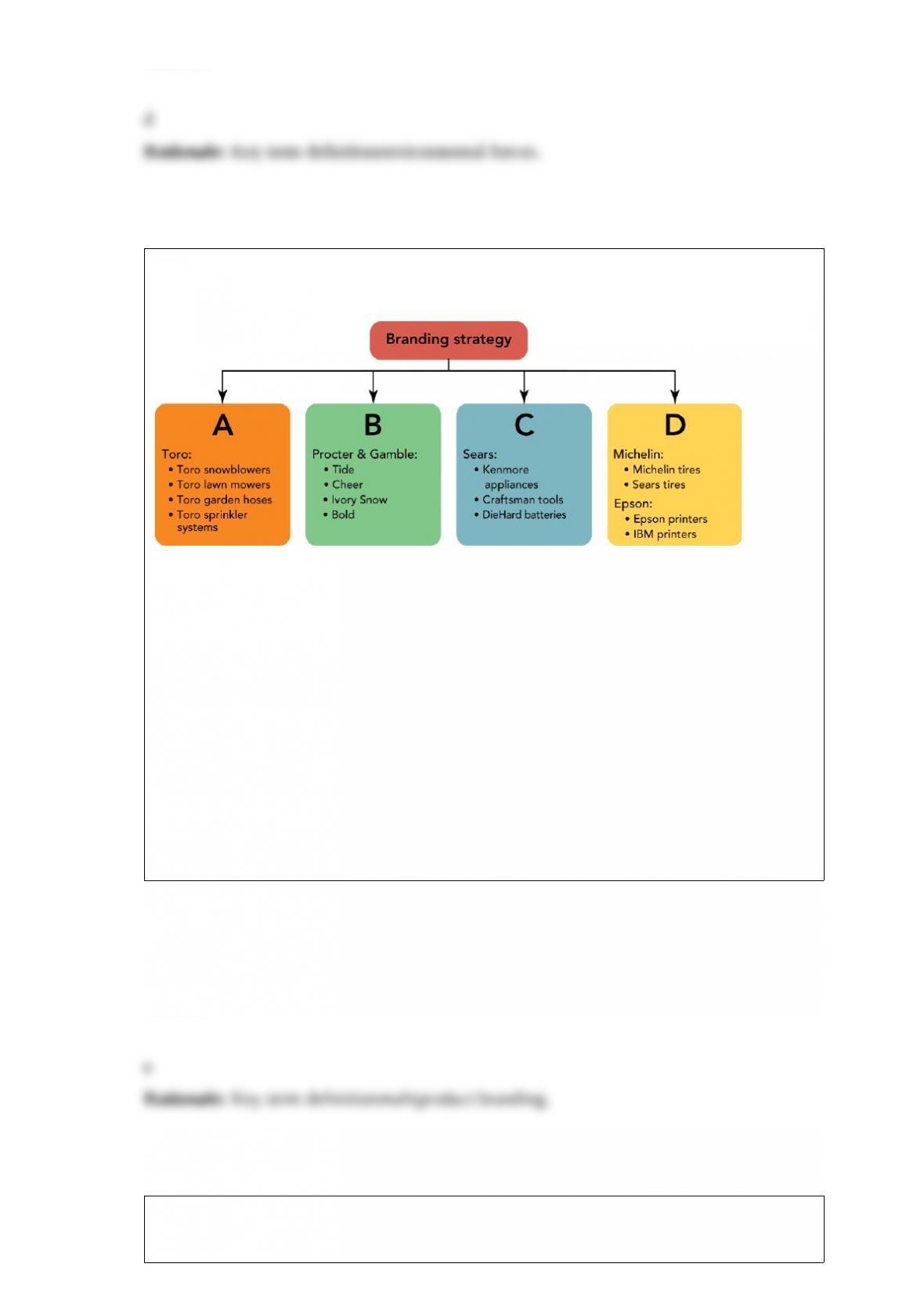
Answer:
Figure 1.
A branding strategy in which a company uses one name for all its products in a product
class is referred to as __________.
a. global branding
b. public branding
c. multibranding
d. brand licensing
e. multiproduct branding
Answer:
Which buyer requirement would be most important in choosing a channel for a
financial service for a consumer who is interested in setting up a retirement account?
a. information
b. context
c. variety
d. pre- and postsale services
e. adaptation
Answer:
All of the following are cost-oriented approaches to select an approximate price level
EXCEPT:
a. cost-plus fixed-fee pricing.
b. standard markup pricing.
c. yield management.
d. experience curve pricing.
e. cost-plus percentage-of-cost pricing.
Answer:
__________ is a VALS group that are the heaviest readers of Reader’s Digest.
a. Experiencers
b. Believers
c. Makers
d. Achievers
e. Innovators
Answer:
How might a marketing manager for a manufacturer of turboprop engines, used in
private jet planes, use the NAICS to help her with marketing planning?
a. Record the NAICS numbers for each of her firm’s best customers and then obtain
lists of companies with the same NAICS numbers.
b. Go to a library and find the NAICS numbers for all government unitsfederal, state,
and local.
c. Identify all NAICS numbers that reflect the classifications of her firm’s customers
and compare them to previous SIC codes.
d. Poll her field sales organization to see if her company’s sales representatives know
what NAICS numbers mean.
e. Forgo using the NAICS system because it is a dated concept that has no current
usefulness.
Answer:
In the VALS framework, consumers motivated by ideals are guided by knowledge and
principle. One segment of the two Ideals-motivated groups, known as __________,
have fewer resources and are conservative, conventional people with concrete beliefs
based on traditional, established codes such as family, religion, community, and the
nation.
a. Experiencers
b. Believers
c. Makers
d. Achievers
e. Thinkers
Answer:

A full-scale operating model of the product under development is referred to as a
a. sample.
b. framework.
c. template.
d. prototype.
e. blueprint.
Answer:
In a decision, the restrictions placed on potential solutions to a problem are referred to
as
a. objectives.
b. inhibitors.
c. dependent variables.
d. obstructions.
e. constraints.
Answer:
Marginal analysis might take the form of such questions as, “Should we extend our
hours to include Sundays?” or “What if we put more apples in the pie?” The basic
principle is that
a. as long as a marketing action breaks even, the action is worth taking.
b. expected incremental revenues from pricing and other marketing actions must more
than offset incremental costs.
c. you “don”t rock the boat” if your program is making a profit; instead, you “leave well
enough alone.”
d. if you are not willing to take risks, even if the numbers tell you otherwise, your
business will ultimately fail.
e. marketing and finance are two different animals: “If it feels right in your gut go for
it.”
Answer:
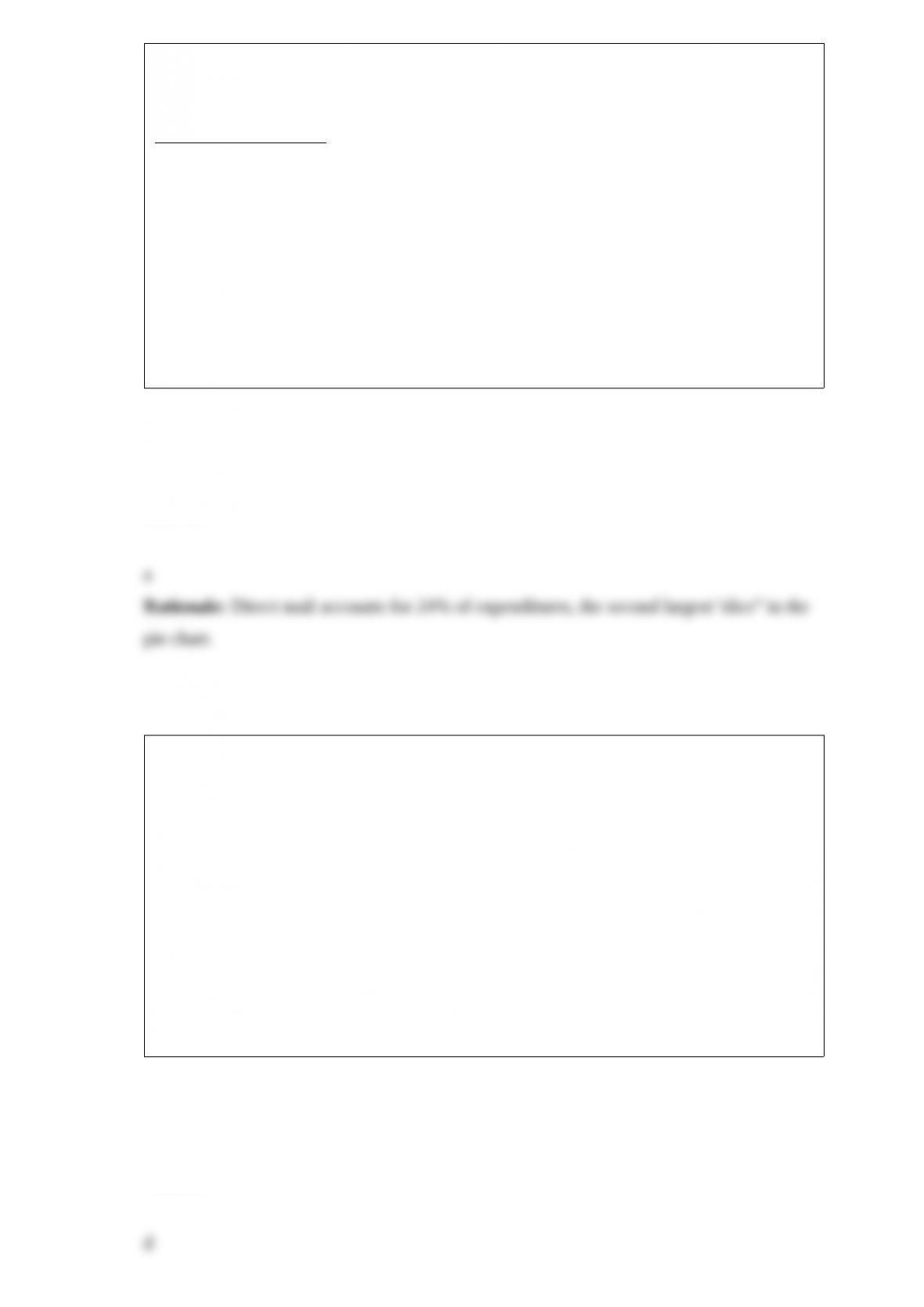
Figure 1.B
With respect to Figure 1.B above, “B” represents which media alternative that has the
SECOND LARGEST amount of advertising expenditures (or ‘slice” of the pie chart)?
a. direct mail
b. newspapers
c. radio
d. magazines
e. television
Answer:
The marketing director for a(n) __________ is most likely to believe the following
statement, “The purpose of advertising is to increase demand for the product class.”
a. oligopolist competitor
b. monopolistic competitor
c. pure competition competitor
d. pure monopolist competitor
e. competitive oligopolist competitor
Answer:
The break-even point for a large grain farming operation was calculated to be 2 million
bushels of corn. Break-even analysis would take place during which step of the
price-setting process?
a. identify pricing objectives and constraints
b. determine cost, volume, and profit relationships
c. estimate demand and revenue
d. select an approximate price level
e. make special adjustments to list or quoted price
Answer:
A target market refers to
a. people who could purchase a product regardless of who ultimately uses it.
b. one or more specific groups of potential consumers toward which an organization
directs its marketing program.
c. former customers who now use competitors’ products.
d. the cluster of benefits that an organization focuses on to satisfy consumers’ needs.
e. people with both the desire and the ability to buy a specific offering.
Answer:
In planning and obtaining publicity, a frequently used tool is the __________, which is
an announcement regarding changes in the company or the product line.
a. trade announcement
b. news release
c. infomercial
d. news conference
e. public trade announcement
Answer:
Penningtons Superstore specializes in plus-size fashions for women. It recognized a
potential marketing opportunity in plus-size junior clothes and was considering adding
a line of teen plus-sizes to its 117 stores. Before doing so, it contracted with a marketing
research firm to make sure that the teen plus-size market was a viable one. It told the
research company it needed the results of its study by September 15 so it could
introduce the line the following March, if the market was viable. The major constraint
for the marketing research firm in this scenario would be __________.
a. collecting secondary data
b. finding primary research candidates to interview
c. meeting the time deadline
d. establishing measures of success
e. locating age-appropriate styles in plus sizes
Answer:
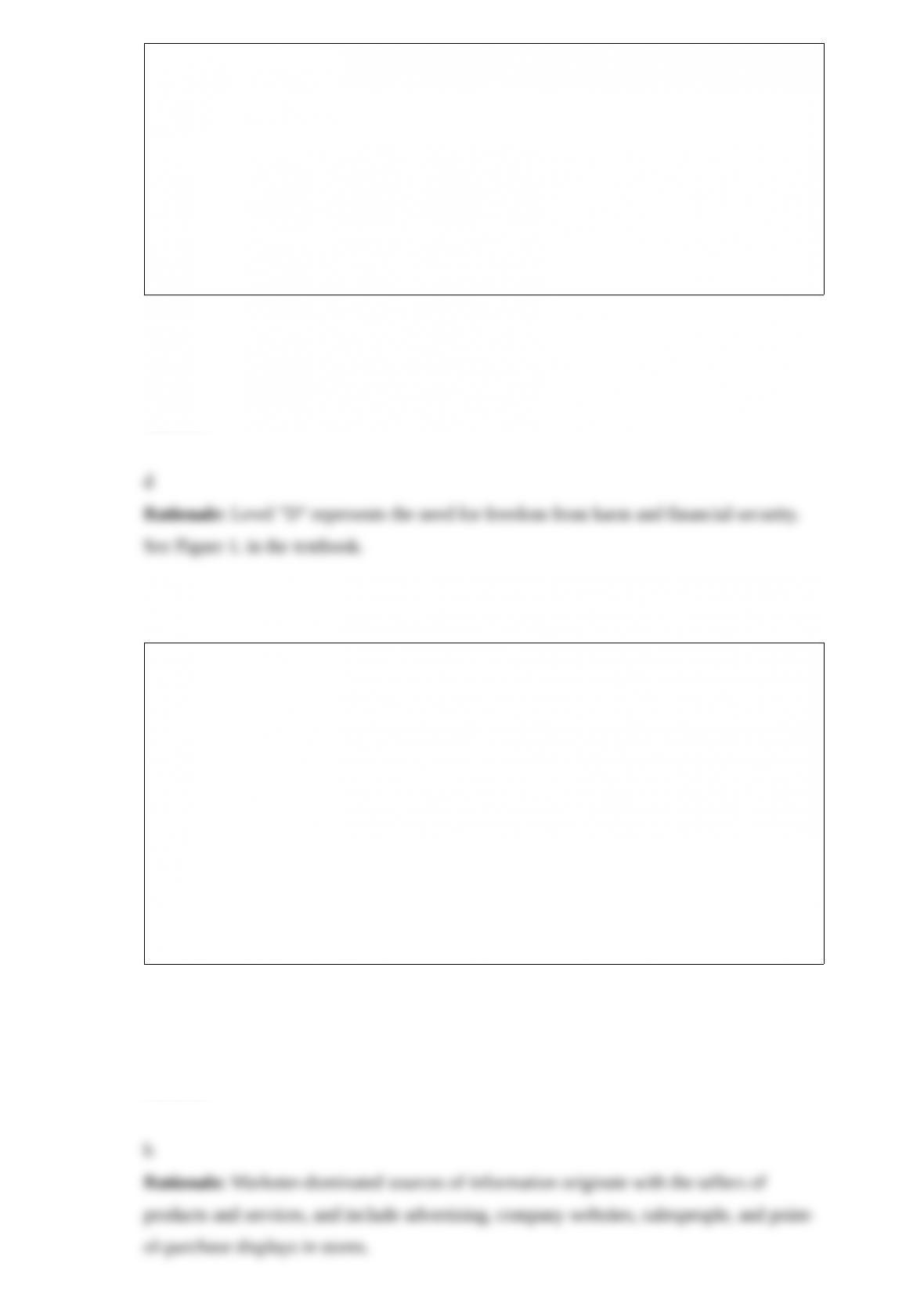
Figure 1.
According to Figure 1. above, the need for freedom from harm and financial security
would be found in what level of the hierarchy of needs?
a. “A”
b. “B”
c. “C”
d. “D”
e. “E”
Answer:
An example of a marketer-dominated source of information consulted during an
external search would include
a. personal experience.
b. salespeople.
c. consumer programs on talk radio stations.
d. friends and relatives.
e. Consumer Reports magazine.
Answer:
Chrysler recycles thousands of tons of wooden pallets, cardboard, and paper annually.
Chrysler cars are 75 percent recyclable. Chrysler’s recycling programs are examples of
a. recycle marketing.
b. cause marketing.
c. green marketing.
d. environmental marketing.
e. triple-top line marketing.
Answer:
A product line refers to
a. a product and all its ancillary services (warranties, financing, etc.).
b. the variations within a product class.
c. a specific product SKU that has a unique brand, size, or price.
d. a group of product or service items that are closely related because they satisfy a
class of needs, are used together, are sold to the same customer group, are distributed
through the same types of outlets, or fall within a given price range.
e. the entire product category or industry.
Answer:
In terms of website design, connection refers to
a. the text, pictures, sound, and videos that the website contains.
b. the website’s capabilities to enable commercial transactions.
c. the network of linkages between a company’s website and other sites.
d. the layout of the website.
e. the website’s ability to tailor itself to different users or to allow users to personalize
the website.
Answer:
At the U.S. Census Bureau, gross income is referred to as __________.
a. buying power
b. cash inflow
c. money income
d. fiscal power
e. household income
Answer:
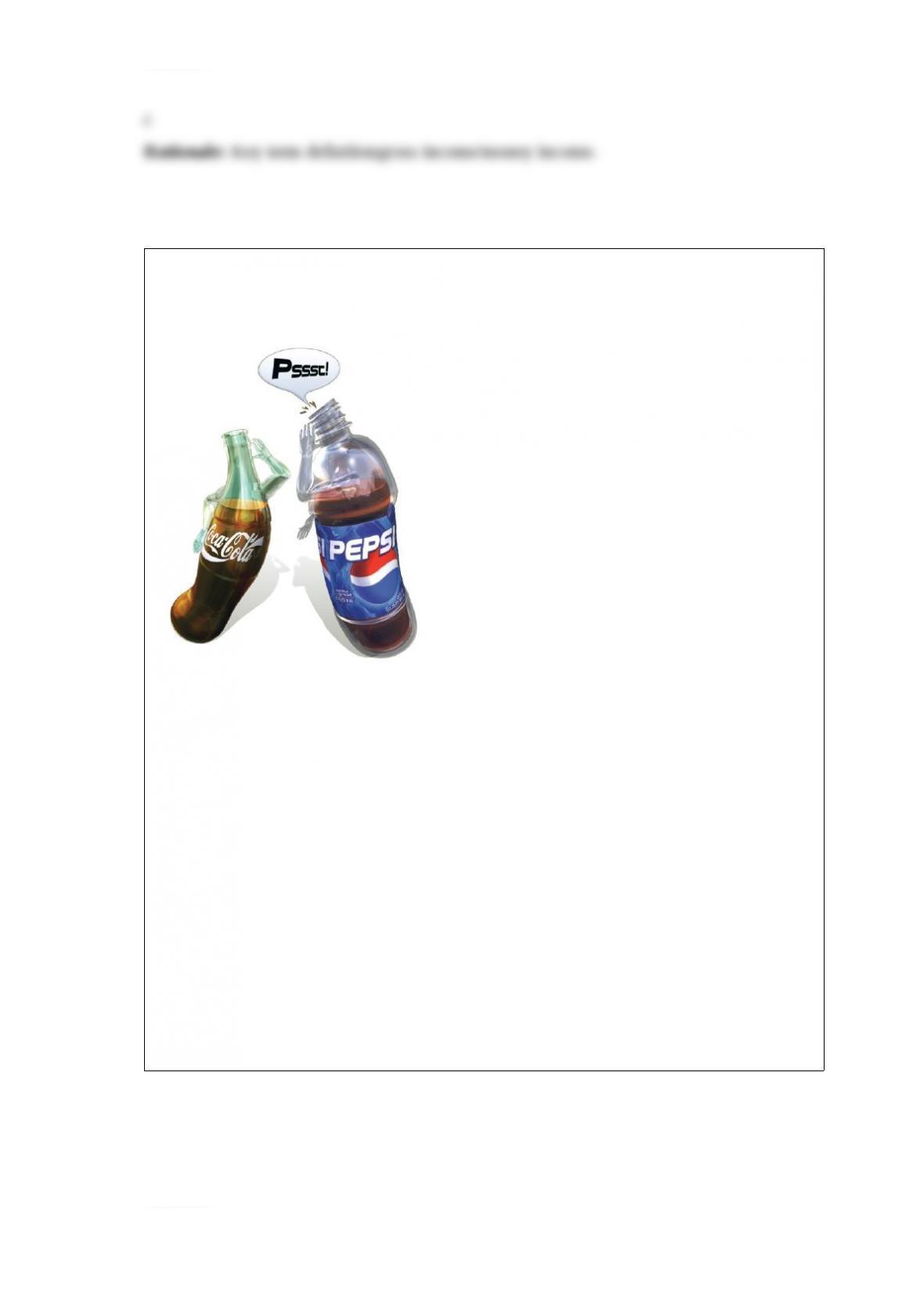
Coke-Pepsi Photo
Consider the Coke-Pepsi photo above. Suppose you are a senior executive at Pepsi-Cola
and a Coca-Cola employee offers to sell you the marketing plan and sample for a new
Coke product at a modest price. When asked this question in an online survey,
__________ percent of marketing and advertising executives said they would buy the
plan and product sample if there were no repercussions.
a. 15
b. 36
c. 52
d. 67
e. 89
Answer:
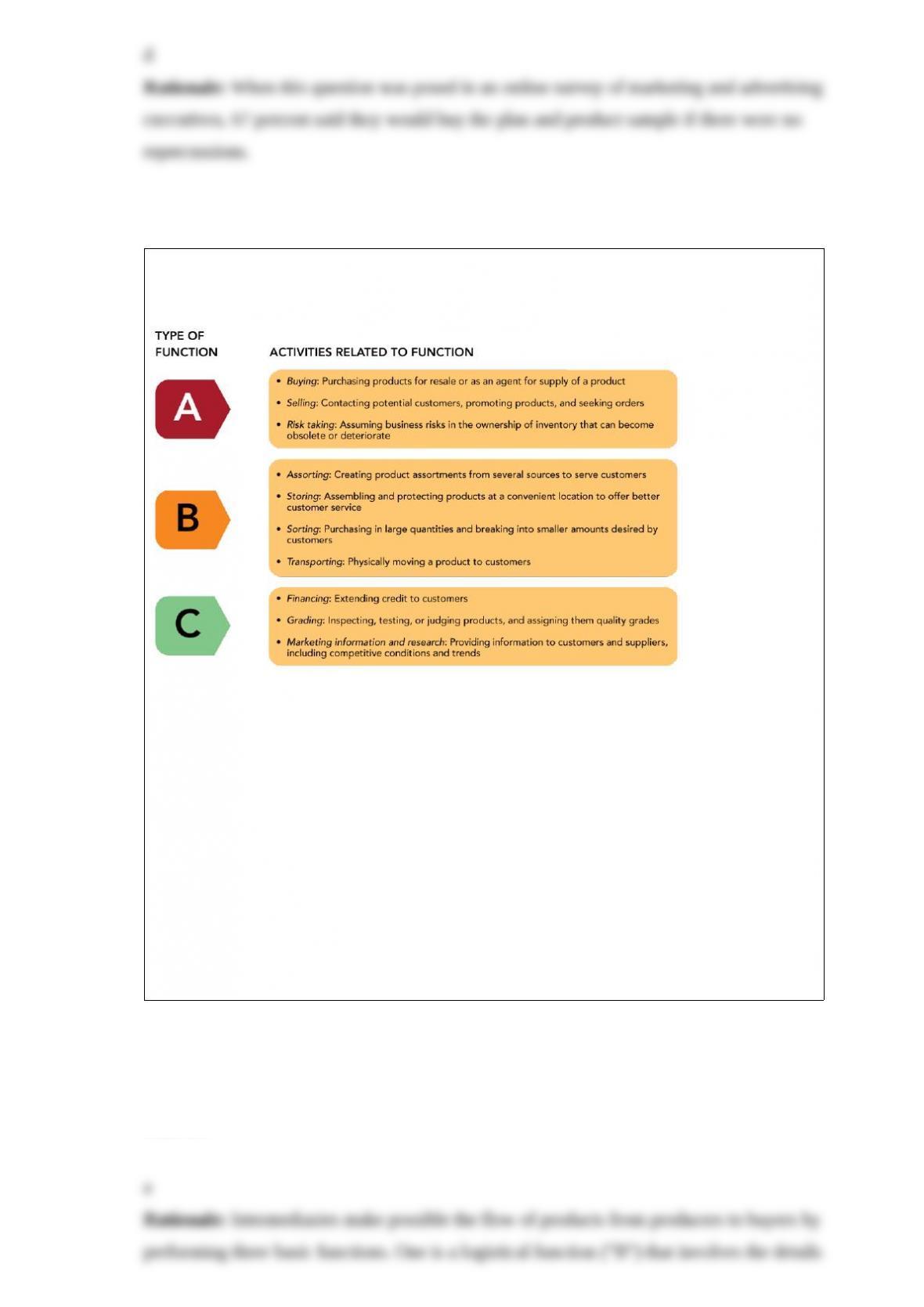
Figure 1.
Intermediaries perform three basic functions. According to Figure 1. above, “B”
represents a(n) __________.
a. logistical function
b. transactional function
c. middleman function
d. facilitating function
e. operational function
Answer:
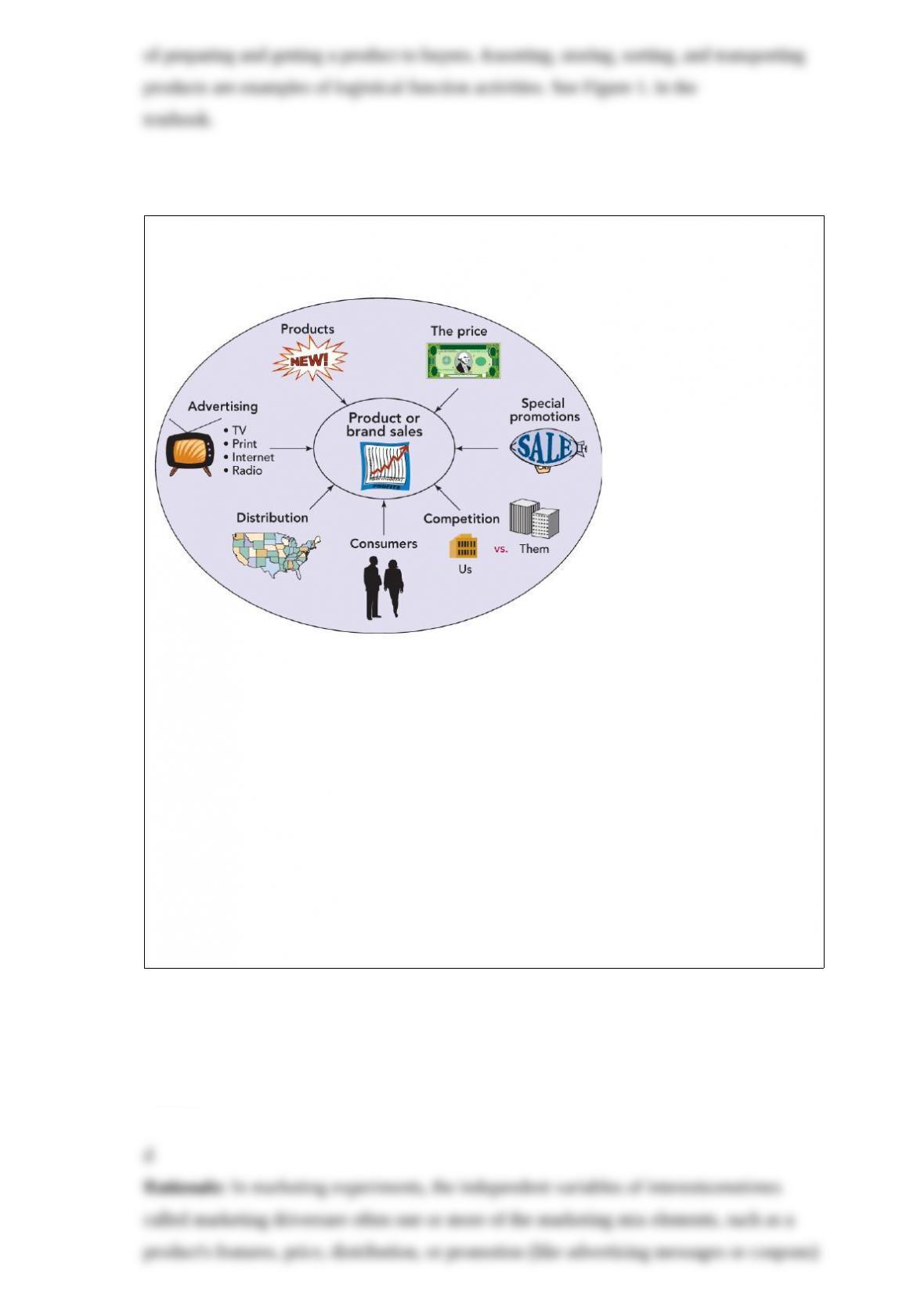
Figure 8-A
All the following in Figure 8-A above represent __________ that serve as independent
variables in marketing experiments.
a. sales drivers
b. environmental forces
c. the market mix
d. marketing drivers
e. “what if” factors
Answer:
The U.S. Census Bureau uses a classification system that reflects the varying locations
of the population. The largest of these geographical areas is called
a. megapolitan statistical areas.
b. statistical areas.
c. combined statistical areas.
d. zip codes.
e. metropolitan statistical areas.
Answer: