Standard markup pricing refers to
a. adjusting the price of a product so it is “in line” with that of its largest competitor.
b. setting the price of a line of products at a number of different price points.
c. setting prices to achieve a profit that is a specified percentage of the sales volume.
d. increasing the price slightly to protect against undue profit losses from unforeseen
environmental forces.
e. adding a fixed percentage to the cost of all items in a specific product class.
Answer:
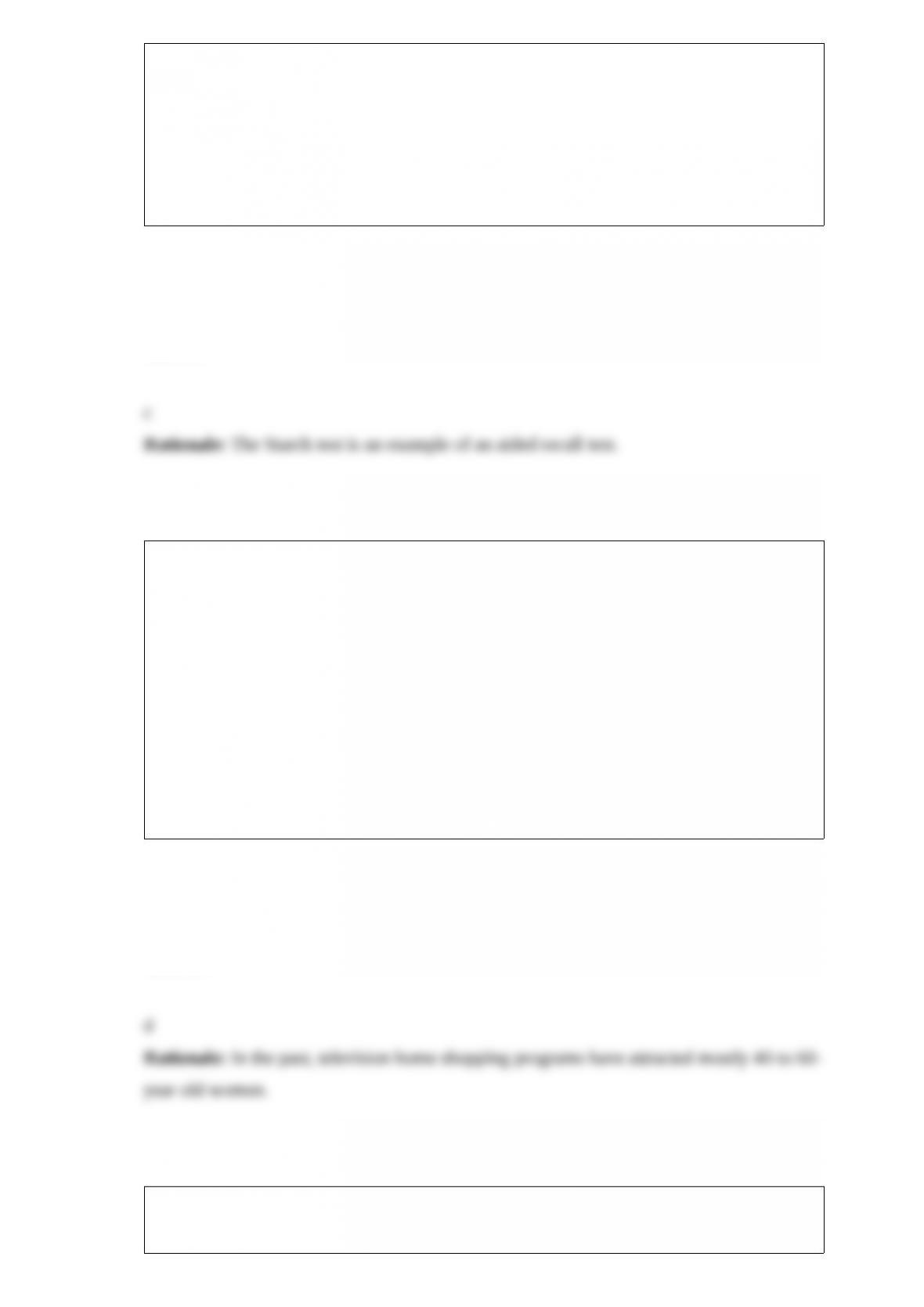
Starch Test Image
The Starch test shown above is an example of a(n)
a. sales test
b. unaided recall test
c. aided recall test
d. inquiry test
e. concept test
Answer:
In the past, television home shopping programs have attracted mostly
a. 20 to 30 year old men.
b. 30 to 40 year old women.
c. 40 to 50 year old men.
d. 40 to 60 year old women.
e. 50 to 60 year old men.
Answer:
Marketers produce a customer experience through seven website design elements: (1)
context; (2) __________; (3) community; (4) customization; (5) communication; (6)
connection; and (7) commerce.
a. content
b. creativity
c. consistency
d. collaboration
e. control
Answer:
Consumer ethnocentrism refers to
a. the belief that all products that are foreign made are cheap and of poor quality.
b. the belief that one should only purchase made by indigenous people groups in
developing countries.
c. the belief that all corporations are corrupt and consumers must look out for
themselves.
d. the tendency to believe that the only products that are of true quality are those that
are manufactured in one’s own country.
e. the tendency to believe it is inappropriate, indeed immoral, to purchase a
foreign-made product.
Answer:
Hewlett-Packard is taking a proactive role in reducing the amount of electronic
merchandise dumped in landfills by using __________ to reclaim recyclable and
reusable materials.
a. reverse materials handling
b. reverse logistics
c. cause-related marketing
d. vendor-managed inventory
e. materials transformation
Answer:
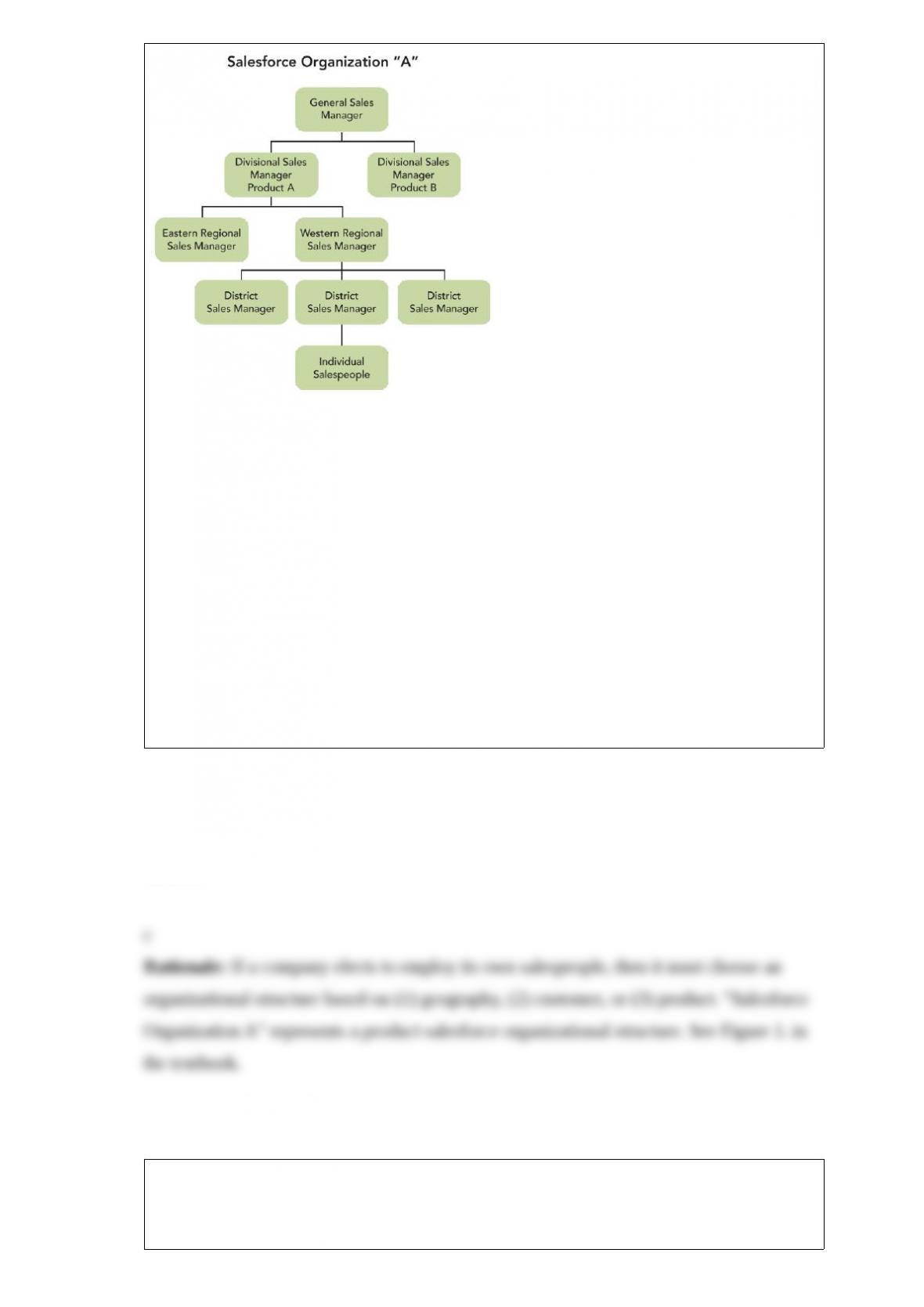
Figure 1.A
Consider Figure 1.A above. If a company chooses to employ its own salesforce, there
are three basic organizational salesforce structures from which to choose. “Salesforce
Organization A” represents which type of salesforce organizational structure?
a. geographical
b. NAICS
c. product
d. market type
e. customer
Answer:
Alternative firms that could provide a product to satisfy a specific market’s needs are
referred to as __________.

a. substitute firms
b. target markets
c. complementary firms
d. cross product marketers
e. competition
Answer:
In marketing, the idea of exchange refers to
a. the negotiation phase between the manufacturer and the seller.
b. the financial remuneration (monetary payment) for a product or service.
c. the trade of things of value between buyer and seller so that each is better off after the
trade.
d. the bartering of products and services for other products and services.
e. the practice of swapping products and services for other products and services rather
than for money.
Answer:
According to Nandan Nilekani, CEO of Infosys Technologies, Ltd., there are a number
of fundamental changes in world business, which include outsourcing, broadband
connectivity, lower priced computers, and
a. the natural evolution of a more computer literate society.
b. the explosion of software and search engines.
c. multilingual search engines.
d. virtual time translation of multilingual transmissions.
e. the absence of governmental authority or regulation of Internet commerce.
Answer:
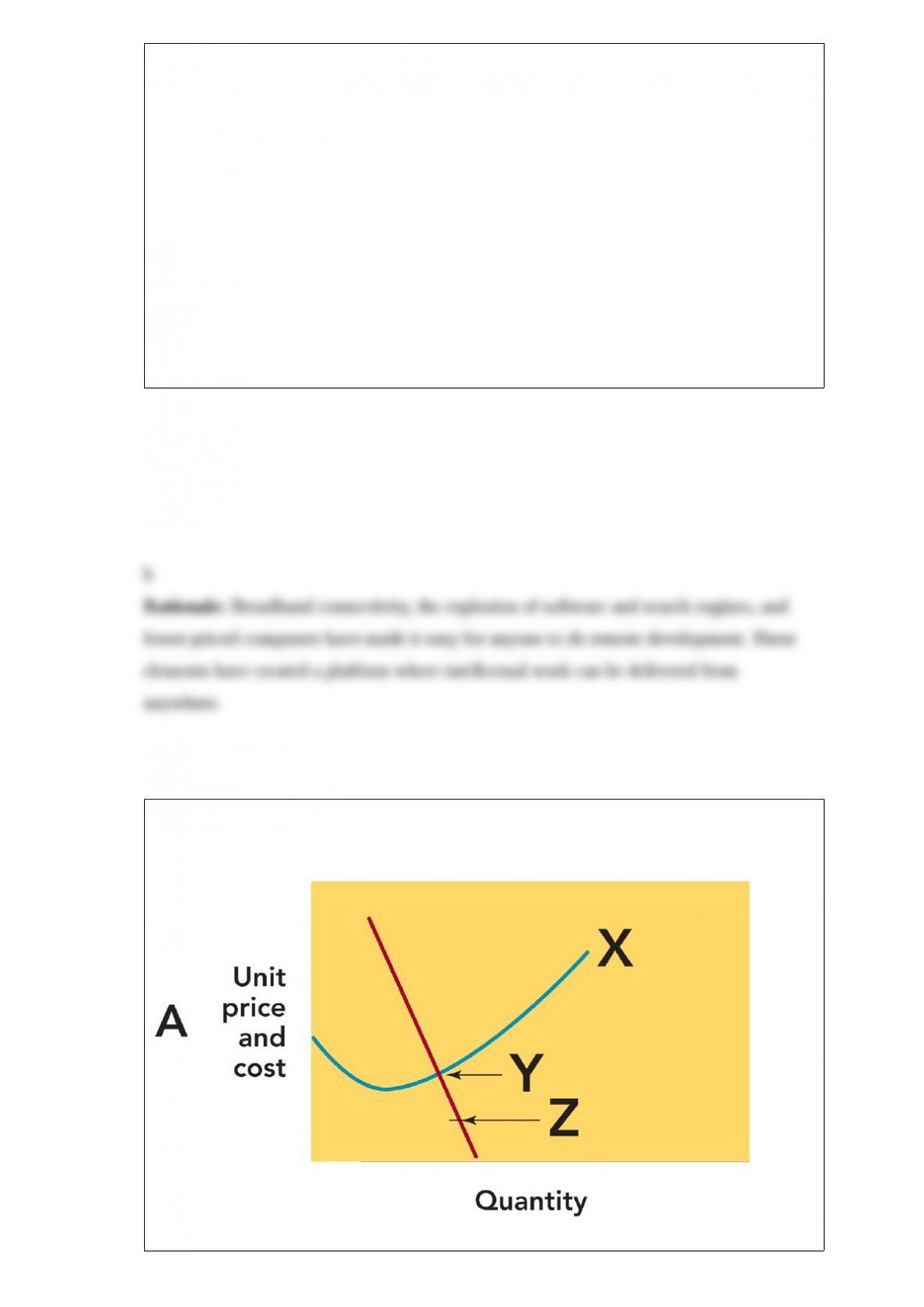
Figure 1.A

In Figure 1.A above, “Y” represents
a. fixed cost
b. marginal cost
c. variable cost
d. marginal revenue
e. MR = MC
Answer:
Target pricing refers to
a. a method of selecting specific prices wholesalers and retailers are willing to pay
based upon the elasticity of each given item.
b. a method of charging different prices to maximize revenue for a set amount of
capacity at any given time.
c. the practice of simultaneously increasing product and service benefits while
maintaining or decreasing price.
d. a method of estimating the price that ultimate consumers would be willing to pay for
a product, then working backward through markups taken by retailers and wholesalers
to determine what price to charge wholesalers..
e. a method of estimating the price that ultimate consumers would be willing to pay for
a product, then determining how much wholesalers wish to charge its customers,
deliberately adjusting the composition and features of the product to achieve the target
price to consumers.

Answer:
Toyota Motor Corporation executives were widely criticized for their failure in
practicing __________ when selected Toyota brands had been linked to sticky gas
pedals, which can lead to sudden acceleration problems. The company recalled over 9
million cars worldwide under pressure from the National Highway Traffic Safety
Administration and thousands of consumer complaints. After the recall, Toyota sales
fell, which affected Toyota employees, suppliers, shareholders, and distributors.
a. moral idealism
b. stakeholder responsibility
c. utilitarianism
d. cause marketing
e. profit responsibility
Answer:
The Starch test used aided recall to determine the percentage of those (1) __________,
(2) who saw or read any part of the ad identifying the product or brand, (3) who read
any part of the ad’s copy, and (4) who read at least half of the ad.
a. who remember seeing a specific magazine ad
b. who felt the ad was vague or ambiguous
c. who felt elements of the ad were inappropriate
d. who could summarize the key ad points in their own words
e. who remembered having seen the ad before and had already tried the product
Answer:
The vertical dimension of the retail positioning matrix is
a. depth of product line.
b. relative market share.
c. value added.
d. breadth of product line.
e. stage in the retail life cycle.
Answer:
Which term describes factors that limit the range of prices a firm may set?
a. price fixings
b. pricing constraints
c. price elasticities
d. pricing demands
e. pricing margins
Answer:
Why did 33 percent of Pepsi’s marketing and advertising executives say they would
decline an offer to buy one of Coke’s marketing plans and samples?
a. They would prefer competing ethically so they could sleep at night.
b. They thought they might go to work for Coke one day and didn’t want to spoil their
employment chances.
c. They were afraid the media would find out.
d. They knew they would get fired.
e. They didn’t want to disappoint their children.
Answer:
Which of the following is the best example of a people-based service?
a. a lawyer
b. movie theaters
c. airlines
d. vending machines
e. taxis
Answer:
With respect to advertising, CPM is defined as
a. the cost of one medium relative to the costs of other media (e.g. direct mail versus
television, radio, or outdoor), each of which is divided by the multiple of their
respective reach and frequency.
b. the reach multiplied by frequency divided by the cost of reaching 1,000 individuals
or households.
c. the cost of reaching 1,000 individuals or households with the advertising message in
a given medium.
d. the cost per minute of television or radio airtime.

e. the number of consumers exposed to an advertising message, in thousands.
Answer:
General Mills uses a marketing structure in which one person is ultimately responsible
for the marketing of a specific product. For instance, one person is responsible for
setting marketing goals and developing and implementing related marketing strategies
for the well-known breakfast cereal, Cheerios. This person, who takes responsibility for
the success or failure of the marketing of Cheerios, is called a(n) __________.
a. key strategist
b. product manager
c. line advisor
d. marketing advisor
e. account executive
Answer:
Which of the following statements about consumer ethics is most accurate?
a. Most consumers’ unethical acts are motivated by economic need.
b. Some consumers believe that if they can get away with unethical behavior, it is worth
it.
c. If “everyone else does it,” then that becomes the norm so, ultimately, there is no such
thing as unethical consumer behavior.
d. Most consumers who shoplift do so because a salesperson has been insulting or rude.
e. Few customers behave unethically toward smaller, independently owned businesses.
Most unethical consumer behavior is against “big business.”
Answer:
The owners of a small bookstore want to run an ad in their local newspaper. Their
objective is to create awareness for the bookstore among the town’s consumers. Which
of the following measures should be used to compare the number of different people or
households exposed to the advertisement?
a. reach
b. rating
c. GRPs
d. CPM
e. frequency

Answer:
A maintained markup refers to
a. the difference between the final selling price and the retailer’s cost.
b. the amount subtracted from the cost the retailer paid for a product to reach the initial
selling price.
c. the amount the manufacturer adds to achieve the desired suggested retail price.
d. the net margin.
e. the highest price listed on the product sales ticket.
Answer:
In assessing the value of tweets, Twitter users considered the majority of tweets to be
a. news.
b. self-promotion.
c. conversational.
d. pointless babble.

e. spam.
Answer:
In a supply chain setting, replenishment time refers to lead time for an item, which
means the lag from ordering an item until it is
a. billed to the customer.
b. acknowledged by the customer.
c. billed and paid for by the customer.
d. promised for delivery.
e. received and ready for use or sale.
Answer:
Much of Google’s success is based on the ten guidelines of its corporate philosophy.
Guideline 5 states, “You don”t need to __________ to need an answer.”
a. be an Einstein

b. ask a question
c. be in need
d. be at your desk
e. be at your computer
Answer:
An IT engineer specifies the type of plug-in to be used on the company’s new website.
The engineer also chooses the supplier who receives the contract to provide the
software. In the buying center, this person is the __________.
a. gatekeeper
b. decider
c. broker
d. influencer
e. user
Answer:

When a product reaches the decline stage of the product life cycle, a firm has two
choices. One choice involves product deletiondropping it from a firm’s product line.
The other is called __________, which retains the product in the product line but
reduces marketing costs.
a. reaping
b. paring down
c. divesting
d. milking
e. harvesting
Answer:
One advantage of using billboards as an advertising medium is
a. it is environmentally friendly.
b. it is relatively low-cost.
c. it has universal appeal.
d. it is particularly suited to national campaigns.
e. it is especially suited for pioneering product advertisements.
Answer:

When a company manufactures a new product with the current brand name to enter a
new market segment in its product class, it is using __________.
a. mixed branding
b. brand extension
c. co-branding
d. family branding
e. product line extension
Answer:
The primary responsibility of order takers is to __________.
a. “preach” the benefits of a new product or service to a customer, rather than close the
sale
b. build market share in his or her territory
c. convince a customer from a competitor to switch to the firm’s product or brand
d. preserve an ongoing relationship with existing customers and maintain sales
e. create a sense of goodwill not only to the brand but also to the entire product mix of
the firm
Answer:
According to Toney Hsieh, CEO of Zappos, the greatest amount of time is spent
a. seeking out new and unusual styles of shoes from all over the world.
b. improving the website to make it faster, more interesting, and fun.
c. seeking out new markets that will go beyond the Internet.
d. finding the fastest and least expensive modes of delivery for its products.
e. finding ways to improve customer-service levels.
Answer:
Cookies provide which of the following to improve a consumer’s online buying and
shopping experience?
a. convenience
b. cost
c. choice
d. communication
e. customization
Answer:
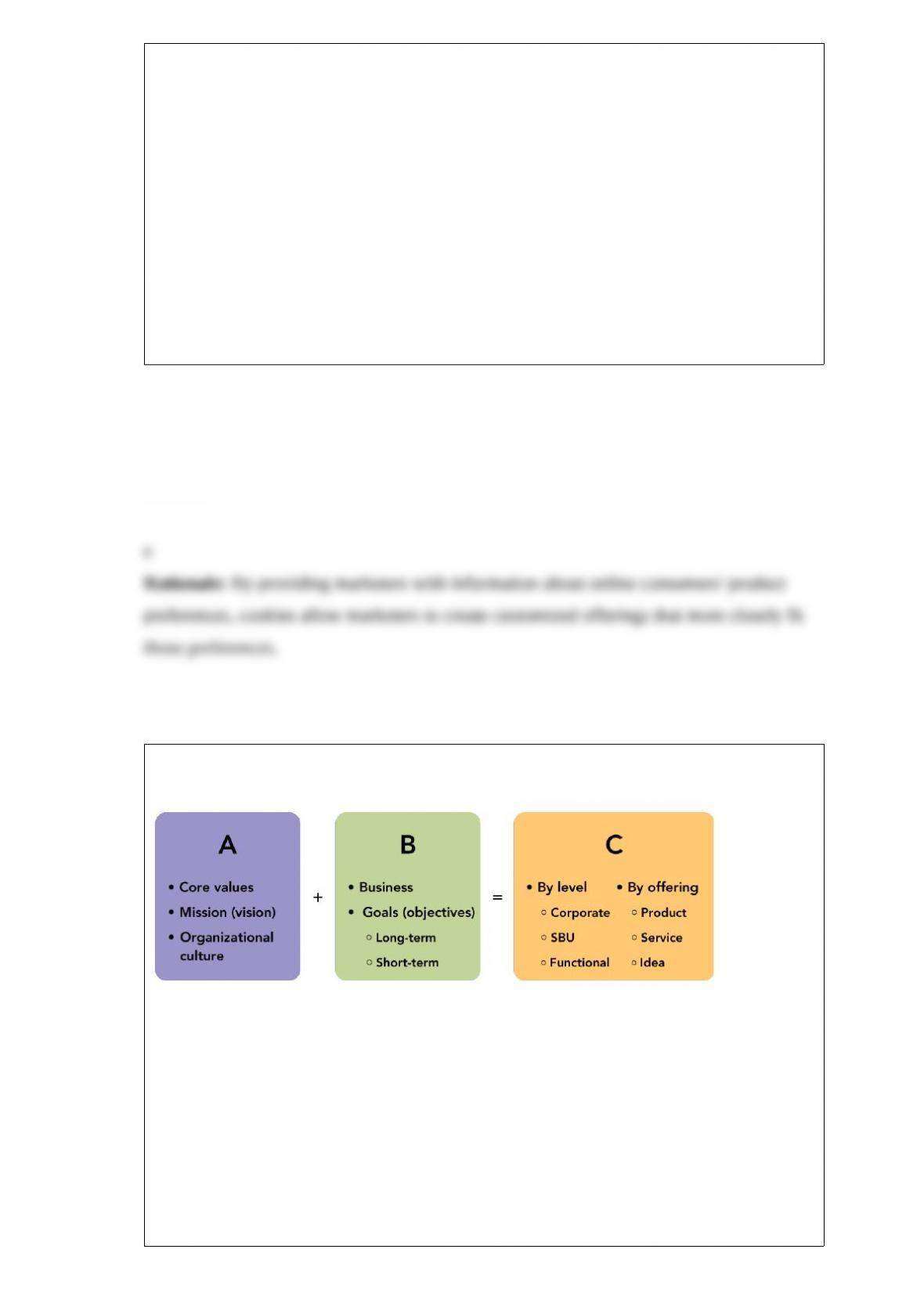
Figure 1.
In Figure 1. above, “C” represents the “how” element of visionary organization. This is
referred to as __________.
a. organizational tactics
b. organizational mission
c. organizational foundation

d. organizational direction
e. organizational strategies
Answer:
Which of the following statements regarding the maturity stage of the product life cycle
is MOST accurate?
a. Technological forces often push a product from the introduction stage to the maturity
stage.
b. During this stage, companies add more distribution outlets to maximize target market
coverage.
c. Sales increase at a decreasing rate as fewer new buyers enter the market.
d. Industry profits peak because production and distribution costs are declining.
e. Total industry profits exceed total industry sales.
Answer: