
A penetration pricing policy is MOST LIKELY to be effective when
a. lowering the price has only a minor effect on increasing sales volume and reducing
unit costs.
b. the high initial prices do not attract competitors.
c. a low initial price discourages competitors from entering the market.
d. customers interpret high price as signifying high quality.
e. customers are willing to buy immediately at the high initial price.
Answer:
Many service businesses use off-peak pricing to reflect variations in
a. costs of delivering service.
b. demand for the service.
c. profitability based on time of day or week.
d. promotional events.
e. government regulations.
Answer:
The demographic characteristics of the population and its values are referred to as
a. attitudinal forces.
b. psychographic forces.
c. social forces.
d. cultural forces.
e. market forces.
Answer:
A limited-service wholesaler that furnishes shelves that display merchandise in stores,
performs all channel functions, and sells on consignment to retailers is referred to as a
__________.
a. stack loader
b. rack jobber
c. drop shipper
d. desk jobber
e. truck jobber
Answer:
Which of the following characteristics of electronic commerce creates customer value
by contributing to place and time utility?
a. Electronic commerce makes products and services available to customers faster.
b. Comparison shopping is easier in the marketspace than in the marketplace.
c. Customers anywhere can shop in the marketspace at any time.
d. Products available in the marketspace are more easily customized.
e. Consumers can tell marketers exactly what they want in the marketspace.
Answer:
Percentage points of market share used in analysis as the common basis of comparison
to allocate marketing resources effectively for different product lines within the same
firm are referred to as
a. market share
b. ratings
c. marketing ROI
d. S-curve points
e. share points
Answer:
In the United States, the Harry Potter series of books were often at the top of The New
York Times fiction bestseller list. These books have been marketed to preteen, teen, and
adult readers around the world. Scholastic Press, the publisher of the Harry Potter
books in the U.S., is using which of the following segmentation strategies?
a. multiple products with one segment
b. one product with one channel of distribution
c. one product with multiple market segments
d. one product with changes based on customer behavior
e. multiple products with multiple segments
Answer:
When Kroger, a national supermarket chain, uses a special promotion to price a
six-pack of soda at $2.09 (which is below its customary price level), it is attempting to
a. drive its competition out of business.
b. attract customers in hopes they will buy other products as well.
c. fill its parking lot so its store will look successful.
d. work with the local bottler to move products that are close to their expiration dates.
e. help stimulate the local economy and generate good will with its customers.
Answer:
In __________, the marketing researcher tries to test ideas discovered earlier to help the
marketing manager recommend marketing actions.
a. idea generation
b. new-product concept testing
c. data mining
d. data analysis
e. idea evaluation
Answer:
In the Boston Consulting Group (BCG) model for analysis of a firm’s strategic business
units, or SBUs, the vertical axis reflects __________.
a. market growth rate
b. marketing efficiencies
c. industry attractiveness
d. market segment size
e. relative market share
Answer:
Figure 1.
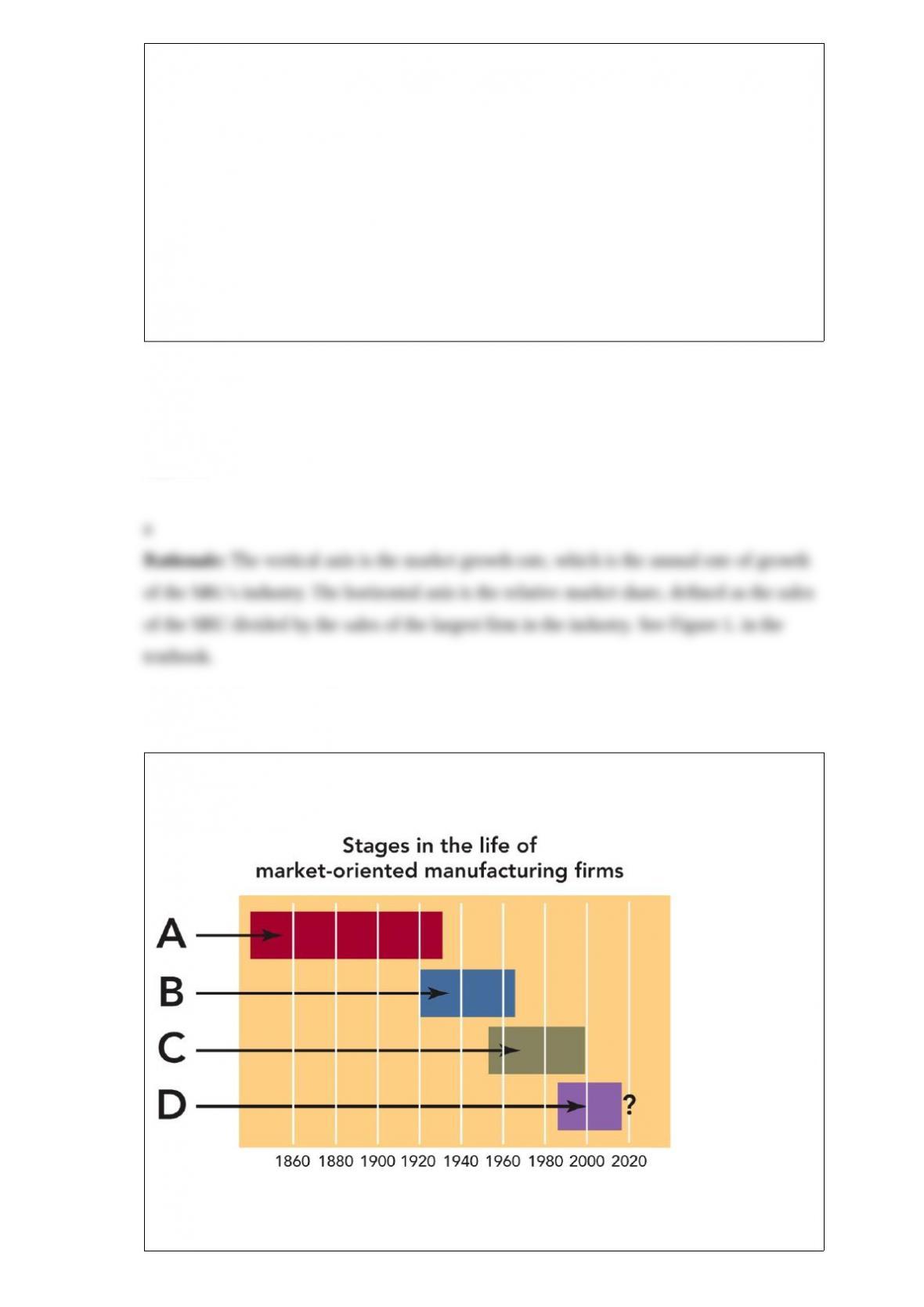
In Figure 1. above, letter “C” represents which era in U.S. business history?

a. sales era
b. production era
c. age of consumerism
d. marketing concept era
e. customer relationship era
Answer:
The __________ established the Consumer Product Safety Commission to monitor
product safety and establish uniform product safety standards.
a. Nutritional Labeling and Education Act
b. Consumer Protection Act
c. Fair Packaging and Labeling Act
d. Child Protection Act
e. Consumer Product Safety Act
Answer:
The Swedish manufacturer of Asko dishwashers concluded that consumers would be
willing to pay approximately $989 for a dishwasher that was quieter than any other
machine on the market. Based on this price, Asko determined the margins that would
have to be given to wholesalers and retailers to arrive at the $989 retail price. Asko used
a. prestige pricing.
b. price lining.
c. cost-plus pricing.
d. target pricing.
e. customary pricing.
Answer:
__________ applies innovative approaches to organize, create, and manage a venture to
solve the practical needs of society.
a. Corporate welfare
b. Social entrepreneurship
c. Sustainable development
d. Cause marketing
e. Societal capitalism
Answer:
Market-based groupings refer to organizational groupings
a. based on specific customer segments.
b. in which sales territories are subdivided according to geographic location.
c. that represent the different departments or business activities within a firm.
d. in which a unit is responsible for specific product offerings.
e. that combine both functional groupings with product groupings.
Answer:
Cash and carry wholesalers refer to wholesalers who
a. furnish the racks or shelves that display merchandise in retail stores, perform all
channel functions, and sell on consignment to retailers.
b. take title to merchandise but sell only to buyers who call on them, pay cash for
merchandise, and furnish their own transportation for merchandise.
c. own the merchandise they sell but do not physically handle, stock, or deliver it.
d. have a small warehouse from which they stock their trucks for distribution to
retailers.
e. work for several producers and carry noncompetitive, complementary merchandise in
an exclusive territory.
Answer:
Data refers to
a. subjective psychographic feelings collected by an organization upon which it bases
subsequent actions.
b. objective demographic characteristics collected by an organization upon which it
bases subsequent actions.
c. the facts and figures related to the problem that are divided into two main parts:
secondary data and primary data.
d. information collected by a source other than the company itself used to determine the
best possible solution to a problem.
e. opinions collected from within a company to determine which alternative within a
solution set offers the greatest opportunity for success of a marketing program.
Answer:
Which of the following statements regarding corporate chains is most accurate?
a. Corporate chains usually avoid using centralized decision-making.

b. Corporate chains generally own most if not all of their suppliers so they do not have
to negotiate for price.
c. Consumers have fewer choices in merchandise since all buying decisions are made
unilaterally.
d. Corporate chains offer the least benefit to consumers since they are the farthest
removed from the ultimate consumer.
e. Corporate chains are multiple outlets under common ownership.
Answer:
Which of the following would be an example of a fixed cost for a company that makes
carbon monoxide monitoring systems for employees to wear that work in hazardous
areas?
a. the lithium batteries that are used in each monitor
b. the chest harness the employee must use to wear the monitor
c. the rent for the company’s offices
d. the free training videos that are sent to each new customer
e. the stainless steel, water-resistant cases in which the monitors sit
Answer:
The aptitudes, knowledge, skills, and a variety of behavioral characteristics considered
necessary to perform a job successfully are contained in a __________.
a. statement of credentials
b. statement of training
c. statement of education
d. statement of experience
e. statement of job qualifications
Answer:
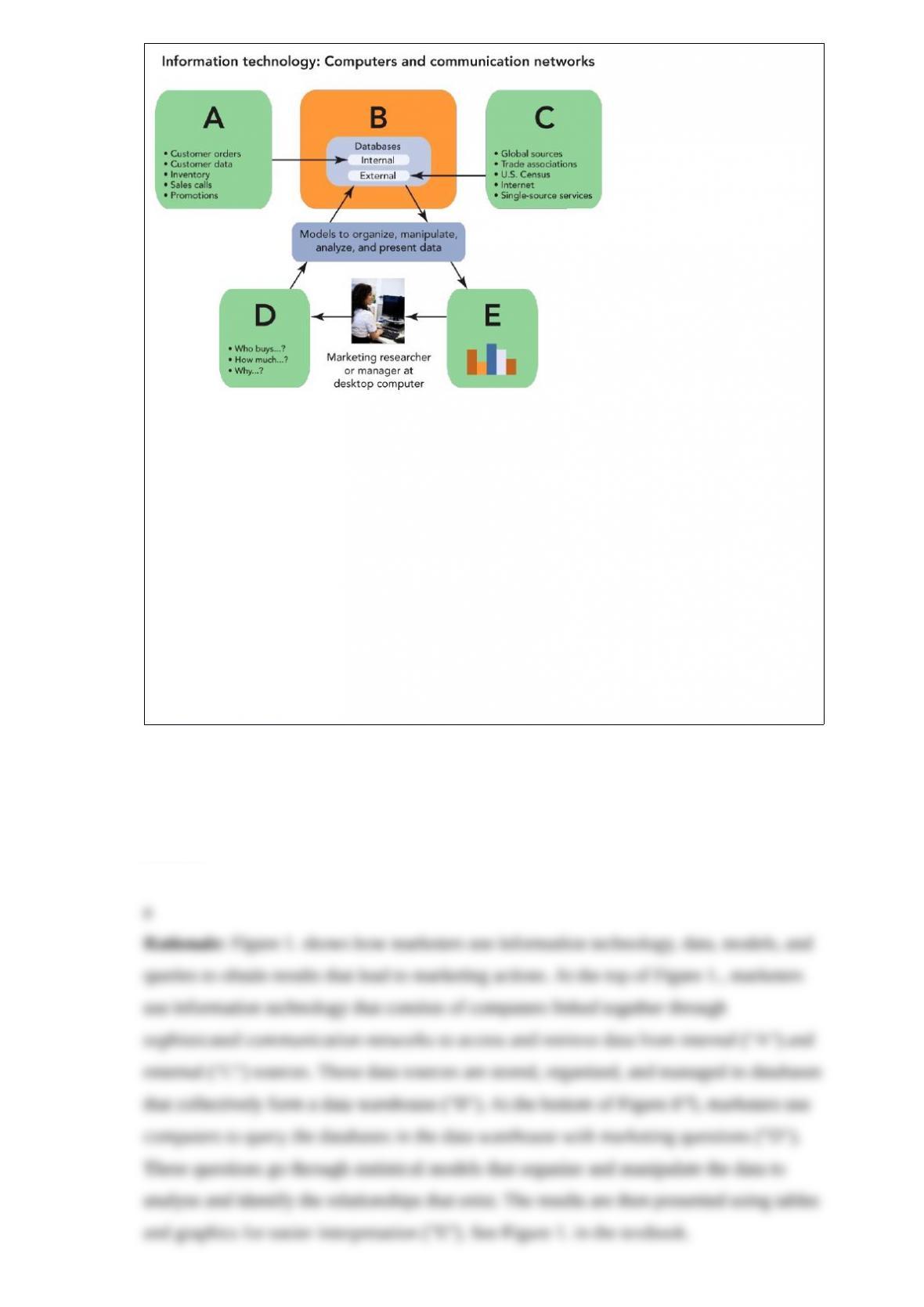
Figure 1.
Figure 1. above shows how marketing researchers and managers use information
technology to turn information into marketing actions. What does “C” represent?
a. external data sources
b. results
c. data warehouse
d. internal data sources
e. buying queries
Answer:
The North American Industry Classification System (NAICS) system designates
industries with a numerical code in a defined structure. A six-digit coding system is
used. The sixth digit designates a(n)
a. industry subsector.
b. industry group.
c. specific industry.
d. individual country-level national industry.
e. sector of the economy.
Answer:
Research indicates that there are four key factors involved with salesforce motivation:
(1) a clear job description; (2) effective management practices; (3) __________; and (4)
proper compensation, incentives, or rewards.
a. an opportunity for professional growth
b. a personal need for achievement
c. constructive criticism
d. adequate time for bookkeeping and paperwork
e. a moderate degree of competitive spirit within a team

Answer:
The American Red Cross created a series of advertisements to encourage people to
donate blood. After viewing an ad, Amanda went to the local Red Cross office and
donated a pint of her blood. Amanda returned home feeling happy that she had
performed a good deed. Was this an exchange in a marketing sense?
a. Yes, because the blood was donated to the Red Cross based on an advertisement, a
marketing activity.
b. Yes, because the donated blood was exchanged for a feeling of satisfaction.
c. No, because the Red Cross is nonprofit organization.
d. No, because no money changed hands.
e. No, because the Red Cross, a service organization, did not provide Amanda with a
product.
Answer:

Inventions or innovations from applied science or engineering research are referred to
as
a. scientific discoveries.
b. theoretical development.
c. technology.
d. patents.
e. dynamic engineering.
Answer:
Informational ads, particularly those with specific information, have been found to be
interesting, convincing, and
a. inexpensive.
b. humorous.
c. expensive.
d. effective.
e. competitive.
Answer:
Franchising is a type of __________.
a. administered system
b. contractual system
c. vertically integrated chain
d. retail-sponsored cooperative
e. corporate system
Answer:
There are three key factors when choosing among place-based media options for an
advertising campaign: (1) __________; (2) the product’s attributes; (3) and cost.
a. the perceived risk
b. the sustainability of the message
c. the reputation of the prospective media firm
d. the media habits of the target audience
e. the length of time required to get the message across
Answer:
In 2007, Gap Inc. ended its relationship with 23 foreign production facilities due to
code violations. Several closings occurred because of the use of child labor. In response
to these events, the Gap created a large team whose purpose is to travel worldwide to
ensure compliance with its Code of Vendor Conduct. This is an example of
a. cause marketing.
b. profit responsibility.
c. utilitarianism.
d. moral idealism.
e. social responsibility.
Answer:
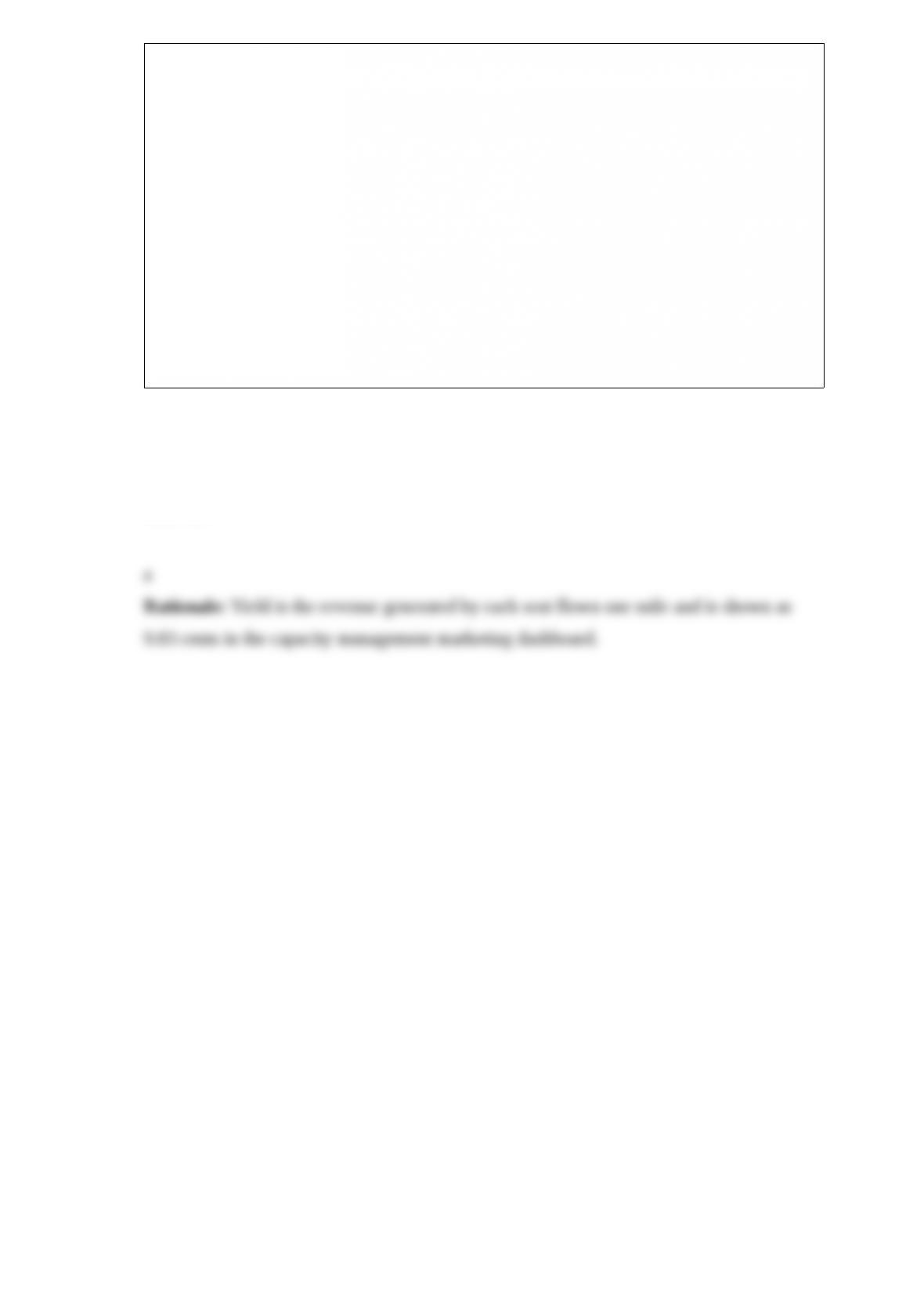
Capacity Management Marketing Dashboard
The revenue generated by each seat flown one mile is shown in the capacity
management marketing dashboard above as
a. 9.83 cents.
b. 82.1 cents.
c. 8.28 cents.
d. 18.11 cents.
e. 7.99 cents.
Answer: