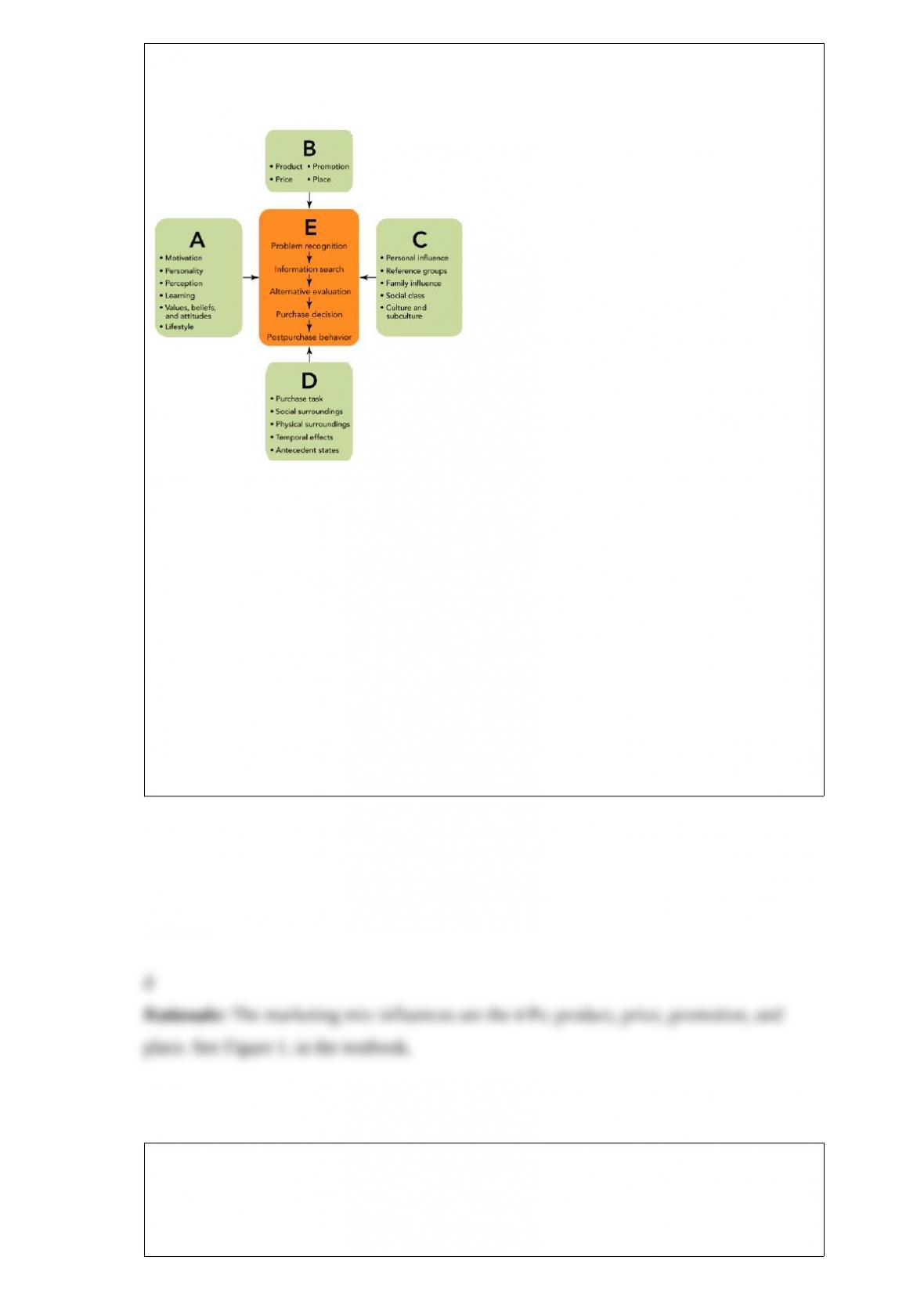
Figure 1.
In Figure 1. above, “B” represents the __________ influences that can affect the
consumer purchase decision process.
a. economic
b. situational
c. environmental
d. marketing mix
e. market dominated
Answer:
Private branding refers to a branding strategy in which a firm __________.
a. gives each product a distinct name when each brand is intended for a different market

segment
b. uses different brand names for the same product across multiple countries
c. uses one name for all its products in a product class
d. produces products but sell them under the brand name of a wholesaler or retailer
e. contractually, and for a fee, allows other firms to use its brand name, requiring that
the product be made to its specifications
Answer:
The practice of charging a very low price for a product with the intent of driving
competitors out of business is referred to as
a. price fixing.
b. predatory pricing.
c. price discrimination.
d. deceptive pricing.
e. geographical pricing.
Answer:

Tiffany & Co. manufactures about half of the fine jewelry items for sale through its
stores and boutiques worldwide. Tiffany & Co. practices
a. backward integration.
b. forward integration.
c. vertical integration.
d. joint venturing.
e. horizontal integration.
Answer:
Companies that use a(n) ___________ marketing strategy have as many different
product variations, brand names, and advertising programs as countries in which they
do business.
a. ethnocentric
b. multidomestic
c. transnational
d. meganational
e. international
Answer:

In terms of the diffusion of innovation, early majority accounts for __________ of
product adopters.
a. 2.5%
b. 13.5%
c. 16%
d. 34%
e. 50%
Answer:
A fixed alternative question with three or more choices uses a(n) __________.
a. scale
b. frequency distribution
c. measure of success
d. open-ended question
e. constraint
Answer:
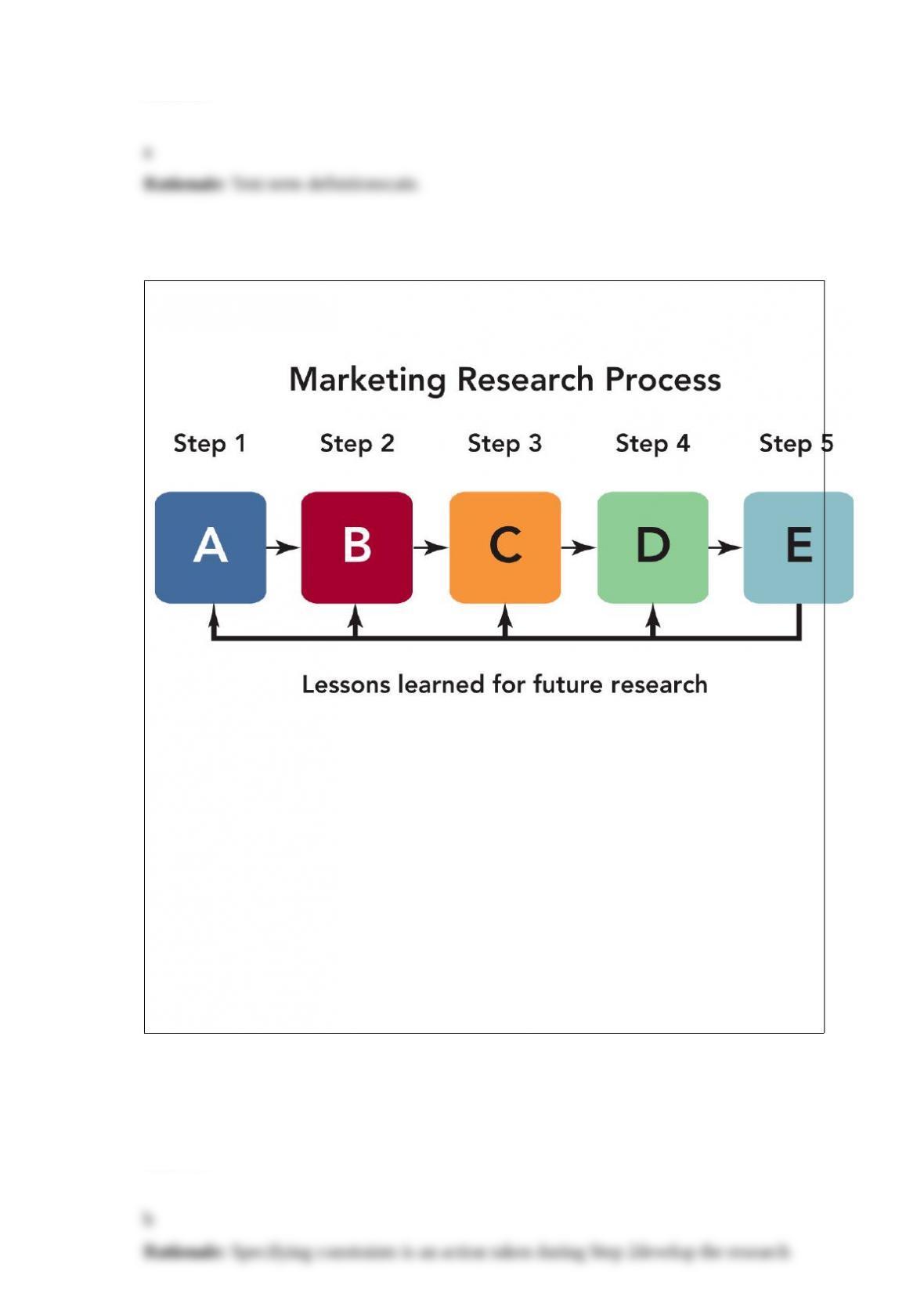
Figure 1.
According to Figure 1. above, ‘specify constraints” occurs during which step of the
five-step marketing research approach?
a. “A”
b. “B”
c. “C”
d. “D”
e. “E”
Answer:

In the traditional advertising model, advertisers were charged using a __________
approach Google transformed the traditional model to a model called __________
where an advertiser pays only when somebody actually clicks on the ad and is delivered
to their website.
a. cost per thousand occurrences; cost-per-clack
b. cost per thousand incidences; cost-per-snap
c. cost per thousand impressions; cost-per-click
d. cost per thousand recurrences; cost-per-lead
e. cost per thousand frequencies; cost-per-hit
Answer:
Which of the following statements about geographical pricing is most accurate?
a. Geographical pricing is generally legal and not normally a concern in the U.S. legal
system.
b. Geographical pricing has come under more government scrutiny than any other
pricing policy.
c. FOB freight-allowed pricing practices are illegal.
d. FOB origin pricing is legal.
e. Basing-point pricing is the only form of geographical pricing that is not under some
type of legal restriction.

Answer:
By 2030, the U.S. population is expected to exceed
a. 273 million.
b. 308 million.
c. 323 million.
d. 373 million.
e. 408 million.
Answer:
There are four popular types of franchising: (1) manufacturer-sponsored retail franchise
systems, (2) __________; (3) service-sponsored retail franchise systems; and (4)
service-sponsored franchise systems.

a. service-sponsored retail franchise systems
b. manufacturer-sponsored wholesale franchise systems
c. horizontal-marketing franchise systems
d. contractual-sponsored franchise systems
e. customer-oriented franchise systems
Answer:
The practice of offering a bargain that is conditional on the purchase of other products
may exist when a buyer is offered the “1-Cent Sale,” the “Buy 1, Get 1 Free,” or the
“Get 2 for the Price of 1” deal. Such pricing is legal only if
a. the seller is using bundle pricing.
b. there is a reasonable amount of inventory to satisfy the needs of the retailers normal
traffic flow.
c. the first items are sold at the regular price, not a price inflated for the offer.
d. the product is not outdated.
e. the quantity available to the customer is not limited.
Answer:

All of the following are behavioral measures that are used to evaluate salespeople
EXCEPT __________.
a. attitude
b. product knowledge
c. sales
d. communication skills
e. appearance
Answer:
At which stage in the personal selling process would the salesperson obtain further
information about the prospect and decide on the best method of contact?
a. prospecting
b. preapproach
c. approach

d. presentation
e. close
Answer:
A limited-service wholesaler who performs all channel functions, and sells on
consignment to retailers, which means they retain the title to the products displayed and
bill retailers only for the merchandise sold is a _________.
a. truck jobber
b. transport vendor
c. rack jobber
d. cash and carry wholesaler
e. drop shipper
Answer:

The clandestine collection of trade secrets or proprietary information about a company’s
competitors is referred to as
a. trade piracy.
b. transnational fraud.
c. economic espionage.
d. competitive duplicity.
e. transnational espionage.
Answer:
Cost-plus percentage-of-cost pricing refers to
a. summing the total unit cost of providing a product or service and adding a specific
amount to the cost to arrive at the price.
b. adding a fixed percentage to the cost of all items in a specific product class.
c. setting a price that is dictated by tradition, a standardized channel of distribution, or
other competitive factors.
d. setting the price of a product or service by adding a fixed percentage to the total unit
cost.
e. charging different prices to different buyers for goods of like grade and quality.
Answer:

Product changes characteristically take place in the __________ stage of the product
life cycle.
a. introduction
b. growth
c. maturity
d. decline
e. harvest
Answer:
The formula to calculate a CDI = __________.
a. (Percent of the total U.S. population in a market segment Percent of a brand’s total
U.S. sales in a market segment) 100
b. (Percent of a product category’s total U.S. sales in a market segment Percent of the
total U.S. population in a market segment) 100
c. (Percent of a brand’s total U.S. sales in a market segment Percent of the total U.S.
population in a market segment) 100
d. (Percent of the total U.S. population in a market segment Percent of a product
category’s total U.S. sales in a market segment) 100
e. There is not enough information to make any conclusions.
Answer:

Which of the following statements best describes the activities of a whistle-blower?
a. Mattel employees were sorry that 150 of the 10 million Power Wheels cars and trucks
the company sold had caught on fire.
b. Mattel research engineers proved that the spate of fires in the company’s Power
Wheels cars and trucks was the result of consumers’ tinkering with the engine.
c. A former Mattel employee owned one of the Mattel Power Wheel cars that caught on
fire and slightly burned its rider.
d. The Consumer Product Safety Commission investigated the fires and ordered a recall
to repair all of the 10 million units that had been sold.
e. A Mattel employee reported to the Consumer Product Safety Commission that Mattel
knowingly manufactured an electrical system for Power Wheels that would catch on
fire after long use.
Answer:
For years, a local “greasy spoon” diner had customers lining up around the building for
breakfast. When the city announced that it was building an off ramp from the highway
that would conceivably double his customer traffic, the proprietor was delighted.

Having saved enough in previous years, he was certain it could hold him over through
the three-month construction. Unfortunately, construction delays continued for an
additional six months and the work is still in progress. The best pricing objective at this
point for the diner’s owner would most likely be __________.
a. profit
b. market share
c. unit volume
d. survival
e. social responsibility
Answer:
In the nonprofit world of the performing arts, box office technology has essentially
remained the same since the 1980s. A company called Tessitura is trying to change that.
Tessitura is able to track every transaction with its patrons in one database. This
information collected includes ticket purchases, fund-raising, volunteering, and gift
shop purchases that will help symphonies, operas, and theaters develop customer
profiles in order to tailor their sales messages to specific individuals. In other words,
Tessitura is going to allow arts groups to engage in
a. market aggregation.
b. relationship marketing.
c. societal marketing.
d. market mining.
e. mainstream marketing.

Answer:
Purchasing that aims to integrate environmental considerations into all stages of an
organization’s buying process with the goal of reducing the impact on human health and
the physical environment is referred to as
a. ecological procurement.
b. sustainable procurement.
c. green marketing.
d. supplier partnership.
e. stakeholder procurement.
Answer:
Which of the following statements describes the difference between a corporate vertical
marketing system and an administered vertical marketing system?
a. Administered vertical marketing systems gain power through ownership while
corporate vertical marketing systems gain power through contractual agreement.

b. Administered vertical marketing systems gain power through the size and influence
of one channel member and through ownership.
c. Administered vertical marketing systems gain power through contractual agreements
and ownership.
d. Administered vertical marketing systems are usually larger and more profitable than
corporate vertical marketing systems.
e. Administered vertical marketing systems achieve coordination at successive stages of
production and distribution by the size and influence of one channel member rather than
through ownership.
Answer:
IKEA sells a portable workbench called the FAHRTFULL. The product has many
positive features, and in German or Swedish markets, the name describes the product’s
features well (fahrt meaning travel). This brand name in the United States however,
may not be as effective due to __________.
a. disappointment when the product fails to perform
b. the element of humor which makes consumers question product quality
c. governmental restrictions on brand names regarding bodily functions
d. language and cultural differences
e. difficulty in spelling and pronunciation
Answer:

The world’s largest manufacturer of peppermint candy canes was in Albany, Georgia,
until it could no longer afford to buy the sugar needed for its operation. It moved its
manufacturing business to Mexico where there are no restrictions (as existed in the
United States) on the amount of sugar that can be brought into the nation. The
movement of this U.S. business to Mexico was caused by a(n) __________ established
by the U.S. government.
a. tariff
b. trade imbalance
c. quota
d. excise tax
e. subsidy
Answer:
Which of the following statements regarding the Phillies special promotions nights is
most accurate?
a. Although they foster good will in the community, there is little change in attendance.

b. Regular and diehard fans tend to stay away because they are too distracted by
children who are only there for the “free gifts” (bats, balls, bobble head dolls, etc.).
c. Attendance remains steady but people tend to spend more money during special event
days because there is a greater sense of fun and excitement.
d. Game attendance can increase by 30 to 35 percent during special event days.
e. Game attendance increases by 25 percent with the bump in attendance usually lasting
throughout the entire month.
Answer:
Which of the following is a criterion used for selecting a target market?
a. similarity of needs of potential buyers within a segment
b. difference of needs of sellers between segments
c. feasibility of a marketing action to reach a segment
d. competitive position
e. simplicity and cost of assigning potential buyers to segments
Answer:

Prestige pricing refers to
a. charging different prices to different buyers for goods of like grade and quality.
b. setting a low initial price on a new product to appeal immediately to the mass market
odd-even pricing.
c. setting a market price for a product or product class based on a subjective feel for the
competitors’ price or market price.
d. setting a high price so that quality- or status-conscious consumers will be attracted to
the product and buy it.
e. setting a price that is dictated by tradition, a standardized channel of distribution, or
other competitive factors.
Answer:
It is estimated that the average cost of an outbound telemarketing sales call on a
business customer is about __________, versus $350 for a single field sales call.
a. $10 to $15
b. $15 to $20
c. $20 to $25
d. $30 to $40
e. $40 to $50
Answer:

One advantage of using the Internet as an advertising medium is
a. there is no need to segment markets.
b. it has video and audio capabilities similar to television.
c. initial encoding is easily outsourced.
d. online ads almost always result in a “click,” an action that leads to the purchasing of
a product.
e. messages are automatically translated into multiple languages.
Answer: