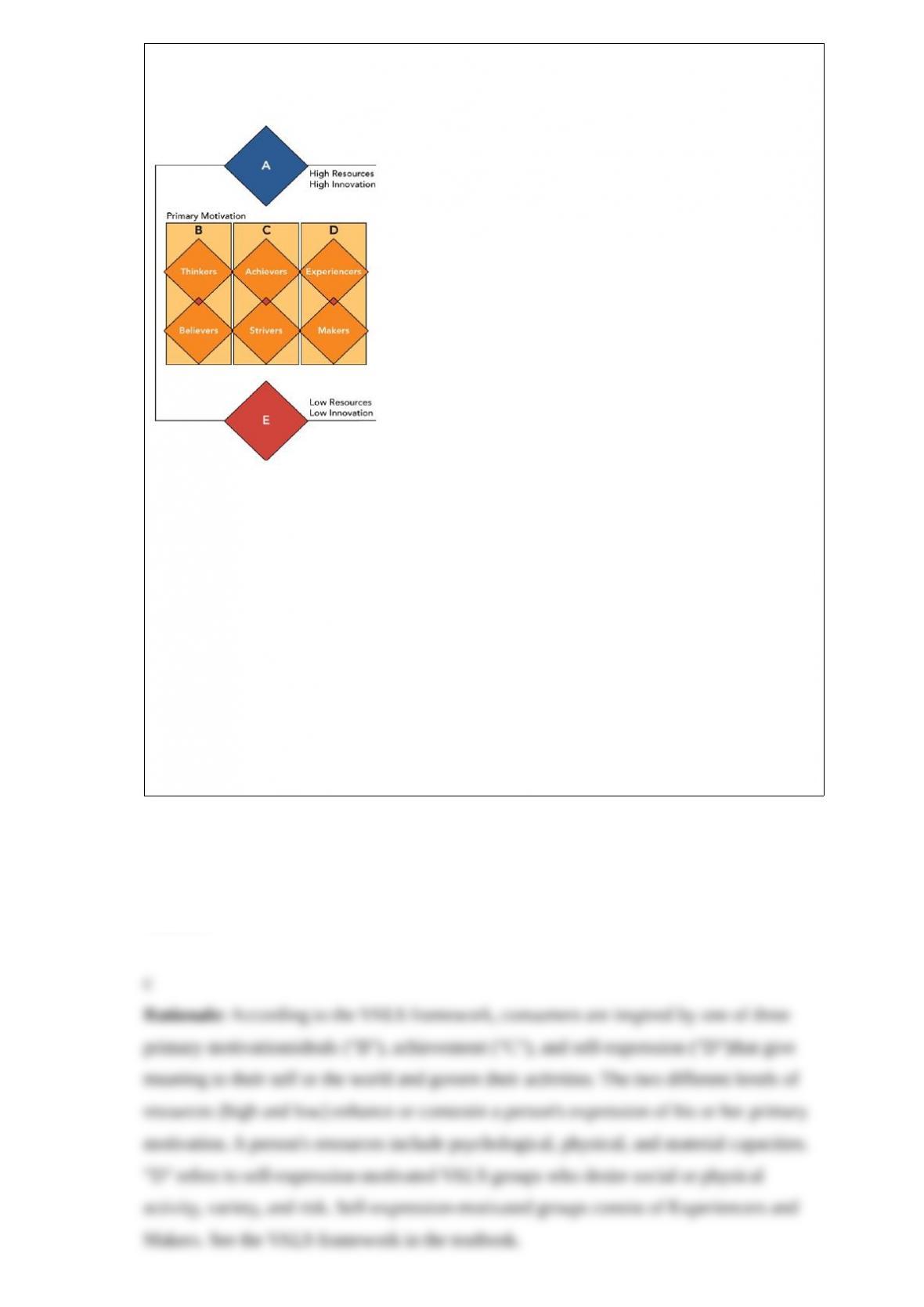
VALS Framework
VALS creates profiles of people based on their primary motivation and resources. In the
VALS framework above, “D” refers to
a. Ideals.
b. Achievement.
c. Self-Expression.
d. Survivors.
e. Innovators.
Answer:
According to the price equation, final price equals list price minus __________ plus
extra fees.
a. profits
b. commissions
c. trade-ins
d. taxes
e. incentives and allowances
Answer:
Test marketing involves offering a product for sale
a. to random sample of people in the top ten major cities of the U.S.
b. in as broad a geographic region as possible.
c. to consumers that are representative of the target market.
d. on a limited basis in a defined area.
e. only on certain days of the week and hours of the day.
Answer:
Which of the online consumer lifestyle segments spends the most time online?
a. ebivalent newbies
b. click-and-mortar
c. hooked, online, and single
d. brand loyalists
e. time-sensitive materialists
Answer:
Published data from outside the organization are referred to as __________ data.
a. proprietary
b. external primary
c. internal secondary
d. internal primary
e. external secondary
Answer:
A quota refers to
a. a government tax on goods or services entering a country that primarily serves to
raise prices on imports.
b. government payments to companies or industries that serve to lower costs and
provide a competitive advantage to domestic industries.
c. a restriction placed on the amount of a product allowed to enter or leave a country.
d. a minimum requirement for the purchase of specific products or services between
two nations.
e. a refusal to purchase or exchange goods or services with another nation unless certain
financial or ideological requirements have been satisfied.
Answer:
McDonald’s offered eight collectable toys related to the FIFA World Cup for free with
the purchase of a Happy Meal. These FIFA collectibles are an example of a
__________.
a. deal
b. rebate
c. coupon
d. sample
e. premium
Answer:
Traffic generation is
a. the outcome of an offer designed to motivate people to visit a business.
b. the result of offers that contain all the information necessary for a prospective buyer
to make a decision to purchase and complete the transaction.
c. direct communication with consumers to generate a response in the form of an order,
a request for further information, or a visit to a retail outlet.
d. the result of a direct marketing offer designed to generate interest in a product or
service, and a request for additional information.
e. an increase in the amount of foot traffic in a retail establishment that coincides with a
new advertising campaign.
Answer:
Online content that is published on a publicly accessible website or social networking
site is a criterion of
a. social networks.
b. user generated content (UGC).
c. blogs.
d. wikis.
e. YouTube.
Answer:
Walmart’s marketing strategy is to be a reliable, lower-price retailer for a wide variety
of mass consumption consumer goods. This strategy favors a(n) __________ designed
to deliver products to consumers at the lowest possible cost.
a. integrated supply chain
b. global supply chain
c. efficient supply chain
d. responsive supply chain
e. customer service supply chain
Answer:
A manufacturer using _________ is setting a high price so that quality- or
status-conscious consumers will be attracted to the product and buy it.
a. skimming pricing
b. penetration pricing
c. price lining
d. odd-even pricing
e. prestige pricing
Answer:
Washburn Guitars markets its guitars to four distinct market segments. The firm’s
batch-custom products instruments are targeted at
a. first-time buyers.
b. professional musicians.
c. stars and famous musicians.
d. large institutional buyers such as band programs.
e. intermediate-skill players who may become professional musicians.
Answer:
A middleman refers to
a. a person or firm whose sole responsibility is bringing a buyer to the last link in the
distribution chain.
b. a person or firm whose sole responsibility is to find distributors for a manufacturer’s
products.
c. any intermediary between a manufacturer and end-user markets.
d. a person or firm that takes possession of a product and in some way alters it before
passing it on to ultimate consumers.
e. an intermediary who sells to ultimate consumers.
Answer:
If there is a prolonged downturn in U.S. passenger air travel, a number of U.S. airlines
would very likely cancel some of their orders for new planes. The relationship between
passenger air travel and the demand for new planes is referred to as
a. ultimate consumer demand.
b. derived demand.
c. manufacturer demand.
d. reseller demand.
e. the price-inelasticity of demand.
Answer:
Which of the following statements represents an organizational buyer?
a. A local baker buys sugar at the grocery store to make cookies with his children at
home.
b. A dentist buys a new Samsung SmartTV 65-inch 3D LED HDTV for her den.
c. Mr. Langley hires a housecleaning service to clean his apartment.
d. The owner of a fried chicken restaurant hires a snow removal service to keep the
parking lot clear.
e. The city mayor rents a tuxedo to wear to his daughter’s wedding.
Answer:
Which of the following statements regarding order getters is most accurate?
a. Order getters often replenish a retailer’s inventories.
b. Order getters handle orders obtained on inbound telemarketing.
c. Order getters require considerable product knowledge.
d. Order getters typically process reorders for products already sold by the company.
e. Order getter sales calls traditionally require the lowest financial investment from the
firm.
Answer:
Which of the following types of firms would be most likely to use a global marketing
strategy?
a. multidomestic
b. multinational
c. multicountry
d. transnational
e. transborder
Answer:
Customers can build their own computers with Dell’s online configurator simply by
answering a few questions and choosing from a menu of product attributes, prices, and
delivery options. The design of a Dell customized computer is made possible through
the use of a _________.
a. seller menu
b. seller cookie
c. content screen
d. choiceboard
e. collaborative filter
Answer:
__________ influences on consumer behavior results from three sources: consumer
socialization, passage through the family life cycle, and decision-making within the
family or household.
a. Functional
b. Situational
c. Social
d. Family
e. Personal
Answer:
A new field of marketing that studies the brain and its response to marketing stimuli is
referred to as
a. extrapolation.
b. hypothesizing.
c. neuromarketing.
d. deduction.
e. conjecture.
Answer:
Supply chain management refers to
a. the integration and organization of information and logistic activities across firms in a
supply chain for the purpose of creating and delivering goods and services that provide
value to ultimate consumers.
b. organizing the cost-effective flow of raw materials, in-process inventory, finished
goods, and related information from point-of-origin to point-of-consumption to satisfy
customer requirements.
c. the integration and organization of information and logistical activities that actively
bring consumers together with sellers through the express use of agents and brokers.
d. an inventory management system that is designed to reduce the retailer’s lead time for
receiving merchandise, which then lowers a retailer’s inventory investment, improves
customer service levels, and reduces logistic expenses.
e. a highly organized system that facilitates minute-to-minute communication between
all members of a supply chain and ensures the producer is aware of any changes in
delivery or demand for a product or service.
Answer:
How a person establishes expectations for a service not yet experienced is influenced by
word of mouth communications, personal needs, __________, and promotional
activities.
a. how the organization delivers its service
b. past experiences
c. competitive trends
d. the economy
e. consumer income
Answer:
Travelers throughout the world have relied on Frommer’s guides such as Italy from $90
a Day. These books outline out-of-the-way, inexpensive restaurants and hotel, giving
invaluable _________ to these establishments.
a. direct sales
b. publicity
c. direct marketing
d. personnel selling
e. public service announcements
Answer:
The __________ is an international treaty intended to limit trade barriers and promote
world trade through the reduction of tariffs.
a. North Atlantic Treaty Organization (NATO)
b. General Agreement on Tariffs and Trade (GATT)
c. North American Free Trade Agreement (NAFTA)
d. World Trade Association Treaty (WTAT)
e. United Nations Agreement on Trade (UNAT)
Answer:
Lockheed Martin’s Skunk Works is a leader in delivering world-class aircraft. About 50
engineers and designers and 100 expert machinists closely follow this guideline for
organizational structure and implementation: Use a small number of good people who
a. implement the idea that “it is better to ask forgiveness than permission.”
b. know their jobs, as well as the ones around them.
c. can talk to anyone in the organization to solve a problem.
d. recognize that everyone should have a voice in decision-making.
e. never offer excuses, only explanations.
Answer:
The emphasis of a marketing strategy for a dynamically continuous innovation would
include
a. advertising to generate awareness.
b. obtaining widespread distribution.
c. advertising to explain points of difference and benefits.
d. setting a low price.
e. using personal selling.
Answer:
Black & Decker uses a __________ strategy to reach the “do-it-yourself” market with
the Black & Decker brand name and the professional construction market with the
DeWalt brand name.
a. product differentiation branding
b. multiproduct branding
c. multibranding
d. segmentation branding
e. private branding
Answer:
The Xerox salesforce is divided into four __________ organizations.
a. profit
b. geographic
c. customer
d. market
e. product life cycle
Answer:
The practice of using information provided by cookies for directing online advertising
from marketers to those online shoppers whose behavioral profiles suggest they would
be interested in such advertising is referred to as
a. viral marketing
b. buzz
c. data mining
d. behavioral targeting
e. spyware
Answer:
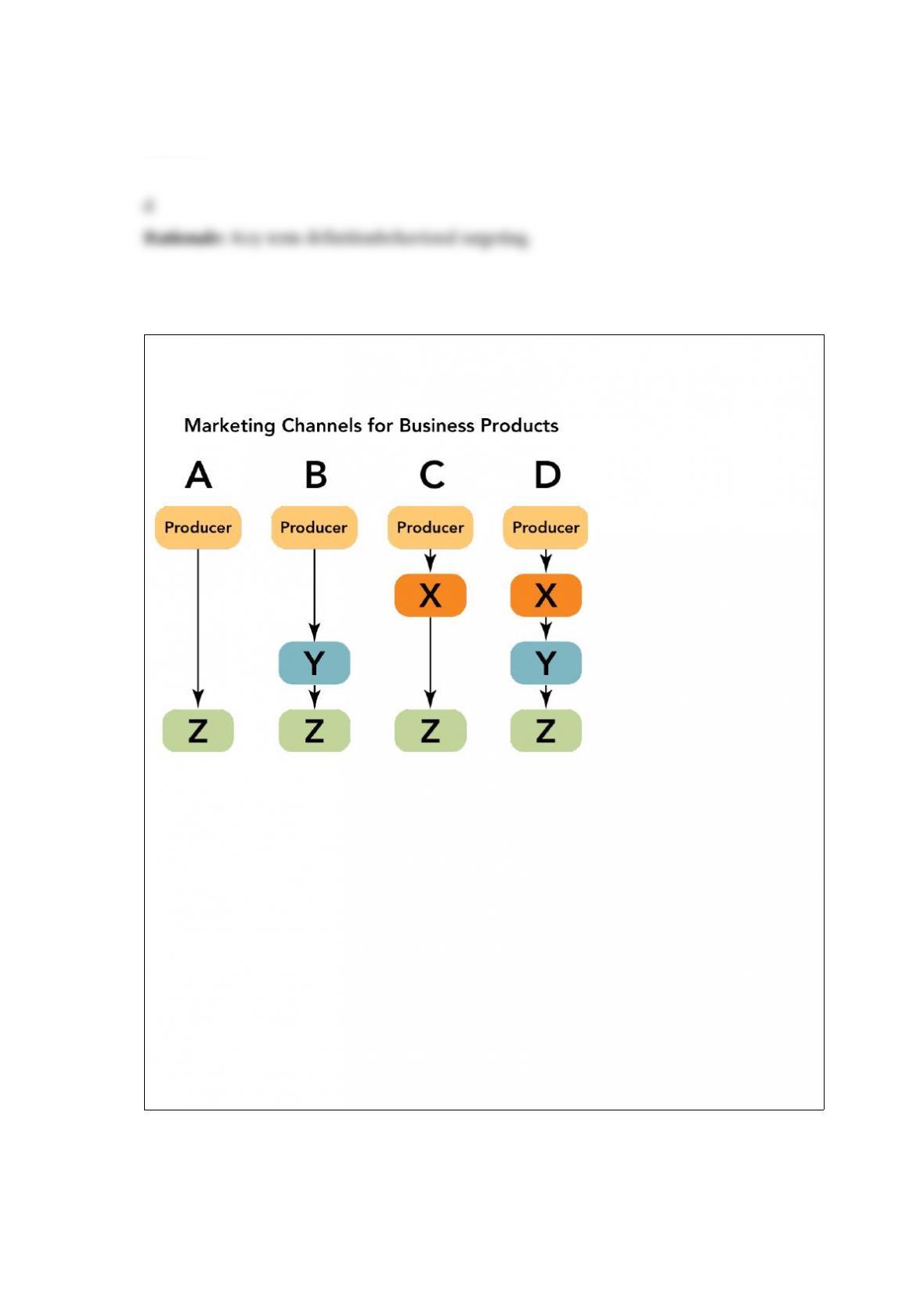
Figure 1.
Figure 1. above depicts the four most common marketing channels for business
products and services. Channel “C” would be an appropriate marketing channel for
__________.
a. IBM mainframe computers
b. Caterpillar excavators
c. electrical motors
d. industrial fasteners
e. Bombardier aircraft
Answer:
Facsimile, e-mail, and voice mail are common __________ technologies salespeople
use today.
a. tablet device
b. communication
c. cutting-edge
d. computer
e. social media
Answer: