
All of the following are forms of direct marketing EXCEPT:
a. catalogs
b. in-store free samples
c. telemarketing
d. paid searches
e. direct mail
Answer:
Income used to buy luxury items such as a Regent cruise is referred to as __________.
a. gross income
b. disposable income
c. surplus income
d. wealth income
e. discretionary income
Answer:

Leon George sold kites at the beach last summer. He invested $2,500 in the venture and
made $1,400 net profit (net income). Calculate his return on investment.
a. 15.6 percent
b. 17.9 percent
c. 29.9 percent
d. 47.0 percent
e. 56.0 percent
Answer:
By preserving the natural environment, Anheuser-Busch is appealing to
environmentalists through its alcohol abuse awareness initiatives; it is attempting to
persuade underage children from thinking that drinking beer makes them cool.
Anheuser-Busch is exhibiting which of the following?
a. stockholder responsibility
b. profit responsibility
c. utilitarianism
d. cause marketing
e. social responsibility

Answer:
A market-product grid shows __________ horizontally across the rows and
__________ vertically down the columns.
a. financial synergies; marketing synergies
b. distribution synergies; R&D-manufacturing synergies
c. R&D-manufacturing synergies; financial synergies
d. revenue synergies; cost synergies
e. marketing synergies; R&D-manufacturing synergies
Answer:
The Sierra Club is the oldest continuously operating environmental organization. By
2001, its growth had plateaued. To rekindle interest in the organization, its members
elected a new 23-year-old president who promised to use MTV artists to create public
service announcements about the organization targeting his peer group, who are
members of

a. Generation X.
b. Generation Y.
c. Generation Z.
d. baby busters.
e. baby boomers.
Answer:
Marketing ROI (return on investment) uses modern measurement technologies to
determine the results of __________.
a. marketing spending
b. manufacturing and distribution procedures
c. market-product sales
d. organizational structure
e. personal selling
Answer:

A trial close refers to __________.
a. asking the prospect to make a decision on some aspect of the purchase
b. allowing the prospect to use or lease the item on a limited temporary basis before
making a final commitment of purchase
c. committing the prospect quickly by making references to the time limits of the
purchase
d. making an exchange of money or other unit of value
e. asking the prospect to make choices concerning delivery, warranty, or financing
terms
Answer:
Sara Burns is the owner of a company called TropicalSpice and was looking for a new
product to go with her company’s line of food condiments when a friend suggested
combining spices from India with tea. In the __________ stage of the new-product
process, the spices and tea mixtures were exposed to prospective consumers under
realistic purchase conditions.
a. idea generation
b. screening and evaluation
c. business analysis
d. market testing
e. commercialization

Answer:
In terms of the diffusion of innovation, innovators account for __________ of product
adopters.
a. 2.5%
b. 13.5%
c. 16%
d. 34%
e. 50%
Answer:
With a marketing dashboard, a marketing manager can glance at all of the following
EXCEPT:
a. the time frame for which the data are presented.
b. a graph.

c. a table.
d. a printed report.
e. a map.
Answer:
Although an organization has limited influence on market growth rate, its main
alternative is to try to change its relative market share. The most likely way for a
company to turn a “question mark” into a ‘star” rather than a “dog” is to
a. remove cash from it.
b. reduce advertising for it.
c. inject cash into it.
d. reduce the feature set for it.
e. decrease the market growth rate.
Answer:
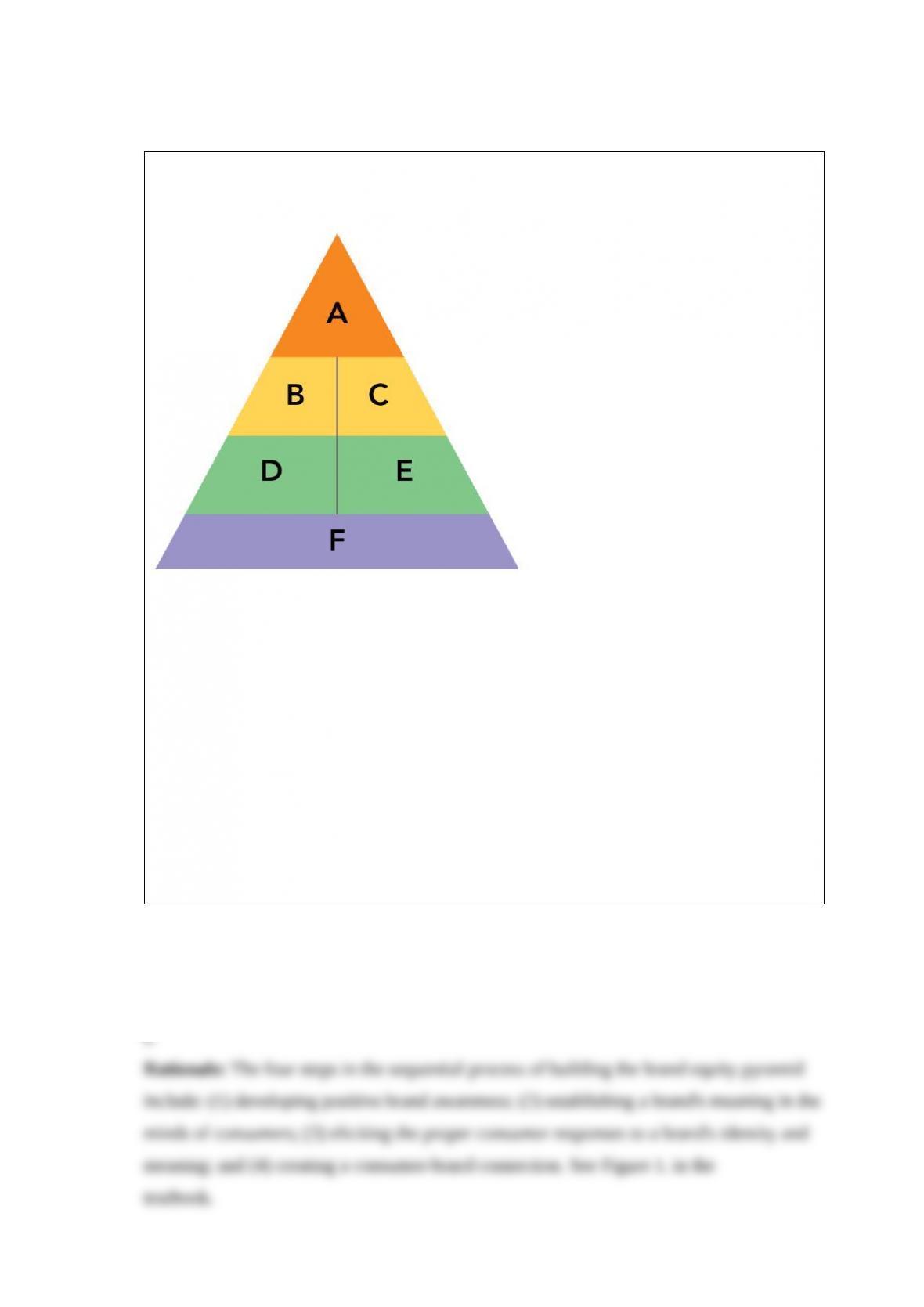
Figure 1.
Figure 1. above shows the sequential process of building brand equity. “F” represents
the first step, which is to __________.
a. create a consumer-brand connection
b. develop positive brand awareness
c. reward loyal customer behavior
d. establish a brand’s meaning in the minds of consumers
e. elicit the proper consumer responses to a brand’s identity and meaning
Answer:
The New York Times calls Marissa Mayer the “__________” of Google’s home page, the
one person who “controls the look, feel, and functionality of the Internet’s most heavily
trafficked search engine.”
a. Einstein
b. Hillary Clinton
c. gatekeeper
d. Picasso
e. CEO
Answer:

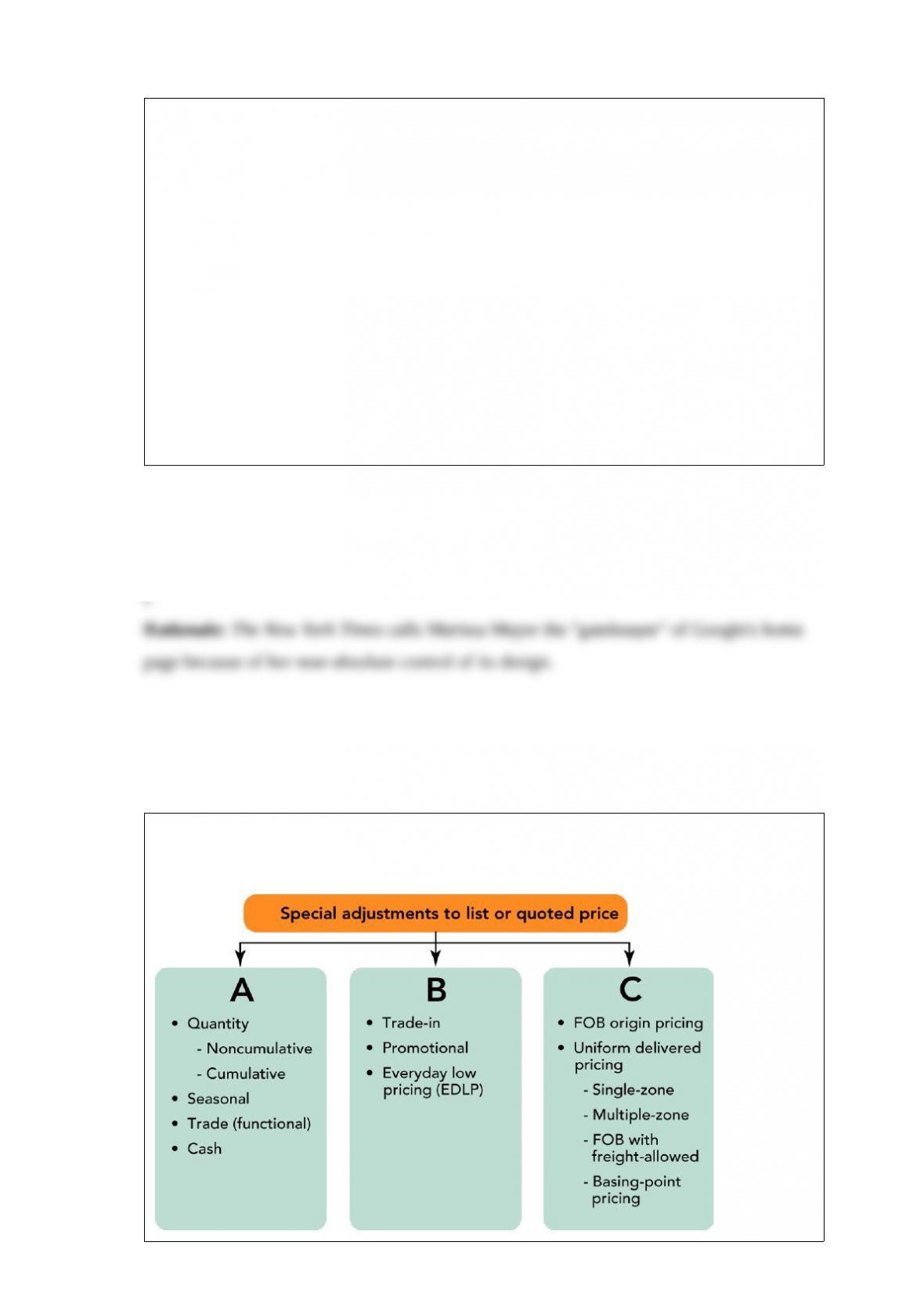
Figure 1.
Figure 1. above shows the three types of special adjustments to list or quoted price. “B”
represents
a. demand-oriented price adjustments.
b. geographical adjustments.
c. allowances.
d. discounts.
e. customary pricing adjustments.
Answer:
To attend a winter concert presented by the community chorus, every person had to
donate one unwrapped toy at the concert hall door. This statement is most closely
related to the __________ element of the marketing mix.
a. product
b. philanthropy
c. price
d. place
e. promotion
Answer:

Several years ago, SwissAir made some unwise investments to pay for a planned
expansion. As a result, the company had to make some cost-cutting moves that
alienated its customers. Eventually, the company declared bankruptcy, regrouped, and
found itself able to resume business. Its board of directors recently announced that the
company would resume flying if it could prove that the airline could regain at least 75
percent of its lost customers. It decided to allocate $50,000 to determine the likelihood
that its former customers would fly on the airline again and find methods requiring little
or no money that could be used to increase that probability. This description represents
which stage in the marketing research approach?
a. define the problem
b. develop the research plan
c. collect relevant information
d. develop findings
e. take marketing actions
Answer:
Experts have observed that our marketplace is in the midst of an “age of engagement.”

What does “engagement” mean at Twitter?
a. one-way communication
b. multimedia communication
c. free advertising
d. Marketers are “loud.”
e. The recipient takes some action.
Answer:
Cause marketing refers to
a. when the charitable contributions of a firm are tied directly to the customer revenues
produced through the promotion of one of its products.
b. the recognition of the need for organizations to improve the state of people, the
planet, and profit simultaneously if they are to achieve sustainable, long-term growth.
c. marketing services provided at little or no cost for the purpose of promoting or
supporting a worthy cause.
d. marketing efforts to produce, promote, and reclaim environmentally sensitive
products.
e. when marketing actions that took place actually caused more harm than good.

Answer:
How an individual organization directs its marketing activities and allocates its
resources to benefit its customers is known as __________.
a. microeconomics marketing
b. cultural marketing
c. micromarketing
d. macromarketing
e. megamarketing
Answer:
A buy class situation affects buying center tendencies in different ways. If there are two
or three people involved, the problem definition has only minor modifications, and the
buying objective is the low-priced supplier, the buy class situation is a
a. new buy.
b. modified rebuy.
c. conditional rebuy.
d. straight rebuy.
e. standard reorder.
Answer:
Which of the following is a criterion used for selecting a target segment?
a. potential for increased profit
b. similarity of needs of potential buyers within a segment
c. cost of reaching the segment
d. difference of needs of buyers among segments
e. potential of a marketing action to reach a segment
Answer:
As a performance measure, share of voice is
a. the number of comments users are making on a product or a brand.

b. the percentage of comments users are making on the unique videos posted about a
product or brand.
c. the brand’s share or percentage of all the online social media chatter related to a
product category or topic.
d. the number of users tweeting about a brand or product.
e. the number of users chatting online about a brand or product.
Answer:
A penetration pricing policy is MOST LIKELY to be effective when: (1) __________;
(2) unit production and marketing costs fall dramatically as production volume
increases; and (3) many segments of the market are price sensitive.
a. lowering the price has only a minor effect on increasing sales volume and reducing
unit costs
b. the high initial prices do not attract competitors
c. customers interpret high prices as signifying high quality
d. customers are willing to buy immediately at the high initial price
e. a low initial price discourages competitors from entering the market
Answer:
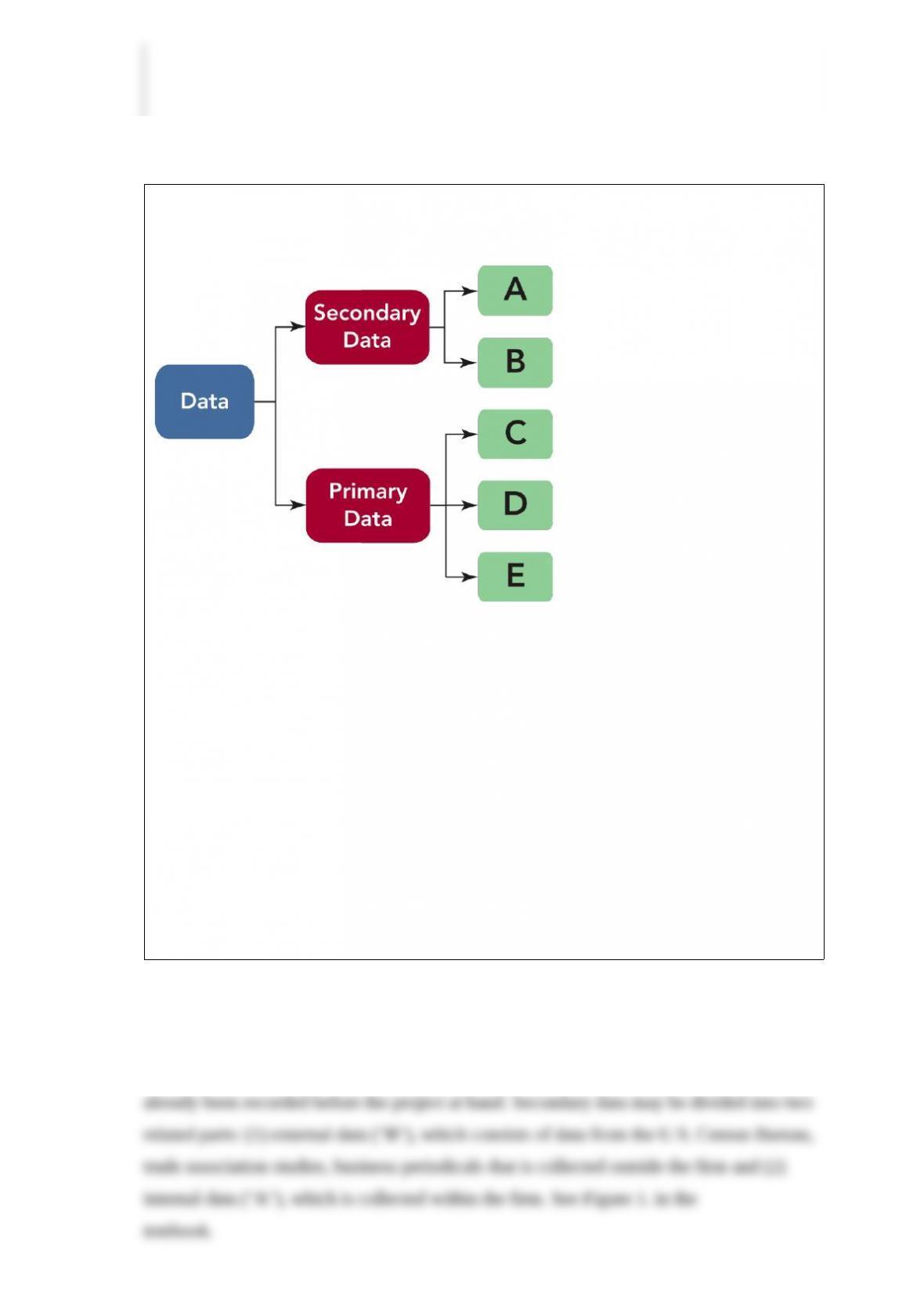
Figure 1.b
Figure 1.b above shows that secondary data may be divided into two related parts. If
“B” represents data collected from the U.S. Census Bureau, trade association studies,
business periodicals, etc., which type of data is “B?”
a. questionnaire data
b. mined data
c. internal secondary data
d. external secondary data
e. observational data
Answer:

In terms of the global marketplace, there are three primary types of companies: (1)
international firms; (2) multinational firms; and (3) transnational firms. The key factor
that distinguishes one from another is
a. the firm’s financial capacity to take risks.
b. the willingness and ability to embrace diversity.
c. the firm’s orientation toward and strategy for global markets and marketing.
d. the relative position of the product or service in terms of its life cycle.
e. the relative size of the firm both in financial terms and in production capacity.
Answer:
Which of the following statements regarding supply chains is most accurate?
a. The best supply chain is the one that is consistent with the needs of the customer
segment being served and complements a company’s marketing strategy.
b. The most common form of supply chain is the collaborative-response efficiency
strategy.
c. In order for a supply chain to work effectively, key decisions should be made by a
third-party logistics provider.
d. The longer the supply chain, the greater the economies of scale and the better the
profit margin.
e. Supply chains should consider the needs of suppliers, provided those needs are
consistent with marketing strategies.
Answer:
A marketing manager should develop segments for a market that meet five principal
criteria. List these important factors in forming market segments.
Answer:
The Department of Labor monitors consumer expenditures through its annual
Consumer Expenditure Survey. In 2009, consumers spent about 13 percent of their
income on food, 34 percent on __________, and 3.5 percent on clothes.
a. education
b. housing
c. vacations
d. health care
e. transportation
Answer:
A restaurant that offers food made exactly to each customer’s preference is providing its
customers with __________ utility.
a. time
b. place
c. possession
d. form
e. process
Answer:
Each cell of the market-product grid shows the __________.
a. relative market share
b. estimated market size
c. investment required to reach the market
d. market growth rate
e. estimated profit
Answer:
The General Mills”Nestl strategic channel alliance
a. increased the ready-to-eat cereal worldwide market share of these companies.
b. decreased the ready-to-eat cereal worldwide market share of these companies.
c. increased the ready-to-eat cereal market abroad and decreased General Mills’
ready-to-eat cereal market in the U.S.
d. served as a model for Post Cereal and Weetabix, a British firm.
e. resulted in a lawsuit from Kellogg’s, the global leader in the ready-to-eat cereal

market for unfair trade practices.
Answer: