Managers at Wayzata Communications, an Internet service provider, want access to a
continual flow of information about their market-available whenever they need it.
Wayzata managers need a(n)
A. marketing information system.
B. intranet.
C. data warehouse.
D. customer relationship management system.
E. big data.
Answer:
Will Bishop sells a wide assortment (in small quantities) of “emergency” home repair
items (fuses, electrical tape, small packets of nails) to grocery and convenience stores.
He owns the products he handles, and displays them for his customers. Bishop is a:
A. manufacturers’ agent.
B. selling agent.
C. rack jobber.
D. cash-and-carry wholesaler.
E. truck wholesaler.
Answer:
Company objectives
A. should be set within the framework of marketing objectives.
B. are made redundant by mission statements.
C. should always be overly ambitious.
D. should only be revised every five years.
E. guide managers as they search for and evaluate opportunities.
Answer:
Public warehouses:
A. generally do not provide all the services that could be obtained in a company’s own
branch warehouse.
B. are not usually responsible for the risk of damage in the warehouse.
C. provide flexibility because the user pays only for the space used.
D. are not very useful to manufacturers who must maintain stocks in many locations,
including foreign countries.
E. All of these alternatives are correct for public warehouses.
Answer:
Regarding the business (manufacturing) market, small firms (with fewer than 10
employees)
A. are not very numerous compared to the very large firms.
B. account for the vast majority of the total employment provided by all manufacturers.
C. are the majority of all firms, but account for less than 3 percent of “value added” by
manufacturing.
D. amount to nearly two million establishments.
E. None of these alternatives is true.
Answer:
A customer who searches the Yellow Pages for information regarding a business is
taking which of the following dual roles in the communication process?
A. Feedback and encoder
B. Receiver and message channel
C. Receiver and initiator
D. Source and initiator
E. Encoder and decoder
Answer:
Myra Martinez was just named Treasure Island, Inc.’s “marketing manager”-with
responsibilities for short-run policy planning of the firm’s advertising, sales, marketing
research, purchasing, and distribution efforts. Apparently, Treasure Island is operating
in the ______________ era.
A. market-oriented
B. production
C. marketing department
D. marketing company
E. sales

Answer:
Which of the following statements about sales promotion is False?
A. Sales promotions may encourage brand switching more than they encourage brand
loyalty.
B. The design and management of sales promotions is often done by specialists from
outside the firm.
C. Sales promotions that are poorly run may reflect negatively on the firm sponsoring
them, even if the firm uses an outside specialist to manage the promotion.
D. Once a firm begins running regular sales promotions, it cannot change its strategy.
E. Sales promotion should not be left to “amateurs.”
Answer:
A channel of distribution:
A. is any series of firms or individuals who participate in the flow of goods and services
from producer to consumer or final user.
B. is only needed when products must be stored.
C. must include one or more intermediaries.
D. is only needed when products are sold indirectly.
E. None of these alternatives is a good answer.
Answer:
The production of a new mountain bike model includes which of the following
activities?
A. Determining how to get the new model to likely bike purchasers.
B. Actually making the new mountain bikes.
C. Estimating how many competing companies will be making bikes.
D. Predicting what types of bikes different types of bike riders will want.
Answer:
If customers already have a positive attitude about a product, which promotional
objective would you recommend?
A. Inform.
B. Remind.
C. Persuade.
D. Educate.
E. Change position.
Answer:
When a purchasing agent from Ford Motor Co. is trying to find information about a
new type of component that might be used in the production of a new Ford SUV, the
most common message channel for him to search is:
A. television.
B. newspapers.
C. radio.
D. the Internet.
E. trade magazines.
Answer:
Consumer buying behavior is affected by:
A. opinion leaders.
B. social class.
C. physiological, safety, social, and personal needs.
D. reference groups.
E. all of these affect consumer buying behavior.
Answer:
Which of the following types of products is LEAST sensitive to environmental changes,
according to the “continuum of environmental sensitivity”?
A. Industrial products.
B. Commodity-type consumer products.
C. Consumer products linked to cultural variables.
D. “Me-too” products.
E. Fad products.
Answer:
The two basic methods for obtaining primary information about customers are
A. defining and analyzing.
B. questioning and observing.
C. intranet and data from private research organizations.
D. marketing information systems and cost data.
E. Internet search and library search.
Answer:
If many individuals are involved in a buying decision, this is:
A. a multiple input situation.
B. a selective rebuy.
C. a modified rebuy.
D. a multiple buying influence situation.
E. a straight rebuy.
Answer:
Because of increased competition during the ___________ era, firms put new effort
into winning customers.
A. simple trade
B. sales
C. production
D. marketing company
E. marketing department
Answer:
Customers for complicated installations and accessories usually expect a sales rep
A. to know all the technical details of the product.
B. to be able to discuss general business conditions with their top executives.
C. to know the details of the customer firm’s particular applications of the product.
D. to use a well-organized sales presentation to get their business.
E. All of these alternatives are correct.
Answer:
Which of the following statements about selling agents is FALSE?
A. They take over the whole marketing job for a producer.
B. They may handle the entire output of one or more producers, even competing
producers.
C. They may provide a producer with working capital.
D. They may even take over the affairs of the producer’s whole business.
E. None of these statements about selling agents is FALSE.
Answer:
Which of the following is NOT a good example of the observation method of marketing
research?
A. The manager of a supermarket occasionally walks through the store to see what
customers are doing.
B. A drugstore installs optical scanners at its checkout counters.
C. The owner of a shopping center puts a counting device at the entrance to count how
many cars come in.
D. A store manager studies videotapes of consumers shopping in the store.
E. All of these are good examples of observation research.
Answer:
The price per unit is $1.00. The average variable cost per unit is 60 cents. The total
fixed cost is $20,000. Compute the break-even point.
A. 75,000 units
B. 50,000 units
C. 20,000 units
D. 33,334 units
E. 40,000 units
Answer:
Which of the following pricing tools combines both, the cost-oriented price setting
approach as well as the demand-oriented price setting approach?
A. Break-even analysis
B. Average-cost pricing
C. Markup pricing
D. Marginal analysis
E. Price sensitivity
Answer:
Use this information for question that refer to the United Tools case.
Terry Harter is marketing manager for United Tools and Mike O’Reilly is the firm’s
logistics manager. They work together to make decisions about how to get United’s
hand and power tools to its customers-a mix of manufacturing plants and final
consumers (who buy United tools at a hardware store). United Tools does not own its
own transport facilities and it works with wholesalers to reach its business customers.
Together, Harter and O’Reilly try to coordinate transporting, storing, and product
handling activities to minimize cost while still achieving the customer service level
their customers and intermediaries want. This usually requires that United keep an
inventory of most of its products on hand, but demand for its products is fairly
consistent over time so inventory is easy to manage.
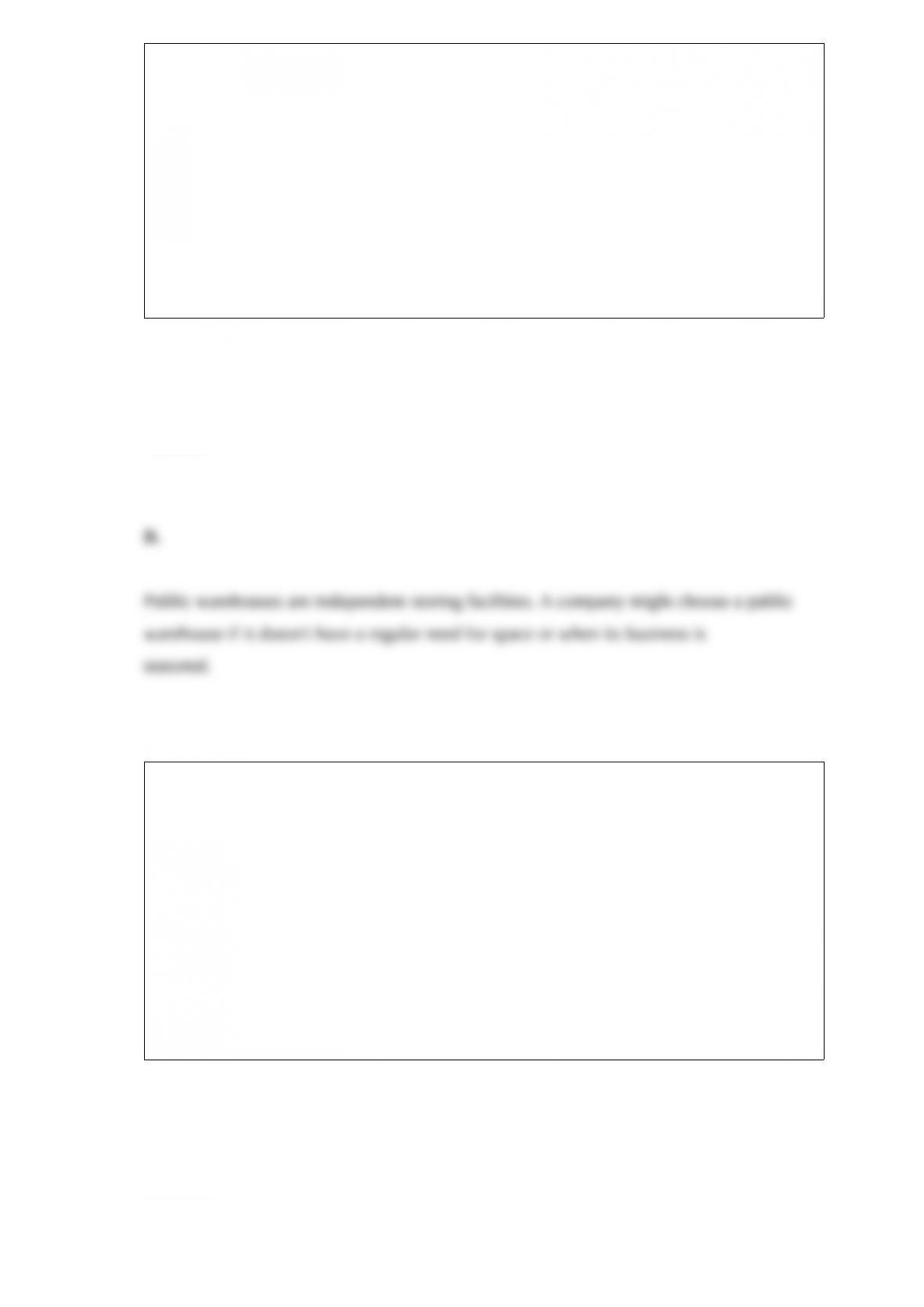
Harter has identified four options for physical distribution systems she could use to
reach two of her key wholesalers, Ralston Supply and Ricotta Tool Co. The total cost
for each option-and the distribution service levels that can be achieved-are as follows:
Ralston Supply expects a very high level (90 percent) of distribution customer service.
Ricotta Tool Co. is willing to settle for a 70 percent customer service level, even if that
means some products will occasionally be out of stock, if it gets products at a lower
price.
For its large retail hardware customers (like Home Depot), United regularly ships
smaller orders directly to individual stores or in some cases to the retail chain’s
warehouses. Cross-country shipments usually go by rail while regional shipments
usually go by truck.
To help in managing excess inventory, United Tools would most likely use:
A. a private warehouse.
B. a public warehouse.
C. piggyback mode.
D. a distribution center.
E. all of these would help in managing excess inventory.
Answer:
A good share of total U.S. wholesale sales are made by manufacturers’ sales branches
because:
A. they are well-managed.
B. branches are usually placed in the best market areas.
C. costs are lower because some marketing functions are eliminated.
D. about half of all wholesale businesses are owned by manufacturers.
E. All of these are good reasons.
Answer:
As a mode of transportation, railroad freight would be least suited for
A. iron ore.
B. sand.
C. fresh fruit.
D. automobiles.
E. coal.
Answer:
The current U.S. population is largest in which of the following states?
A. California.
B. Florida.
C. Illinois.
D. New York.
E. Texas.
Answer:
A marketing manager for a new brand of bar soap decides to mail free samples to
consumers. The logic for using this approach is best explained by
A. the “economic buyer” model.
B. the stimulus-response model.
C. the typical consumer’s adoption process.
D. the need to reduce dissonance.
E. the high level of problem solving required with such a product.
Answer:
Lisa wants to book a hotel suite at Luxury International and looks up the company
website for information about the range of services offered, the prices, the hours of
operation, the phone number, and the address. She makes a phone call to the hotel,
which is promptly answered by the front office. Later the bellman opens the door and
takes her luggage and the concierge helps her make a dinner reservation. Each of these
contacts with Luxury International is called a ________.
A. point of contact
B. corporate interface
C. touchpoint
D. contact opportunity
E. opportunism
Answer:
Every morning, Sycamore Dairy picks up milk that farmers have “milked” that
morning. The dairy processes the milk and separates the cream from the milk. Some of
the cream is then made into butter and packaged in various size containers. The milk
and remaining cream are blended into various products, sealed in pint, quart, and
half-gallon containers, and then delivered to supermarkets in the quantities and
assortments ordered. The dairy is providing what regrouping activity?
A. Assorting
B. Accumulating
C. Sorting
D. Bulk-breaking
E. All of these regrouping activities are being provided by Sycamore Dairy.
Answer:
This type of problem solving is typical for a low-involvement purchase.
A. Extensive problem solving
B. Critical problem solving
C. Limited problem solving
D. Intensive problem solving
E. Routinized response behavior
Answer:
A detailed plan for handling transportation and storage of a new product that is now
being distributed to wholesalers nationwide is an aspect of which part of the 4Ps?
A. Place
B. Product
C. Promotion

D. Price
Answer: