
In some cases, penetration pricing may follow skimming pricing. The skimming pricing
would help __________ and the penetration pricing would help__________.
a. increase market share; attract price-insensitive customers
b. attract price sensitive customers; increase market share
c. recoup initial research and development costs; increase market share
d. recoup initial research and development costs; maintain market share
e. increase market share; attract price insensitive customers
Answer:
In the telemarketing industry, issues such as consumer privacy, __________, and
industry standards have become a topic of discussion among consumers, Congress, the
Federal Trade Commission (FTC), and businesses.
a. product quality
b. price differences
c. on-time delivery
d. competitive antics
e. ethical guidelines
Answer:

Logistics management refers to
a. the practice of organizing the cost-effective flow of raw materials, in-process
inventory, finished goods, and related information from point of origin to point of
consumption to satisfy customer requirements.
b. the integration and organization of information and logistics activities across firms in
a supply chain for the purpose of creating and delivering products and services that
provide value to ultimate consumers.
c. the integration and organization of information and logistical activities that actively
brings consumers together with sellers through the express use of agents and brokers.
d. systems that are designed to reduce a retailer’s lead time for receiving merchandise,
which then lowers a retailer’s inventory investment, improves customer service levels,
and reduces logistics expense.
e. proprietary computer and telecommunication technologies to exchange electronic
invoices, payments, and information among suppliers, manufacturers, and retailers.
Answer:
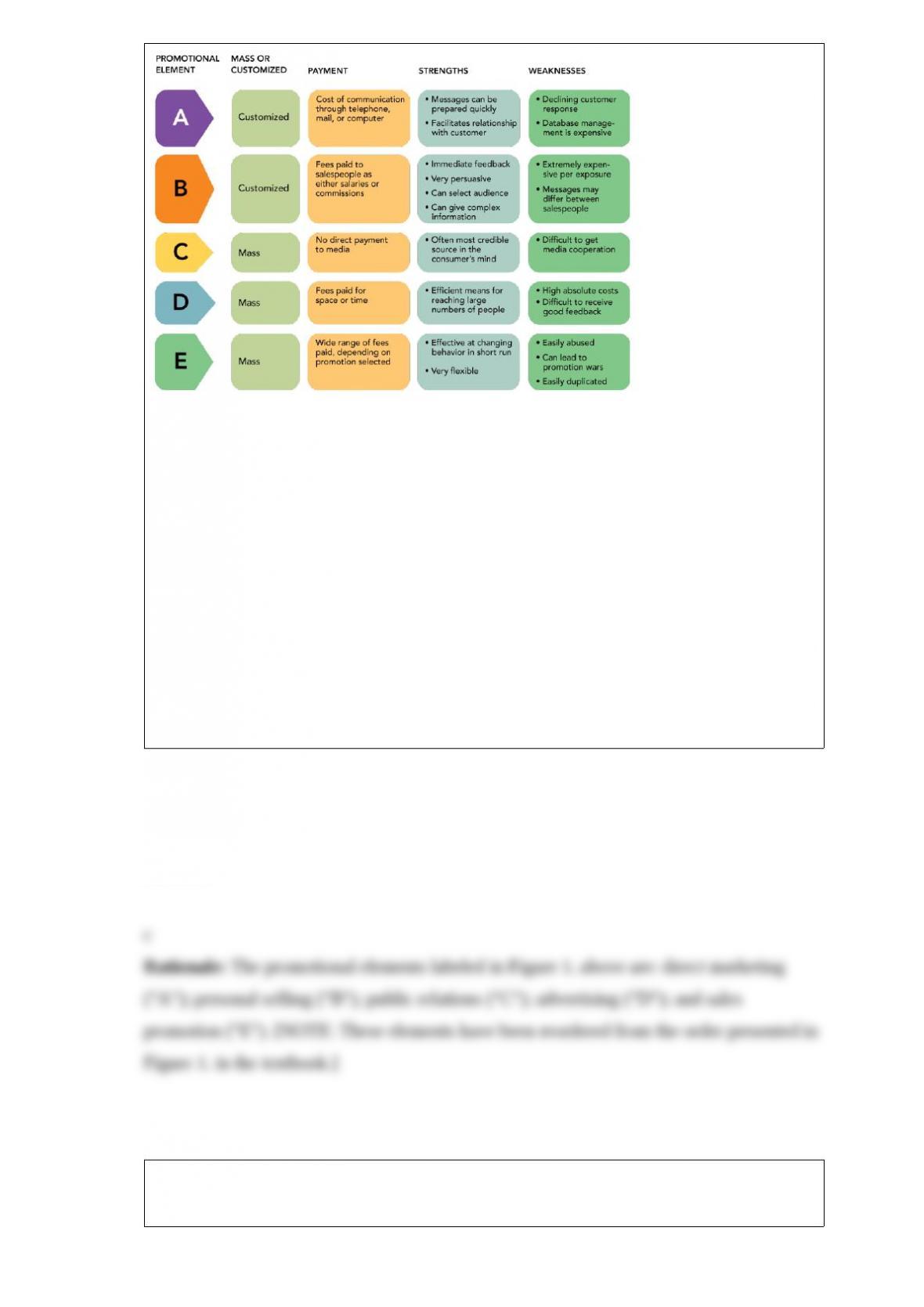
Figure 1.
To communicate with consumers, a company can use one or more of five promotion
alternatives. In Figure 1. above, the promotional element labeled “C” represents
_________.
a. advertising
b. personal selling
c. public relations
d. sales promotion
e. direct marketing
Answer:
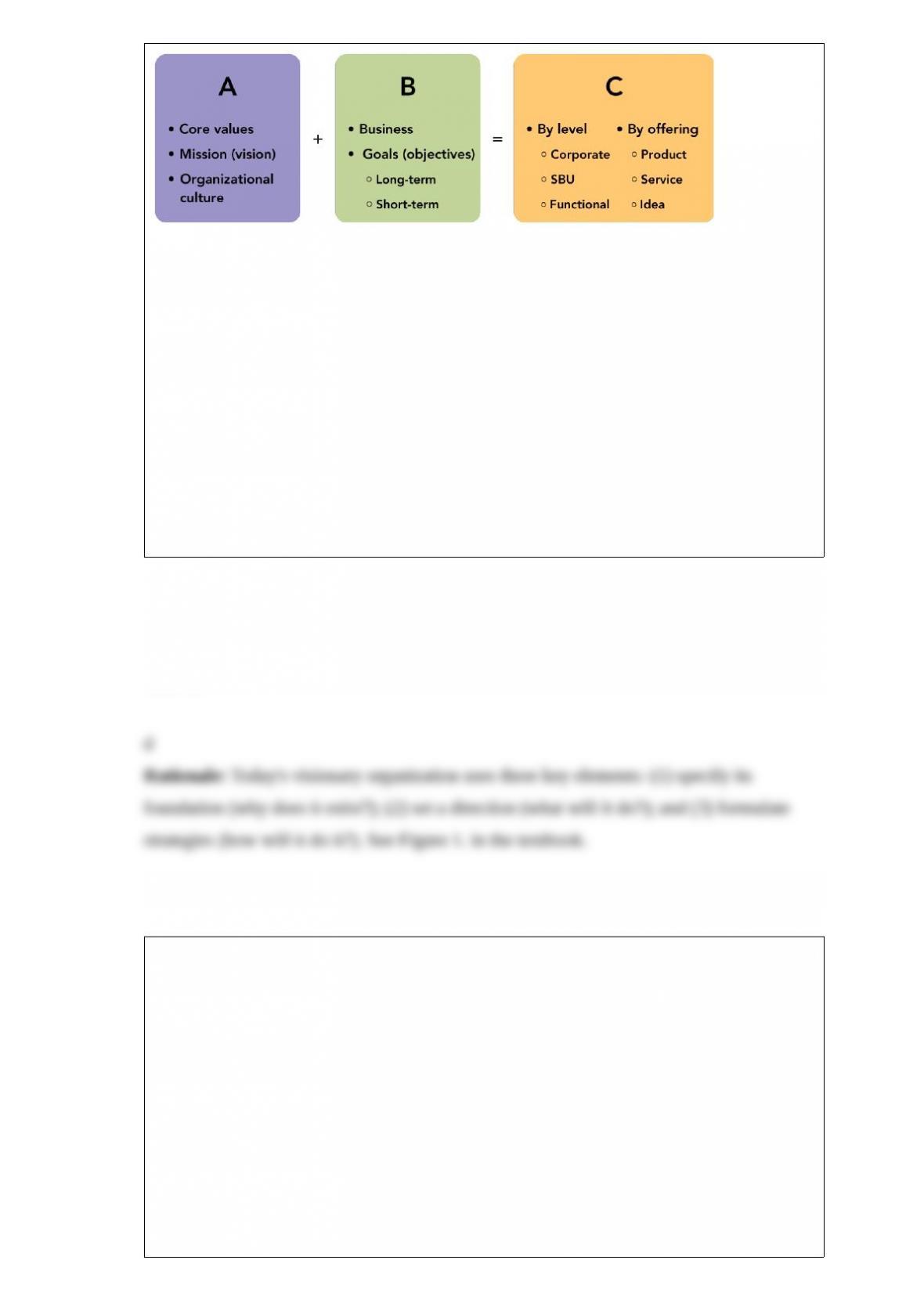
Figure 1.
In Figure 1. above, “B” represents the “what” element of visionary organization. This is
referred to as __________.
a. organizational tactics
b. organizational mission
c. organizational foundation
d. organizational direction
e. organizational strategies
Answer:
Online content that shows a significant degree of creative effort, and thus is more than
simply posting a newspaper or magazine article on a personal blog, is a criterion of
a. online advertisements.
b. blogs.
c. user generated content (UGC).
d. wikis.
e. YouTube.

Answer:
The total number of people who interact with a Post (for example, “like” or make a
comment) divided by the total number of people seeing the Post is the
a. fan rate.
b. liker rate.
c. reader rate.
d. active receiver rate.
e. interaction rate.
Answer:
Yield management pricing refers to
a. controlling the production of products based upon seasonal demand.

b. deliberately selling a product below its customary price, not to increase sales, but to
attract customers’ attention in hopes that they will buy other products as well.
c. charging different prices during different times of the day or days of the week to
reflect variations in demand for the service.
d. offering significant price discounts to wholesalers who agree to purchase products in
advance for a period of a year or more at a time.
e. charging different prices to maximize revenue for a set amount of capacity at any
given time.
Answer:
Disintermediation refers to channel conflict that arises when
a. a channel member severs relationships with other channel members to work for or
with a competing manufacturer.
b. channel conflicts are resolved by a third party.
c. a channel member bypasses another member and sells or buys product directly.
d. channel conflicts are resolved through a binding arbitration from a panel of
representatives from all channel members involved.
e. the entire distribution chain is eliminated, such as when a company sets up its own
wholesaler and retailer network.
Answer:
There are five dimensions to emotional intelligence: __________; self-awareness; the
ability to manage one’s emotions and impulses; empathy; and social skills.
a. the ability to read body language
b. sense of humor
c. self-motivation
d. the ability to be positive
e. a need to be in control
Answer:
A regional bakery makes organic breads and muffins. It feels the choice of distribution
channel is critical to the product’s success, especially since it wants to have the product
distributed nationally. However, it will take some time before sales take off, and the
bakery wants to make sure the marketing program is consistent everywhere. It should
use
a. a manufacturer’s agent to sell to truck jobbers who in turn will deal with retailers.
b. its own salesforce to sell directly to retailers.
c. the services of a selling agent to sell to general merchandise wholesalers who will
sell to retailers.
d. a dual distribution system composed of both direct and indirect wholesalers.

e. a rack jobber who will sell to a merchant wholesaler and who will in turn sell to
retailers.
Answer:
In 2003, Kodak’s traditional film sales were an $8 billion dollar “cash cow.” In 2009,
the revenue generated dropped below $500 million. By 2012, film sales will almost
evaporate. Kodak’s film SBU became a “dog” primarily due to
a. an exponential increase in the price of silver, which is necessary for the production of
film.
b. the loss of patent protection.
c. too much revenue shifted from this SBU to the more profitable ink-jet printer SBU.
d. the use of traditional film cameras was only a fad.
e. the advent of the popularity of digital photography.
Answer:

Vertical integration can lead to legal prosecution if
a. there is potential to lessen competition or create a monopoly.
b. mergers create too much competition.
c. a corporate vertical system attempts to become a contractual vertical marketing
system.
d. an administered vertical system attempts to become a corporate vertical marketing
system.
e. one member of the channel attempts to take the position of channel captain away
from another.
Answer:
In marketing, “doppelgangers” refer to
a. ads or logos that look similar to a familiar brand that have been altered by digital
technology.
b. products that are so similar to one another in form and function that trademarks
cannot be issued to one of them.
c. products that are almost identical, but are registered independently with different
trademarks in different countries.
d. two trademark symbols that closely resemble one another in appearance.
e. two distinctly different products (and product classes) whose colors are so similar to
one another that customers believe both products are owned by the same company.

Answer:
The description of a population according to selected characteristics such as age,
gender, ethnicity, income, and occupation is referred to as __________.
a. product group profiling
b. demographics
c. behavioral analysis
d. psychographics
e. statistical analysis
Answer:
The retailing mix includes all of the following EXCEPT:
a. merchandise.
b. target market.
c. retail pricing.
d. store location.
e. retail communication.

Answer:
The online consumer segment that consists of young, affluent, and single online
consumers who bank, play games, and spend more time online than any other segment
is referred to as
a. hunter-gatherers.
b. click-and-mortar.
c. brand loyalists.
d. hooked, online, and single.
e. time-sensitive materialists.
Answer:
Mattel has a contractual agreement to let Colgate use the Barbie name and image on
kids’ toothpaste and toothbrushes. Colgate pays Mattel a fee for the use of the Barbie
name and image. This is an example of __________.
a. co-branding
b. generic branding
c. reseller licensing
d. mixed branding
e. brand licensing
Answer:
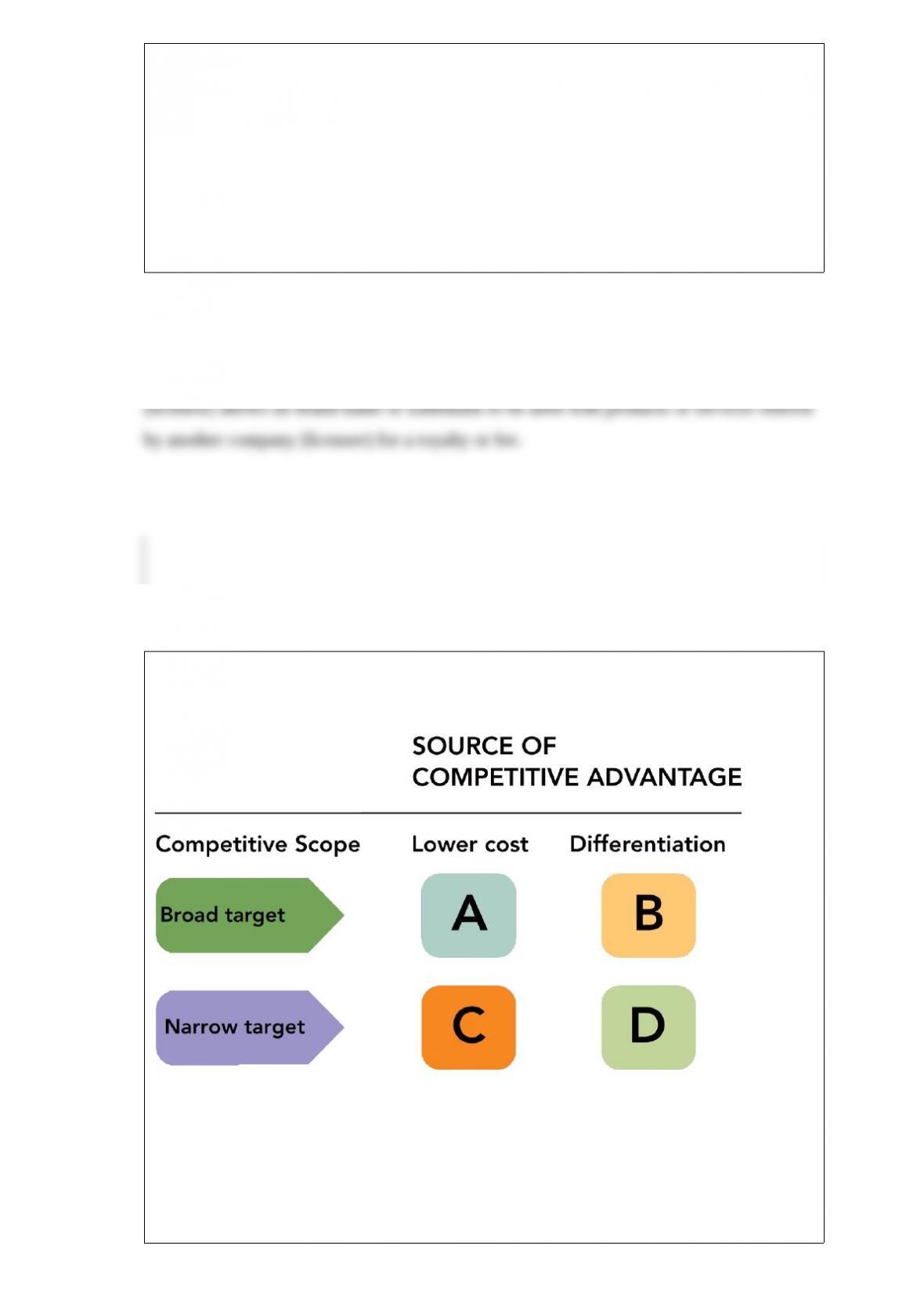
Figure 1.
In Porter’s generic business strategies shown in Figure 1. above, “A” refers to a
__________ strategy.
a. quality focus
b. cost leadership
c. differentiation
d. cost focus
e. differentiation focus
Answer:
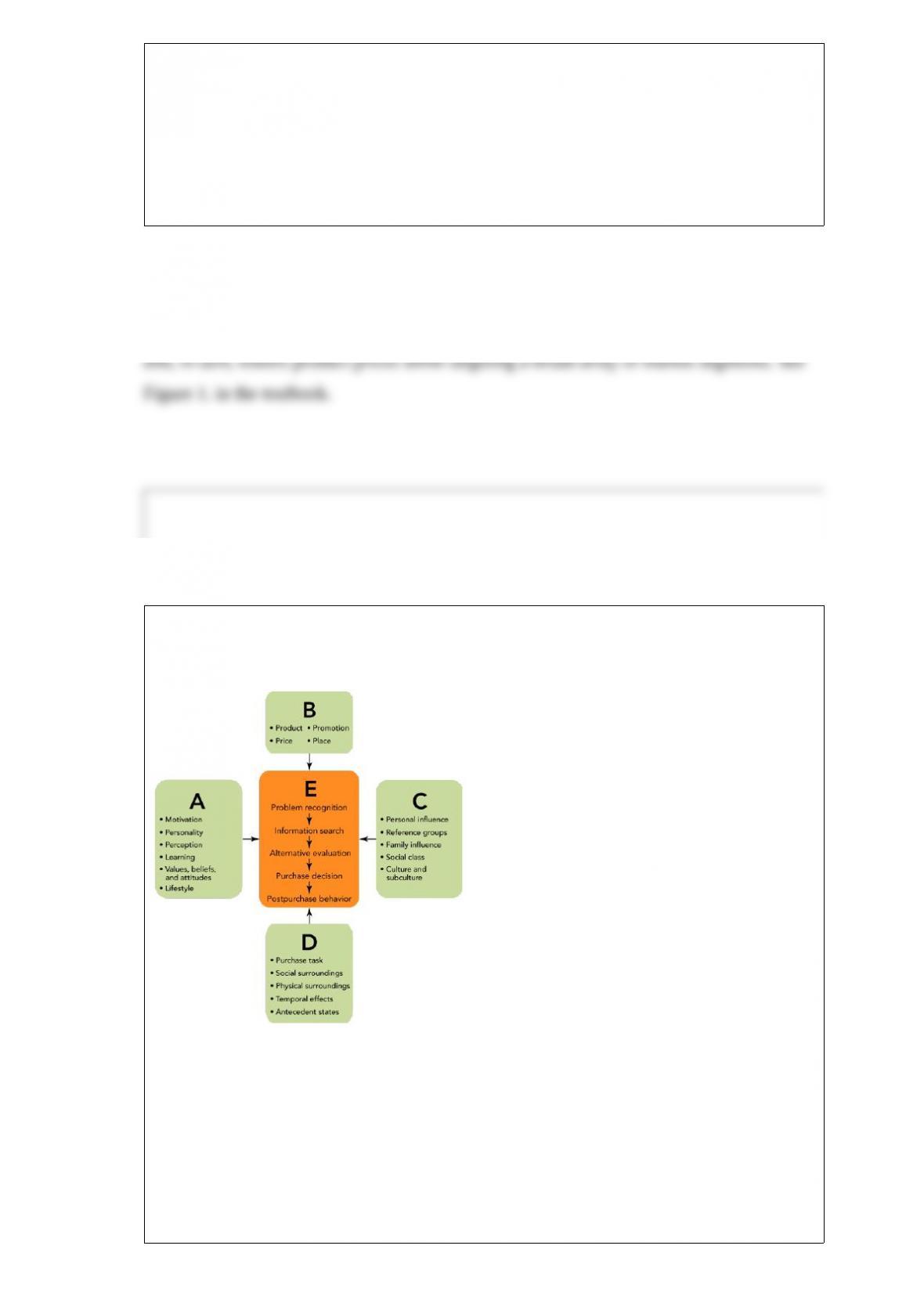
Figure 1.
In Figure 1. above, “A” represents the __________ influences that can affect the
consumer purchase decision process.
a. economic
b. situational

c. psychological
d. sociocultural
e. marketing mix
Answer:
Today, marketers are increasingly emphasizing a Tiffany/Walmart strategy, which is to
offer
a. a low-priced product to a high-income or high net worth segment.
b. a high-priced product to a low-income or low net worth segment.
c. different variations of the same basic offering to high-end and low-end segments.
d. a high-priced and a low-priced offering to a single market segment.
e. different offerings to high-end and low-end segments.
Answer:

To reduce the price sensitivity for some of its products, Washburn
a. uses multiple suppliers for its raw materials.
b. offers three months of free music lessons with the purchase of each guitar.
c. uses endorsements by internationally known musicians who play Washburn signature
guitars.
d. offers a lifetime, unconditional warranty on all its instruments regardless of the price
of its guitars.
e. sponsors free music programs and special Washburn guitar camps for children.
Answer:
The average price Washburn charges for a guitar is $349. This price must cover its
variable costs of $25 for direct materials and $120 in direct labor. It must also cover
fixed expenses of $38,000. Assuming everything else stays the same, the company’s
planned move to Nashville, Tennessee, will reduce its fixed costs by $4,800. This would
cause total costs to __________ and the break-even quantity to __________.
a. decrease; stay the same
b. decrease; increase
c. increase; increase
d. stay the same; increase
e. decrease; decrease

Answer:
Which of the following statements about the VALS framework is NOT true?
a. Consumers are inspired by one of three primary motivationsideals, achievement, and
self-expressionthat give meaning to their self or the world and govern their activities.
b. Consumers are motivated to buy products and services and seek experiences that give
shape, substance, and satisfaction to their lives.
c. The VALS framework seeks to explain why and how consumers make purchase
decisions.
d. The VALS framework identifies eight consumer segments.
e. The different levels of resources people may possess (money, time, talents, etc.) have
no effect on the expression of their primary motivation.
Answer:

Which of the following statements is most accurate?
a. For some products, price influences the perception of overall quality, and ultimately
value, to consumers.
b. A consumer’s view of a product’s value is always tied to quality.
c. A consumer’s view of value is a function of his or her education and income.
d. Price plays only a small part in a consumer’s perceived value of a product or service.
e. Price plays a large role in assessing value but a very minor role in assessing quality.
Answer:
Yellow pages publishers are facing increasing public concern about
a. the competition among directories.
b. the lack of online yellow pages.
c. the difficulty of keeping the ads up-to-date.
d. privacy.
e. the environmental impact of the directories.
Answer:

A marketing dashboard refers to
a. a “report card” prepared by the marketing department regarding its performance in
terms of environmental and social responsibility.
b. the display of information found on a car’s dashboard.
c. an “app” that uses a car navigation device metaphor to indicate the specific direction
in which a company wishes to grow based on its annual marketing plan.
d. information about an organization’s marketing metrics graphically so marketers can
quickly (1) spot deviations from plans and (2) take corrective actions.
e. the visual computer display of the essential information related to achieving a
marketing objective.
Answer:
In terms of the global marketplace, there are three primary types of companies:
__________, multinational firms, and transnational firms.
a. worldwide
b. conglomerate
c. intercontinental
d. international
e. cosmopolitan

Answer:
Boston Pizza wants to determine how effective their retail format is compared to other
pizza establishments in the local area. The calculation for this indicator is arrived at by
determining the __________ for its store and comparing it against the same indicator
for all of the other local pizza outlets.
a. gross margin
b. same-store sales growth
c. sales per square foot
d. net profit
e. net present value
Answer:
Individual interviews involve
a. a single researcher asking questions of one respondent.
b. several people asking the same person the same questions over a period of time to

check for answer reliability.
c. asking respondents in a shopping mall to fill out a brief survey.
d. having the interviewee talk about specific aspects of a product or service using a
video camera in his/her natural use environment.
e. a panel of respondents participating in a guided discussion lead by an experienced
moderator.
Answer: