
A statement indicating the liability of the manufacturer for product deficiencies is
referred to as a(n) __________.
a. warranty
b. consumer bill of rights
c. product liability statement
d. manufacturer’s disclaimer
e. guarantee
Answer:
A contractual arrangement between a parent company and an individual or firm that
allows the latter to operate a certain type of business under an established name and
according to specific rules is referred to as __________.
a. a corporate vertical marketing system
b. a wholesaler sponsored voluntary chain
c. a retailer-sponsored cooperative
d. franchising
e. an administered vertical marketing system
Answer:
Walmart uses which pricing strategy that affects both customers and competitors?
a. penetration pricing
b. every day fair pricing
c. every day low pricing
d. supply-side pricing
e. value-pricing
Answer:
Unlike merchant wholesalers, agents, and brokers, manufacturers’ branches and sales
offices are __________ that perform wholesaling activities.
a. independent distribution managers
b. independent intermediary channels
c. wholly-owned extensions of the producer
d. wholly-owned extensions of the distributor
e. wholly-owned extensions of the retailer
Answer:
Direct investment in international marketing refers to
a. offering the right to a trademark, patent, trade secret, or similarly valued items of
intellectual property in return for a royalty or fee.
b. contracting with a foreign firm to manufacture products according to certain
specifications.
c. a national market-entry strategy that entails a foreign company and a local firm
investing together to create a local business.
d. having a company handle its own exports directly, without intermediaries.
e. a global market-entry strategy that entails a domestic firm actually investing in and
owning a foreign subsidiary or division.
Answer:
A student would like to buy a sports car from the local dealer, but she cannot afford one.
Marketing does not occur in this situation because
a. two or more parties have unsatisfied needs.
b. there is no desire on the part of either party to satisfy its needs.
c. one of the involved parties does not have the ability to satisfy its needs.
d. there is no way for each party to communicate with one another.
e. there has been no assessment of consumer wants and needs.
Answer:
A major regional shift in the U.S. population toward the __________ states is under
way.
a. eastern
b. west coast
c. southern
d. midwestern
e. southern and western
Answer:
Many cosmetology schools allow their advanced students to style hair for “real world”
clients for a reduced fee. The students benefit from the experience, the clients get a less
expensive haircut, and the school is able to provide students with additional training
without costing it anything; in fact, they even profit from it. This is an example of
a. value-pricing.
b. societal pricing.
c. revenue sharing.
d. barter.
e. cost-assist pricing.
Answer:
Which element of the marketing mix is demonstrated when Mars, Inc. has a sale on
M&Ms brand candies?
a. product
b. price
c. promotion
d. place
e. production
Answer:
The requirement that users “opt-out” of changes to Facebook’s privacy settings was
considered unethical because
a. “by default” privacy settings would not be changed.
b. all Facebook users want automatic updates to new features such as facial recognition.
c. Facebook was providing additional privacy and security for its users.
d. “by default” privacy settings would be changed.
e. the new privacy settings made it harder for brand managers to find “evangelist”
consumers of their products.
Answer:
What five criteria are mentioned most often in selecting a good brand name? Give an
example of a brand name that illustrates each of the criteria.
Answer:
Which of the following statements regarding a market share pricing objective is most
accurate?
a. A market share objective is often difficult for product managers since stockholders
are looking for immediate dividends (return of profits) and obtaining market share
usually takes time.
b. Although increased market share is a primary goal of some firms, others see it as a
means to other ends, such as increased sales or profits.
c. Selecting market share as a pricing objective is particularly effective if industry sales
are rising.
d. An advantage of market share as a pricing objective is that it is particularly
insensitive to competitors’ actions.
e. Ironically, a market share objective is realized by raising prices in order to increase
consumer confidence during the decline stage of a product’s life cycle.
Answer:
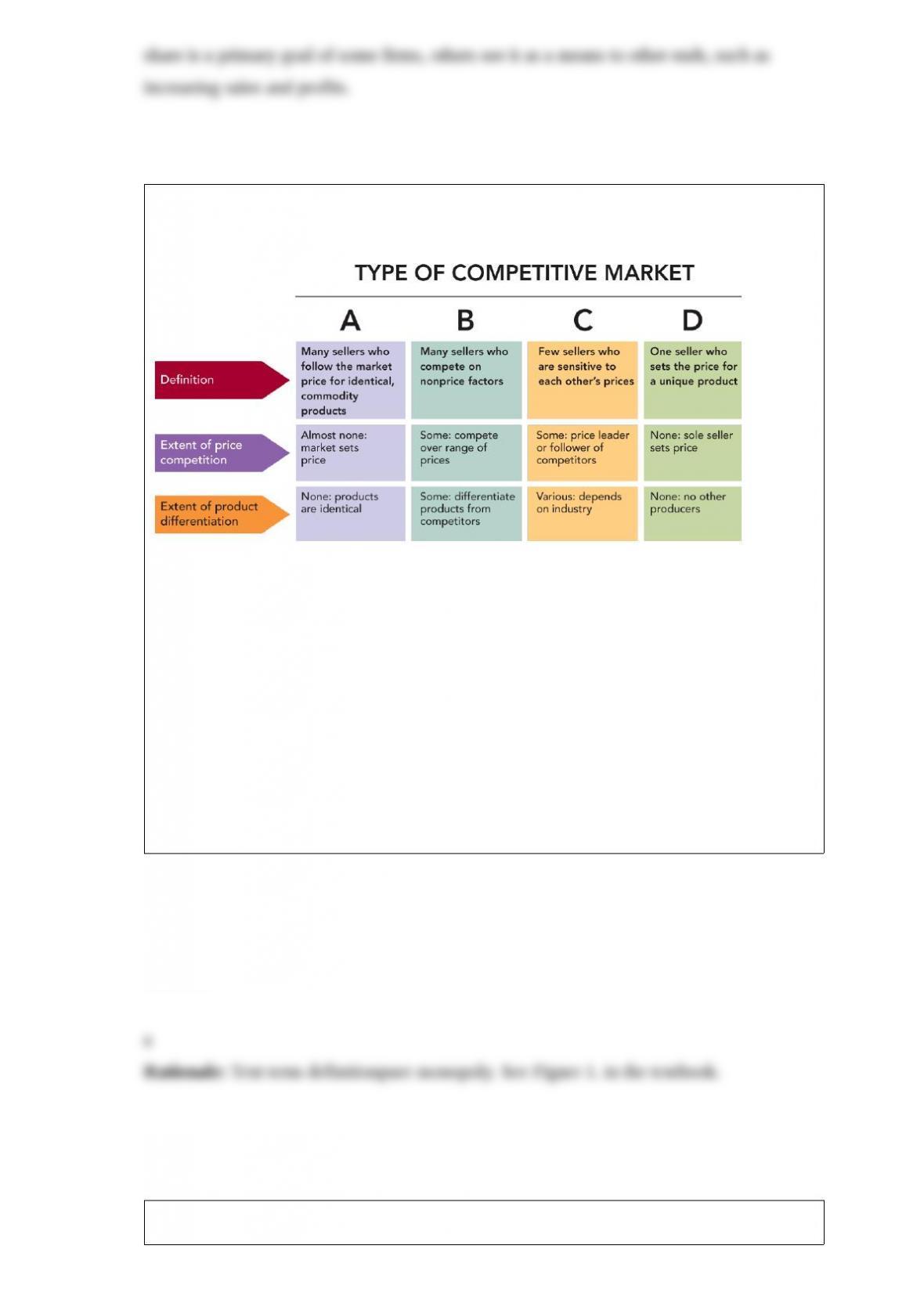
Figure 1.
In Figure 1. above, column “D” represents which type of competitive market?
a. pure monopoly
b. oligopoly
c. monopolistic competition
d. pure competition
e. monopolistic oligopoly
Answer:
All of the following statements are true EXCEPT:
a. “LEED” stands for “Leadership in Energy and Environmental Design.”
b. Today’s college graduates now seek “green” jobs that involve some aspect of social
responsibility.
c. Colleges of business have yet to establish sustainability course electives, case studies,
or links to organizations that expose students to socially responsibility concepts and
initiatives.
d. Many students want to be involved with organizations like Net Impact to “use
business to improve the world.”
e. Millennials want to make a difference by making the world a better place.
Answer:
Which of the following statements concerning marketing research is most accurate?
a. The primary purpose of marketing research is to collect data, not to take actions on it.
b. When collecting marketing research, people may or may not be willing to tell you
what you want to know if it is potentially embarrassing.
c. Marketing research, if done properly, will always result in a positive marketing result.
d. People are just as able to give accurate information about products they have only
heard about as those they have actually used.
e. Among those people who participate in market research studies, there is an almost
perfect correlation between a respondent’s stated intentions and his/her actual buying
behavior.
Answer:
Product form refers to __________.
a. the legal description of an individual item including all its salient characteristics
b. the SKU designation assigned to a product item
c. a series of product items that share similar characteristics in terms of usage
d. variations within the product class
e. a group of product items that comprise an industry
Answer:
Two prominent personal moral philosophies that have direct bearing on marketing
practice are
a. existentialism and pragmatism.
b. pragmatism and idealism.
c. moral idealism and utilitarianism.
d. social responsibility and personal ethics.
e. moral behaviorism and secular ethics.
Answer:
An organization’s __________ are the fundamental, passionate, and enduring principles
that guide its conduct over time.
a. goals
b. culture
c. strategies
d. core values
e. mission statements
Answer:
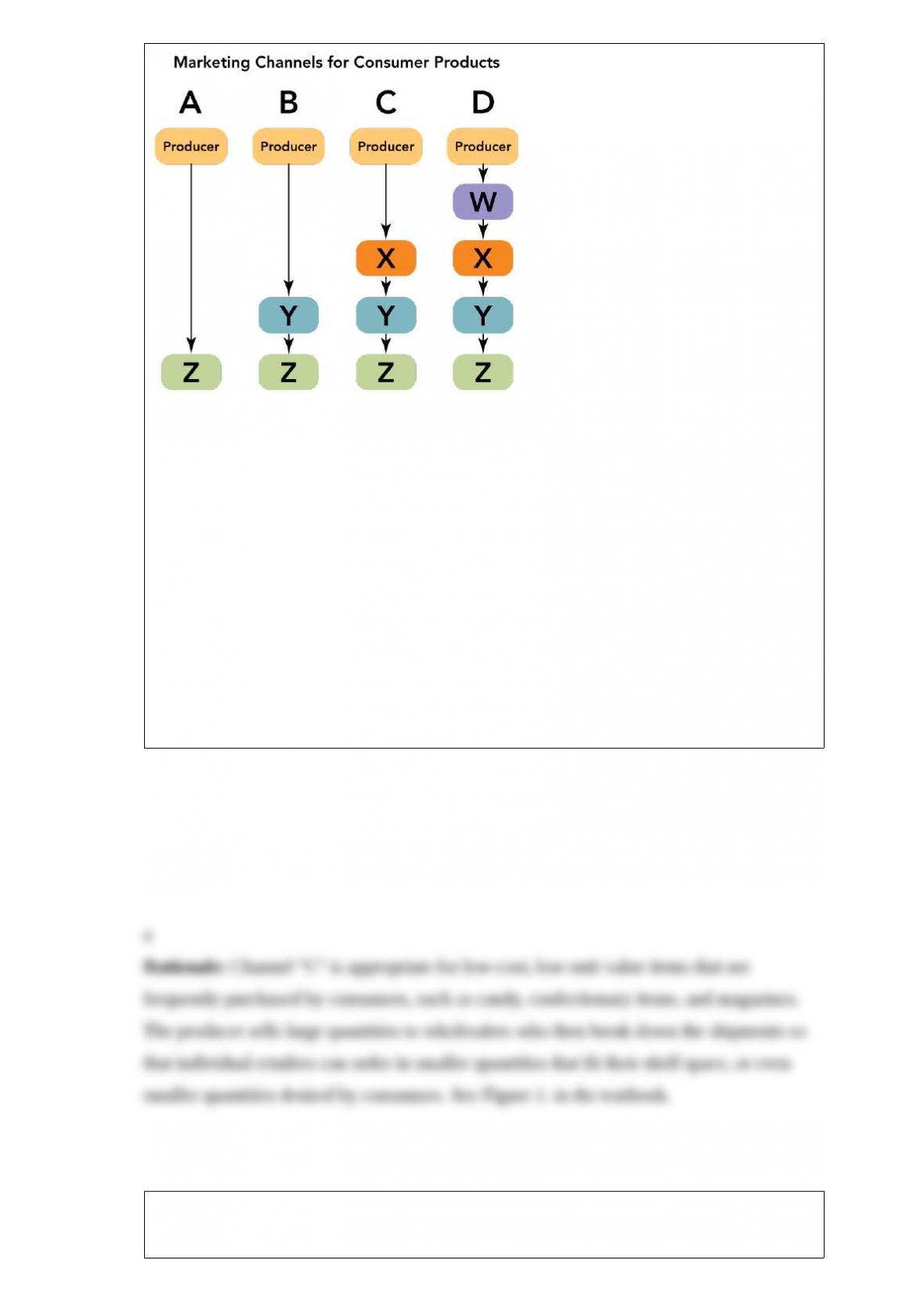
Figure 1.
Figure 1. above depicts four common marketing channels for consumer products and
services that differ by the kind and number of intermediaries. Channel “C” would be an
appropriate marketing channel for __________.
a. candy bars
b. automobiles
c. car insurance
d. dental services
e. tickets to a rock concert
Answer:
Sarah has a backache due to overexertion. She believes a massage would loosen her
back muscles and make her feel better. She is concerned because a massage, unlike a
pair of shoes, cannot be held, touched, or seen before she buys it. Which characteristic
of services is she concerned about?
a. incongruity
b. inconsistency
c. inventory costs
d. inseparability
e. intangibility
Answer:
For a promotional campaign, the sequence of stages a prospective buyer goes through
from initial awareness of a product to eventual action is referred to as _________.
a. the purchase continuum
b. the hierarchy of effects
c. the product life cycle
d. the consumer purchasing scale
e. Maslow’s hierarchy
Answer:
Manufacturers of consumer products use transactional websites less frequently than
other firms because
a. in some industries, this form of vertical integration is illegal.
b. there is a threat of channel conflict.
c. it is difficult to maintain inventory levels at online warehouses.
d. some stakeholders are opposed to websites that drain resources without providing
any return on investment.
e. such websites require dynamic pricing, which is difficult to use if supply and demand
change frequently.
Answer:
Product differentiation refers to
a. a good, service, or idea consisting of a bundle of tangible and intangible attributes
that satisfies consumers’ needs.
b. the unique combination of product benefits received by targeted buyers.
c. those characteristics of a product that make it superior to competitive substitutes.
d. the legal requirement that requires a specified degree of distinction between products
to ensure an organization’s intellectual property rights.
e. a marketing strategy that involves a firm using different marketing mix activities to
help consumers perceive the product as being different and better than competing
products.
Answer:
The Lanham Act (1946)
a. prevents someone from using a trademark on a noncompeting product.
b. protects the consumer from product defects.
c. provides for registration of a company’s trademarks.
d. allows a company to secure rights to a name before its actual use.
e. facilitates the protection of U.S. trademark rights throughout the world.
Answer:
An example of a nonprofit organization is
a. the Food and Drug Administration.
b. CVS Pharmacies.
c. the University of Kentucky School of Medicine.
d. the manufacturer of Bayer Aspirin.
e. the American Red Cross.
Answer:
Items for which the consumer compares several alternatives on several criteria such as
price, quality, or style are referred to as __________.
a. specialty products
b. selective products
c. shopping products
d. prestige products
e. convenience products
Answer:
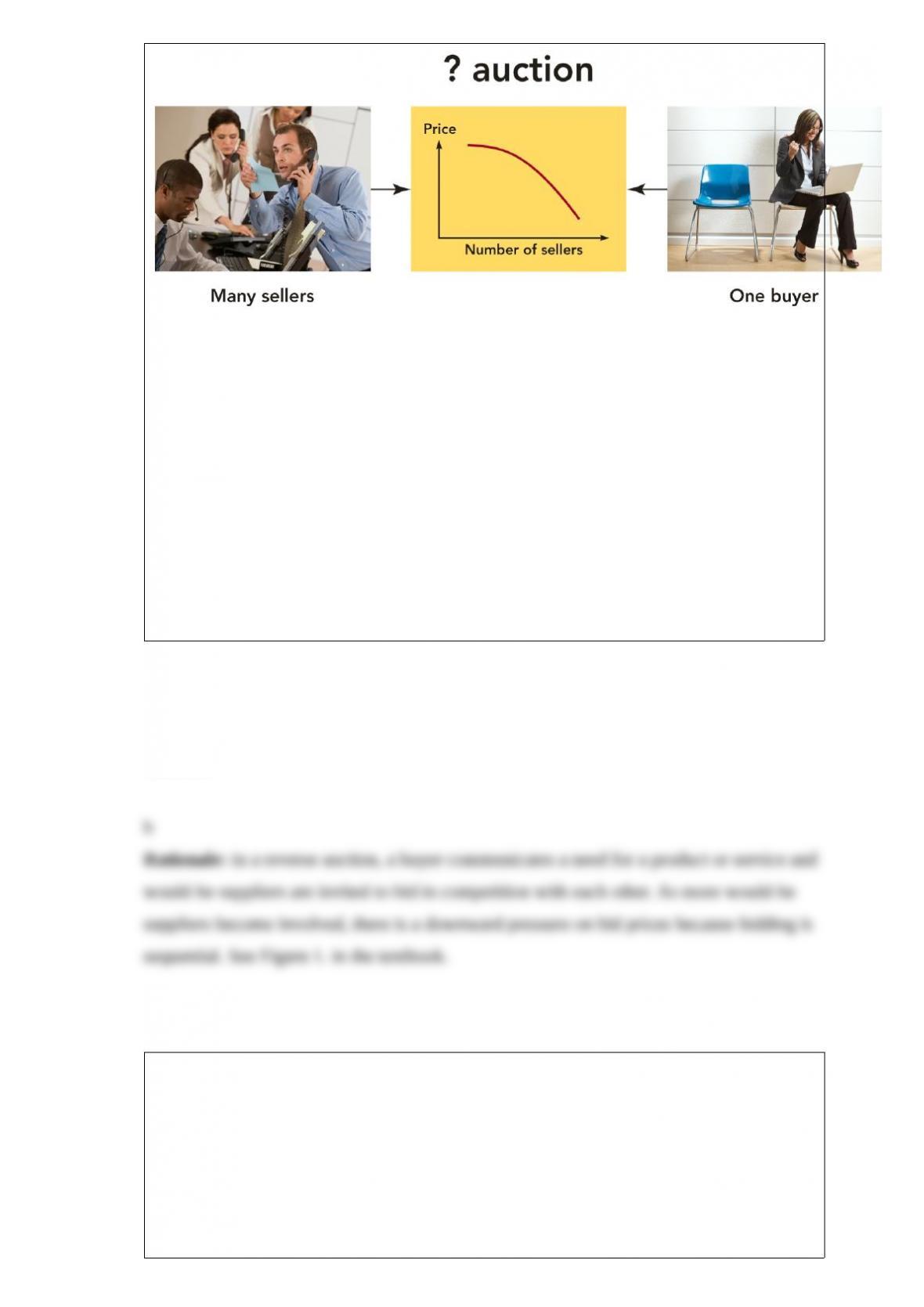
Figure 1.b
As shown in Figure 1.b above, what type of online auction do one buyer and many
sellers typify?
a. forward auction.
b. reverse auction.
c. traditional auction.
d. vertical auction.
e. bidder’s war.
Answer:
Target return-on-sales pricing refers to
a. adjusting the price of a product so it is “in line” with that of its largest competitor.
b. setting the price of a line of products at a number of different price points.
c. adding a fixed percentage to the cost of all items in a specific product class.
d. setting prices to achieve a profit that is a specified percentage of the sales revenue.
e. setting a price based on a specific annual dollar target profit volume.
Answer:
Sociocultural influences, which affects the consumer purchase decision process, include
all of the following EXCEPT:
a. personal influence
b. reference groups
c. family influences
d. culture and subculture
e. values, beliefs, and attitudes
Answer:
The means by which an advertising message is communicated to the target audience is
through
a. advertising media.
b. reach and frequency.
c. a source.
d. CPM.
e. celebrity spokespeople.
Answer:
The first stage in the hierarchy of effects is __________.
a. interest
b. awareness
c. adoption
d. trial
e. evaluation
Answer:
One of the strengths inherent in the use of the BCG business portfolio analysis is that it
a. is based solely on company perception rather than actual data.
b. considers all factors that might impact an SBU’s value to an organization.
c. acts as a strong motivational tool for employees in SBUs that have been labeled
“dogs” or “question marks.”
d. forces a firm to place each of its SBUs in the growth-share matrix, which in turn
suggests which SBUs will be cash producers and cash users in the future.
e. identifies specific marketing strategies and marketing tactics on how to solve SBU
shortcomings.
Answer: