A mission statement includes all of the following elements EXCEPT:
a. short-term.
b. inspirational.
c. clear.
d. meaningful.
e. concise.
Answer:
Balance of trade refers to
a. the sum of all a nation’s imports and exports.
b. the difference between the monetary value of a nation’s exports and imports.
c. the comparison of total exports from one country to another.
d. the difference between projected sales and actual sales for a nation’s exports.
e. the state of equilibrium when two neighboring nations participate in countertrade.
Answer:
According to the Same-Store Sales Growth Marketing Dashboard above, which retailer
has the greatest same-store sales growth?
a. Target
b. Neiman Marcus
c. Apple
d. Best Buy
e. Tiffany
Answer:
Lands’ End will custom fit a Marinac jacket and make it with additional features such as
thumb loops, underarm ventilation slits, and a key clip when you order from
LandsEnd.com. This is an example of
a. family branding.
b. mass customization.
c. “Tiffany/Walmart” marketing.
d. market melding.
e. specialty customization.
Answer:
In marketing, an offering refers to
a. the formal designation of a publicly-traded stock for a specific product, service or
idea.
b. a thing of value between buyer and seller so that each is better off after an exchange
between them.
c. a product, service, or idea that creates value for both the organization and its
customers by satisfying customer needs and wants.
d. the manufacturer’s suggested retail price of a product or service to the general public
or the wholesale price to distributors and retailers.
e. the service suppliers and distributors provide to help manufacturers bring a product to
market.
Answer:
Enhancing a product or service to make it more appealing to buyers is __________
utility.

a. time
b. place
c. possession
d. form
e. transactional
Answer:
One evening while watching TV, your stomach growls. You see an ad for Subway. You
walk to the Subway shop and buy a sandwich, which tastes great. In terms of behavioral
learning, the great taste of the sandwich is a(n) __________.
a. reinforcement
b. achievement
c. drive
d. cue
e. response
Answer:
Comparative advertising, in which one brand is compared to another, is intended to
cause consumers to perceive differences between the products featured in the
advertising. Marketers who use comparative advertising are trying to use __________
to make consumers believe that its product is better than a competitor’s offering.
a. cognitive dissonance
b. selective retention
c. selective comprehension
d. stimulus generalization
e. stimulus discrimination
Answer:
Which of the following statements about services is MOST accurate?
a. Although a major contributor to the GDP nationally, services play only a minor role
in GDP on a global scale.
b. Whether tangible or not, the marketing of services is exactly the same as the
marketing of products or ideas since they both satisfy customer needs.
c. Almost 35% of all jobs created in the United States are in the services sector.
d. In the U.S., more than 47% of the GDP comes from services.
e. There is much more in common with the marketing of services and business products
than there is between the marketing of services and consumer products.

Answer:
A snack vending machine located in a university building that students use between
classes when hungry creates both __________ utility.
a. time and place
b. place and form
c. form and creation
d. possession and form
e. application and place
Answer:
The State of Alabama Board of Tourism ran a series of ads showing traditional families
enjoying various attractions in the state. Since the apparent target of these ads is the
traditional family, it appears that the State of Alabama Board of Tourism has segmented
the market using __________ variables.
a. regional
b. demographic
c. socioeconomic
d. geographic
e. psychographic
Answer:
Social responsibility refers to
a. a personal moral philosophy that focuses on the greatest good for the greatest number
by assessing the costs and benefits of the consequences of ethical behavior.
b. a democratic consensus of moral principles and laws that govern the behavior of
individuals based on legislation adopted at the federal, state, and local levels.
c. a societal moral philosophy based on the Golden Rule of the Judeo-Christian ethic
found in the U.S. Constitution’s Bill of Rights.
d. the view that organizations are part of a larger society and are accountable to that
society for their actions.
e. a personal moral philosophy that considers individual rights or duties as universal,
regardless of the outcome.
Answer:
The European Union (EU) has created abundant marketing opportunities because it is
no longer necessary to
a. print material in multiple languages.
b. continually monitor currency exchange rates.
c. trade with the former Eastern European communist countries.
d. obey international trade regulations.
e. use the American dollar as an economic standard.
Answer:
All of the following statements are true EXCEPT:
a. Only 21 percent of American households consist of married couples with children.
b. Parents close to retirement typically refuse to allow their parents or children to move
in with themthey like their “empty nest” lifestyle.
c. The increase in unmarried partner households is likely due to the current economic
downturn.
d. Today, most divorced couples choose to remarry rather than remaining in single
person households, with or without children.
e. Currently, many young people are postponing marriage and parenthood.
Answer:
Depth of product line refers to
a. the percentage of goods stored as inventory.
b. the variety of different product a store carries
c. variations in price and color on specific items in a store.
d. the number of items available within a product line.
e. the number of different product classes owned by a corporate chain.
Answer:
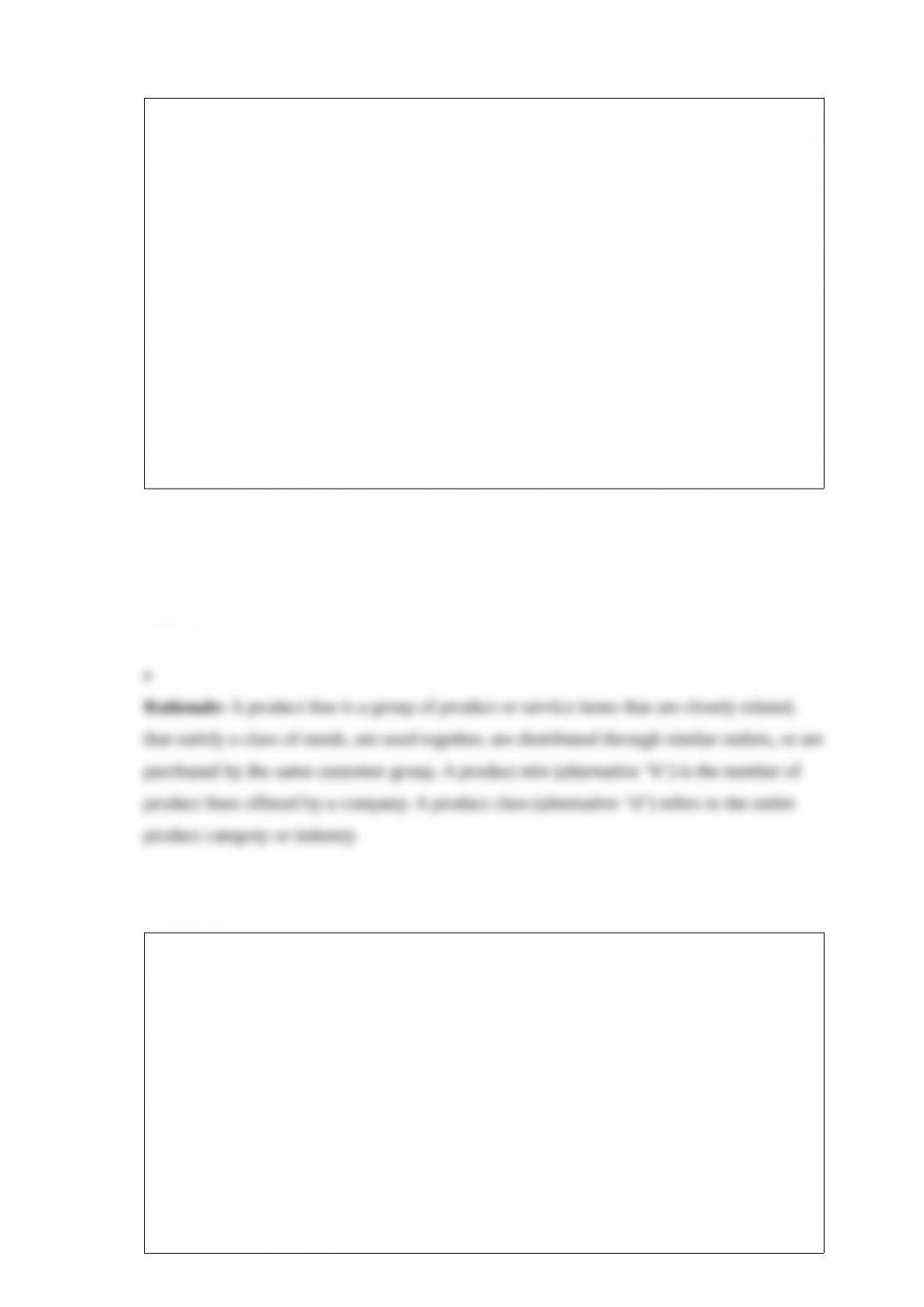
Figure 1.

In Figure 1. above, the market-product grid labeled “E” illustrates which of the
following market-product strategies?
a. full coverage
b. market specialization
c. product specialization
d. selective specialization
e. market-product concentration
Answer:
The Latin phrase caveat emptor is a legal concept that means
a. “Cash on delivery.”
b. “Let the buyer beware.”
c. “Let’s make a deal.”
d. “Don”t take any wooden nickels.”
e. “Such is life.”
Answer:
During a recent shopping trip to a local Target store, Pat noticed several things. First,
she noticed that the store offered a tremendous variety of products, including toys; pet
food; clothing for men, women, and children; health and beauty aids; small household
appliances; automotive products; and more. Each product grouping at Target is an
example of a(n) __________.
a. product item
b. product mix
c. industry
d. product class
e. product line
Answer:
Which of the following statements regarding the promotional mix is most accurate?
a. For maximum impact, funding for promotions should be equally divided among the
five elements of the promotional mix.
b. The promotional mix can be influenced by the product’s life cycle, characteristics of
the product, purchase decision stage of the buyer, and the channel of distribution.
c. Regardless of which other elements are selected, advertising must be included in
every promotional decision in order for an IMC campaign to be successful.
d. Decisions regarding the promotional mix should be left to each manager in the
marketing department who knows best what to do for his or her own specialty.
e. It is not necessary to have a coordinated goal for an IMC campaign provided each
department has a goal of its own.
Answer:
In applying its innovation strategy to “involve some consumers in product design as
soon as we have the concept,” __________ launched ____________ in 2012. It is “a
revolutionary three-chamber dose that cleans, fights stains, and brightens” laundry.
a. Nestl; Oxi Clean 2.1
b. Arm & Hammer; Clean Burst
c. Procter & Gamble; Tide Pods
d. S.C. Johnson & Sons; Shout
e. Unilever; Wisk
Answer:

When a seller puts an item up for sale and would-be buyers are invited to bid in
competition with each other, it is referred to as a(n) __________.
a. reverse auction
b. traditional auction
c. bidder’s war
d. e-auction
e. Webfront auction
Answer:
Marketers use social media to reach the important market of college-age students
because
a. of their discretionary spending.
b. only a small percentage of students check their Facebook pages.
c. Internet advertising is ineffective with this age group.
d. these media are less effective than print and TV advertising.
e. rebellious students reject the brands their parents buy.
Answer:
Changes in the products Americans buy and sell, additional jobs, and an improved
standard of living are all effects of
a. an increase in imports and an increase of exports.
b. an increase in imports and a decrease in exports.
c. a decrease in imports and a decrease in exports.
d. a state of equilibrium between imports and exports.
e. the reversal of importance between the services sector and the manufacturing sector.
Answer:
Equipment-based services like ATMs, online brokerage firms, and automated car
washes, do not have the marketing concerns of
a. inconsistency.
b. intangibility.
c. inseparability
d. inventory.
e. deliverability.
Answer:
In a snack vending machine, consumers can choose one of up to of 20 choices. These
snacks are
a. an ideal example of unitary demand.
b. likely to have a price elasticity equal to 1.
c. more likely to be price elastic.
d. likely to have a price elasticity less than 1.
e. more likely to be price inelastic.
Answer:
At which step of the planning stage of the strategic marketing process does a firm
develop its marketing mix?
a. situation analysis
b. goal setting
c. marketing program
d. sales forecasting
e. market segmentation
Answer:
What is the marketing research term for the specific, measurable goals the
decision-maker seeks to achieve in conducting the marketing research?
a. research constraints
b. research objectives
c. research decisions
d. measures of success
e. marketing conjectures
Answer:
Merchants such as the Burlington Coat Factory sell brand-name merchandise at lower
than regular prices. As such, they are using a(n)
a. off-price retailing strategy.
b. markdown pricing strategy.
c. everyday fair pricing strategy.
d. everyday low pricing strategy.
e. maintained markdown pricing strategy.
Answer:
The marketing metrics related to a retailer’s products or merchandise include all of the
following EXCEPT:
a. the cost of carrying inventory.
b. the inventory turnover.
c. the average number of items per transaction.
d. the number of returns.
e. the average length of a store visit.
Answer:
In which sales budgeting approach is the amount of money spent based on past or
anticipated sales?
a. competitive parity
b. all-you-can-afford
c. objective and task
d. percentage of sales
e. relative scale
Answer:
The two major aspects of the evaluation phase of the strategic marketing process are
a. segmenting the market and selecting target markets.
b. establishing a business mission and designing measurable goals and objectives.
c. designing the marketing mix and setting the budget.
d. comparing the results of the marketing program with the goals in the written plans to
identify deviations and to act on them.
e. executing the marketing plan and designing the marketing organization.
Answer:
Fixed cost refers to
a. the sum of the expenses of the firm that vary directly with the quantity of a product
that is produced and sold.
b. the total expense incurred by a firm in producing and marketing a product, which
equals the sum of overhead cost and variable cost.
c. the sum of the expenses of the firm that are stable and do not change with the
quantity of a product that is produced and sold.
d. the average amount of money received for selling one unit of a product or simply the
price of that unit.
e. the sum of the expenses of the firm that vary directly with the quantity of a product
that is produced and sold.
Answer:
Another name for multiproduct branding is __________.
a. mixed branding
b. uniform branding
c. corporate branding
d. co-branding
e. agent licensing
Answer:
New-product experts generally estimate that up to __________ percent of the more than
40,000 new consumable products introduced in the United States annually “don”t
succeed in the long run.”
a. 33
b. 50
c. 67
d. 75
e. 94
Answer: