Four key challenges that package and label designers face include: (1) connecting with
customers; (2) environmental concerns; (3) health, safety, and security issues; and (4)
__________.
a. social and societal issues
b. competition from global markets
c. cost reduction
d. governmental regulations
e. diminishing color, symbol, and trademark selections
Answer:
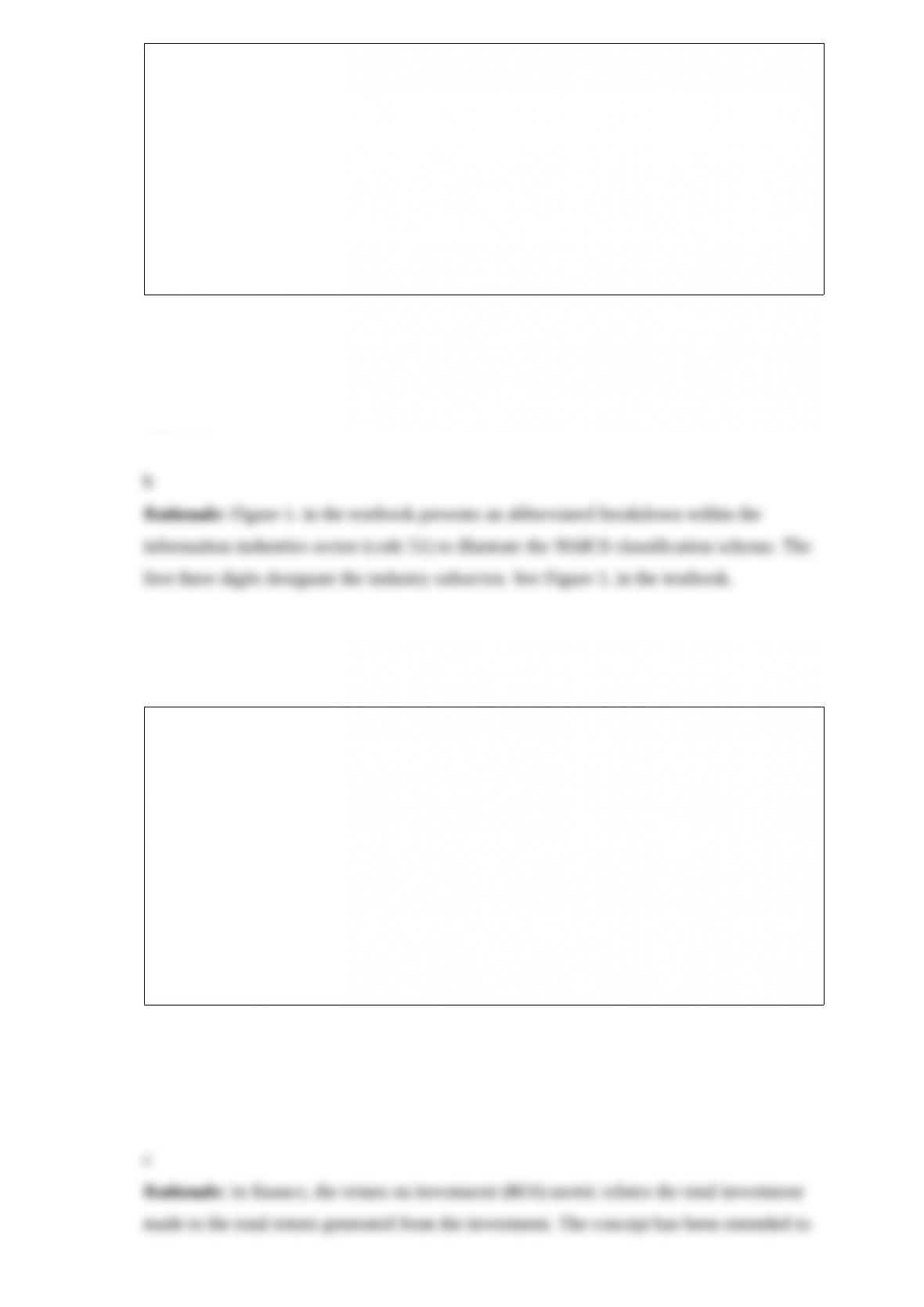
Figure 1.
In the breakdown for the NAICS code based on Figure 1. above, “A” represents the
a. two-digit industry sector code
b. three-digit industry subsector code
c. four-digit industry group code
d. five-digit industry code
e. six-digit U.S. national industry code
Answer:
Marketing ROI (return on investment) is an extension of __________.
a. marginal analysis
b. marketing audits
c. ROI in finance
d. Six Sigma
e. the strategic marketing process
Answer:
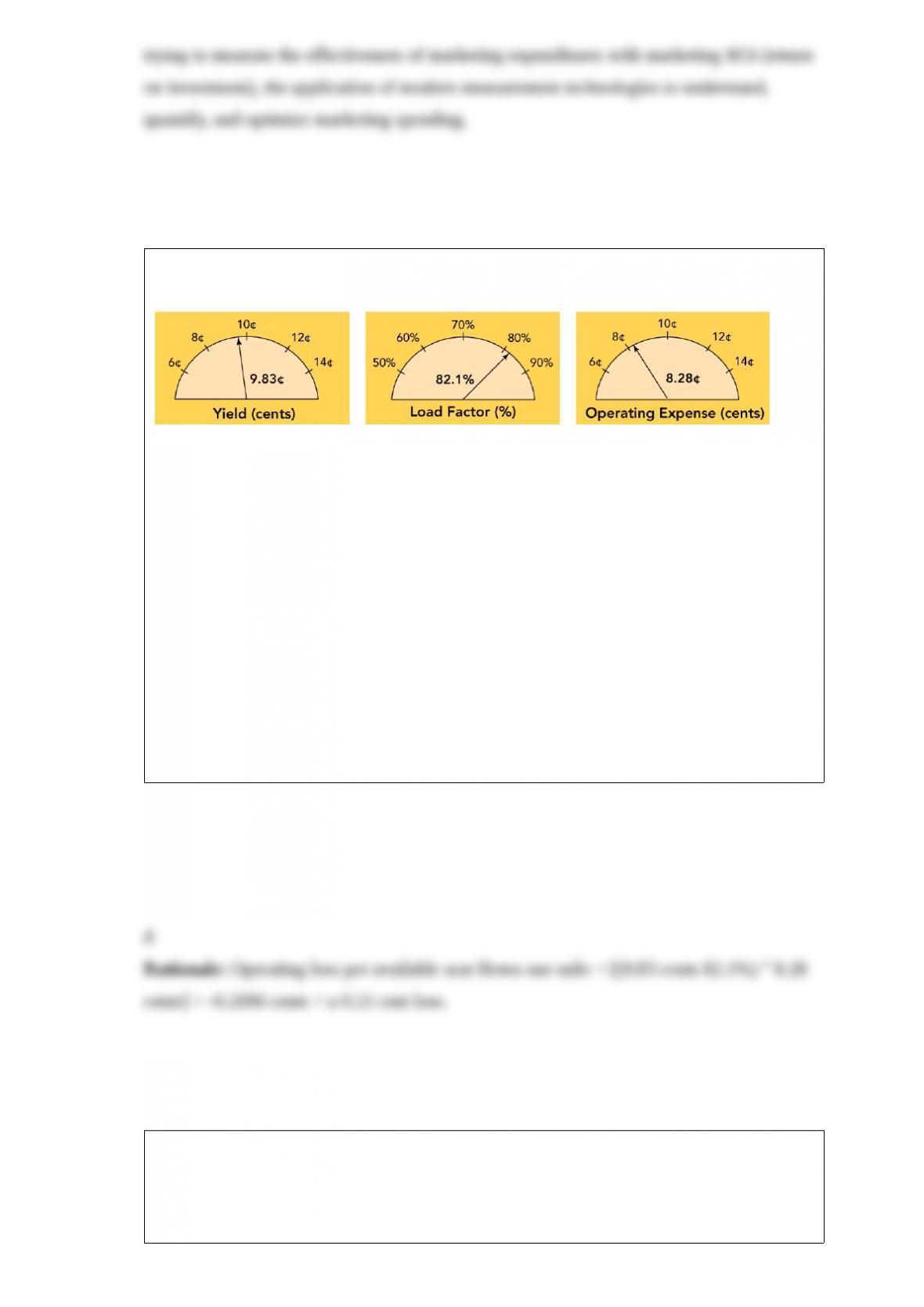
Capacity Management Marketing Dashboard
The marketing dashboard for JetBlue Airways shown in the capacity management
marketing dashboard above indicates that JetBlue posted a(n) __________ profit/loss
per available seat flown one mile.
a. 9.83 cent profit
b. 1. cent profit
c. 1. cent profit
d. 0.21 cent loss
e. 8.28 cent loss
Answer:
A study on ethical practices in purchasing found that smaller firms frequently make
agreements with other organizations to purchase each other’s products and services.
This practice is referred to as
a. exclusive dealing.
b. supply partnerships.
c. reciprocity.
d. strategic alliances.
e. tying arrangements.
Answer:
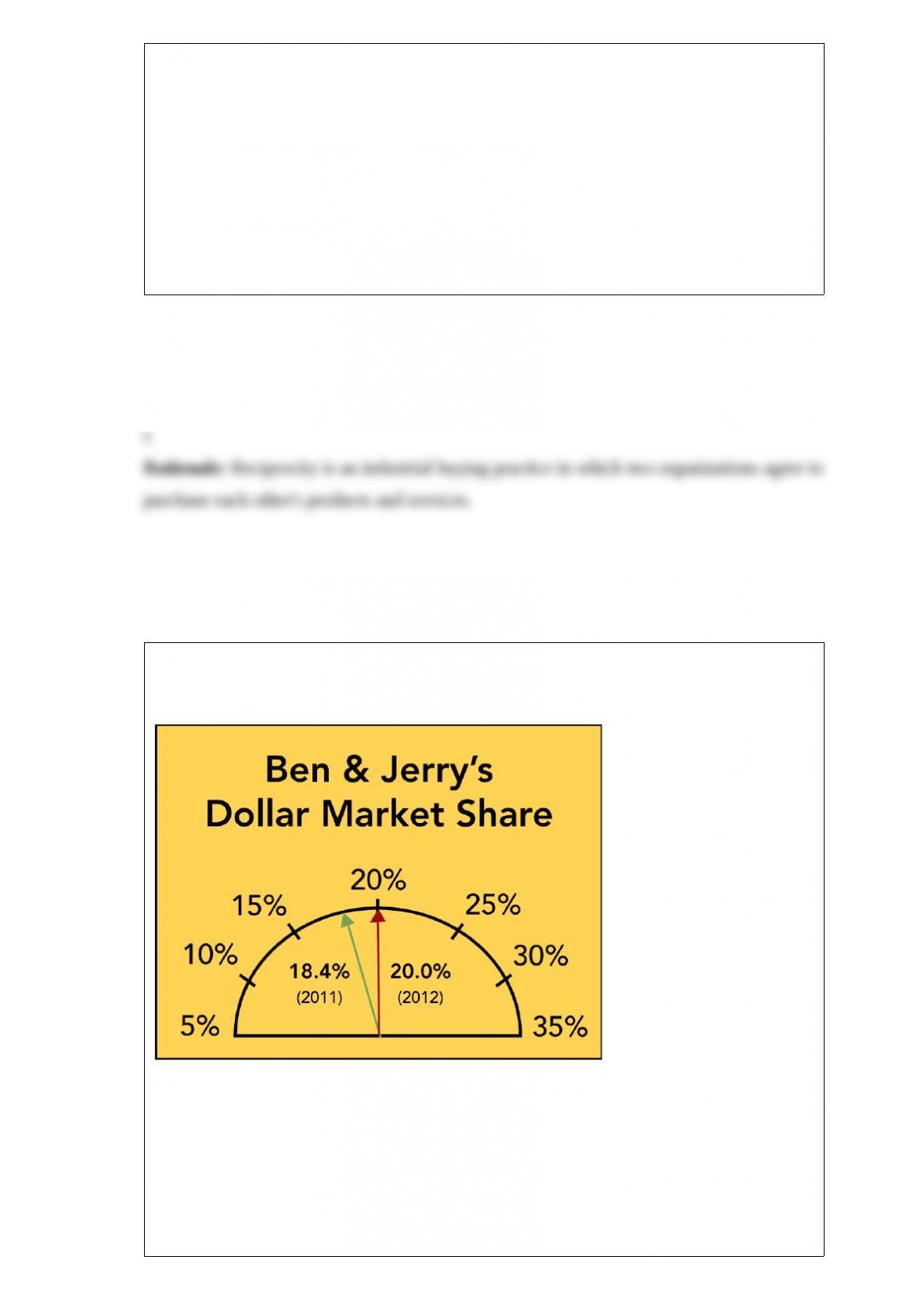
Ben & Jerry’s Marketing Dashboard (Dollar Market Share)
A marketing manager for Ben and Jerry’s has been provided with a marketing
dashboard display shown above. He notices that dollar market share for 2011 was
18.4% and for 2012 it was 20.0%. What simple formula was used to calculate the dollar
market share percentages for each of these two years?
a. Dollar market share (%) = Ben and Jerry’s sales ($) divided by total industry sales
($).
b. Dollar market share (%) = Total industry sales ($) divided by Ben and Jerry’s sales
($).
c. Dollar market share (%) = Total industry sales ($) divided by Ben and Jerry’s unit
sales (#).
d. Dollar market share (%) = Total industry sales ($) divided by Ben and Jerry’s net
profit ($).
e. Dollar market share (%) = Ben and Jerry’s sales ($) divided by gross domestic
product ($).
Answer:
Which of the following products has the brand name that best suggests its benefit
according to the five criteria for selecting a good brand name?
a. Spam canned meat
b. Ken’s salad dressing
c. Formula 409 cleaner
d. Match Light charcoal
e. Bayer aspirin
Answer:
Plastics Net, Hospital Network.com, Textile Web, and eBay Business are all examples
of
a. Webfront operations.
b. clicks-and-mortar stores.
c. e-marketplaces.
d. iMarkets.
e. integrated markets.
Answer:
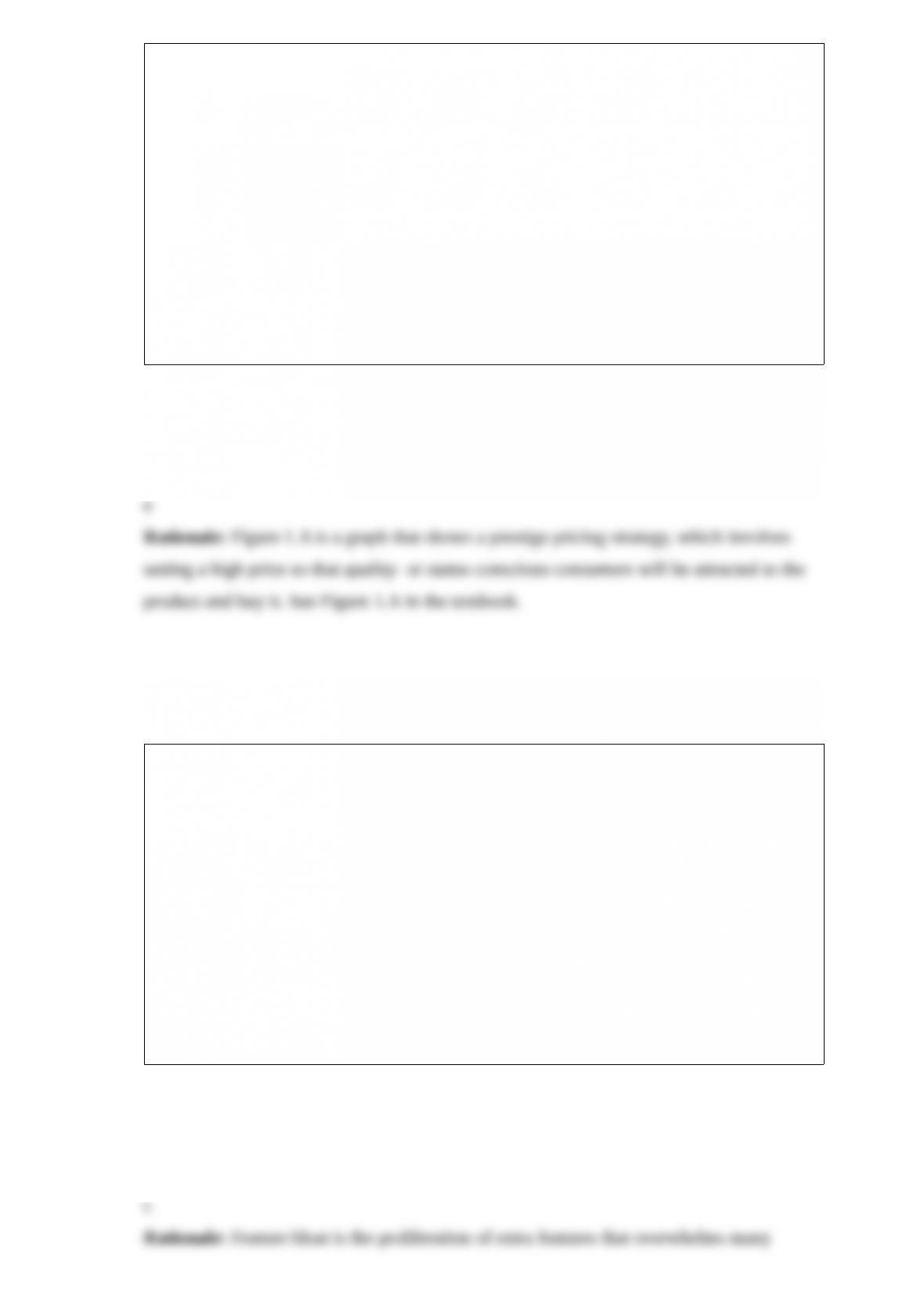
Figure 1.A
Figure 1.A above is a graph that shows which pricing strategy?
a. skimming
b. penetration
c. cost-plus
d. price lining
e. prestige
Answer:
The proliferation of extra features that overwhelms many consumers with
mind-boggling complexity is referred to as
a. sensory overload.
b. product line extension.
c. feature bloat.
d. feature overkill.
e. product differentiation.
Answer:
A unique feature of the Robinson-Patman Act is that it allows for price differentials to
different customers under several conditions. Which of the following practices would
be permitted?
a. Using price differentials when price differences charged to different customers do not
exceed the differences in the cost of manufacture, sale, or delivery resulting from
different methods or quantities in which such goods are sold or delivered to buyers.
b. Using price differentials when price differences are given on the basis of other family
businesses.
c. Using price differentials when charging different prices to different buyers for goods
of like grade or quality.
d. Using price differentials when charging different prices on the basis of religious
affiliation.
e. Using price differentials when charging the original price for refurbished goods that
have been damaged or used and returned but repaired according to company
specifications.
Answer:

Charging different prices to maximize revenue for a set amount of capacity at any given
time is referred to as
a. demand backward pricing.
b. target pricing.
c. skimming pricing.
d. yield management pricing.
e. penetration pricing.
Answer:
Introducing the champion at medical conventions across Asia to demonstrate its many
beneficial features is an example of Medtronic’s
a. market segmentation and targeting strategy
b. price strategy
c. place strategy
d. promotion strategy
e. product/service strategy
Answer:
How would consumers who purchased a new and innovative Nike LunarGlide+ 3
running shoe try to reduce any cognitive dissonance they feel?
a. use only an internal information search
b. have little or no problem solving involvement
c. read ads for the new running shoe even after the purchase has been made
d. use routine problem solving
e. If the shoe is comfortable and gives the requisite support, there will be no cognitive
dissonance.
Answer:
The types of products Mary Kay, Inc. offers to its women customers are __________
products.
a. fad
b. low-learning
c. skin-care
d. trading-down
e. brand-licensed
Answer:
An advertising message usually focuses on the __________that is/are important to a
prospective buyer in making trial and adoption decisions.
a. emotional aspects
b. price
c. psychological aspects
d. financial risks
e. key benefits of the product
Answer:
Visitors to the Universal Studios theme park can borrow one of three user-controlled
webcams to take pictures of the park and themselves enjoying the park. Then the
webcam users can e-mail the pictures to their friends. The average webcam user sends
four e-mails to friends, which has resulted in more than 6 million park images being
sent to potential visitors. Universal Studios is using __________ to promote its theme
park.
a. viral marketing
b. opt-out marketing
c. customerization
d. niche marketing
e. buzz marketing
Answer:
At which point of the organizational buying decision process would a firm use a formal
vendor rating system to evaluate the quality of the vendor’s product and customer
service?
a. problem recognition
b. information search
c. purchase decision
d. postpurchase behavior
e. performance review
Answer:
Usage of specialty catalogs, like those from firms like IKEA, Crate and Barrel, and
L.L.Bean have been affected by all of the following factors except:
a. influence of larger retailers as their marketing activities have increased the number
and variety of products consumers purchase through direct mail and catalogs.
b. higher paper costs, increase in postage rates, and the possibility of the U.S. Postal
Service reducing delivery to five days a week.
c. growing interest in do-not-mail legislation.
d. concern for “green” mailings and catalogs.
e. growing influence of television home shopping where consumers order over the
telephone.
Answer:
Barter is the practice of exchanging products and services for other products and
services rather than for ___________.
a. value
b. ideas
c. promises
d. tariffs
e. money
Answer:
Competitive pressures among existing firms depend on
a. the current economic growth rate.
b. the total number of established competitors.
c. low fixed costs.
d. the rate of industry growth.
e. the availability of raw materials and natural resources.
Answer:
In terms of promotion, which of the following types of products would stress price,
availability, and awareness?
a. shopping
b. convenience
c. specialty
d. unsought
e. supplies
Answer:
Publicity tools refer to
a. methods of tying charitable contributions of a firm directly to the customer revenues
produced through the promotion of one of its products.
b. methods used to get a nonpersonal, directly paid presentation of a company or its
products.
c. short-term inducements of value offered to arouse interest in buying a product or
service.
d. methods of obtaining nonpersonal presentation of an organization, product, or service
without direct cost.
e. free space or time donated by the media.
Answer:
Which of the following statements regarding the maturity stage of the product life cycle
is MOST accurate?
a. Marketing emphasis is directed towards generating more consumer awareness.
b. Marketing emphasis switches to finding more channel intermediaries to carry the
product.
c. Marketing emphasis aims at stimulating primary demand for the product.
d. Marketing attention is directed toward holding market share through further product
differentiation and finding new buyers.
e. Marketing emphasis is directed towards having salespeople allocate less time to
selling the product.
Answer:
Which of the products in the Generics photo above is least likely, at this point in time,
to be concerned with having its name become generic?
a. Kleenex because most people just ask for a tissue.
b. Jell-O because there are not other gelatin desserts.
c. All Sport Disk because most people call it a Frisbee.
d. Q-Tips because most people call it a cotton swab.
e. Vaseline because most people refer to it as petroleum jelly.
Answer:
The recent large decline in __________ has had a psychological impact on consumers
who tend to spend more when they feel their net worth is rising and postpone purchases
when it declines.
a. automobile prices
b. fuel prices
c. the number of people competing for jobs
d. consumer confidence
e. property values
Answer:
In choosing the appropriate marketing channel, a firm should consider the interests that
buyers might want fulfilled. These interests fall into four broad categories: (1)
__________; (2) convenience; (3) variety; and (4) pre- or postsale services.
a. profitability
b. information
c. quality
d. brand name recognition
e. availability
Answer:
A major grocery chain pays its baggers a regular hourly wage. The baggers not only
pack the groceries, they will take customers’ groceries to their car, regardless of the
weather. The baggers are not permitted to accept tips, even if they are offered. This
carryout service is an example of
a. pricing enhancement.
b. societal pricing.
c. revenue sharing.
d. value-pricing.
e. cost-pricing.
Answer:
Brand licensing refers to __________.
a. the registration fee paid by a manufacturer to states, provinces, or countries in order
to sell its products there
b. a branding strategy in which the producer dictates the brand name to retailers for the
products sold to their respective markets
c. a branding strategy in which a company uses one name for all of its products
d. a contractual agreement whereby a company allows another firm to use its brand
name, patent, trade secret, or other product for a royalty or fee
e. a branding strategy in which manufacturers produce products but sell them under the
brand name of a wholesaler or retailer
Answer:
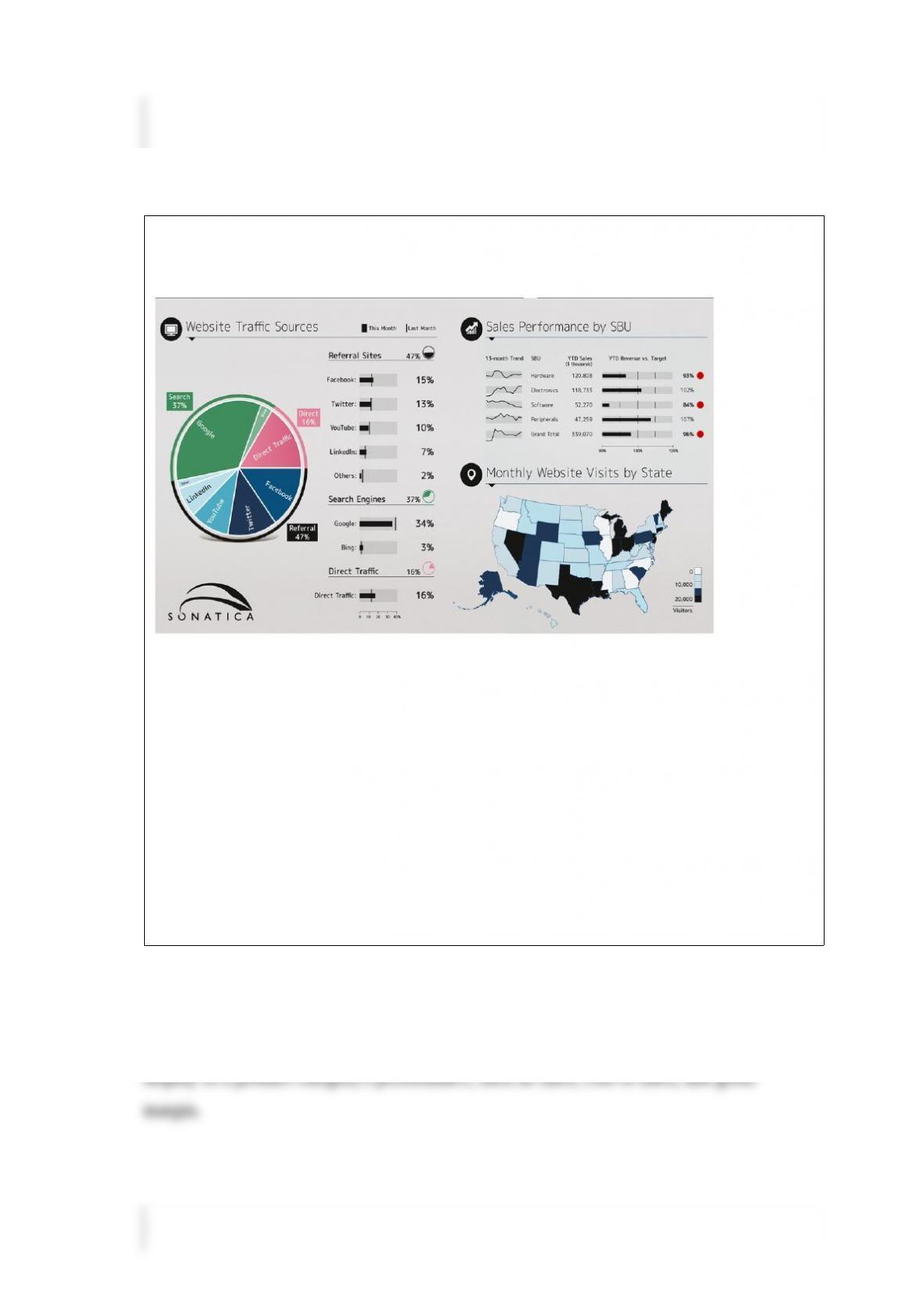
Figure 1.
According to Figure 1. above, the image shown is an example of a(n)
a. Gantt chart.
b. marketing dashboard.
c. Pert chart.
d. marketing gauge.
e. operations spreadsheet.
Answer:
One advantage of using the Internet as an advertising medium is
a. there is no need to segment markets.
b. messages are automatically translated into multiple languages.
c. initial encoding is easily outsourced.
d. online ads almost always result in a “click,” an action that leads to the purchasing of
a product.
e. it can use animation to capture attention.
Answer:
The dimension of service quality called __________ is knowledge and courtesy of
employees and their ability to convey trust and confidence.
a. assurance
b. sympathy
c. empathy
d. responsiveness
e. reliability

Answer:
The final stage in the personal selling process is referred to as __________.
a. presentation
b. assumptive close
c. trial close
d. urgency close
e. follow-up
Answer:
A brand name that cannot be spoken is referred to as a __________.
a. label
b. copyright
c. trade name
d. trade mark
e. logo or logotype
Answer:
If a firm’s marketing dashboard displays a CDI over 100 for a consumer packaged
good, such as General Mills’ Warm Delights Minis, this indicates which of the
following?
a. a weak brand position in a segment
b. a strong brand position in a segment
c. above-average product category purchases by a market segment
d. below-average product category purchases by a market segment
e. There is not enough information to make any conclusions.
Answer:
What are the three major roles of personal selling in a firm’s overall marketing effort?
Answer:
Give at least one argument for and one argument against protectionism.
Answer:
Would you expect the music player (MP3) industry to be highly competitive? Provide
support for your answer using the three components of competition.
Answer:
What is neuromarketing? What does it do? Why is it important to marketers?
Answer:
Explain the four ways the marketspace creates value for consumers.
Answer:
Identify and describe the three phases of the strategic marketing process.
Answer:
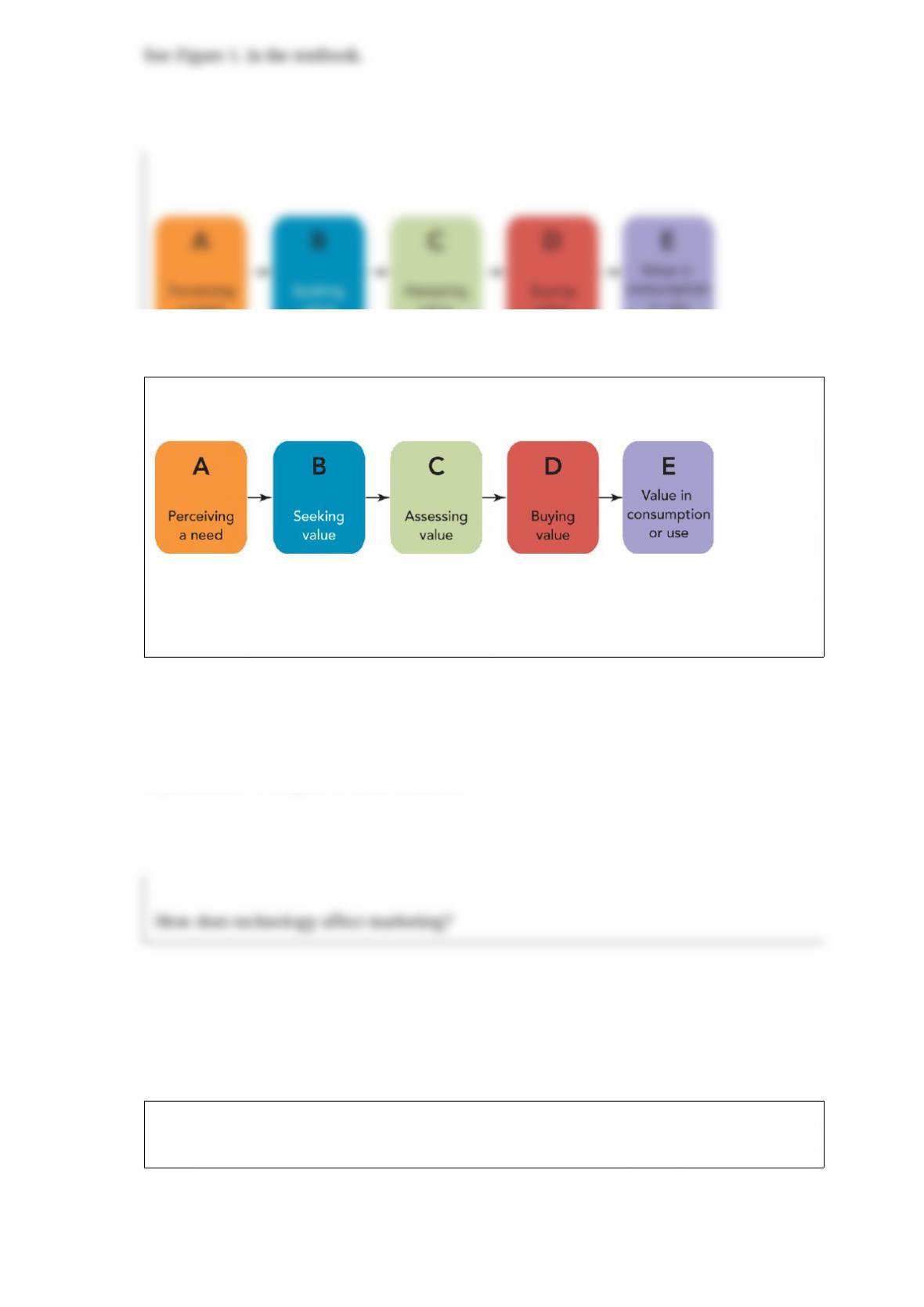
Figure 1.
Identify and explain the five stages of the consumer purchase decision process as shown
in “A,” “B,” “C,” “D,” and “E” in Figure 1. above.
Answer:
How does technology affect marketing?
Answer:
How is management by exception used in the evaluation phase of the strategic
marketing process?
Answer:
Where would potatoes, a photographic studio, and a psychologist fit into the service
continuum?
Answer:
What are the two key objectives of marketing? Define “exchange” and explain how it
supports these objectives.
Answer:
What is publicity? What are the main types of publicity tools? What is the main
objective of each type of tool?
Answer:
Identify each stage of the product life cycle and discuss the role of promotion in the
four stages of the product life cycle.
Answer:
Identify and describe the four branding strategies that product and brand managers use.
Answer:
Define needs and wants. Can marketing shape a person’s wants? Explain your answer.
Answer:
What are the three questions marketing executives consider when choosing a marketing
channel and intermediaries?
Answer:
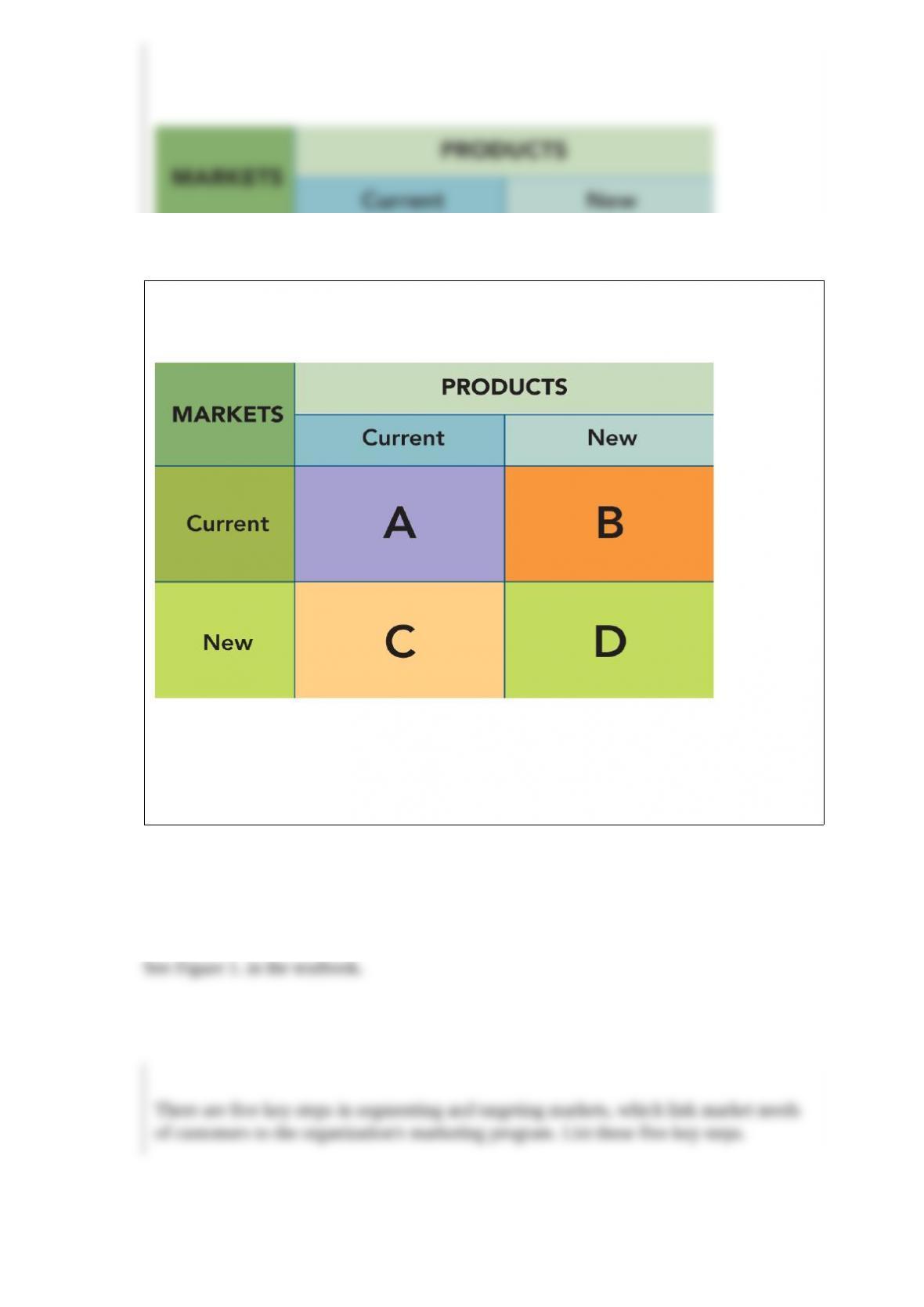
Figure 1.
Based on Figure 1. above, identify and explain each of the four market-product
strategies represented by each quadrant (“A,” “B,” “C,” and “D”) in the diversification
analysis matrix.
Answer:
There are five key steps in segmenting and targeting markets, which link market needs
of customers to the organization’s marketing program. List these five key steps.
Answer:
How do the macroeconomic conditions as well as consumer income affect marketing?
Answer: