
Organizations that decide to franchise (franchisors) have __________ expansion costs
accompanied by __________ control, compared to owning their own retail outlets.
a. greater; greater
b. reduced; reduced
c. greater; reduced
d. reduced; greater
e. greater; about the same
Answer:
The purpose of environmental scanning is to
a. only identify trends in the marketplace.
b. only interpret trends in the marketplace.
c. only forecast trends in the marketplace.
d. identify, interpret, and forecast trends in the marketplace.
e. only identify and interpret trends in the marketplace.
Answer:
__________ is a VALS group that is most likely to visit Internet chat rooms.
a. Believers
b. Makers
c. Experiencers
d. Achievers
e. Innovators
Answer:
An extremely large machine for producing sheet metal from steel ingots would be
classified as which kind of business products?
a. installations
b. finished goods
c. supplies

d. industrial services
e. raw materials
Answer:
In a ___________ situation, users, influencers, or deciders in the buying center want to
change product specifications, price, delivery schedule, or suppliers.
a. new buy
b. straight rebuy
c. make-buy
d. buy class
e. modified rebuy
Answer:
Protectionism refers to
a. the practice of purchasing products exclusively from a domestic market in order to
shore up a nation’s economy.
b. the use of tariffs, quotas, and boycotts with the express intention of putting foreign
competitors out of business.
c. the practice of shielding one or more sectors of a country’s economy from foreign
competition through the use of tariffs or quotas.
d. a form of domestic imperialism that holds that only those products manufactured
within one’s home nation are of sufficient quality to warrant purchase.
e. the practice of purchasing products exclusively from a foreign developing country in
order to develop its industries and economic infrastructure.
Answer:
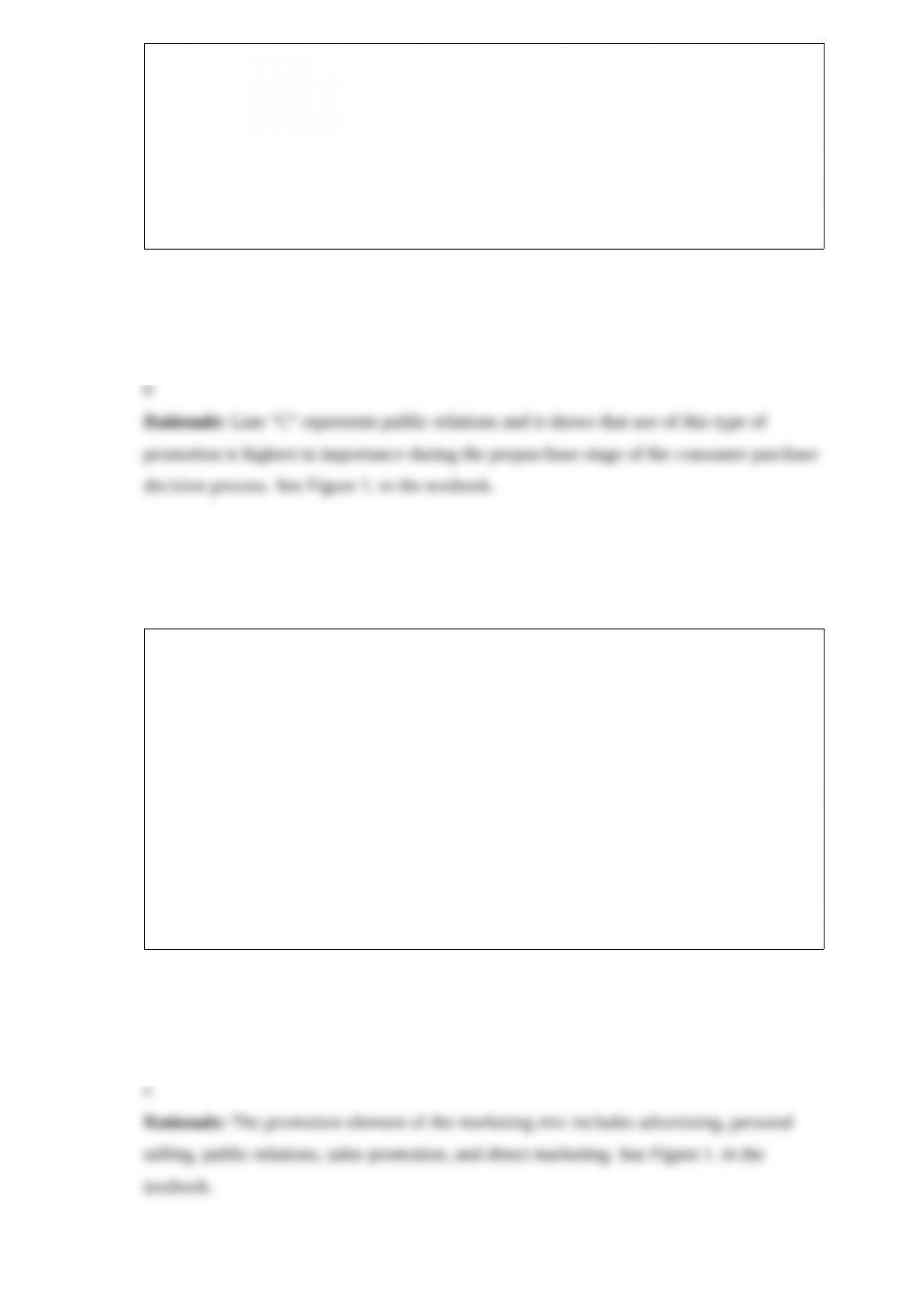
Figure 1.
In Figure 1. above line “C” shows that __________, a tool of the promotion mix, is
highest in importance during the prepurchase stage of the consumer purchase decision
process.
a. advertising
b. public relations
c. communication
d. sales promotion
e. personal selling
Answer:
The __________ element of the marketing mix includes personal selling and sales
promotion.
a. product
b. price
c. promotion
d. place
e. people
Answer:

The acronym “FOB” stands for __________.
a. freight on board
b. free on board
c. freight of buyer
d. forward onto buyer
e. freight owner bonus
Answer:
Which of the following statements regarding social forces is most accurate?
a. Social forces can have a dramatic impact on marketing strategy.
b. As a social force, consumer incomes have more impact on marketing strategy than
demographics.
c. Social forces within an organization motivate employees to improve their
productivity.
d. Social forces determine all the other environmental forces that affect an organization.
e. Of all the environmental forces, social forces are the easiest for a marketer to
manipulate.
Answer:

Market segmentation refers to
a. the philosophy that to do a truly excellent job of marketing, a company should
concentrate only one customer segment at a time.
b. aggregating prospective buyers into groups that have common needs but who
respond differently to a marketing action.
c. aggregating prospective buyers into groups that have common needs and will respond
similarly to a marketing action.
d. disaggregating prospective buyers from groups into segments of one (individuals)
and creating or designing specific products that will satisfy each individual’s unique
needs.
e. the belief that it is possible to satisfy every customer’s needs if you can identify the
correct segment within which they belong.
Answer:
Emphasizing consistently low prices and eliminating most markdowns is referred to as
__________.
a. low-margin pricing
b. everyday low pricing
c. everyday fair pricing
d. value-based pricing

e. maintained pricing
Answer:
Multicultural marketing refers to combinations of the marketing mix that reflect the
unique attitudes, ancestry, communication preferences, and lifestyles of different
__________.
a. races
b. nations
c. religions
d. generational cohorts.
e. genders.
Answer:
When establishing product line pricing, the lowest-priced item is typically positioned as
a. the youngest product item in the line.
b. the smallest-selling product item in the line.

c. the lost-cost item in the line in terms of quality and features.
d. the profit leader for the rest of the product line.
e. the traffic builder designed to capture the attention of hesitant or first-time buyers.
Answer:
A retailer purchased a gross of silk shells each costing exactly $17 apiece. Although the
only difference between the shells was color, when they were put on the floor, the
primary colors were marked $25, the pastel colors were marked $28, and the
black-and-white shells were marked $30. These prices were set most likely because
a. retailers using a price lining strategy will occasionally mark up items based on color,
style, and expected consumer demand.
b. fewer people buy black-and-white shells, so the retailer has to charge a higher price
to break even.
c. the retailer is using prestige pricing; black-and-white shells are more elegant.
d. the primary colors were priced using a penetration strategy, the pastels were priced
using a skimming strategy, and the black-and-white shells were priced using prestige
pricing.
e. price lining is essentially the same as above-, at-, or below market pricing.
Answer:

Deliberately selling a product below its customary price, not to increase sales, but to
attract customers’ attention in hopes that they will buy other products as well, is referred
to as
a. loss-leader pricing.
b. bundle pricing.
c. magnet pricing.
d. predatory pricing.
e. below-market pricing.
Answer:
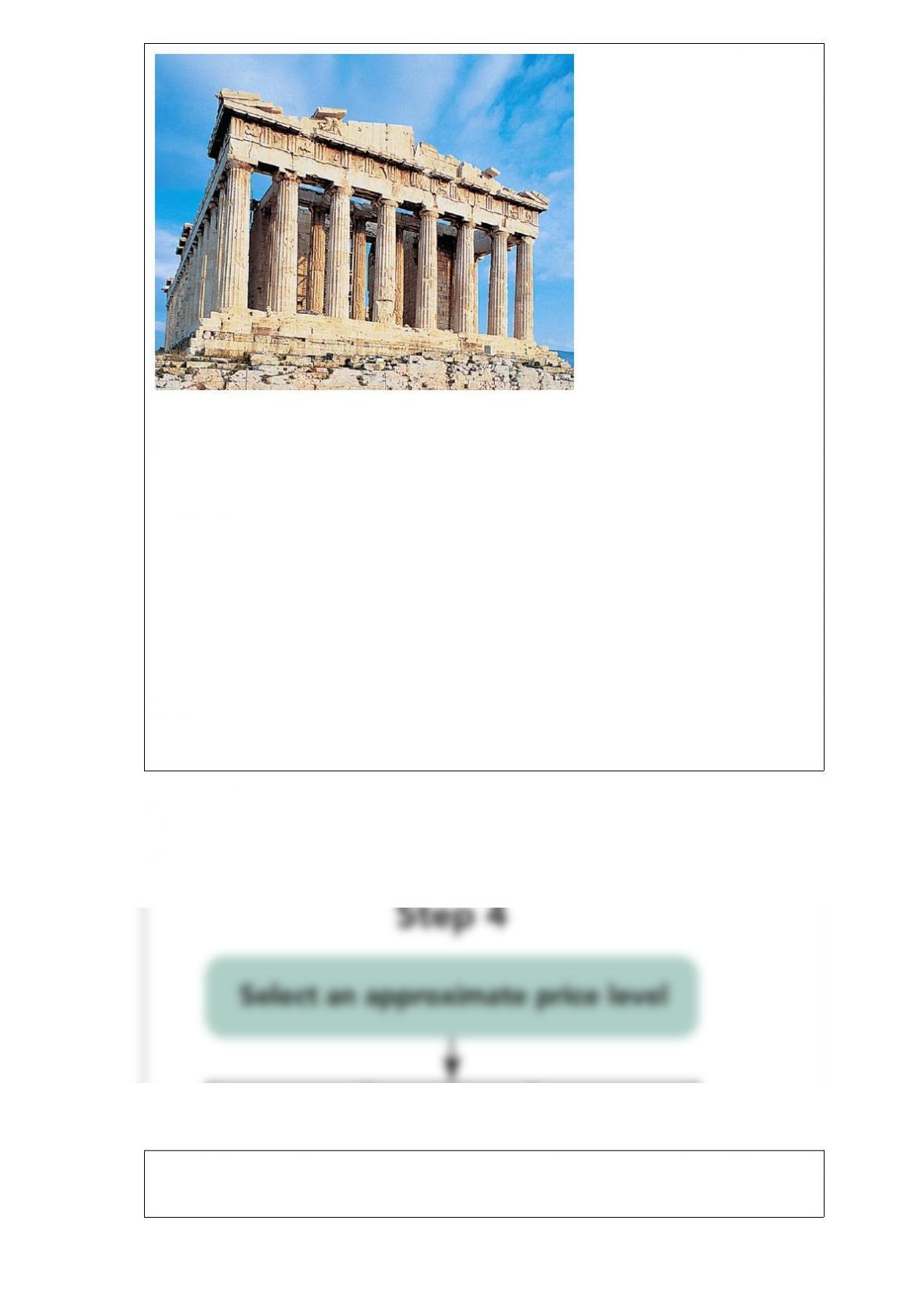
Parthenon Photo
The Parthenon, shown in the photo above, evokes strong feelings from consumers in
Greece. As a result, marketers must be mindful in accessing the meaning of this
__________ when developing marketing programs to reach consumers of a specific
country.
a. cultural symbol
b. secret codes
c. back translations
d. semantic symbolisms
e. semiotics
Answer:
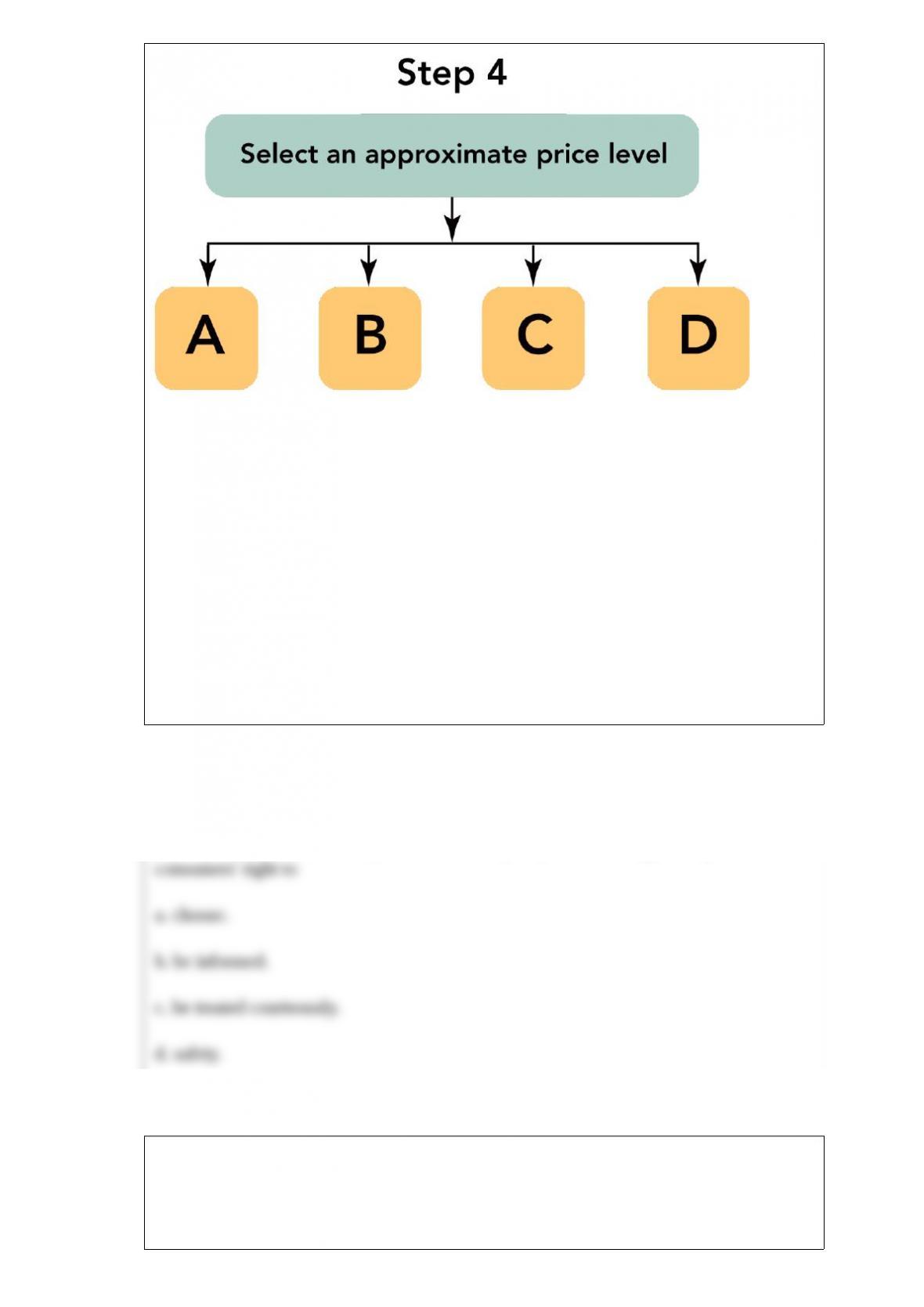
Figure 1.
Figure 1. above represents the four approaches to selecting an appropriate price level.
“B” represents which approach?
a. demand-oriented approach
b. profit-oriented approach
c. competition-oriented approach
d. results-oriented approach
e. cost-oriented approach
Answer:
The Children’s Online Privacy Protection Act (1998) is a law designed to protect
consumers’ right to

a. choose.
b. be informed.
c. be treated courteously.
d. safety.
e. be heard.
Answer:
Economists have identified four types of competitive markets, which are
a. capitalistic, monopolistic, socialist, and communist.
b. pure monopoly, monopolistic competition, oligopoly, and pure competition.
c. free market, restrained market, government-regulated, and command economy.
d. market economy, command economy, traditional economy, and controlled economy.
e. open market, consumer-dominated market, service market, and product market.
Answer:

A __________ is very important to the process aspect of services because it helps
identify steps that will ultimately lead to better service creation and delivery processes.
a. customer contact audit
b. internal marketing review
c. tangibility gap analysis
d. service continuum
e. consumer experience audit
Answer:
According to the American Cancer Society, 57,000 Americans a year die from colon
cancer. Regular screening is recommended after age 50. Because colonoscopies are
dreaded by many, the American Cancer Society created an ad campaign featuring “Mr.
Polyp Man” to lightheartedly encourage people to get tested for colon cancer. The
red-suited character looks like a harmless, animated M&M. This is an example of a
_________ appeal.
a. humorous
b. cognitive
c. rhetorical
d. fear
e. sex
Answer:
“To inform” is the promotional objective of which stage of the product life cycle?
a. early growth
b. growth
c. accelerated development
d. maturity
e. introduction
Answer:
You have been told that a company increased its marketing effort from $2 million to $5
million, resulting in increased sales revenue from $12 million to $21 million. Calculate
the company’s ratio of incremental sales revenue to incremental marketing effort.
a. 3:1
b. 1:3

c. 8:5
d. 5:2
e. 21:12
Answer:
In a(n) __________ economy, the cost to produce and buy products and services
escalates as prices increase.
a. inflationary
b. deflationary
c. stagflationary
d. recessionary
e. depressive
Answer:

The sales process at Xerox typically follows the six stages of the personal selling
process. During the second stage, the salesforce prepares for a presentation by
__________.
a. having a cross-functional team conference before each customer encounter
b. preparing state of the art presentations about the newest Xerox printer technologies
c. familiarizing themselves with the potential client and its document needs
d. secretly visiting the client as a “mystery shopper” to uncover any potential problems
of which the firm may be unaware
e. role-playing different possible scenarios that might occur during the actual sales
presentation
Answer:
If you read a chapter from your marketing textbook the night before this test and still
cannot remember the correct marketing term to answer this question, it may very well
be the result of
a. selective retention.
b. selective comprehension.
c. selective exposure.
d. selective perception.
e. subliminal perception.

Answer:
The four steps in the sequential process of building the brand equity pyramid include:
(1) developing positive brand awareness; (2) establishing a brand’s meaning in the
minds of consumers; (3) __________; and (4) creating a consumer-brand connection.
a. forming a brand personality
b. easing consumers’ decision making
c. developing brand licensing criteria
d. rewarding loyal customer behavior
e. eliciting the proper consumer responses to a brand’s identity and meaning
Answer:
When a producer owns an intermediary at the next level down in the marketing channel,
it is referred to as __________.
a. backward integration
b. forward integration

c. vertical integration
d. lateral integration
e. horizontal integration
Answer:
Which generational cohort is interested in distinctive, memorable, and personal
experiences?
a. baby busters
b. Generation Y
c. baby boomers
d. Generation X
e. Generation Z
Answer: