
Irene has been saving up and searching for the right house to buy. She was ecstatic
when a friend told her of a website that deals with real estate promotion and purchase.
Irene, who confesses to be not so proficient with the use of the Internet, visited the site
for information. However, she was disappointed since her laptop did not have all the
necessary software to download information and images from the site. The
disappointment that Irene experienced can best be described as search _____.
a. overdrive
b. regret
c. bias
d. dissonance
e. insurance
Which of the following statements is true about the issues that affect consumer
judgments?
a. Consumer judgments based on the perceived relationship between attributes of
products always lead to negatively biased implications about the product.
b. Brand names have an impact on consumer judgments.
c. If consumers cannot tell the difference between two options, then their judgments
about the products are highly accurate.
d. Consumers who are highly impulsive make the best judgments.
e. Brand inertia is often used by consumers as a signal of quality.

Mental representations of stored knowledge about groups of products are known as
product _____.
a. metrics
b. categories
c. segments
d. sections
e. levels
Which of the following elements is/are most likely to influence the functional quality of
a shopping environment?
a. Low prices
b. Crowds
c. Upbeat music
d. Cool colors
e. Pleasant odors

Risk associated with how other consumers will view the purchase is referred to as
_____ risk.
a. financial
b. performance
c. social
d. physical
e. time
Which of the following theories hypothesizes that the way in which information is
framed differentially affects risk assessments and any associated consumer decisions?
a. Signal theory
b. Habituation theory
c. Dual coding theory
d. Multiple store theory
e. Prospect theory
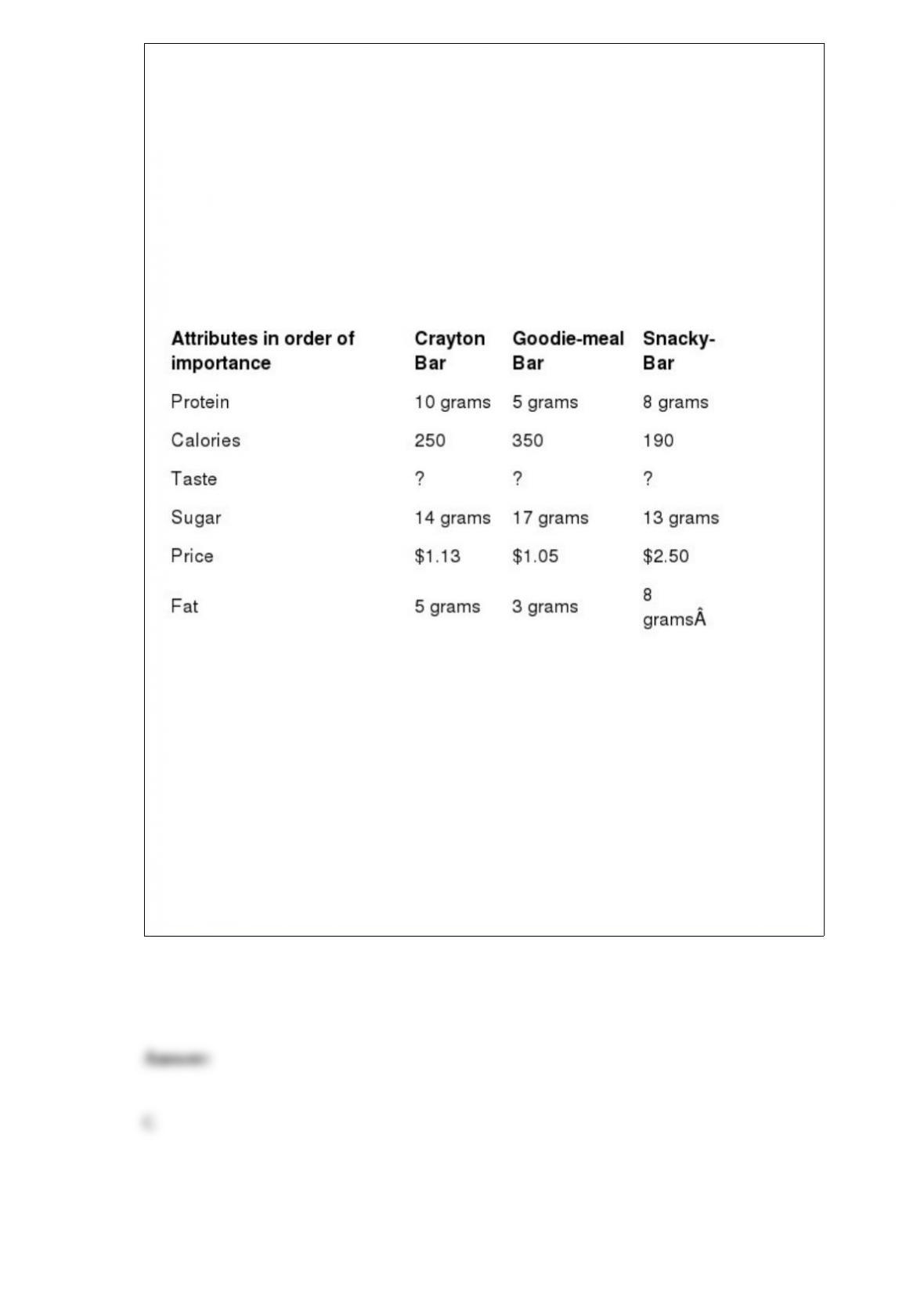
ENERGY BAR SCENARIO
Nutrition labels on products provide considerable information for consumers. For
example, a consumer deciding among the many brands of energy bars might compare
three offerings: Crayton Bar, Goodie-meal Bar, and Snacky-Bar. The most important
attribute for this consumer is protein content, followed by calories, taste, sugar, price
and fat content. This consumer would like an energy bar with high-protein content but
low in calories, sugar, fat, and price, and also one that tastes good. Information for all
the attributes is found on the product nutrition label except for the taste attribute. This
information is summarized in the following table:
Refer to Energy Bar Scenario. The consumer also evaluated the three bars along the
criterion of product price. Product price is an example of a(n) _____ attribute.
a. underlying
b. experience
c. perceptual
d. objective
e. primary

Abigail joined PETA (People for the Ethical Treatment of Animals) as she strongly
believes in the group’s cause of helping animals. She even chose to become a vegetarian
because of her belief in the group’s vision for animal welfare. Which of the following
types of group influence does PETA exert on Abigail?
a. Hedonic influence
b. Utilitarian influence
c. Informational influence
d. Value-expressive influence
e. Ego-defensive influence
Which of the following types of shopping is most likely to provide the greatest
utilitarian shopping value?
a. Acquisitional shopping
b. Epistemic shopping
c. Experiential shopping
d. Impulsive shopping
e. Unplanned shopping

Customer lifetime value includes the net present value of the stream of profits over a
customer’s lifetime and _____.
a. the costs associated with satisfying that customer
b. the costs associated with keeping that customer for more than 10 years
c. the retention rate for all customers
d. opportunity cost saved from having loyal customers
e. the worth attributed to the equity a good customer can bring
Susan, a single-parent, is very close to her friends and relatives and she feels the need to
be connected with them. She visits her grandparents every week, as doing so makes her
feel as a part of the extended family. According to Maslow’s hierarchy of needs, Susan
is most concerned with:
a. the need for self-actualization.
b. the need for self-esteem.
c. physiological need.
d. the need for safety and security.
e. the need for belongingness and love.

Families consisting of previously married spouses and their children are known as
_____ families.
a. consanguineal
b. generational
c. blended
d. extended
e. kindred
THE BILLIONAIRE LIFESTYLE SCENARIO
Philip, Joe and Ralph are all part of a billionaire’s club in their city. They are all in their
mid-40s, but with remarkably successful careers, they became billionaires within a very
short period of time. Philip, the CEO of his own real-estate venture, started out as a
dynamic entrepreneur who managed to make huge profits within two years of starting
his business venture. He believes in living life luxuriously and lavishly. Joe, the CEO of
an event management company, shares the same thought. Joe and Philip splurge on the
latest cars and electronic gadgets in the market. They buy designer clothes, shoes and
watches. They party at the best clubs in the city and are known to order customized
suits for themselves from some of the best designers around the world. They also have a
passion for traveling. They take time off from their work and visit exotic locations
around the world, stay in the best hotels, and eat at expensive restaurants. But not all
billionaires are like Philip and Joe; Ralph, the CEO of a chain of luxury hotels, used to
be materialistic like the others. These days, he is no longer interested in living a lavish
life and is rather keen on reducing his material consumption. He prefers living a simple
life with his family, and rarely indulges himself like he used to do earlier. He feels that
being too materialistic can not only lead to financial distress in the future, but also
create problems in his personal life. Instead of partying like the others, he is often seen
at charity events making donations. He wants to be known primarily for his
contributions to the society and not for having an extravagant lifestyle. Refer to The
Billionaire Lifestyle Scenario. Philip and Joe mostly wear designer outfits, watches, and
shoes. They also buy the latest and the most expensive cars and electronic gadgets. If
Philip and Joe were to engage in flaunting their material possessions as a way of
displaying their social class, such a tendency could be described as _____.

a. value consciousness
b. frugality
c. philanthropy
d. low self-monitoring
e. conspicuous consumption
Amy is a member of the readers’ club in her school. Before she buys any new book, she
checks what is popular with the others in her club. Amy’s readers’ club is part of her
_____ that influences Amy’s everyday experiences.
a. internal environment
b. value network
c. relationship network
d. emotional environment
e. social environment
Mom & Baby Inc., a firm specializing in mother and child care products, gives away
free samples of their latest products to new mothers. They also encourage mothers to

provide feedback on their product samples in a blog for new mothers. The company’s
goal is to stimulate positive word-of-mouth communications about their products. This
is an example of _____ word-of-mouth.
a. primary
b. natural
c. organic
d. amplified
e. scripted
Enduring characteristics of neither a particular consumer nor a product or brand are
known as _____ influences.
a. attitudinal
b. tangential
c. perceptual
d. preferential
e. situational

Which of the following approaches to personality assumes that some traits are specific
(bargaining proneness), and others are more broad (extroversion)?
a. Nomothetic perspective
b. Hierarchical approach
c. Five-level model
d. Idiographic perspective
e. Single-trait approach
Which of the following laws states that as the intensity of the initial stimulus increases,
a consumer’s ability to detect differences between two levels of the stimulus decreases?
a. Law of Diminishing Differences
b. Law of Just Noticeable Differences
c. Skinner’s Law
d. Pavlov’s Law
e. Weber’s Law
Mike has a passion for sports cars. He owns an envious array of sports sedans and

supercars, and keeps himself updated about the latest models, their features, and so on.
According to the elaboration likelihood model, which of the following is most likely to
be activated when Mike comes across an advertisement for a new sports vehicle
introduced in the market?
a. Peripheral route to persuasion
b. Contrast effect route to persuasion
c. Central route to persuasion
d. Latitude of rejection route to persuasion
e. Low-involvement hierarchy route to persuasion
Which of the following is most likely to be true of consumers who experience time
pressure while deciding on a purchasing activity?
a. Consumers are more likely to process purchase related information at a deeper level.
b. Consumers are more likely to rely on simple choice heuristics.
c. Consumers’ orientations are more likely to switch from utilitarian to hedonic.
d. Consumers are less likely to buy brands positioned as relatively high quality.
e. Consumers are more likely to shop with others rather than shopping alone.

Which of the following represents the worth of an activity because the time spent doing
the activity itself is personally gratifying?
a. Utilitarian shopping value
b. Acquisitional shopping value
c. Absolute shopping value
d. Hedonic shopping value
e. Epistemic shopping value
When James and his wife were looking for a new house, they acknowledged the fact
that they would each consult their parents and then decide on the house to buy. Which
of the following factors contribute to their evaluation of alternatives?
a. Marketing communications
b. Product knowledge
c. Expert opinions
d. Social influences
e. Online sources

When Richard finally decided to buy a car, he chose a hybrid model that scored very
high on being environment friendly. Which of the following criteria is most likely to
account for Richard’s choice of the car?
a. Relative criteria
b. Rational criteria
c. Hedonic criteria
d. Egalitarian criteria
e. Utilitarian criteria
Americans born between 1928 and 1945 tend to be frugal and follow largely utilitarian
motivations with their purchases. The generational microculture group illustrated here
is the _____.
a. Baby Boomers
b. greatest generation
c. silent generation
d. Millennials
e. Generation X

_____ refers to a design that gives human like characteristics to inanimate objects.
a. Iconism
b. Animism
c. Anthropomorphism
d. Aniconism
e. Zoomorphism
Situational characteristics that a consumer brings to a particular information processing,
purchase, or consumption environment are called _____ conditions.
a. coalescent
b. descendent
c. impendent
d. antecedent
e. respondent
Consumer lifestyles are measured using _____.

a. demographics
b. cost-benefit analysis
c. psychographics
d. geodemographics
e. conjoint analysis
_____ is a term that is used to describe how the appeal of a message and its
construction affect persuasion.
a. Message effects
b. Source effects
c. Structural effects
d. Central effects
e. Peripheral effects
Prime’s is a company that manufactures and markets suits for professional kayakers.
These consumers are predominantly males in the age group of 25-45 years. This market
segment that Prime’s serves with a specific marketing mix is called its _____.

a. preferred market
b. optimum market
c. target market
d. dominant market
e. elementary market
Which of the following is an economic trend shaping the value received by consumers
today?
a. Internationalization
b. Online shopping
c. Decrease in family size
d. Advent of private-label brands
e. Widespread use of Facebook
Jane is a little girl who is learning culture-appropriate behavior from her observations in
daily life. She keenly watches and analyzes the way people around her act. This type of
learning is referred to as _____.

a. adaptation
b. modification
c. externalization
d. socialization
e. acclimatization
The decision-making approach that is used depends heavily on the amount of
involvement a consumer has with a product purchase and the amount of perceived risk
involved with the decision.
Consumers who frame expectations based on what ought to happen show a greater
tendency toward being satisfied relative to consumers who experience anticipatory
hope.

A consumer with a strong ethnic identification is most likely to feel close-minded about
adopting products from a different culture.
An influx of nonnative media can influence the rate of acculturation.
Natalie regularly goes for treks with her college friends. This group of trekkers is an
example of a formal group.

In general, personal connections originating in brand communities lead to negative
outcomes for consumers and companies.
Define expectations. Describe the four types of consumer expectations with an example
for each.

Mood-congruent judgments are evaluations in which the value of a target is judged in a
way that is consistent with one’s mood.
Demographics refer to the way consumer lifestyles are measured.
According to the idiographic perspective, consumers agree on the shared meaning of
products and symbols.
In low-power-distance nations, marketing messages that make use of authority appeals
are very effective in facilitating positive consumers’ response.
Signs that emphasize price by using large numerals create the perception of an up-scale
store.
The presence of music in an environment is a social influence that may shape consumer
behavior.
The experiential decision-making process illustrates attribute-based evaluation.
All consumers have a single self-concept.
Initial judgment theory proposes that consumers compare incoming information to their
existing attitudes about a particular object or issue and that attitude change depends
upon how consistent the information is with the initial attitude.
Brand loyalty has an impact on the value of the brand to the firm.
Service quality is often discussed as the difference between consumer expectations of
different service aspects and the actual service that is delivered.

Sex roles refer to the societal expectations for men and women among members of a
cultural group.
A researcher measuring consumers’ attitudes toward different brands on a scale ranging
from 1 (very negative) to 5 (very positive) is using qualitative research.