
The questionnaire ________ explains the purpose and goals of the research and asks for
respondent participation.
A) screener
B) introduction
C) classification questions
D) synopsis
The following two statements refer to the structure of experiments.
I. An experiment can only manipulate one aspect or level of the independent variable at
a time.
II. An experiment can only have one independent variable.
Which, if any, of these statements is (are) true?
A) I only
B) II only
C) I and II are both true
D) Neither I nor II are true

How many of the following would be considered an example of CGM?
– posting a product review
– responding to a blog entry
– posting your family pictures to Flickr
– a Facebook page maintained by Pepsi
A) 1
B) 2
C) 3
D) 4
Consider the perceptual map shown below.
Which is the worst quadrant for a brand to be in?
A) I
B) II
C) III
D) IV

One of the criticisms of CAQDAS noted in the text relates to its ________ literal
content.
A) high cost to code
B) awkward data bases used to store coded
C) lack of speed in analyzing
D) inability to code
E) emphasis on
Consider the two statements below with regard to neuromarketing.
I. Neuromarketing is no longer considered a “fringe” research technique.
II. Mainstream companies such as Google are now exploring neuromarketing
applications.
Which, if any, of these statements is (are) true?
A) I only
B) II only
C) I and II are true
D) Neither I nor II are true

________ campaign evaluation might monitor and collect data on the number of Web
site visits generated by a campaign, track the number of banner ad click-throughs, or
monitor the number of “forwards” of the viral videos comprising a communication
campaign.
A) Systematic
B) Tracking
C) Concurrent
D) Sequential
E) Multi-modal
A researcher observes children in a playground and records the childrens’ activities on a
precoded sheet which lists the range of activities and provides a space to record the time
spent on each activity. This would most likely be a ________ approach to human
observation.
A) qualitative
B) quantitative

Which of the following descriptive statistics is (are) appropriate for checklist questions?
A) percentages
B) averages
C) standard deviation
D) all three are appropriate ways to examine checklist data
The text discusses factors which can influence the cost of a survey. How many of the
factors noted below were noted as influencers of cost.
– the cost of long distance telephone calls
– required response rate
– sample characteristics
– degree of client participation in research planning
A) 1
B) 2
C) 3
D) 4

John works in the NewWave Advertising Agency research department. John has been
asked to prepare a presentation for senior management that focuses on how individuals
respond to rich media advertising. John is most likely to turn to a ________ for
assistance.
A) media consulting company
B) research specialist
C) field service
D) syndicated research company
E) proprietary research company
Consider the responses to a question measuring commercial believability (shown
below).
What is the average believability rating?
A) 1.5
B) 2.5
C) 2.8
D) 28.0
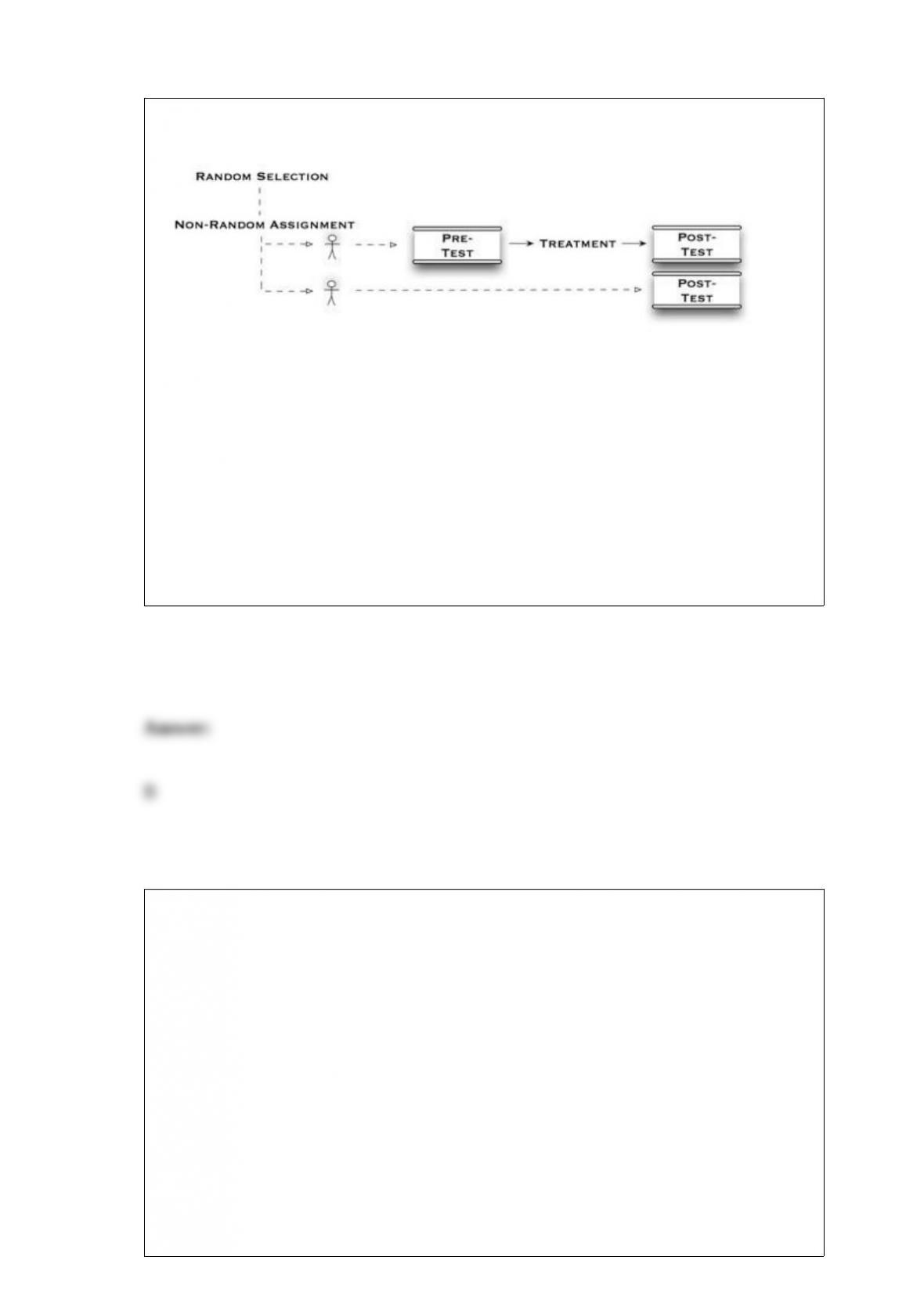
Consider the diagram shown below.
Assume that 50 people were assigned to each group. Which of the following would
result in the best improvement to this design?
A) Increase sample size to 200 per group
B) Use random assignment to place individuals in each group
C) Decrease the time lag between pretest and post-test
D) Restrict the group composition to include individuals of only one gender
The following two statements refer to experimental causality.
I. In order for causality to be accepted in an experiment, changes in the independent
variable must precede changes in the dependent variable.
II. In order for causality to be accepted in an experiment, only one
alternative explanation of the outcome must be eliminated.
Which, if any, of these statements is (are) true?
A) I only
B) II only
C) I and II are both true

D) Neither I nor II is true
________ control refers to the extent to which a researcher has control over the
circumstances in which a respondent provides his or her answers to a survey.
A) Administrative
B) Survey
C) Sample
D) Interview
Which of the following is NOT a characteristic of a conceptual definition?
A) states the major characteristics of the concept
B) distinguishes the target concept from similar, but different, concepts
C) needs to be less than 15 words in length

Which of the following descriptive statistics is (are) appropriate for constant sum
questions?
A) percentages
B) averages
C) standard deviation
D) all three are appropriate ways to examine responses to a constant sum
Which of the following descriptive statistics is (are) appropriate for ranking questions?
A) percentages
B) averages
C) standard deviation
D) all three are appropriate ways to examine responses to ranking questions

The text discussed the use of observation related to safe food preparation. This was an
example of using observation research when ________.
A) there appears to be a disconnect between attitudes and behaviors
B) self-reported data regarding attitudes and behaviors may not be accurate
C) behavioral rather than attitudinal change is the focus.
Consider the statements shown below. How many of these statements describe
situations in which a census is preferable to a sample?
– when the population of interest is small and identifiable
– when sampling might eliminate important cases from the study
– when the client has unlimited funds to conduct the research
– when the research results will be published in newspapers or other media
A) 1
B) 2
C) 3
D) 4

You are walking through the mall and an interviewer from a survey company asks you
to participate in a research study. This would be an example of a(n) ________
interview.
A) pre-recruited
B) preplanned
C) intercept
D) interrogation
How many of the following are examples of direct question types?
– Specification
– Grand tour
– Third-person
– Sentence completion
A) 1
B) 2
C) 3
D) 4

The search results at the bottom of the search page (beneath Google’s Golden Triangle)
were viewed by ________% of viewers.
A) 20
B) 50
C) 90
D) 100
A ________ test permits an advertiser to compare a current approach to print
advertising to one or more potential alternatives.
A) A/B
B) Split-run
C) Bi-modal
D) Multi-modal
E) Split-synergy
The first step in the sampling process focuses on determining ________.

A) sample size given the research budget
B) absolute required sample size
C) if a sample or census should be used
D) the amount of time required to contact the sample
E) if a quota sample is needed
CATI stands for ________.
A) Computer Aided Telecommerce Interviewing
B) Computer Assisted Teleconferenced Interviews
C) Computer Aided Teleconferenced Interviews
D) Computer Assisted Telephone Interviewing
The following two statements refer to comparing a sample average to a population
average.
I. You want to compare a sample average to a population average. The test you select
depends upon the size of the sample population.

II. You are comparing a sample average to a population average. A Z-score of 2.08 is
obtained. This means that the observed difference between the two averages is real and
meaningful and not due to chance.
Which, if any, of these statements is (are) true?
A) I only
B) II only
C) I and II are both true
D) Neither I nor II are true
Consider the data shown in the table below. The table shows responses to a
classification question.
What percent of the sample is not enrolled in any school?
A) 9%
B) 11%
C) 55%
D) cannot be calculated from the data shown

A ________ panel is a continuing group of prerecruited individuals who have agreed to
participate in survey research studies.
A) synergistic
B) personalized
C) focus group
D) hybrid
E) mail
Premeasurement is a threat to internal validity that is related to problems associated
with ________.
A) a pretest survey
B) variation in data collection procedures
C) the sample
D) the study context
E) the researcher
An experiment’s ________ refers to the extent to which one can eliminate alternative
explanations for the observed experimental results.
A) internal validity
B) external validity
C) external reference
D) internal reference
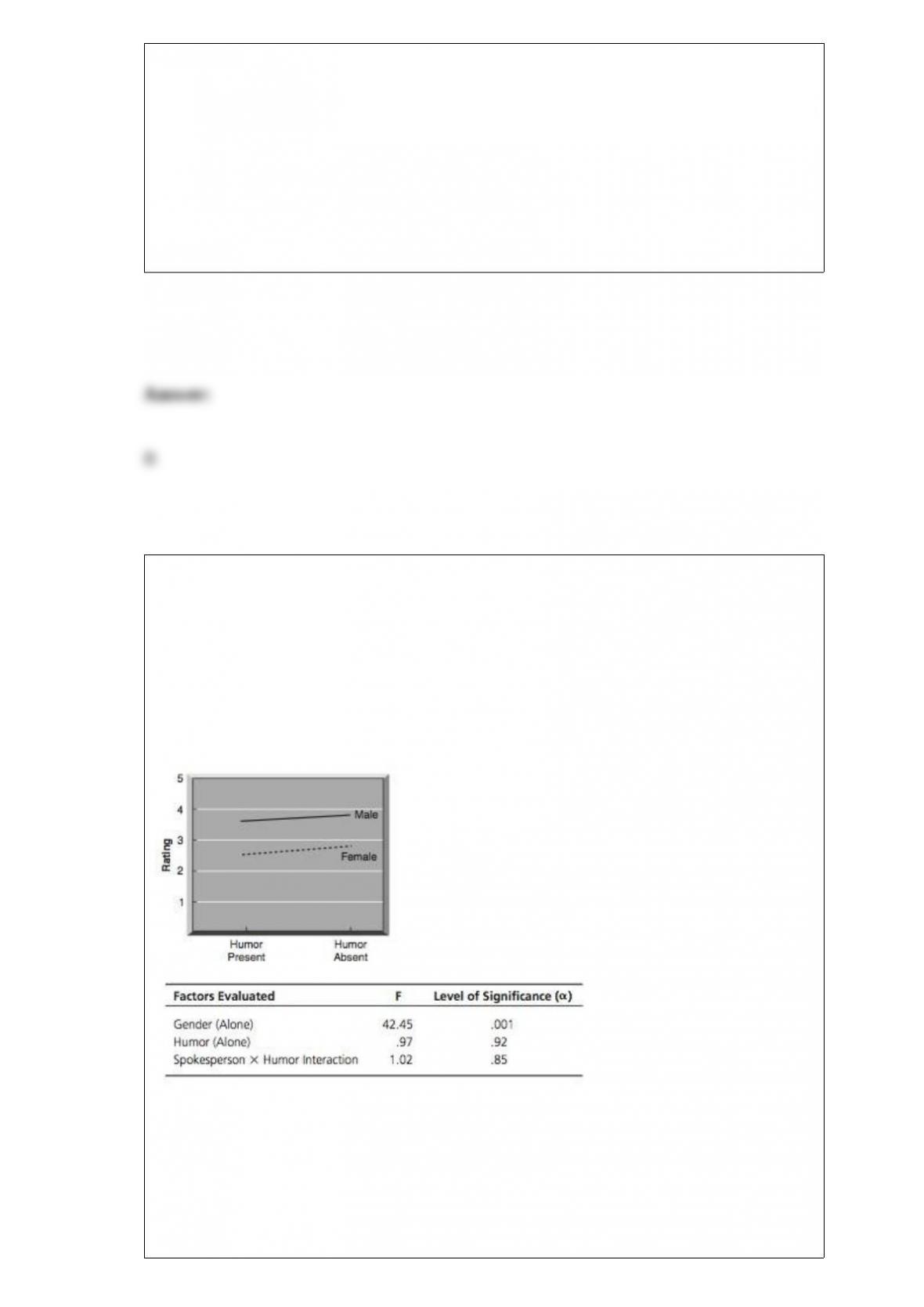
You conduct a factorial research study which has two variables with two aspects of each
variable. The variables and their aspects are: gender of spokesperson (male or female)
and humor (present or absent). The goal of all four ads is to improve attitudes toward
the brand, using the measure “How much do you agree or disagree with the statement:
This is a brand for me” as the key measure. A five point-scale was used where higher
scores indicate more agreement.
The data and results of the F-test are shown below.
Which of the following is the correct conclusion to draw from this data?
A) neither factor is significant, no interaction between factors
B) a male spokesperson is more effective versus a female, humor does not make a
difference

C) a female spokesperson is more effective versus a male, humor does not make a
differencce
D) types of spokesperson and humor both affect commercial effectiveness