Creating product assortments from several sources to serve customers would be an
example of a __________ function.
a. transactional
b. facilitating
c. selling
d. logistical
e. risk taking
Answer:
What do the United States Post Service, the U.S. Park Service, and a local fire
department have in common?
a. They are all privately owned companies.
b. They do not fit on the service continuum.
c. They are all government-sponsored service providers.
d. They never experience idle production capacity.
e. Capacity management is not an issue for these organizations.
Answer:
Since global marketing is affected by economic considerations, a scan of the global
marketplace should include this factor:
a. an analysis of cultural diversity within the country under consideration.
b. regulatory constraints regarding contracts, mergers, and partnerships.
c. an assessment of language differences including dialect variation.
d. political and ideological differences between the countries involved.
e. recognition of a country’s currency exchange rates.
Answer:
A strategy for managing a product’s life cycle that attempts to increase a product’s use
among existing customers, create new use situations, or find new customers is referred
to as __________.
a. market modification
b. product modification
c. product repositioning
d. product extension
e. diversification
Answer:
Google’s __________ program was designed for website owners as a tool for placing
ads next to their web page content rather than next to search results.
a. AdPage
b. AdLeaf
c. AdWords
d. AdRank
e. AdSense
Answer:
To serve both buyers and sellers, marketing seeks to __________ and satisfy the needs
and wants of prospective customers.
a. change
b. create
c. manipulate
d. discover
e. weigh
Answer:
Applied to recruiting and selecting salespeople, a __________ explains to whom a
salesperson reports and how a salesperson interacts with other company personnel.
a. job description
b. sales plan
c. job analysis
d. sales performance audit
e. personal performance plan
Answer:
Marketers use perceptual maps as a means to display or graph in two dimensions the
location of products or brands

a. against large market segments in a market-product grid.
b. against small market segments in a market-product grid.
c. in the minds of consumers.
d. in the mind of a single consumer.
e. against the revenues generated by other products or brands within the company.
Answer:
A limited-coverage warranty __________.
a. provides a written statement of manufacturer liability
b. states the bounds of coverage, and more importantly, areas of noncoverage
c. has no limits of noncoverage
d. assigns responsibility for product deficiencies to the manufacturer
e. assigns responsibility for product deficiencies on misuse by the consumer
Answer:
Which of the following types of promotion uses customized interaction?
a. advertising
b. direct marketing
c. public relations
d. sales promotion
e. publicity
Answer:
The four steps in the sequential process of building the brand equity pyramid include:
(1) developing positive brand awareness; (2) __________; (3) eliciting the proper
consumer responses to a brand’s identity and meaning; and (4) creating a
consumer-brand connection.
a. easing consumers’ decision making
b. forming a brand personality
c. rewarding loyal customer behavior
d. establishing a brand’s meaning in the minds of consumers
e. developing brand licensing criteria
Answer:
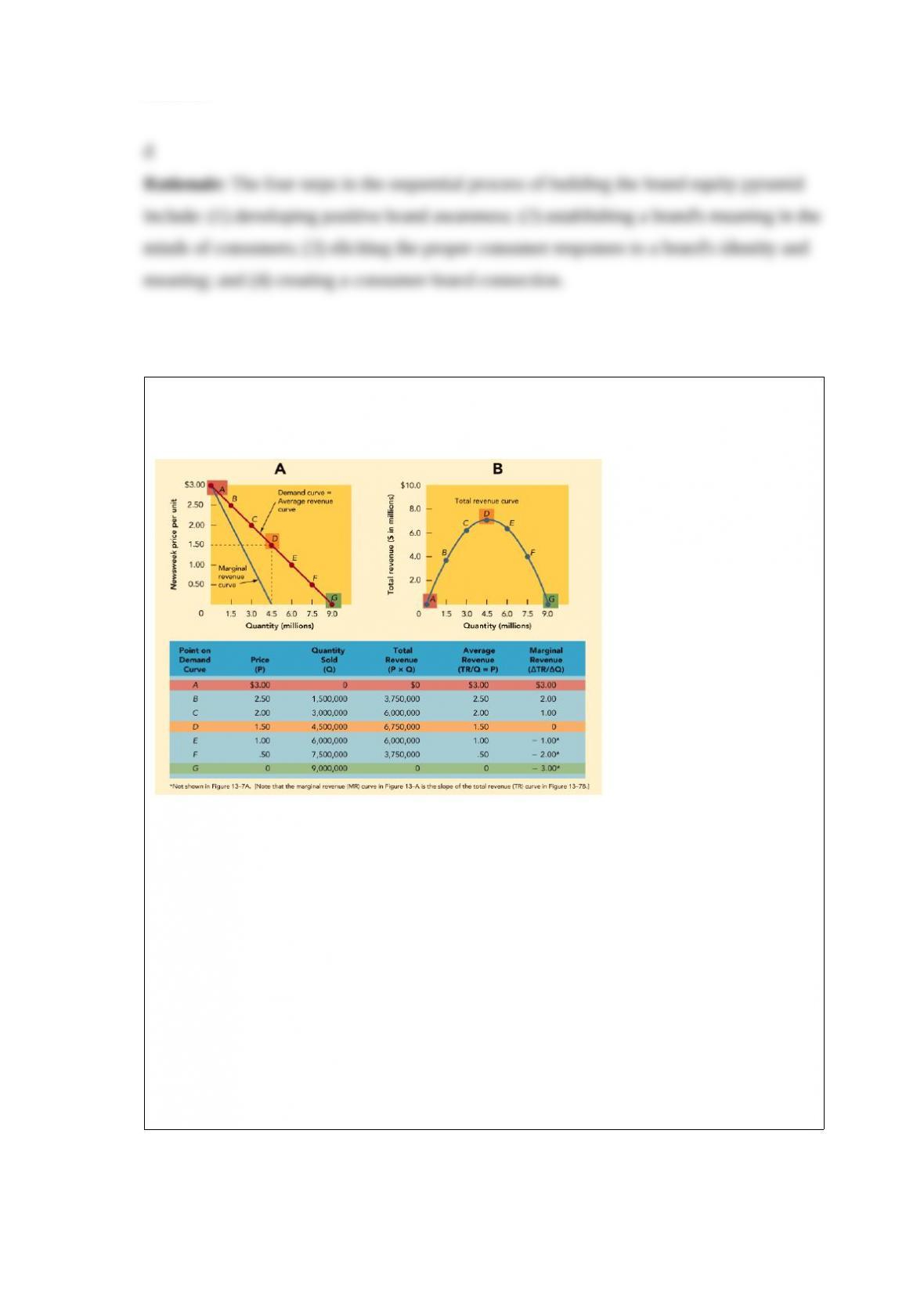
Figure 1.
According to Figure 1. above, when the price of Newsweek is $1. per issue, how many
magazines will it sell?
a. 1,500,000
b. 3,000,000
c. 4,500,000
d. 6,000,000
e. 7,500,000
Answer:

Classic economic theory assumes a firm seeks to maximize its long-run __________,
achieving as high a financial return on its investments as possible.
a. profits
b. quality
c. market share
d. employee welfare
e. social responsibility
Answer:
If a firm hired SymphonyIRIGroup’s BehaviorScan service to track sales made to a
panel of consumers and assess the effectiveness of advertising and other promotion
tactics, what type of test market is this?
a. laboratory test market
b. concept test market
c. simulated test market
d. controlled test market
e. standard test market
Answer:
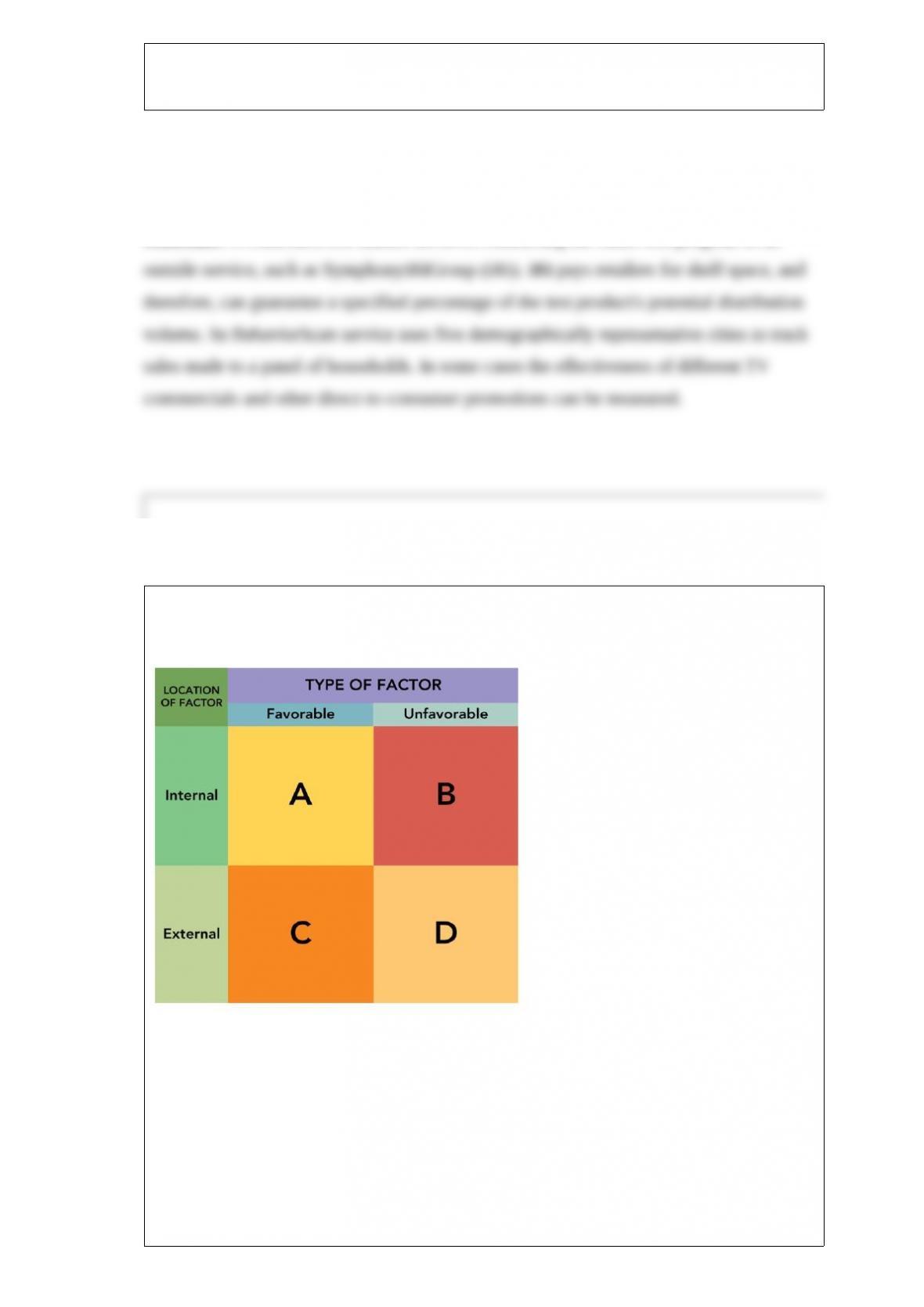
Figure 1.
Quadrant “D” in Figure 1. above represents a(n) __________ in a SWOT analysis.
a. Threat
b. Weakness
c. Strength

d. Opportunity
e. Market segment
Answer:
The Nielsen PRIZM (part of Nielsen Claritas) lifestyle segmentation is based on the
belief that “birds of a feather flock together.” This type of consumer segmentation is
referred to as
a. psychographic segmentation.
b. behavioral segmentation.
c. situational segmentation.
d. socioeconomic segmentation.
e. geographic segmentation.
Answer:

The assumption that demand is elastic at a number of price points but is inelastic
between these price points leads to which pricing approach?
a. product line pricing
b. skimming pricing
c. penetration pricing
d. price lining
e. odd-even pricing
Answer:
Price fixing refers to
a. an arrangement a manufacturer makes with a reseller to handle only its products and
not those of a competitor.
b. the practice of charging a very low price for a product with the intent of driving
competitors out of business.
c. the practice of charging different prices to different buyers for goods of like grade
and quality.
d. a conspiracy among firms to set prices for a product.
e. a seller’s requirement that the purchaser of one product also buy another product in
the line.

Answer:
Marketers use three approaches to try to change consumer attitudes toward products
and brands: (1) __________; (2) changing the perceived importance of attributes; and
(3) adding new attributes to the product.
a. reinforcing the consumers’ sense of self confidence in making wise purchase
decisions
b. actively educating consumers about the product’s competitive advantages
c. refocusing a consumer’s attention from one attribute to another
d. changing beliefs about the extent to which a brand has certain attributes
e. denigrating the attributes of competitors’ products
Answer:
Quantitative assessments of sales performance may be based on output-related
measures, such as __________.
a. dollar or unit sales volume, last year/current year sales ratio, and new accounts
generated
b. sales calls, selling expenses, and account management policies
c. selling expenses, profits generated, and emotional intelligence quotient
d. new lead generation, sales quotas, and sales increases over the previous evaluation
period
e. recruitment, selection, and training of new sales representatives
Answer:
With cost-oriented approaches, a price setter stresses the cost side of the pricing
problem, not the __________ side.
a. shareholder equity
b. income
c. service
d. supply
e. demand
Answer:
Many supermarkets have in-store restaurants where a customer can buy prepared meals
to take home or eat there. Supermarkets and restaurants that provide these kinds of
meals are engaged in __________ competition.
a. intertype
b. institutional
c. intermodal
d. functional
e. selective
Answer:
The company’s own advertising staff, which may provide full services or a limited
range of services, is referred to as a(n) __________.
a. intra-firm agency
b. in-house agency
c. full-service agency
d. limited-service agency
e. promotion department

Answer:
Two students, Nick and Lee, were studying for an upcoming exam in their introduction
to marketing course. While studying the chapter on marketing channels and
wholesalers, Nick made the following statement: “If it weren”t for wholesalers and
other intermediaries in the channel of distribution, the products we buy would cost a lot
less!” After contemplating Nick’s statement, Lee said, “Wait a minute. We learned in
class that channel intermediaries actually make marketing more efficient by minimizing
the number of transactions necessary to sell products.” Lee’s statement refers to
a. channel intermediary development.
b. the relationships between channel intermediaries themselves.
c. the value created by channel intermediaries.
d. channel intermediary promotional efforts.
e. an inaccurate statement by Lee; Nick was correct.
Answer:
The essence of marketing evaluation is (1) comparing results with planned goals to
identify deviations and (2) __________.

a. taking corrective actions
b. devising a new budget
c. revising the goals that fell short of expectations
d. investigating the causes of deviations
e. updating the marketing plan
Answer:
Consumers often use the prices of __________ items, such as a can of Coke, to form an
overall impression of the store’s prices.
a. benchmark
b. stoplight
c. point-of-purchase
d. value-based
e. loss-leader
Answer:

In a buying center, __________ affect the buying decision, usually by helping define
the specifications for what is bought.
a. gatekeepers
b. deciders
c. buyers
d. influencers
e. users
Answer:
The retail life cycle refers to
a. the distinct stages a product goes through before it becomes obsolete.
b. the process of growth and decline that retail outlets, like products, experience.
c. the cycle of a customer’s buying behavior from awareness of a product to its ultimate
purchase.
d. the relationship between the tangible aspects of a product and the types of services
that need to accompany it.
e. the traditional management changes that take place as a retail outlet grows.
Answer:

Which type of wholesaler offers a relatively narrow range of products but has an
extensive assortment within the product lines carried?
a. general merchandise wholesaler
b. limited-service wholesaler
c. cash and carry wholesaler
d. specialty merchandise wholesaler
e. drop shipper
Answer:
The retail price of a fax machine has decreased from more than $10,000 in the early
1970s to less than $100 today. This is due in large part to
a. skimming pricing.
b. prestige pricing.
c. odd-even pricing.
d. experience curve pricing.
e. customary pricing.
Answer:

The price the seller quotes that includes all transportation costs is referred to as
__________.
a. mode of transportation
b. geographical allowance
c. uniform delivered pricing
d. FOB origin pricing
e. FOB destination pricing
Answer:
Although the U.S. Justice Department frowns on __________ because it restricts the
normal operation of a free market, it is still legal for two companies to buy one
another’s products as long as there is no coercion involved.
a. reciprocity
b. tying agreements
c. just-in-time procurement
d. quid pro quo
e. supply partnerships

Answer:
Transparency International is an organization that
a. monitors how developed nations deal with developing nations.
b. establishes procedures for ethical international business based on the ISO 7000 Code
of Conduct.
c. monitors and ranks nations worldwide according to their perceived use of bribery.
d. creates an acceptable international code of ethics.
e. makes sure federal, state, and local governments in the United States abide by the
Consumer Bill of Rights.
Answer: