
Walmart’s $421 billion in sales in 2010 surpassed the gross domestic product of all but
__________ countries for that same year.
a. 5
b. 12
c. 18
d. 29
e. 50
Answer:
With a cost-oriented pricing strategy, a price setter stress the __________ side of the
pricing problem and the price is set by looking at _________.
a. demand; revenue
b. production and marketing; profit
c. demand; target sales
d. cost; production and marketing costs
e. cost; consumer demand
Answer:

Vertical marketing systems refers to
a. professionally managed geographically dispersed marketing channels designed to
achieve channel economies and maximize marketing impact.
b. professionally managed and centrally coordinated marketing channels designed to
achieve channel economies and maximum marketing impact.
c. retailer-sponsored cooperatives where small, independent retailers form an
organization that operates a wholesale facility cooperatively.
d. professionally managed geographically dispersed marketing channels that are
controlled through strategic channel alliances.
e. channel partnerships that share responsibility for ordering and physically distributing
each other’s products.
Answer:
Product-line pricing refers to
a. setting the price of a line of products at a number of different specific pricing points.
b. deliberately selling a product below its customary price, not to increase sales, but to
attract customers’ attention in hopes that they will buy other products as well.
c. adding a fixed percentage to the cost of all items in a specific product class.
d. setting of prices for all items in a product line to cover the total cost and produce a
profit for the complete line, not necessarily for each item.

e. the marketing of two or more products in a single package.
Answer:
Organizations that develop similar offerings, when grouped together, create a(n)
a. conglomerate.
b. merger.
c. industry.
d. sector.
e. monopoly.
Answer:
One advantage of using billboards as an advertising medium is
a. it is environmentally friendly.
b. it has universal appeal.
c. it is particularly suited to national campaigns.
d. it has good reach and frequency.
e. it is especially suited for persuasive advertisements.
Answer:
A critical assumption when using target profit pricing is that
a. a higher average price will not cause the demand for a product to fall.
b. a higher average price will cause the demand for a product to rise.
c. a higher average price will always cause the demand for a product to fall.
d. this form of pricing is extremely risky because profit is tied to the current value of
the dollar.
e. being first is essential if you increase your average price since all of your competitors
will do the same.
Answer:
In terms of brand loyalty, consumers prefer specific brands but will accept substitutes
after considering which type of consumer product?
a. shopping product
b. convenience product
c. specialty product
d. unsought product
e. discretionary product
Answer:
Figure 1.
According to Figure 1. above, “A” represents which step in the price-setting process?
a. raise initial capital
b. identify pricing objectives and constraints
c. scan competitors for prices of similar products or services
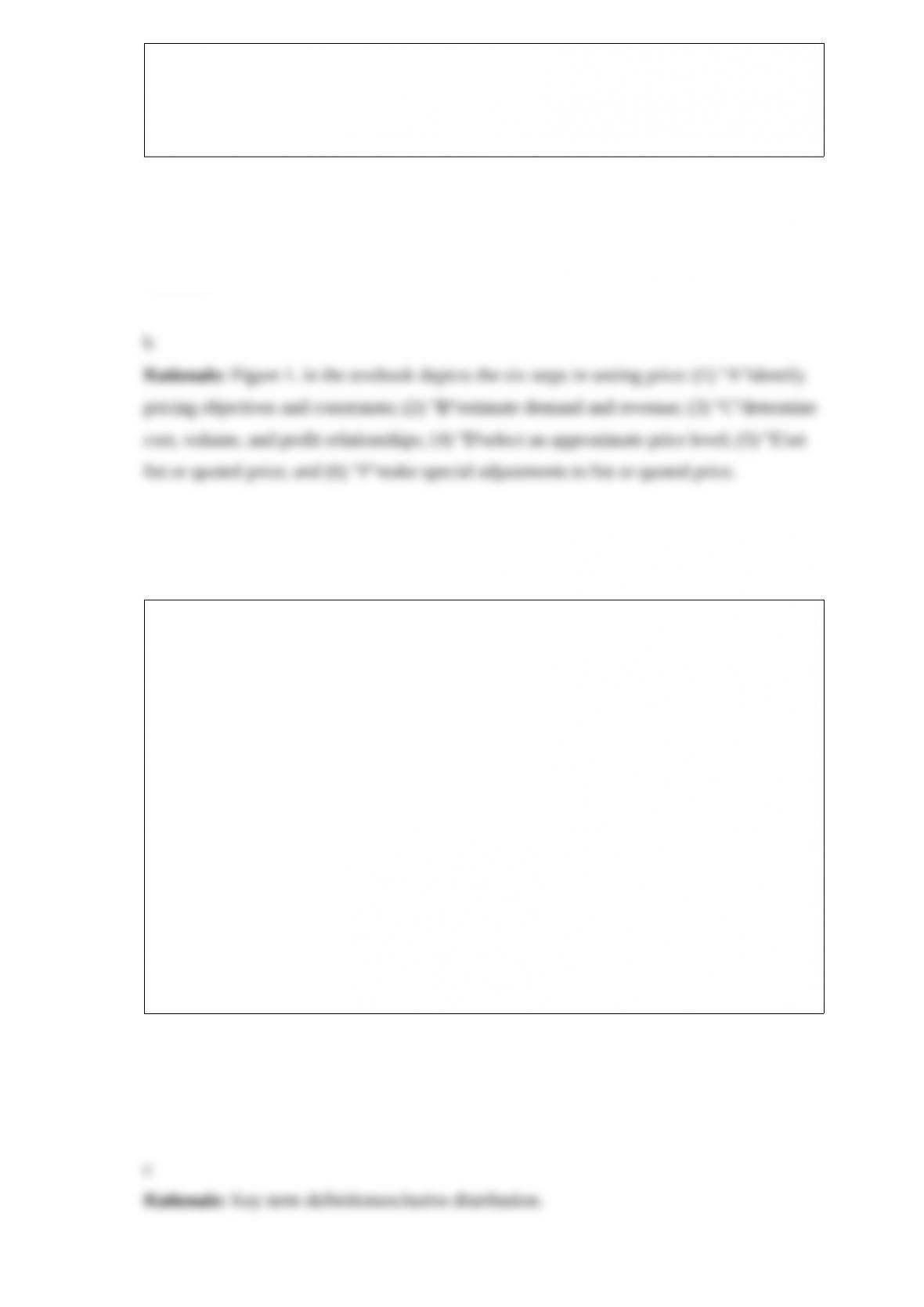
d. select the appropriate pricing formula
e. establish the price range
Answer:
Exclusive distribution refers to
a. the distribution of products or services in markets where there are currently no other
competitors.
b. the distribution of products or services where the producer owns the entire channel of
distribution.
c. the density of distribution whereby a firm tries to place its products or services with
only one retail outlet in a specified geographical area.
d. the density of distribution whereby a firm tries to place its products or services in as
many outlets as possible.
e. the density of distribution whereby a firm tries to place its products or services in a
few retail outlets in a specific area.
Answer:
In response to Duracell’s introduction of the Duracell Ultra battery, Energizer
introduced an Advanced Formula battery. But unlike Duracell, Energizer priced its
batteries at a low initial price to attract the mass market. Energizer used
a. penetration pricing.
b. prestige pricing.
c. skimming pricing.
d. price lining.
e. cost-plus fixed-fee pricing.
Answer:
Between classes, many college students stop at conveniently located vending machines
for their favorite candy bars and soft drinks. Their choices are generally made quickly
and with little or no effort to consider alternative product offerings. The college
students described here are most likely involved in ________ problem solving purchase
situations.
a. limited
b. routine
c. extensive
d. intensive
e. unlimited
Answer:
Kristi goes shopping with a friend and notices her friend’s new duct tape wallet. She
thinks of her own worn wallet and realizes she needs a new one. In which stage of the
consumer purchase decision process was Kristi when she had this realization?
a. information search
b. problem recognition
c. purchase behavior
d. alternative evaluation
e. prepurchase cognition
Answer:
Jane Westerlund owns a picture-framing shop, The Caplow Co. The average price she
receives for a picture she frames for a customer is $120. This price must cover her costs
for a typical framed picture, which consists of $5 for glass, $2 for matting, $13 for the
frame, and $30 for the labor involved. She must also cover monthly expenses of $1,000
for rent and insurance, $200 for heat and electricity, $500 for advertising, and $3,500
for her salary. Assuming there is no change in price or the quantity demanded, if
Westerlund wants to increase her advertising expenses to a total of $1,000 (a $500
increase), this would cause total costs to __________ and the break-even quantity to
__________.
a. decrease; stay the same
b. increase; increase
c. decrease; increase
d. stay the same; increase
e. stay the same; decrease
Answer:
The duty of a firm to maximize profits for its owners or stockholders is referred to as
_________.
a. social responsibility
b. value consciousness
c. benefit marketing
d. profit responsibility
e. stakeholder responsibility
Answer:
The ratio of __________to price is referred to as value.
a. prestige value
b. perceived benefits
c. costs
d. perceived quality
e. profits
Answer:
The product life cycle refers to __________.
a. the average life span of a product
b. a concept that describes the stages a new product goes through from product concept
to commercialization
c. a concept that describes the stages a product goes through in the marketplaceearly

growth, accelerated development, maturity, and decline
d. a concept that describes the stages a product goes through in the
marketplaceintroduction, growth, maturity, and decline
e. the amount of time it takes a product innovation to completely diffuse in the
marketplace
Answer:
Culture refers to the set of values, ideas, and attitudes that are learned and shared
among members of a group. It also serves as a socializing force that
a. reflects the will of the largest or most powerful minority.
b. is determined by the largest generational group at a given point in time.
c. becomes the basis of all legislationfederal, state, and localin societies around the
world.
d. expresses the diverse backgrounds of a nation’s subcultures.
e. dictates what is morally right and just.
Answer:
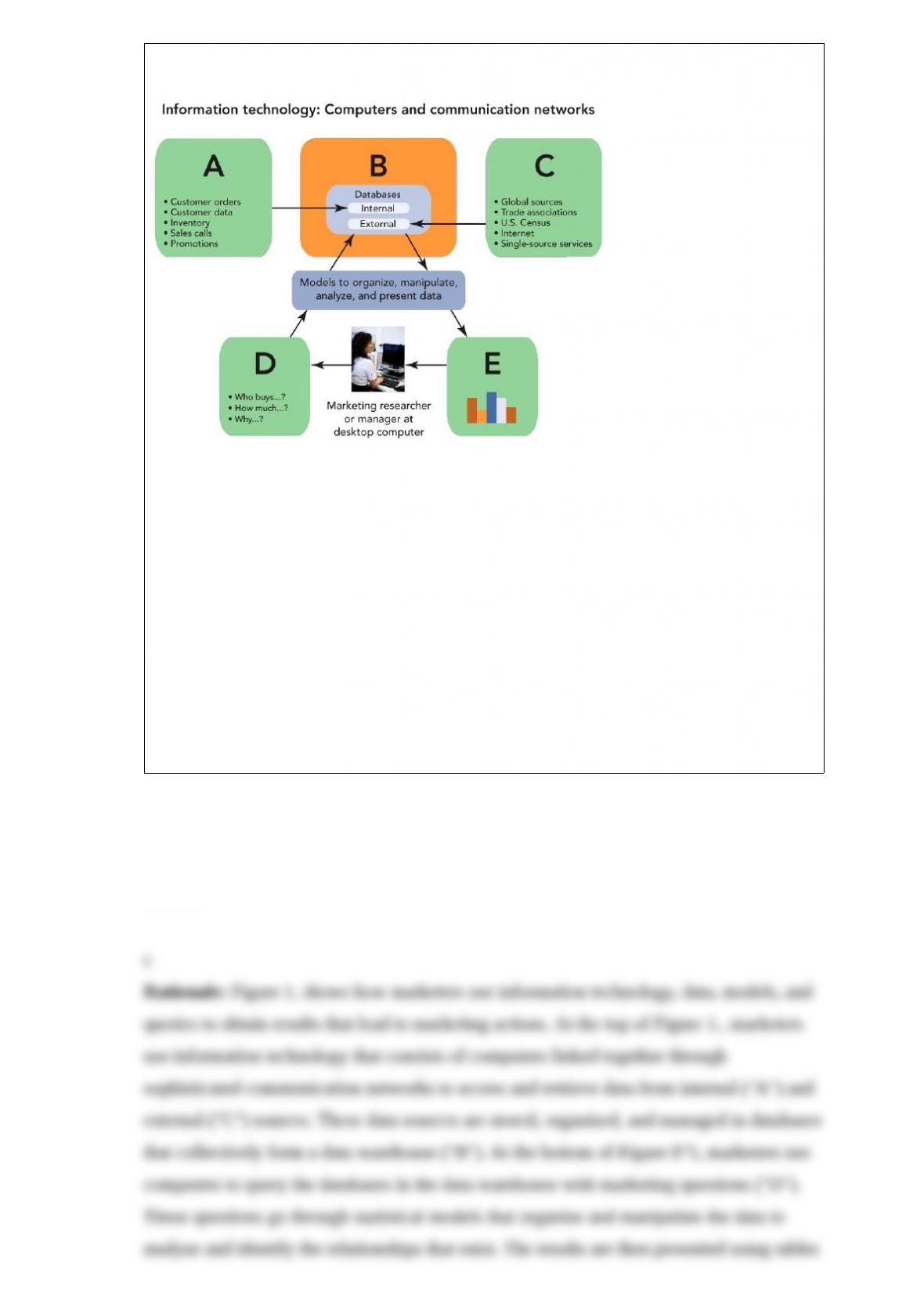
Figure 1.
Figure 1. above shows how marketing researchers and managers use information
technology to turn information into marketing actions. What does “B” represent?
a. external data sources
b. results
c. data warehouse
d. internal data sources
e. buying queries
Answer:
Washburn sells their guitars through a number of channels such as chains and online
dealers, but they feel it is their independent dealers who sell the guitar for them. In
recognition of their hard work, Washburn takes a smaller profit margin from them
because they have to do more work. In essence, this special adjustment to the list price
or quoted price is an example of a(n)
a. quantity discount.
b. seasonal discount.
c. trade discount.
d. cash discount.
e. promotional allowance.
Answer:
Personality refers to
a. a mode of living that is identified by how people spend their time and resources, what
they consider important in their environment, and what they think of themselves and the
world around them.
b. a learned predisposition to respond to an object or class of objects in a consistently
favorable or unfavorable way.
c. the process by which an individual selects, organizes, and interprets information to
create a meaningful picture of the world.
d. a person’s consistent behaviors or responses to recurring situations .
e. those qualities that either attract or repel other members of a person’s personal, social,
or professional environment.
Answer:
Which of the following statements regarding a marketing dashboard is most accurate?
a. The more text (words) that is displayed, the better it is for a marketing manager to
identify trends, interpret the data, and take corrective actions.
b. A marketing dashboard very often includes 20 or more marketing metrics on the
same dashboard computer screen.
c. For accuracy, the marketing dashboard should be updated weekly.
d. Marketing dashboards often show key measures such as HR turnover, strategy
success, and societal well-being.
e. Marketing dashboards provide graphic displays of a product category’s performance,
such as sales, website traffic, etc.
Answer:
Cross-cultural analysis refers to the study of

a. the subgroups within the larger, or national, culture with unique values, ideas, and
attitudes.
b. the set of values, ideas, and attitudes that are learned and shared among the
consumers of a country.
c. similarities and differences among consumers in two or more nations or societies.
d. buying behaviors within a given nation to identify similarities and differences.
e. buying behaviors within a given nation that links a person’s actions to the cultural
group with which he or she identify most.
Answer:
Which answer reflects (in order) a good, a service, and an idea that can be marketed?
a. a candy bar, a wastepaper basket, and a vending machine
b. a CD, a concert, and a souvenir T-shirt
c. a political candidate, democracy, and freedom
d. an iPod, an iPhone, and an iPad
e. a toothbrush, laser teeth whitening, and dental hygiene
Answer:
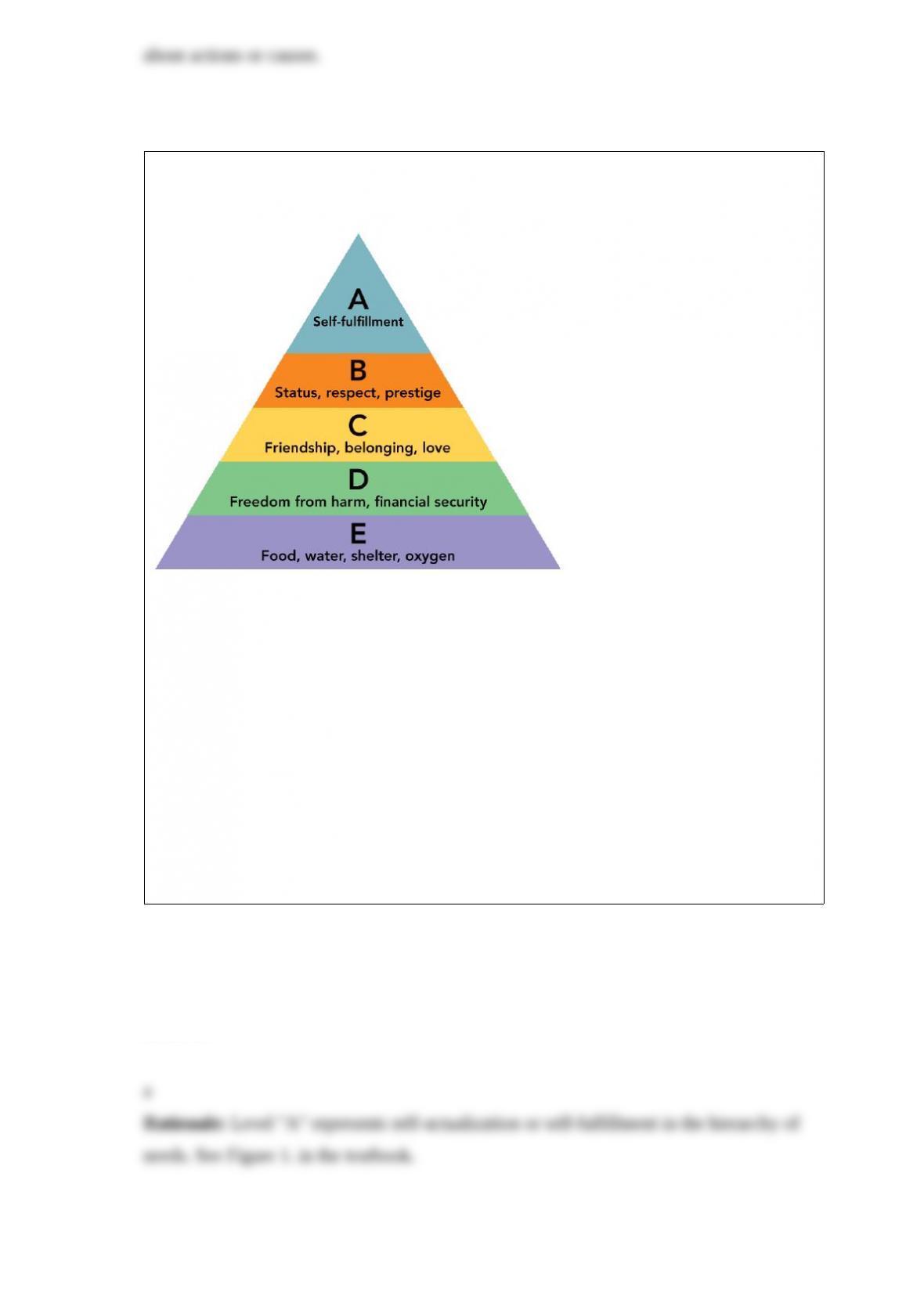
Figure 1.
According to Figure 1. above, a sense of self-fulfillment would be found in what level
of the hierarchy of needs?
a. “A”
b. “B”
c. “C”
d. “D”
e. “E”
Answer:
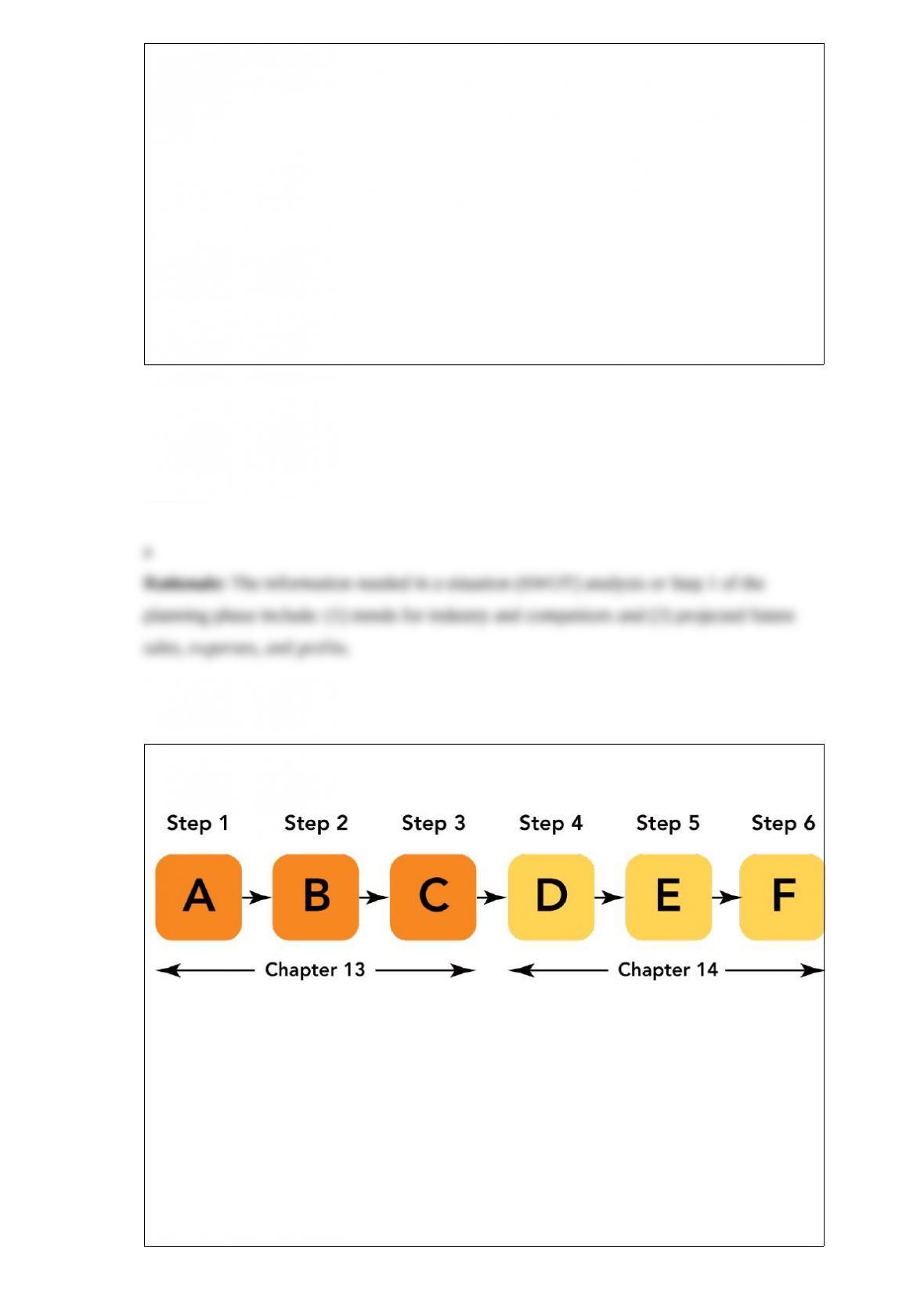
The information needed in a situation (SWOT) analysis or Step 1 of the planning phase
includes: (1) trends for industry and competitors and (2) __________.
a. projected future sales, expenses, and profits
b. market potential studies
c. positioning studies
d. market-product grids with target segments and product groupings
e. marketing mix actions
Answer:
Figure 1.
Figure 1. above represents the six steps in setting price. Which letter represents the step
where a firm would estimate demand?
a. “A”
b. “B”
c. “C”
d. “D”
e. “E”
Answer:
Allocating funds to promotion whereby the company (1) determines its promotion
objectives, (2) outlines the tasks to accomplish these objectives, and (3) determines the
promotion cost of performing these tasks is referred to as
a. percentage of sales budgeting.
b. competitive parity budgeting.
c. all-you-can-afford budgeting.
d. objective and task budgeting.
e. linear forecast budgeting.
Answer:
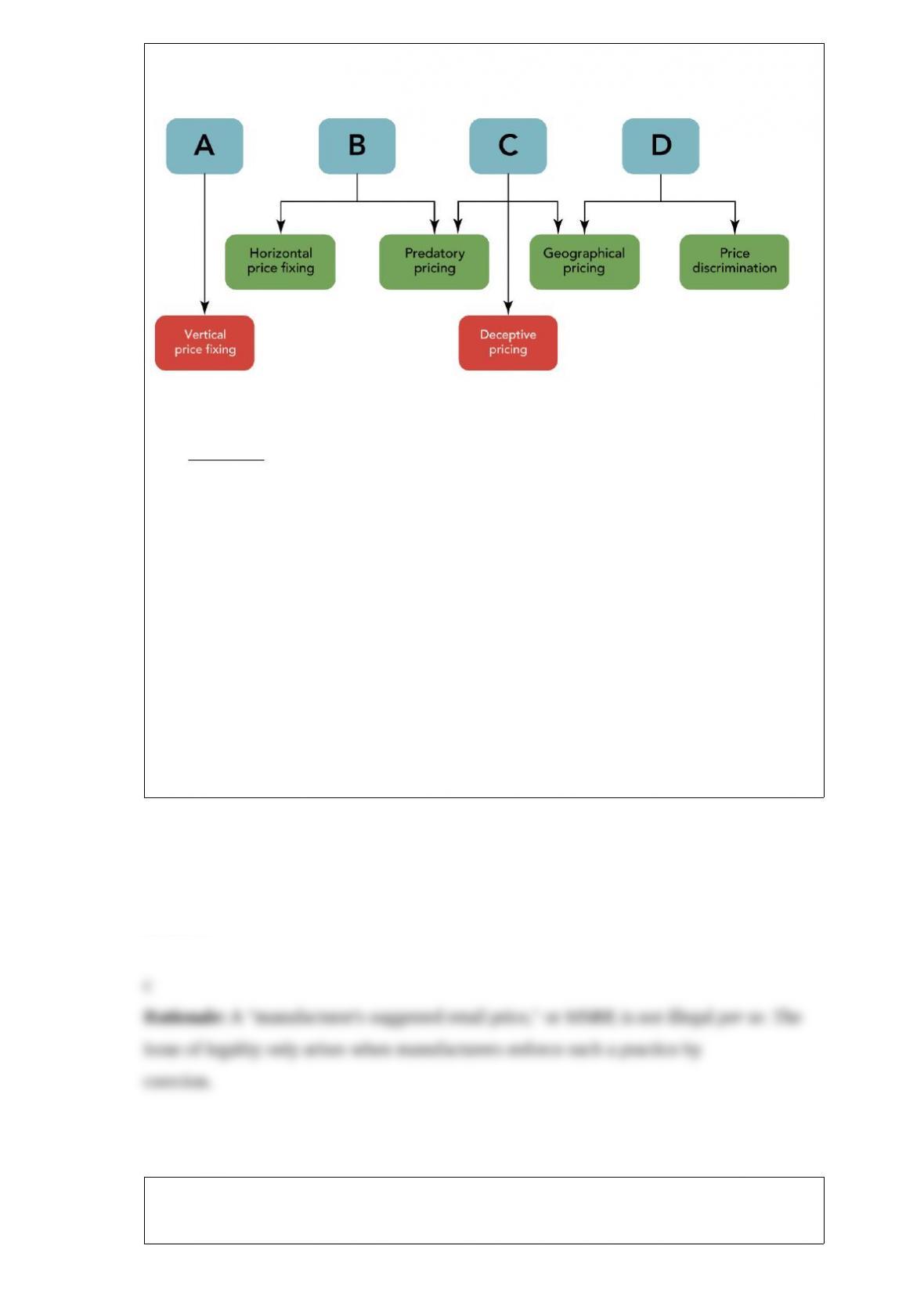
Figure 1.
All of the following statements regarding the legal and regulatory aspects of pricing are
true EXCEPT:
a. there has been a movement towards a “rule of reason” in both horizontal and vertical
price fixing cases.
b. the Robinson-Patman Act allows for price differentials to different customers under
the “cost justification defense.”
c. a manufacturer’s MSRP has been declared illegal per se by a recent U.S. Supreme
Court decision.
d. The “rule of reason” perspective is the direct opposite of the per se rule.
e. wholesalers can fix the maximum retail price for their products provided the price
agreement does not create an “unreasonable restraint of trade.”
Answer:
Reebok makes shoes with DMX Shear and Foam cushioning. The Premier Control shoe
is made for runners whose feet tend to turn out. The Premier Road is made with extra
cushioning for pavement runners. This strategy is an example of
a. mass customization.
b. customized manufacturing.
c. market segmentation.
d. single chain marketing.
e. market specific selection.
Answer:
Figure 1.
Consider Figure 1. above, which is an account management policy grid that groups
customers according to level of opportunity and the firm’s competitive sales position.
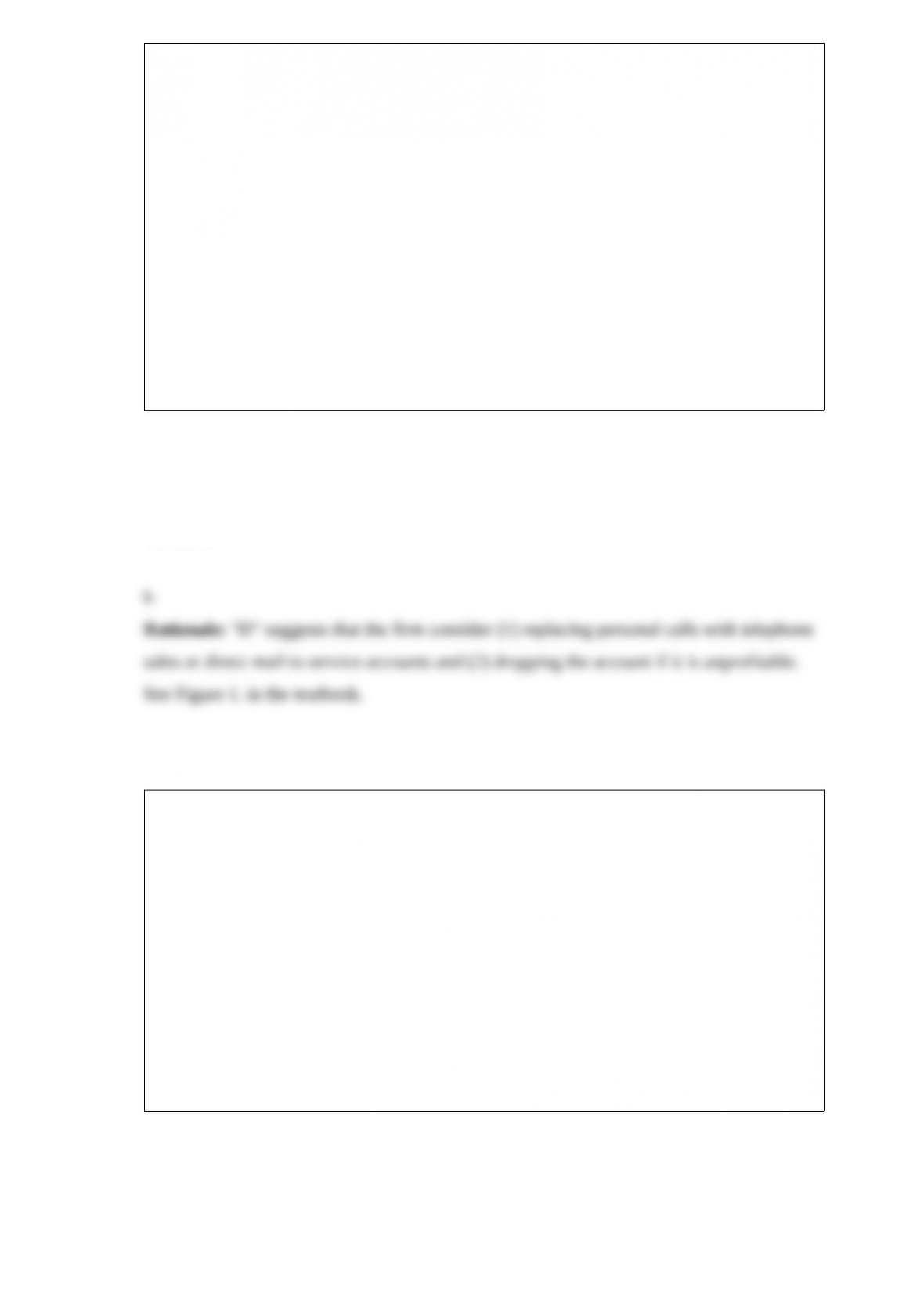
“D” represents what account management policy?
a. Accounts should emphasize a heavy sales organization position or shift resources to
other accounts if a stronger sales organization position is impossible.
b. Consider (1) replacing personal calls with telephone sales or direct mail to service
accounts and (2) dropping the account if it is unprofitable.
c. Accounts offer little opportunity and the sales organization position is weak.
d. Accounts should receive a high level of sales calls and service to retain and possibly
build accounts.
e. Accounts should receive moderate level of sales and service to maintain current
position of sales organization.
Answer:
Perhaps the greatest impact on salesforce communication is the application of
__________ technology.
a. Internet
b. facsimile
c. voice-mail
d. smartphone
e. web camera
Answer: