The Reynold’s Aluminum foil box has two side tabs that say “Press Here to Lock Roll”
to keep the roll of foil in place during use. This demonstrates which elements of good
packaging?
a. perceptual benefits and functional benefits
b. protection benefits and functional benefits
c. communication benefits and perceptual benefits
d. communication benefits and functional benefits
e. functional benefits and protection benefits
Answer:
The three approaches to setting advertising schedules are
a. flexible, seasonal, and continuous.
b. spontaneous, continuous, and intermittent.
c. continuous, flighting, and pulse.
d. daytime, primetime, and off-peak.
e. sporadic, intermittent, and infrequent.
Answer:
A manufacturer offers a suggested list price for a cashmere sweater of $250. The trade
discount is 40/20/10. What amount does the manufacturer expect to receive for the
sweater?
a. $175.00
b. $225.00
c. $108.00
d. $125.00
e. $100.00
Answer:
Errors in communication can occur in several ways: (1) the source may not adequately
transform the abstract idea into an effective set of symbols; (2) a properly encoded
message may be sent through the wrong channel and never make it to the receiver; (3)
__________; or (4) feedback may be so delayed or distorted that it is of no use to the
sender.
a. in an attempt to be creative, the encoder creates a message with too much noise
b. there is no interest on the part of the receiver because the product itself is inadequate
c. the communications channel is not properly developed
d. the message is considered too ordinary because there is too broad a field of
experience
e. the receiver may not properly transform the set of symbols into the correct abstract
idea
Answer:
All of the following are examples of test markets EXCEPT:
a. controlled test market
b. concept test market
c. simulated test market
d. laboratory test market
e. standard test market
Answer:
When a representative for Pampered Chef cooking utensils invites friends to her home
and spends 30 minutes demonstrating the superiority of the Pampered Chef products,
she is engaging in __________.
a. missionary sales
b. sales promotion
c. public relations
d. personal selling
e. a public service announcement
Answer:
A penetration pricing policy is MOST LIKELY to be effective when
a. lowering the price has only a minor effect on increasing sales volume and reducing
unit costs.
b. many segments of the market are price sensitive.
c. the high initial prices do not attract competitors.
d. customers interpret high price as signifying high quality.
e. customers are willing to buy immediately at the high initial price.

Answer:
Diamond Line is a distributor of everything a florist needs to create a beautiful
arrangement except the flowers. It sells to 10,000 flower and gift shops and 5,000
supermarkets nationwide. Each florist is called on four times a month and each
supermarket is called on twice a month. Assume a 52-week calendar year and that each
salesperson takes a four-week vacation. A sales call to a florist takes one hour of selling
time, and a sales call to a supermarket takes two hours of selling time. An average
salesperson spends 1,000 hours per year making sales calls. Calculate the number of
salespeople Diamond Line needs to cover its account base. The number of salespeople
it needs is __________.
a. 15
b. 52
c. 240
d. 480
e. 720
Answer:

Bernina, a sewing machine manufacturer, has an ongoing ad campaign in which it
encourages sewers to stop in to their local Bernina dealer to register to win a new
sewing machine. No purchase is necessary. Bernina is using a __________ to measure
the effectiveness of its ads.
a. sweepstakes
b. lottery
c. contest
d. premium
e. deal
Answer:

The goal of a SWOT analysis is to
a. identify market research questions in order to develop new products for new market
segments.
b. determine how raises, bonuses, and dividends will be paid.
c. reorganize the firm’s marketing department.
d. identify the critical strategy-related factors that can impact the firm.
e. fairly allocate governmental resources and financial aid across the industry.
Answer:
CoolMax is a fabric made by DuPont. It is used in the manufacture of exercise clothes
because it keeps the user “cool and dry.” The ads for the fabric in health and fitness
magazines convinced Kumar to buy a pair of Thorlo CoolMax walking crew socks
made of the material. Since he had never before owned anything made with CoolMax,
Kumar was in which stage of the hierarchy of effects?
a. trial
b. diffusion
c. innovation
d. evaluation
e. interest
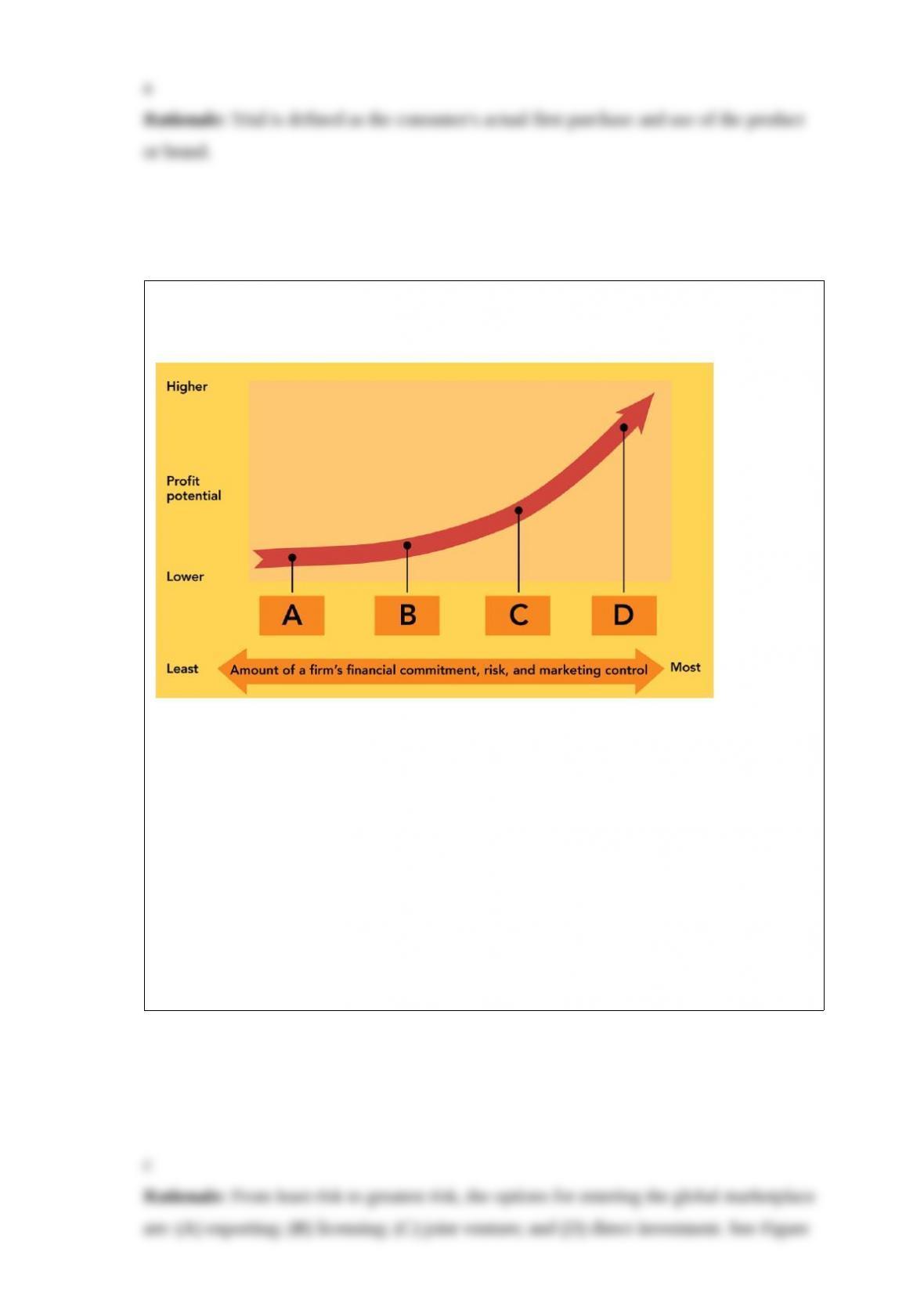
Answer:
Figure 1.
According to Figure 1. above, point “A” would most likely be __________.
a. joint venture
b. licensing
c. exporting
d. direct investment
e. franchise
Answer:

U.S.-based Pratt & Whitney sells aircraft engines to Europe’s Airbus S.A.S., which in
turn sells passenger airplanes to Japan Airlines that fly businesspeople around the
world. This is an example of
a. the product life cycle.
b. reseller dynamics.
c. a global organizational market.
d. ISO 9000.
e. the business cycle.
Answer:
At which stage in the product life cycle do industry profits usually peak?
a. introduction
b. growth
c. maturity
d. decline
e. accelerated development

Answer:
Electronic shopping agents that comb websites to compare prices and product or service
features are referred to as __________.
a. cookies
b. weblinks
c. intranets
d. bots
e. extranets
Answer:
Procter & Gamble (P&G) decided to skip a generation of consumers when it began to
market Old Spice deodorant. The target market consists of men aged 18 to 34 years old
(Generation Y) who don”t remember the Old Spice brand sold to their grandfathers (pre
baby boomer) many years ago. P&G is using which type of segmentation variable?
a. behavioral
b. demographic
c. lifestyle

d. geographic
e. psychographic
Answer:
In a recent survey, consumers were asked the following question: “Who should take the
lead in addressing environmental issues?” The results suggest that __________ should.
a. the federal government
b. businesses
c. individuals
d. environmental groups
e. the state government
Answer:
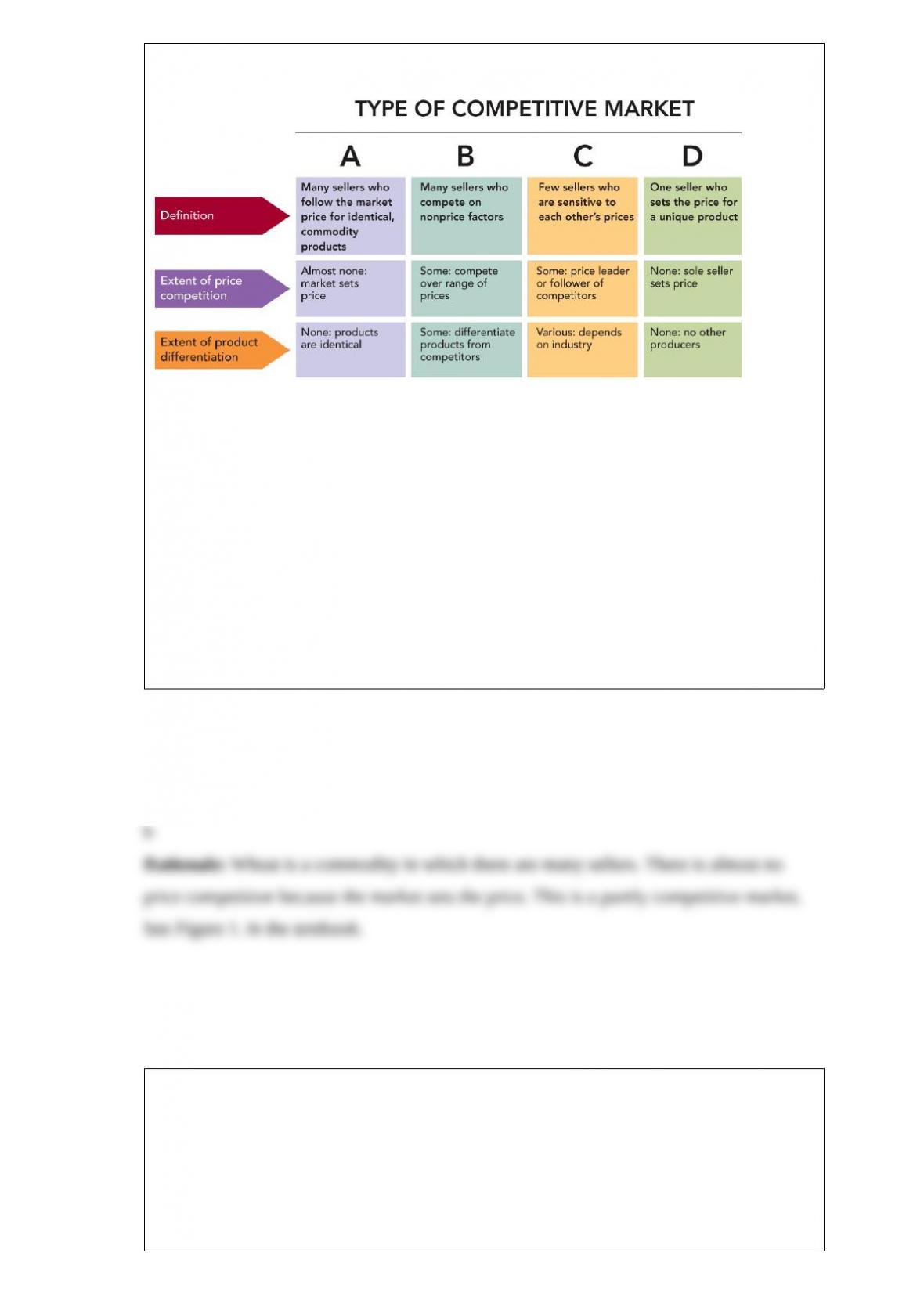
Figure 1.
Using Figure 1. above, how much price competition is likely for bushels of wheat?
a. There is a range of prices at which to sell.
b. The market sets the price so there is no price competition.
c. There is a price leader in the farming industry that sets the price.
d. Since there is only one seller, that firm sets the price.
e. Price is regulated by the government.
Answer:
Which of the following transactions occurred in the marketspace?
a. Connie purchased creative puzzles at an in-home demonstration by Discovery Toys.
b. Joan bought a brand new pair of Dansko shoes through Zappos.com.

c. Shelby purchased an iPhone case at a kiosk at the airport.
d. Corey bought a double-dipped chocolate ice cream cone from a mobile ice cream
truck.
e. Josh bought his mother a menorah through the Source for Everything Jewish gift
catalog by calling a toll-free hotline.
Answer:
Which of the following statements about the marketing concept era is most accurate?
a. The marketing concept era can trace its roots to early Greek culture.
b. During the marketing concept era, companies tried to satisfy the needs of consumers
while also achieving their goals.
c. During the marketing concept era, companies began to implement the idea of a
marketing program.
d. During the marketing concept era, companies believed you could produce as much as
you wanted because the product would sell itself.
e. All U.S. firms are now operating with a marketing concept philosophy.
Answer:

Americans born between 1977 and 1994 are referred to as __________.
a. Generation X
b. baby boomers
c. Generation Y
d. baby busters
e. Generation Z
Answer:
When Dell Computer sells made-to-order PCs to customers online via its website, it is
an example of which type of marketing channel?
a. indirect channel
b. strategic channel alliances
c. marketing channel
d. dual distributive channel
e. direct channel

Answer:
A wholesaler refers to
a. independent firms or individuals whose principal function is to bring buyers and
sellers together.
b. any intermediary who takes ownership of a manufacturer’s products or services and
then finds multiple buyers for those products or services.
c. an intermediary who sells to other intermediaries, usually to retailers in consumer
markets.
d. an intermediary who sells to consumers.
e. a manufacturing “matchmaker” who actively seeks out potential consumers and
brings them to retailers.
Answer:
Cross-docking is most closely related to __________.
a. efficient supply chains
b. intermodal transportation
c. responsive supply chains
d. reverse logistics

e. logistics management
Answer:
After watching the 30-minute infomercial on Oxy-Clean, Sarah was certain the cleaning
product would remove the grape juice stain from her white carpet. In terms of the
communication process, Sarah was __________ the message from Oxy-Clean.
a. integrating
b. transforming
c. translating
d. decoding
e. encoding
Answer:

To implement a __________ strategy, nikeid.com allows customers to visit its website
and design a sneaker to their own personal specifications.
a. product sampling
b. product clustering
c. mass customization
d. usage segmentation
e. psychographic segmentation
Answer:
A country’s communication, transportation, financial, and distribution systems are
considered to be its
a. capital infrastructure.
b. fixed-asset infrastructure.
c. economic infrastructure.
d. geopolitical network.
e. network infrastructure.
Answer:

The linking of the organization to its individual customers, employees, suppliers, and
other partners for their mutual long-term benefit is referred to as
a. relationship marketing.
b. exclusive dealing.
c. loyalty marketing.
d. customer relationship management.
e. symbiotic marketing.
Answer:
Attorneys’ fees, entrance fees, train fares, and organization dues are all examples of
a. premiums.
b. barter.
c. mediums of exchange.
d. price.
e. outlays.

Answer:
There are various nonprofit publications dedicated to assisting in consumer education
and decision-making. Examples of these public sources of information for an external
information search include Consumer Reports, __________, and TV “consumer
programs.”
a. advertisements
b. sales personnel
c. friends and relatives
d. government agencies
e. point of purchase displays
Answer:
Marginal analysis refers to
a. a continuing, concise trade-off of incremental costs against incremental revenues.
b. the change in total cost that results from producing and marketing one additional unit

of a product.
c. a technique that analyzes the relationship between total revenue and total cost to
determine profitability at various levels of output.
d. a continuing concise trade-off of incremental ROI and incremental ROA.
e. a technique that analyzes the relationship between revenues, profit, and market share
relative to changes in market growth rates.
Answer: