Which of the following descriptive statistics is (are) appropriate for rating scales?
A) percentages
B) averages
C) standard deviation
D) all three are appropriate ways to examine responses to a rating scale
Think about concept and communication tests. Initial questions probing reactions to the
message focus on the extent to which respondents feel that the message is important
and ________.
A) creative
B) interesting
C) relevant
D) motivating
E) inspiring
The text provided recommendations for the writing of multiple choice questions. Which
of the following is NOT a recommendation for the proper writing of multiple choice
questions?

A) keep the number of response options to five or less
B) provide a “zero” option when addressing behaviors
C) keep the response categories balanced
D) keep the “typical” behavior in the center of the list of response options
Think about the presentation of qualitative findings. Which situation described below
does NOT increase transparency.
A) When it is clear that there is an absence of bias in data selection.
B) When it is clear that there is an absence of bias in the selection of themes.
C) When there is proof that analysts read all of the transcripts.
D) When it is clear that there is sufficient evidence to support each theme.
E) When it is clear that there is rigor in the way the analysis was carried out.
According to VALS, ________ with many resource constraints, (e.g., little money,
poorer health, low tolerance for risk) consume little and are motivated mostly by low
cost and brand familiarity.
A) Strivers
B) Believers
C) Innovators
D) Survivors
E) Thinkers
Advertisers have learned that increasing ad relevance ________ ad response.
A) decreases
B) increases
C) does not affect
Which of the following allows you to locate books containing content that matches your
search terms?
A) Google Scholar
B) Google Book Search
C) Yahoo! Finder
D) Yahoo! InPrint

The question “How much did you like this advertisement when compared to other car
ads?” provides a ________.
A) frame of analysis
B) frame of reference
C) code for data analysis
D) casual reference
The following may or may not describe acceptable practice in writing a concept test
headline.
– Use catchy phrases
– Use sentence fragments
– Use simple declarative statements
– Use provocative questions
How many, if any, of these recommendations are allowable when writing a concept test
headline?
A) 0
B) 1
C) 2
D) 3
E) 4
Which of the following is NOT a defining characteristic of nominal level measures?
A) response categories are mutually exclusive and collectively exhaustive
B) response options must be four or less
C) for purposes of data analysis numbers are merely a way to distinguish categories
D) there is internal category equivalence
If the focus groups are running “long” the best thing to do is ________.
A) Shorten the discussion, but leave time for the summary
B) Keep the discussion going, but eliminate the summary
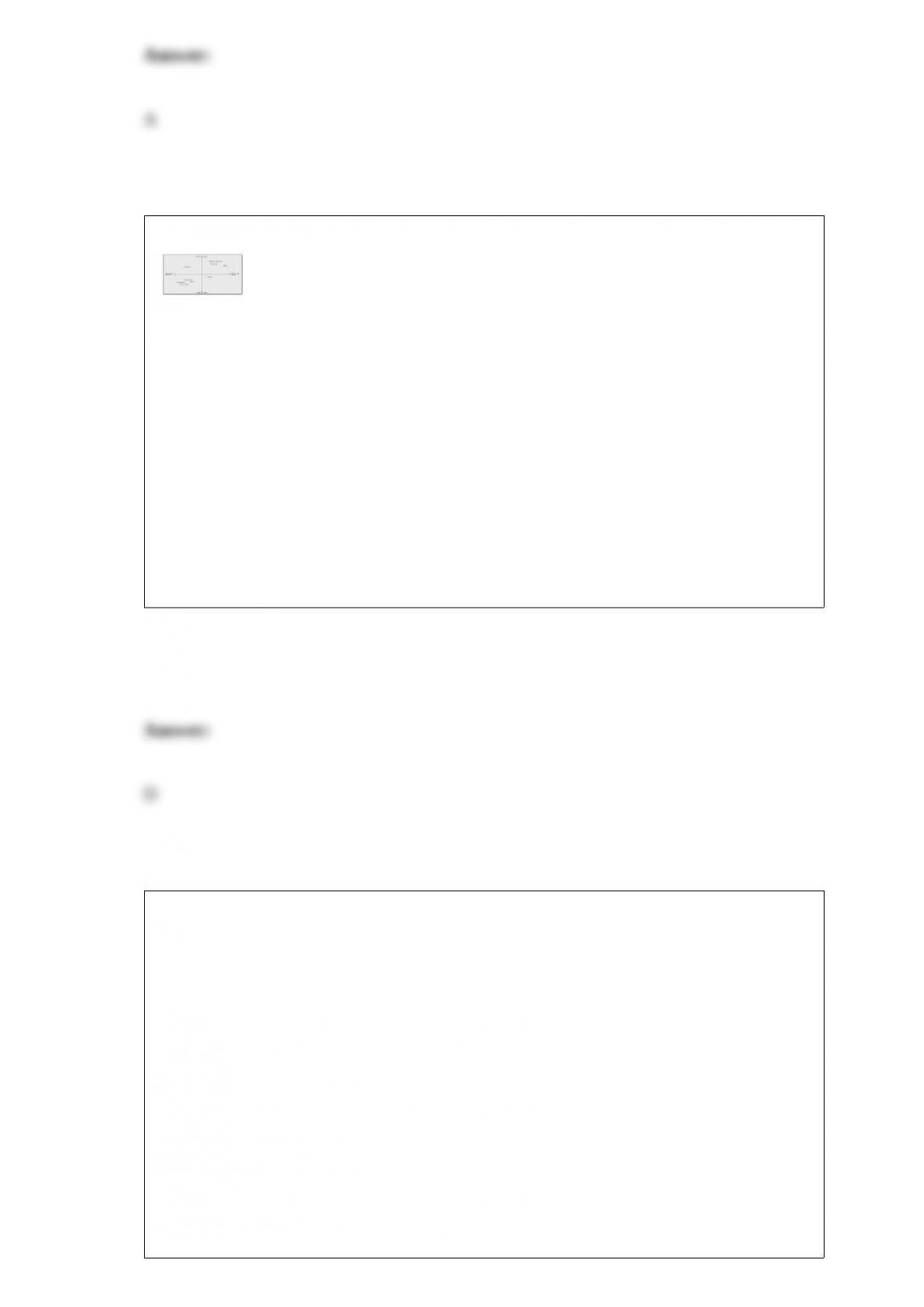
Consider the perceptual map shown below.
What needs to be added to this map in order to determine the single brand that is in the
strongest competitive position?
A) average brand ratings
B) additional brands in the upper left quadrant
C) additional brands in the lower left quadrant
D) the ideal brand
E) additional brands in the lower right quadrant
The two statements below refer to the researcher as presenter.
I. The presenter shows respect for the audience by being prepared and knowing the
material.
II. The presentation should be paced in a way that is best for the presenter.
Which, if any, of these statements is (are) true?
A) I only
B) II only
C) I and II are both true
D) Neither I nor II are true
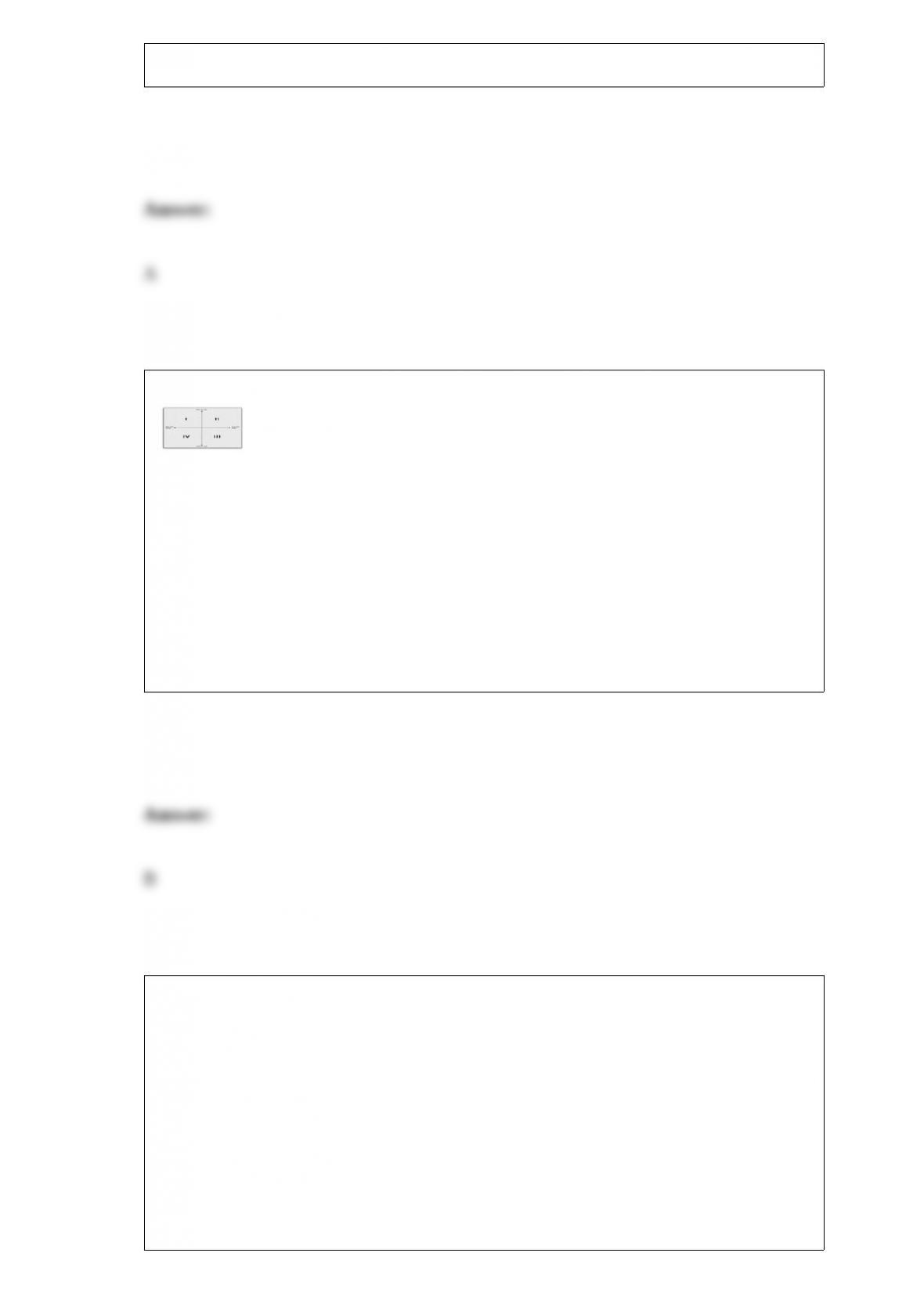
Consider the perceptual map shown below.
Which is the best quadrant for a brand to be in?
A) I
B) II
C) III
D) IV
Imagine that you conduct a segmentation study for McDonald’s. Individuals are
assigned to different segments based on the percentage of all their fast food
consumption which takes place at McDonald’s in an average week. This would be an
example of a segmentation based on ________.
A) product-related attitudes
B) brand loyalty
C) psychographics

D) motivations
According to VALS, the Ideals group consists of the Thinkers and ________ segments.
A) Innovators
B) Strivers
C) Achievers
D) Believers
E) Experiencers
The search results at the top of Google’s Golden Triangle were viewed by ________ %
of viewers.
A) 20
B) 50
C) 90
D) 100
The first step in stratified random sampling is to identify one or more classification
criteria, each of which defines one strata.
Unstructured data recording can ________.
A) only be analyzed qualitatively
B) only be analyzed quantitatively
C) can be analyzed both qualitatively and quantitatively
Think about presenting the results of a segmentation study. A ________ can be created
for each individual segment. This document names and describes the typical individual
in a segment, communicating all segment characteristics as a reflection of that single
individual within the segment.
A) summary sheet
B) persona
C) narrative
D) spec sheet
The first stage in the process of advertising research is ________.
A) preliminary discussions and agreements
B) planning and data collection
C) analysis
D) synthesis
E) tactics and actions
When designing a research study, the number of contacts must always ________ the
number of required completed interviews.
A) be less than
B) be equal to
C) be more than

MindSign is a company that re-edits advertising to reflect ________ test results.
A) EEG
B) eye tracking
C) fMRI
D) facial coding
E) survey
A collection of themes can be used to form a ________.
A) supratheme
B) metatheme
C) master theme
D) controlling theme
E) maxitheme

With regard to eye tracking data, ________ identifies the visual element that attracts the
greatest amount of initial attention.
A) first fixation
B) most fixation
C) total gaze time
D) individual gaze time
The best way to describe a screener is that it works like a(n) ________.
A) gate
B) train
C) stadium
D) apartment

You are holding two focus groups to discuss college savings plans with parents of
teenagers. You want to talk with individuals whose income ranges from $20,000 to over
$100,000 annually. What would be the best course of action with regard to group
composition?
A) Have the first group consist of individuals with incomes between $20,000 and
$30,000; have the second group consist of individuals with incomes between $90,000
and $100,000.
B) Have both groups consist of a mix of individuals who have incomes between
$20,000 and $100,000.
C) Have the first group consist of individuals with incomes between $20,000 and
$50,000; have the second group consist of individuals with incomes between $60,000
and $100,000.
D) Have both groups consist of individuals who have incomes between $85,000 and
$100,000.
________ data recording encourages the observer to record his or her observations in
the form of a narrative.
A) Unstructured
B) Passive
C) Structured
D) Serendipitous
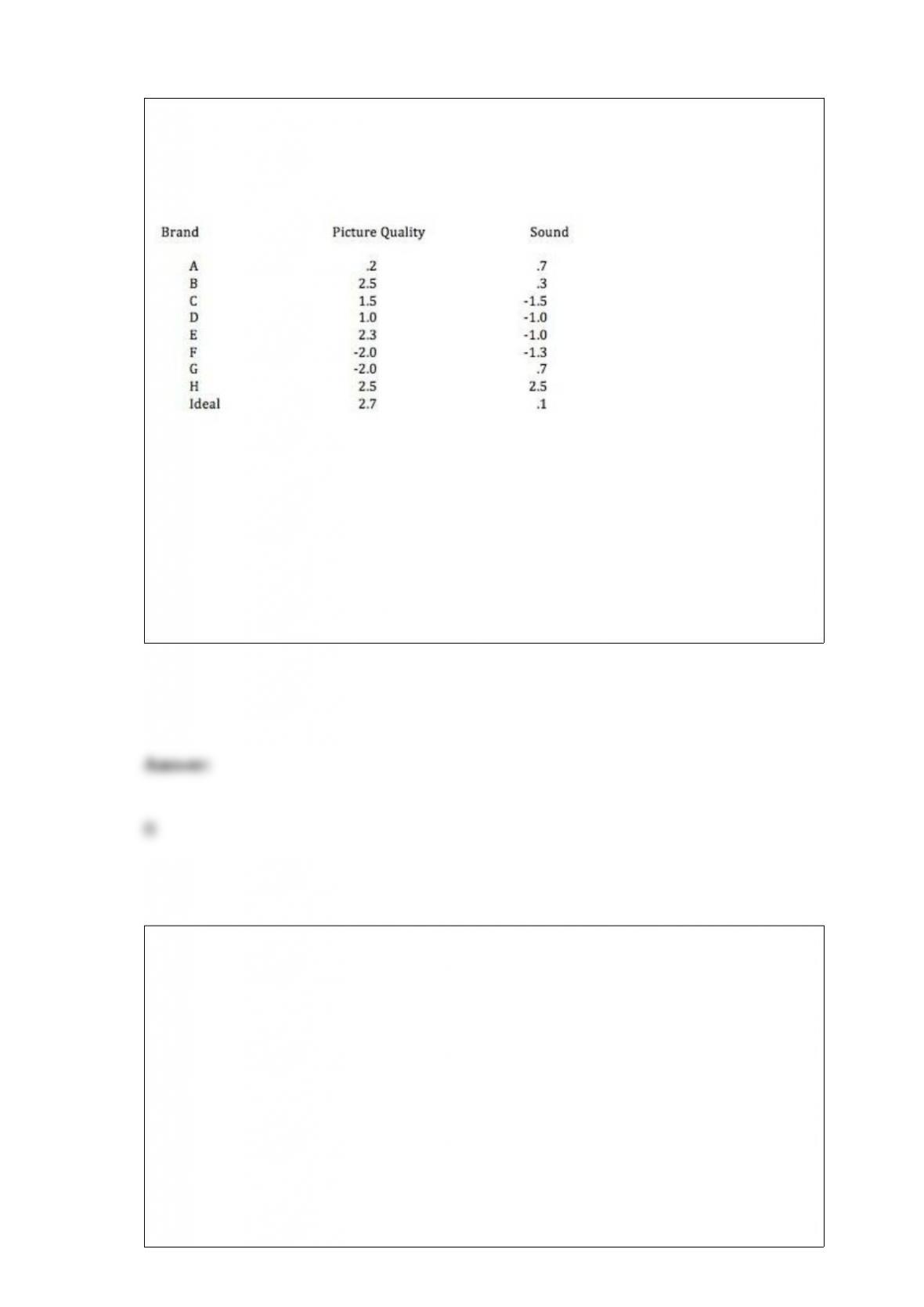
A perceptual mapping study was conducted to explore consumers’ perceptions of
various brands of television sets. Two dimensions were discovered: Picture Quality and
Sound. The average ratings for different brands, as well as the Ideal brand, on each
dimension is shown below. The scale range is from + 3 to -3.
In order to move closer to the Ideal, Brand E needs to primarily generate more positive
perceptions of its ________.
A) picture quality only
B) sound quality only
C) both picture quality and sound quality
Consider the two statements below.
I. Personal and telephone interviews provide the greatest degree of interview control.
II. Mail and online surveys provide weak sample control.
Which, if any, of these statements is (are) correct?
A) I only
B) II only
C) I and II are both true

D) Neither I nor II are true
Which of the following is NOT an important consideration in writing the body copy for
a concept?
A) use short paragraphs
B) use active, declarative sentences
C) keep all word length to seven letters or less
D) avoid sentence fragments
E) keep overall length short
In the original “Magic Face” ad, the last thing looked at was the ________
A) model’s face and body
B) headline
C) brand name
D) product image
E) tagline