The two central concerns of marketing are __________.
a. increasing market share and making profits
b. holding down costs while increasing profits
c. developing products and finding suppliers
d. discovering and satisfying consumer needs
e. practicing ethics and sustainability
Answer:
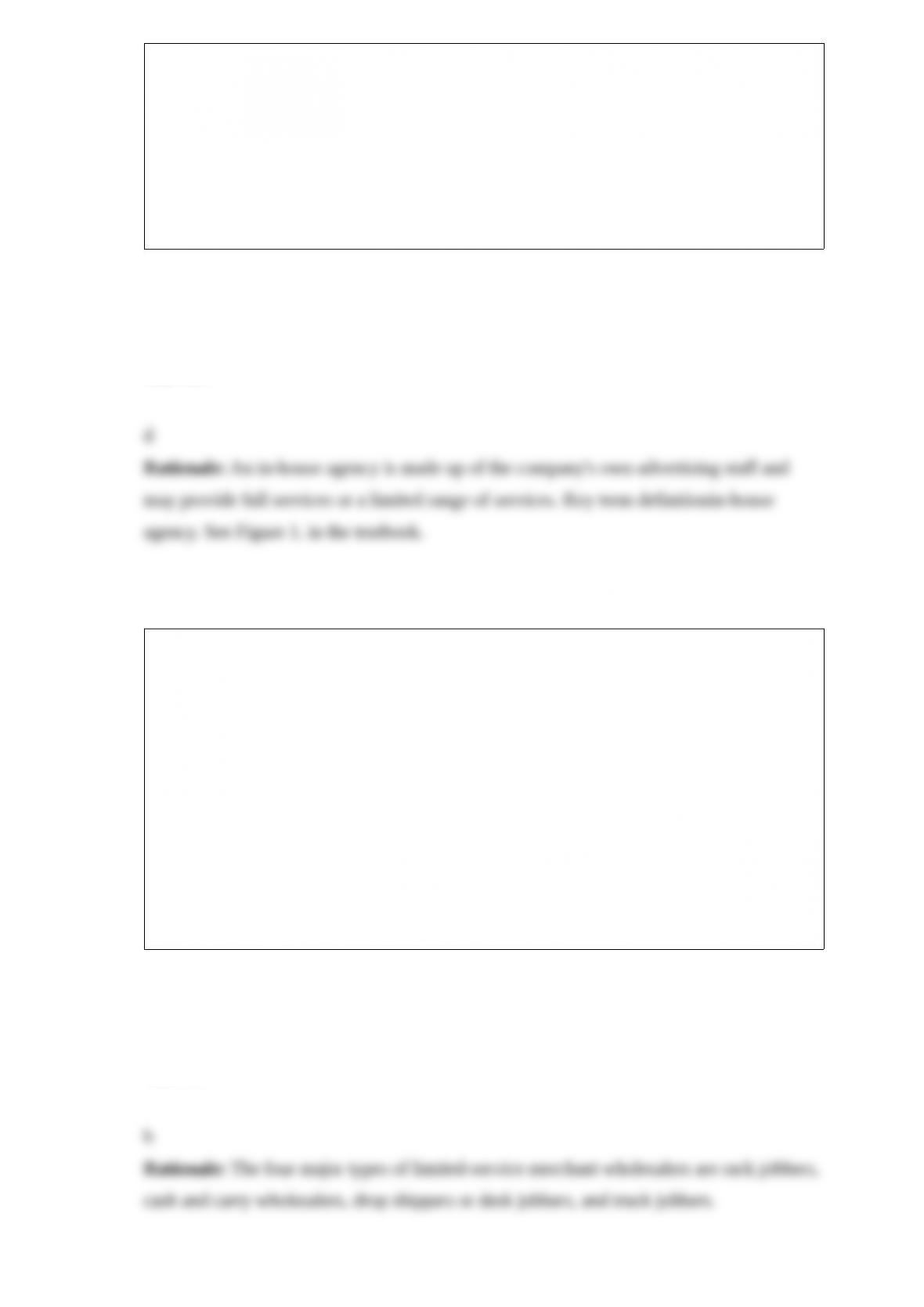
Figure 1.
According to Figure 1. above, “C” is the definition for which type of advertising
agency?
a. a full-service agency
b. a limited-service agency
c. a multi-media agency
d. an in-house agency
e. a social media agency
Answer:
The four major types of limited-service merchant wholesalers are cash and carry
wholesalers, drop shippers, truck jobbers, and __________.
a. display vendors
b. rack jobbers
c. point of purchase wholesalers
d. transport vendors
e. container transport vendors
Answer:
A marketing plan refers to
a. the long-term decisions made to implement the marketing program and the
monitoring of those decisions.
b. a technique that marketing managers use to quantify performance measures and
growth targets to analyze their firm’s strategic business units (SBUs) as though they
were a collection of separate investments.
c. a road map for the marketing activities of an organization for a specified future time
period, such as one year or five years.
d. the detailed day-to-day operational decisions essential to the overall success of
marketing strategies.
e. a road map for the entire organization for a specified future period of time, such as
one year or five years.
Answer:
A manufacturer’s sales office
a. works for several producers and carries noncompetitive, complementary merchandise
in an exclusive territory.
b. takes title to merchandise but sells only to buyers who call on them, pays cash for
merchandise, and furnishes their own transportation for the merchandise.
c. carries a producer’s inventory, performs the functions of a full-service wholesaler and
is an alternative to a merchant wholesaler.
d. does not carry inventory, typically performs a sales function, and is an alternative to
agents and brokers.
e. brings buyers and sellers together to make sales.
Answer:
Studies indicate that comparative ads attract more attention and increase the perceived
quality of the advertiser’s brand although their impact may vary by product type,
message content, and audience __________.
a. gender
b. education
c. income
d. ethnicity
e. occupation
Answer:
All of the following factors are used to BALANCE the use of the promotional mix
elements EXCEPT:
a. the channel of distribution.
b. the product’s life cycle.
c. the decision stage of the buyer.
d. the different departments responsible for implementing the sales promotion strategy
and tactics.
e. the characteristics of the product.
Answer:
Which of the following statements regarding corporate vertical marketing systems is
most accurate?
a. Corporate vertical marketing systems combine successive stages of production and
distribution under shared ownership with all links in the marketing chain sharing title to
the goods.
b. Corporate vertical marketing systems can use forward integration or backward
integration but not both.
c. Corporate vertical marketing systems increase distribution costs.
d. Corporate vertical marketing systems result in increased capital investments and
fixed costs.
e. Corporate vertical marketing systems are only effective with low-end consumer
products.
Answer:
In the VALS framework, consumers motivated by ideals are guided by knowledge and
principle. __________ choose familiar products and brands, favor American-made
products, and are generally brand loyal.
a. Believers
b. Thinkers
c. Makers
d. Experiencers
e. Achievers
Answer:
What is the primary purpose of LinkedIn?
a. LinkedIn keeps track of business trends and news updates.
b. LinkedIn provides a way to integrate all of one’s social networks into one
comprehensive news feed.
c. LinkedIn provides a forum for discussion about the difficulties and stresses of the job
market.
d. LinkedIn provides a forum to create a conversation between large companies and
their employees.
e. LinkedIn is a platform for professional networking and job searching.
Answer:
The grassroots movement started in the 1960s to increase the influence, power, and
rights of consumers in dealing with institutions is referred to as __________.
a. Naderism
b. consumerism
c. green marketing
d. anti-corporate activism
e. consumptionism
Answer:
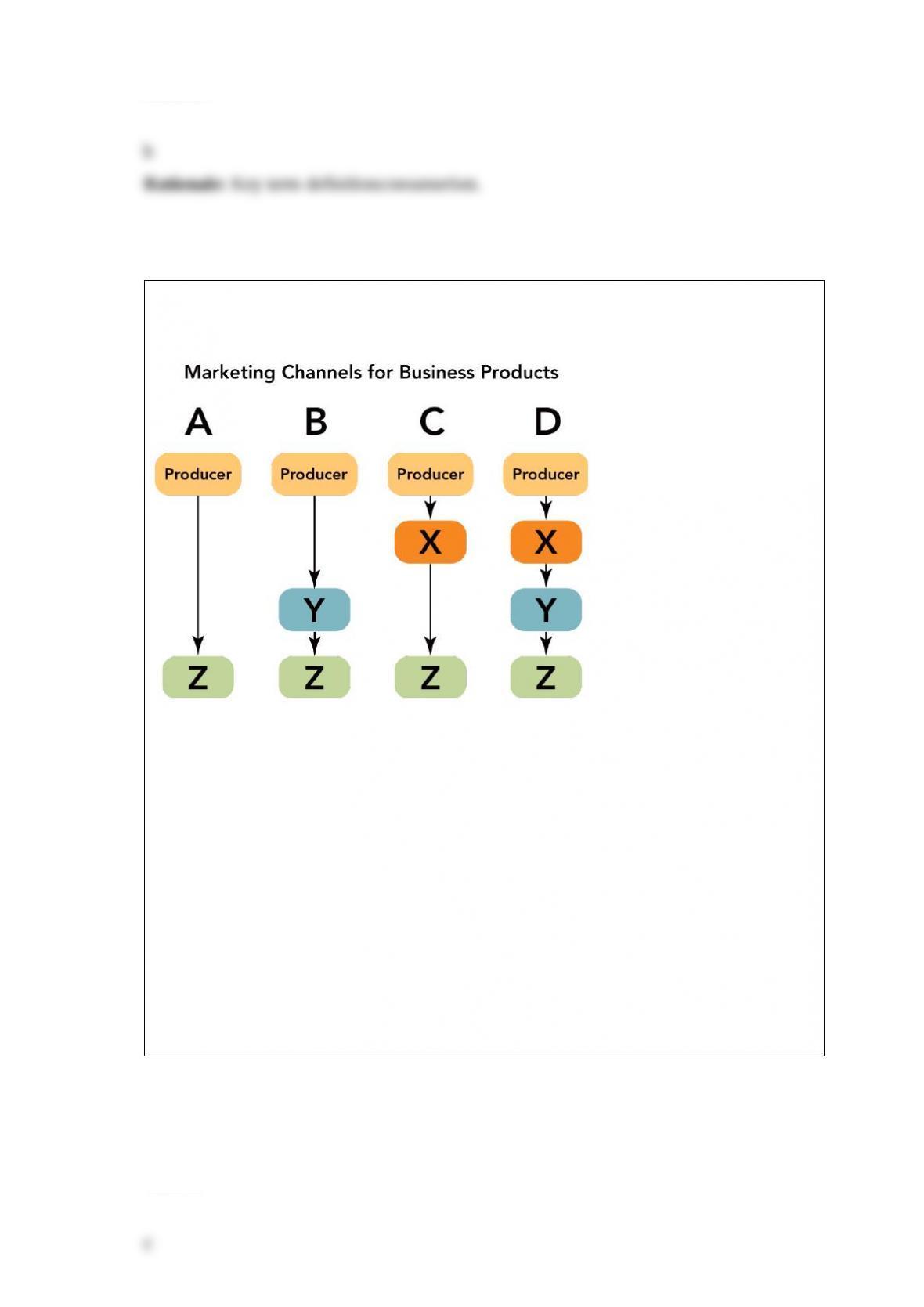
Figure 1.
Figure 1. above, depicts the four most common marketing channels for business
products and services. Channel “B” would be an appropriate marketing channel for
__________.
a. Cray supercomputers
b. magnetic resonance imaging (MRI) machines
c. John Deere excavators
d. industrial fasteners
e. electrical products
Answer:
When retailers set prices on new models or styles of products, the price of existing
models often is _________.
a. marked up
b. off-priced
c. value-added
d. marked down
e. maintained
Answer:
The term branding refers to __________.
a. the licensing of a name, phrase, design, symbol, or combination of these for a period
of 17 years, at which time a firm may renew its intellectual property rights to them
b. the value added to the product from the additional features given to a product beyond
its functional attributes
c. the identification of an organization’s products based upon individual SKUs
d. an organization’s use of a name, phrase, design, symbol, or combination of these to
identify its products and distinguish them from those of competitors
e. the establishment of a commercial, legal name under which a company does business
Answer:
The Direct Selling Association reports that the number of companies using direct
selling has __________ in the past five years.
a. increased by 10 percent
b. increased by 30 percent
c. increased by 50 percent
d. decreased by 20 percent
e. decreased by 40 percent
Answer:
Which of the following statements regarding global brands is most accurate?
a. A global brand has dispersed marketing centers, each of which is responsible for a
specific region.
b. A global brand is marketed under the same name in multiple countries.
c. A global brand alters the product formulation or service for each geographical region.
d. A global brand delivers multiple benefits based on the GDP of each country.
e. A global brand is a collaborative effort among several different national firms.
Answer:
The __________ element of the marketing mix includes discounts and allowances.
a. product
b. price
c. promotion
d. place
e. people
Answer:
Many fast food retailers, including McDonald’s and Burger King, have followed a
predictable pattern of how new forms of retail outlets enter the marketplace.
McDonald’s has evolved from a relatively simple restaurant with low margins, low
prices, limited product offerings, and low institutional status to a worldwide chain with
higher margins, high status, and a diverse menu of products. This evolution of
McDonald’s restaurants is consistent with the
a. slow to fast food restaurant evolutionary cycle.
b. revolution of retailing.
c. retail life cycle.
d. fast food retail sequence.
e. wheel of retailing.
Answer:
Because services tend to be a(n) __________ rather than an object, they are much more
difficult for consumers to evaluate.
a. opportunity
b. performance
c. adventure
d. risk
e. decision
Answer:
Which of the following statements about services is MOST accurate?
a. Whether tangible or not, the marketing of services is exactly the same as the
marketing of products or ideas since they both satisfy customer needs.
b. Although a major contributor to the GDP nationally, services play only a minor role
in GDP on a global scale.
c. Services represent a large export business; it is one of the few areas where the United
States has a trade surplus.
d. Very few jobs in the United States are in the services sector.
e. There is much more in common with the marketing of services and business products
than there is between the marketing of services and consumer products.
Answer:
Thirty-six percent of sales at supermarkets in the United Kingdom carry the stores’ own
brand names. Eighteen percent of all supermarket sales in France and Germany carry
the stores’ own brand names. And in the U.S., 14 percent carry the stores’ own brand
names. These stores use a __________ strategy to sell other manufacturers products
with their own brand names.
a. generic branding
b. multibranding
c. co-branding
d. multiproduct branding
e. private branding
Answer:
A basic approach to scheduling when seasonal factors are unimportant and advertising
is run at a constant or steady schedule through the year is referred to as a
a. continuous schedule.
b. flighting schedule.
c. pulse schedule.
d. relentless schedule.
e. unceasing schedule.

Answer:
In marketing, the effective rules of the game, the boundaries between competitive and
unethical behavior, and the codes of conduct in business dealings are referred to as
a. societal norms.
b. societal mores.
c. business cultures.
d. fair trade practices.
e. corporate values.
Answer:
A market researcher showed a new brand of blue jeans to several groups of college
students and asked the students to rate the quality of the jeans. Two weeks later, the
researcher showed the same college students a television advertisement featuring movie
star Scarlett Johansson wearing the new brand of jeans. The marketer asked the students
again to rate the quality of the jeans. The marketer predicted that after viewing the
advertisement, the students’ ratings of the new jeans would be more positive than their
original ratings. In this experiment, students’ ratings of the new blue jeans served as the
a. dependent variable.
b. independent variable.
c. social environmental force.
d. secondary data.
e. constraint.
Answer:
Based on a study of 6,500 teens in 26 countries, when asked what country had the most
influence on their attitudes and purchase behavior, 54 percent of teens from the United
States, 87 percent of those from Latin America, 80 percent of the Europeans, and 80
percent of those from Asia named
a. the United States.
b. the United Kingdom.
c. Japan.
d. France.
e. Russia.
Answer:
When using share points to make marketing resource allocation decisions, marketing
managers must estimate: (1) the market share for the product, (2) the revenues
associated with each point of market share, (3) __________, and (4) possible
cannibalization effects on other products in the line.
a. total production costs
b. number of market segments
c. stage of the product in its product life cycle
d. the contribution to overhead and profit of each share point
e. the total financial resources available for a sustained marketing effort
Answer:
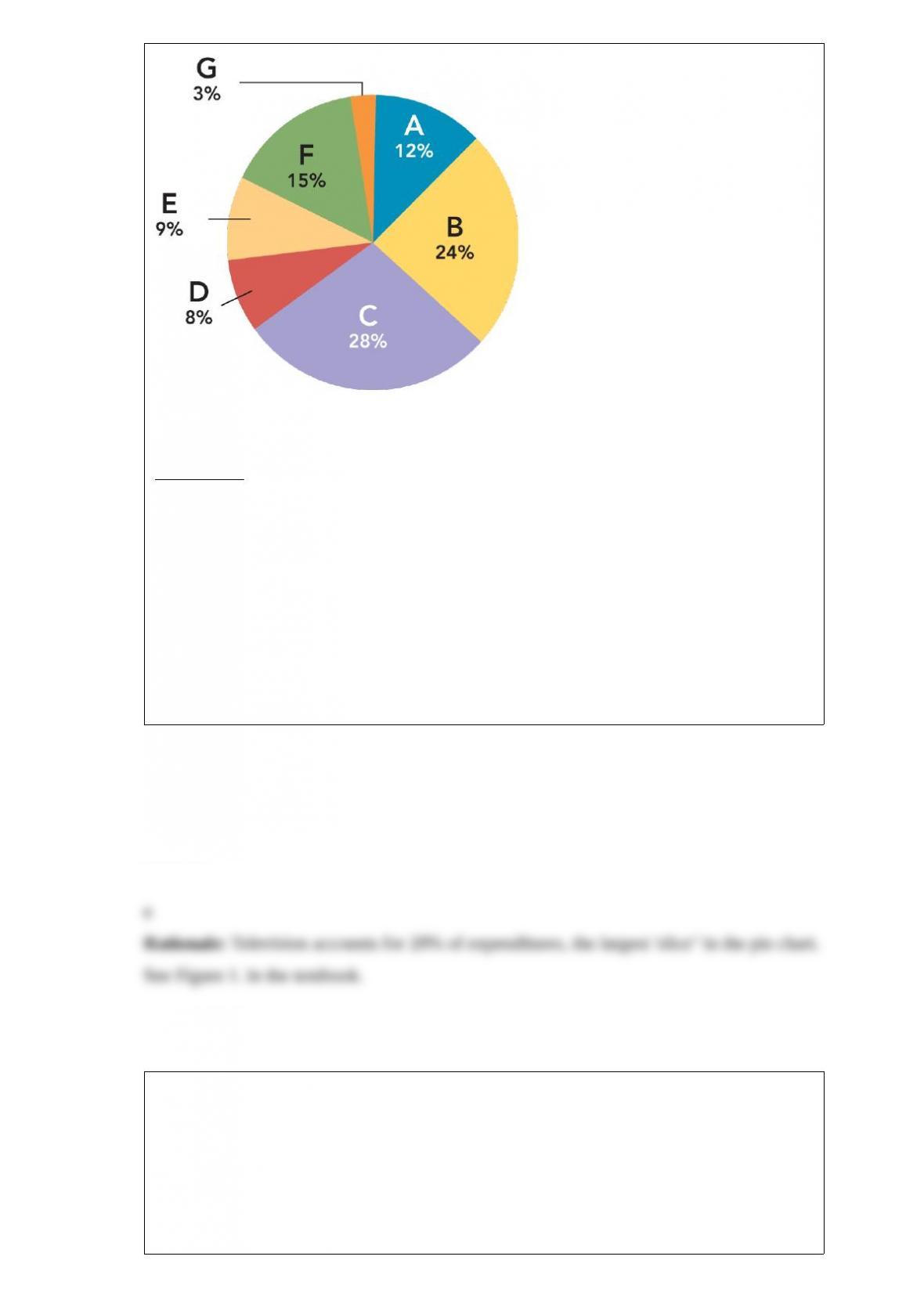
Figure 1.B
With respect to Figure 1.B above, “C” represents which media alternative that has the
LARGEST amount of advertising expenditures (or ‘slice” of the pie chart)?
a. newspapers
b. radio
c. direct mail
d. magazine
e. television
Answer:
On the northern tip of Goose Island in the Chicago River sits the William Wrigley Jr.
Company’s Global Innovation Center. Here, Wrigley creates new products using a joint
effort by some 250 full-time food scientists, researchers, and marketers. The people
who work in this center are most likely members of
a. innovation squads.
b. a business consortium.
c. multiple strategic directional teams.
d. strategic evaluation teams.
e. cross-functional teams.
Answer:
The key to setting a final price for a product is finding an approximate price level to use
as a reasonable starting point. Four common approaches to selecting an approximate
price level are: (1) demand-oriented; (2) cost-oriented; (3) profit-oriented; and (4)
__________ approaches.
a. revenue-oriented
b. distribution-oriented
c. stakeholder-oriented
d. competition-oriented
e. cause-oriented
Answer:
Price refers to
a. the value assigned to the exchange of products and services for other products and
services.
b. the value judgment made by both the buyer and seller regarding an item’s worth.
c. the money or other considerations (including other products and services) exchanged
for the ownership or use of a product or service.
d. the value assessed for the benefits of using a product or service.
e. the highest monetary value a customer is willing to pay for a product or service.
Answer:
President Bill Clinton attempted to protect American firms from foreign competition by
placing a government tax on Japanese automobiles imported to the United States.
President Clinton’s goal was to raise the price on Japanese imports, thereby encouraging
American consumers to purchase American-made automobiles. The tax the president
threatened to impose is an example of a __________.
a. boycott
b. tariff
c. quota
d. sanction
e. subsidy
Answer:
When developing marketing strategies, marketing managers use the elements of the
marketing mix, which includes product, price, place, and promotion. In a similar
fashion, when developing retailing strategies, marketers use what is called the retailing
mix, which includes
a. retail pricing, store location, retail communication, and merchandise.
b. products and services, promotions, and communications.
c. physical distribution, promotions, and communications.
d. physical distribution, products, and personal selling.
e. products, price, and personal selling.
Answer:
A law, amended by the International Anti-Dumping and Fair Competition Act, makes it
a crime for U.S. corporations to bribe an official of a foreign government or political
party to obtain or retain business in a foreign country, is referred to as the
a. International Law for Egalitarian Ethics Act.
b. International Fair Practices Act.
c. Law of International Equity Act.
d. International Law of Ethical Business Practices Act.
e. Foreign Corrupt Practices Act.
Answer:
In the early 1980s, Apple, Inc. was often called “Camp Runamok” because
a. every employee was encouraged to do his or her “own thing.”
b. it was concentrating on laptops while everyone else was concentrating on personal
computers.
c. all the employees were so young, they occasionally played more than they worked.
d. there were no coherent product lines targeted at identifiable market segments.
e. its personal computers were “running amok” with viruses, spyware, and other
problems.
Answer: