What is the nature of the “paid” aspect of advertising?
a. Fees are paid for space or time.
b. Fees are paid to salespeople as either salaries or commissions.
c. Fees are paid to creative arts contributors but there is no direct payment to media.
d. There is a wide range of fees paid depending upon the promotion selected.
e. The primary costs are now associated with communication through mail, telephone,
or the Internet.
Answer:
All of the following are important aspects of product life cycles EXCEPT __________.
a. the shape of their sales curves
b. the rate at which consumers adopt products
c. how they vary with different levels of products
d. how many competitors create “me too” products
e. their length
Answer:
In 2004, the __________ Act became effective and restricts information collection and
unsolicited e-mail promotions on the Internet.
a. Anti-SPAM
b. E-Mail Privacy
c. Digital Marketing
d. Consumer E-Mail Solicitation
e. CAN-SPAM
Answer:
Which of the following statements regarding sales goals is most accurate?
a. For marketing managers, sales revenue or unit sales are more easily addressed than
profit goals.
b. Cutting prices for a single product in a product line to raise unit sales often results in
an increase in sales for related products in the line as well.
c. Very often, cutting prices results in a decrease in market share.
d. Setting unit volume sales as a pricing objective results in price wars with
competitors, so the practice is limited to industries with as few competitors as possible.
e. An advantage of increasing unit volume sales is that it always results in an increase in
profits.
Answer:
Organizations face three kinds of specific buying situations. They are new buy, straight
rebuy, and modified rebuy. Collectively, these situations are referred to as
a. industrial buying behavior.
b. reseller buying behavior.
c. buy classes.
d. selling classes.
e. consideration set.
Answer:
Consumer groups living in many countries or regions of the world that have similar
needs or seek similar features and benefits from products or services are referred to as
a. transnational consumers.
b. meganational consumers.
c. international consumers.
d. multinational consumers.
e. global consumers.
Answer:
One disadvantage of using the yellow pages as an advertising medium is
a. the proliferation of directories in many cities.
b. they have extensive accountability and ROI metrics.
c. the ads are perishable.
d. few households with telephones have them.
e. advertisers must create extensive databases for delivery.
Answer:

Which of the following statements about geographical adjustments to price is most
accurate?
a. In FOB origin pricing, the seller selects the mode of transportation.
b. In FOB with freight-allowed pricing, the seller passes on all transportation costs to
the buyer.
c. Multiple-zone pricing is sometimes referred to as ‘spider web” pricing.
d. Basing point pricing has been used in industries where freight expenses are a
significant part of the total cost to the buyer and products are largely undifferentiated.
e. Geographical adjustments can be subject to government regulation if the firm cannot
supply objective data (lists of mountains, rivers, weather conditions, etc.) explaining
why those adjustments need to be made.
Answer:
In using social media a brand manager tries to select and use one or more social
networks from the hundreds that exist. This often entails assessing (1) the number of
daily visitors to the website, (2) __________, and (3) the focus of the website
a. the availability of social network to run apps
b. the ability of the site to be measured in terms of its sales, profitability, distribution
density, and other performance metrics
c. the characteristics of these visitors
d. the ability of the social network to pull controversial content
e. the site’s ability to present the results of key word searches to improve the odds of a
firm’s products showing up in user searches
Answer:
A technique that managers use to quantify performance measures and growth targets to
analyze its strategic business units (SBUs) as though they were a collection of separate
investments is referred to as
a. investment (ROI) analysis.
b. synergy analysis.
c. marketing audit.
d. diversification analysis.
e. business portfolio analysis.
Answer:

A manufacturer of a new all-natural-ingredient shampoo and conditioner puts free
samples of the product in Sunday newspapers to __________.
a. simulate laggard usage of the product
b. inhibit the innovation diffusion process
c. encourage product trial and adoption
d. erect product adoption barriers against its competitors
e. circumvent the typical adoption cycle
Answer:
Which of the following statements about marketing is most accurate?
a. Unless you take a marketing class, you will never truly know anything about
marketing.
b. Marketing is nothing more than common sense.
c. Marketing requires an innate sense of creativity; you either have it or you don”t.
d. You can call yourself a marketing expert only if you have sold something.
e. You are already a marketing expert because as a consumer, you have already been
involved in marketing decisions.
Answer:
Electronic commerce refers to
a. an information- and communication-based electronic exchange environment mostly
occupied by sophisticated computer and telecommunications technologies and digitized
offerings.
b. any activity that uses some form of electronic communication in the inventory,
exchange, advertisement, distribution, and payment of goods and services.
c. two-way buyer’seller electronic communication in a computer-mediated environment
in which the buyer controls the kind and amount of information received from the
seller.
d. electronic storefronts that focus on converting an online browser into an online,
catalog, or in-store buyer.
e. electronic storefronts that advertise and promote a company’s products and services
and provide information on how items can be used and where they can be purchased.
Answer:
The BCG has given specific names and descriptions to the four resulting quadrants in
its growth-share matrix based on the amount of cash they generate for or require from
the organization. “Dogs” are located in which area of the BCG growth-share matrix?
a. upper left quadrant
b. upper right quadrant
c. center quadrant
d. lower right quadrant
e. lower left quadrant
Answer:
Communication is the process of conveying a message to others and it requires six
elements. These elements include: a source, __________, a channel of communication,
a receiver, and the processes of encoding and decoding.
a. a message
b. a concept
c. a brand
d. a slogan
e. an offer
Answer:
The Clayton Act prohibits, restricts, or influences all of the following channel strategies
and practices EXCEPT:
a. exclusive dealing
b. refusal to deal
c. resale restrictions
d. vertical integration
e. full-line forcing
Answer:
A supply partnership exists when a buyer and its supplier adopt mutually beneficial
objectives, policies, and procedures for the purpose of
a. putting competitors of both buyers and sellers out of business.
b. lowering costs and increasing profits for the supplier.
c. lowering costs or increasing value of products or services to the ultimate consumer.
d. creating a single channel of distribution.
e. creating an exclusionary relationship from all other buyers and sellers.
Answer:
Services can be classified by
a. their method of delivery.
b. their use of idle capacity time.
c. the nature of their ownership.
d. their location on perceptual maps.
e. organizational reach.
Answer:
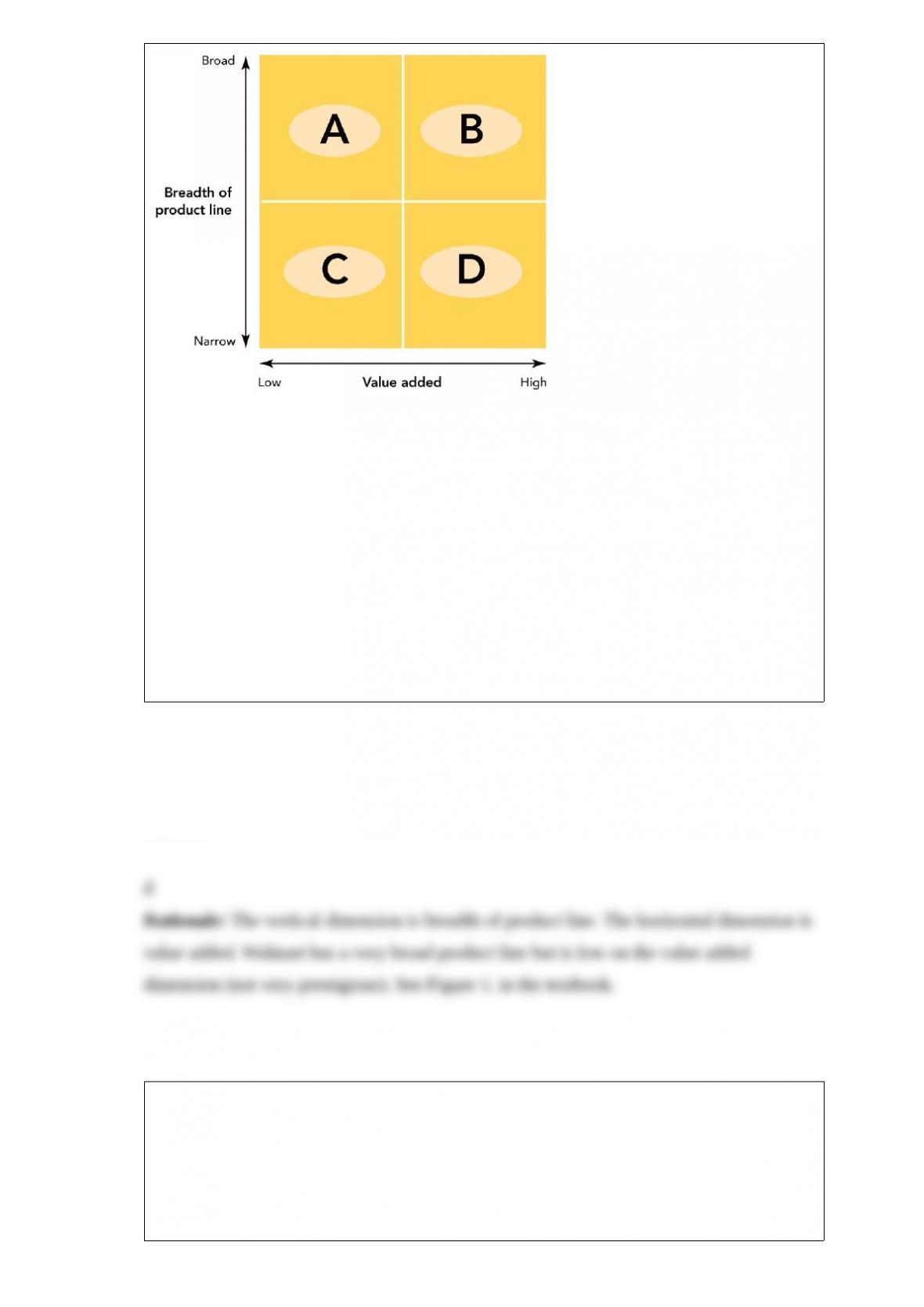
Figure 1.
Which of the following stores would best fit in “A” shown in Figure 1. above?
a. Payless ShoeSource
b. Macy’s department store
c. 7-Eleven convenience store
d. Walmart
e. Lamborghini automobile dealer
Answer:
Austria has been described as “the very heartland of European coffee culture.” These
“coffee-knowledgeable” Austrians drink 21. liters of coffee per person annually.
Starbucks wanted to open coffee houses in Austria and sell Starbucks coffee there. For
Starbucks, the Austrian level of coffee-drinking sophistication would be an example of
a. structural conditions.
b. demand conditions.
c. sociocultural conditions.
d. competitive conditions.
e. factor conditions.
Answer:
Apple introduced the iPhone and iPad that use a multitouch screen to control and
interact with what’s on its screen, as well as the Magic Trackpad, which is also is a
multitouch device. These devices require consumers to use gestures (touch, swipe, tap,
etc.) to perform various functions. This could “exterminate” the “mouse,” a device
Apple invented in 1977 for its Apple II computer that enabled users to perform various
functions by moving the mouse and clicking its buttons. Based on the emergence of
these two multitouch technologies, the mouse is now most likely is in the __________
stage of its product life cycle.
a. introduction
b. decline
c. maturity
d. deletion
e. harvesting
Answer:
Ingram Micro is the biggest computer wholesaler in the world. It has two divisions. One
provides supplies for companies that manufacture computer products, such as IBM and
Microsoft, to which it sells motherboards, monitors, etc. The other has been developed
to serve the needs of the resellers and retailers who sell computers to businesses and
individual customers. It sells them user-ready computers. In this example, Ingram
Micro would use which type of organizational structure for marketing?
a. product line grouping
b. geographical grouping
c. functional grouping
d. matrix organization
e. market-based grouping
Answer:
Hallmark placed its scrapbook supplies, photo albums, and related supplies into one
product group because
a. it was easier to forecast future sales since there were fewer market-product
combinations.
b. customers could buy in quantity and take advantage of quantity discounts.
c. their suppliers provided free displays and shelving to highlight Hallmark’s products.
d. it helped buyers relate to the products and make decisions in a more meaningful way.
e. it allowed customers to compare price and quality with competitors who displayed
their products in a similar manner.
Answer:
In the early 1900s, your great-great-grandfather probably purchased his first
automobile. After years of driving a horse and buggy, he got in his new car and drove it
into his new garage. The new automobile was an example of a
a. continuous innovation.
b. dynamically continuous innovation.
c. disruptive improvement.
d. discontinuous innovation.
e. evolutionary innovation.
Answer:
Olay’s promotions for its Total Effects cleansing cloths, which fight signs of aging, are
targeted toward
a. echo-boomers.
b. Generation Xers.
c. Generation Yers.
d. baby boomers.
e. baby busters.
Answer:
The launch of a new cereal typically costs up to $30 million and usually involves
a. replacing one of more than 300 competing breakfast cereals already on a supermarket
shelf.
b. a minimum of three attempts before it is successfully launched.
c. a tie-in promotion with a major motion picture.
d. steps to counteract the promotional efforts of competitor’s new cereal.
e. obtaining FDA approval for its convenience claims.
Answer:
Which of the following statements regarding supply chains is most accurate?
a. The most common form of supply chain is the collaborative-response efficiency
strategy.
b. In order for a supply chain to work effectively, key decisions should be made by a
third-party logistics provider.
c. There is no one best supply chain for every company.
d. The longer the supply chain, the greater the economies of scale and the better the
profit margins.
e. Supply chains should consider the needs of suppliers, provided those needs are
consistent with marketing strategies.
Answer:
The marketing mix elements are called __________ because they are under the
jurisdiction of the marketing department in an organization.
a. uncontrollable forces
b. profitability factors
c. stakeholder value generators
d. target market segments
e. controllable factors
Answer:
The Harley Owners Group (HOG), sponsored by Harley-Davidson and supported by
the Harley-Davidson website (www.harley-davidson.com), allows fellow HOG owners
to communicate with each other. Because it supports the HOG group, the
Harley-Davidson website has a __________ design element.
a. context
b. choice
c. community
d. convenience
e. connection
Answer:
JCPenney has leveraged its store, website, and catalog channels with impressive results.
A JCPenney customer who shops in all three channelsstore, catalog, and websitespends
four to eight times as much as a customer who shops in only one channel. JCPenney is
likely following a(n) __________ strategy.
a. dual distribution
b. market penetration
c. cross-functional
d. interlocking marketing
e. multichannel marketing
Answer:
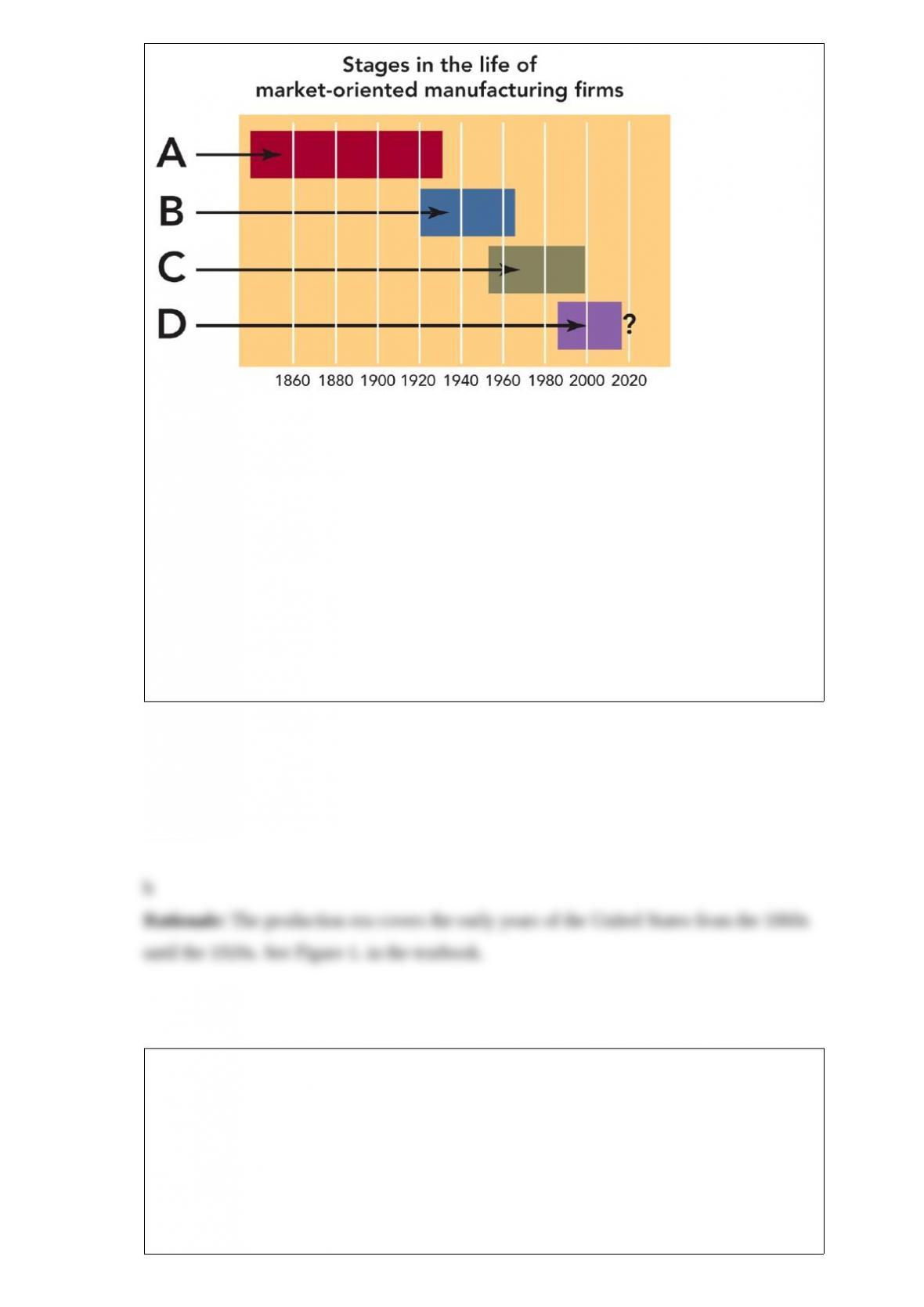
Figure 1.
In Figure 1. above, “A” represents which era in U.S. business history?
a. sales era
b. production era
c. age of consumerism
d. marketing concept era
e. customer relationship era
Answer:
A supply chain refers to
a. the sequence of firms that performs activities required to create and deliver a product
or service to ultimate consumers or industrial users.
b. an inventory management system where the supplier determines the product amount
and assortment a retailer needs and automatically delivers the appropriate items.
c. mathematical formulas and calculations used in determining product volume and
demand in order to generate the greatest revenue at the lowest cost.
d. activities that focus on getting the right amount of the right products to the right place
at the right time at the lowest possible cost.
e. a specialized intermediary in the distribution chain responsible for the coordination of
all production schedules.
Answer:
Offering the right to a trademark, patent, trade secret, or similarly valued items of
intellectual property in return for a royalty or fee is referred to as
a. direct exporting.
b. indirect exporting.
c. licensing.
d. contract manufacturing.
e. outside branding.
Answer:
David and Cecilia Stanford, owners of Prairie Herb vinegars, decided to offer the
product in 5-ounce and 13-ounce sizes. They decided to sell the vinegar only through
the mail and to price the smaller bottle at $4.45 and the largest bottle at $13.25. These
actions consist of Prairie Herb’s marketing
a. tactics.
b. missions.
c. visions.
d. strategies.
e. customer values.
Answer:
You are the research director of a major marketing research consulting firm. You need
to select an NAICS code that gives you the most detail about the competitors in a
client’s industry. Which of the following levels of classification would provide the
greatest detail?
a. Code 512
b. Code 5175
c. Code 51721
d. Code 517212
e. Code 5172122
Answer: