
All of these are examples of typical benefits that a company might enjoy when
switching to a new computer system except:
a) Reduced clerical costs
b) Enhanced sales
c) Better customer service
d) Lower hardware and software costs
Answer:
The value that a database will use if the user does not provide an alternate value is
called a(n):
a) Asset value
b) Text value
c) Control value
d) Default value
Answer:
Using Microsoft Access, you create a “one-to-many” relationship between “Customers”
records and “Customer Orders” records. When you view the Customers records in a

datasheet view, Access indicates the presence of these customer order records using this
symbol:
a) &
b) N
c) √
d) ∞
e) +
Answer:
Which of the following characteristics are common to both service and not-for-profit
organizations?
a) Importance of professional employees
b) Difficulty in measuring the quality and quantity of output
c) Inability to inventory product
d) all of the above
Answer:

Which of computers is the most portable?
a) Minicomputer
b) Laptop computer
c) Mainframe computer
d) Supercomputer
Answer:
A drop down menu on a form that allows the user to select a customer’s state of
residence is a example of:
a) A validation rule
b) A bound control
c) An unbound control
d) A form’s run mode
Answer:
IDEA is used by the Securities and Exchange Commission (SEC) to:
a) Store the financial data of public companies

b) Collect lists of bankrupt companies
c) Store the URL’s of member firms
d) Collect data on individuals victimized by identity theft hackers
Answer:
The terms “parent record,” “child record,” and ‘sibling record” describe the records in a:
a) Hierarchical database
b) Network database
c) Relational database
d) Flat file
Answer:
An example of business intelligence (BI) is to help managers:
a) Identify the slowest-paying vendors
b) Identify which of their customers are most profitable
c) Avoid taxes

d) Spy on their competitors
Answer:
Acts such as dumpster diving, phishing, and smishing are all conducted to:
a) Conduct a denial of service attack
b) Disrupt computer services
c) Get food
d) Perform identify theft
Answer:
In the REA accounting framework, the letter “R” stands for:
a) Resources
b) Recording
c) Remembering
d) none of these
Answer:
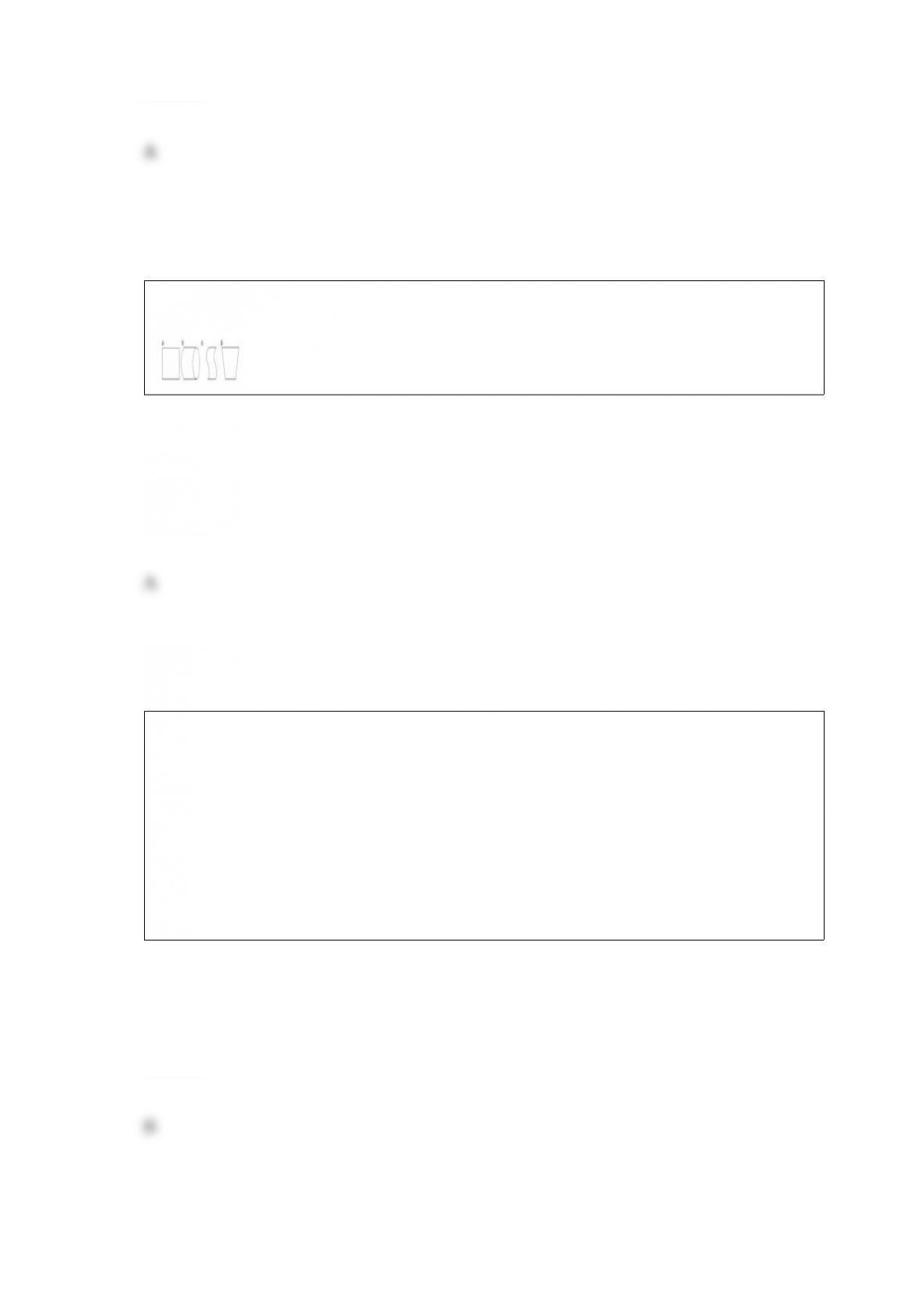
Which of the following symbols represents the standard system flowcharting symbol
for a processing operation?
Answer:
Business process reengineering efforts sometimes fail because:
a) Management gets too involved in the process
b) Management is too optimistic regarding its expectations from its implementation
c) Management support can never overcome employee resistance
d) Employees will never accept change
Answer:

All of these are levels of a data flow diagram except:
a) Physical data flow diagram
b) Process diagram
c) Context diagram
d) Logical data flow diagram
Answer:
Which one of these is not a good guideline to follow when creating tables in a
relational database?
a) Design first, create tables later
b) Name tables systematically, using conventional “tbl” prefixes
c) Use mnemonic names for data fields
d) Assign at least 50 characters to each text field
e) Use consistent data types for primary and foreign key fields
Answer:
Assume that an accounts receivable application contains database tables for customer

orders, inventory items, customers, and salespersons. All of these would be likely data
fields in a customer order table except:
a) Customer name
b) Customer number
c) Date of order
d) Order number
Answer:
All of these are symbols in the E-R model except:
a) Star
b) Diamond
c) Oval
d) Rectangle
Answer:
According to the chapter, which of these statements is most accurate?
a) Most cybercrime is performed as retaliation against employers

b) Very little cybercrime is committed for personal gain
c) Some cybercrime is performed simply to meet a challenge
d) We catch most computer abusers with good accounting controls
Answer:
An advantage of defining a default value for an Access data field is that it:
a) Assures that the data in all records will be exactly the same for that field
b) Eliminates data redundancy
c) Helps create subsequent queries on that field
d) Saves typing, and probably errors
Answer:
A forensic accountant is an accountant who:
a) Performs autopsies on dead accountants
b) Tries to explain why some accounts become inactive
c) Investigates suspected fraud

d) Performs court-approved accounting tasks for bankrupt companies
Answer:
For the following terms find the correct definition below and place the letter of that
response in the blank space next to the term. Each definition is used only once there are
three terms that are not used.
1) ______ input controls
2) ______ business continuity plan (BCP)
3) ______ edit tests
4) ______disaster recovery
5) ______flying-start site
6) ______virtual private network (VPN)
7) ______cold site
8) ______physical security
9) ______ IT general controls
10) ______ red flags
11) ______ data encryption
12) ______ hot site
13) ______ integrated security
14) ______ logical security
15) ______ fault-tolerant systems
16) ______ processing controls

17) ______ output controls
18) ______ security policy
19) ______ eavesdropping
20) ______ computer facility controls
21) ______ application controls
Definitions:
A. Enable computer systems to deal with errors and keep functioning, and is often
based on the concept of redundancy
B. This control limits only authorized individuals access to the organization’s systems
and information
C. The purpose of this control is to securely transmit data to a remote site
D. A disaster recovery site that hasa computer system with capabilities similar to the
system it will replace and also has up-to-date backup data
E. Certain behaviors exhibited by employees that can alert co-workers and supervisors
to trouble (i.e., fraud)
F. Acomprehensive plan that helps protect an enterprise from both internal and external
threats
G. A process whereby management identifies possible events that represent a problem
to the firm and then identifies appropriate responses to those problems
H. A disaster recovery site that hasa computer system with capabilities similar to the
system it will replace
I. A comprehensive approach to making sure organizational activities continue normally
J. An example of this type of control is a “man trap”
K. When organizations combine a number of logical and physical security technologies
(i.e., firewalls, intrusion detection systems, virus protection)
L. Any measures that an organization uses to protect its facilities, resources, or its
proprietary data that are stored on physical media
M. The process and procedures that organizations follow to resume business after a
disruptive event such as an earthquake, a terrorist attack, or a serious computer virus
N. Disaster recovery site that has power, environmentally controlled space, and
processing equipment that can be installed on short notice

O. The controls at this level are critical so that organizations can rely on application
controls
P. A security appliance that runs behind a firewall and allows remote users to access
entity resources by using wireless, hand-held devices
Q. The purpose of this control procedure is to prevent a company’s competitors from
electronically monitoring confidential data transmissions
R. The purpose of these controls is to prevent, detect, and correct errors and
irregularities in processing transactions
S. An example of these controls is the use of point-of-sale devices (such as bar code
readers)
T. These controls examine selected fields of input data and reject those transactions (or
other types of data input) whose data fields do not meet the pre-established standards of
data quality
U. An important objective of these controls is to contribute to a good audit trail
V. An example of this type of control is an authorized distribution list
W. These controls help ensure that no transactions or messages are routed to the wrong
computer network system address
X. The purpose of this control is to perform a backup while the database is on-line and
available for read/write
Answer:
Converting to a new computerized system will typically entail large dollar expenditures
to make the new system operative. These monetary expenditures normally are incurred
for:
a) Transferring a company’s financial data from its present storage media to
computerized storage media

b) Testing the operations of the new system before it replaces the old system
c) Establishing good internal controls for the new computerized system
d) all of the above
Answer:
The sales department bookkeeper has been crediting house-account sales to her
brother-in-law, an outside salesman. Commissions are paid on outside sales but not on
house-account sales. This might have been prevented by requiring that:
a) Sales order forms be prenumbered and accounted for by the sales department
bookkeeper
b) Sales commission statements be supported by sales order forms and approved by the
sales manager
c) Aggregate sales entries be prepared by the general accounting department
d) Disbursement vouchers for sales commissions be reviewed by the internal audit
department and checked to sales commission statements
Answer:
COBIT extensively examined the internal control area.

Answer:
An effective control for maintaining the privacy of data stored on a large, networked
server would be:
a) Security personnel at the building entrance
b) Encryption
c) Laptop protection policies
d) Routing verification
Answer:
Retail sales on the Internet:
a) Are growing rapidly
b) Were growing at first, but are now declining
c) Are not possible on the Internet
d) Have only been achieved by major retailers such as Wal-Mart
Answer:

Which of the following outputs (reports) are common to both the sales process and the
purchasing process?
a) Sales analysis reports
b) Financial statement information
c) both sales analysis reports and financial statement information
d) none of the above
Answer:
Assume that salespeople at your firm make many errors when inputting sales data to the
firm’s Access database. Your manager has asked you to find a way to reduce data input
errors. A good approach for reducing data entry errors would be to create a:
a) Table
b) Query
c) Form
d) Report
e) SQL
Answer:

A computer virus is different from a “Trojan Horse” because the virus can
a) Corrupt data
b) Alter programming instructions
c) Replicate itself
d) Erase executable files
Answer:
The U.S. Patriot act:
a) Requires banks to monitor their accounts in foreign institutions for fraud
b) Prohibits companies from lending money to corporate executives
c) Only applies to publicly-traded companies
d) all of these are correct
Answer:

This tool enables a DBMS to extract only a subset of records from a database:
a) Table
b) Query
c) Validation test
d) none of these
Answer:
The balanced scorecard provides an action plan for achieving competitive success by
focusing management attention on critical success factors. Which one of the following
is notone of the competitive success factors commonly focused upon in the balanced
scorecard?
a) Competitor business strategies
b) Financial performance measures
c) Internal business processes
d) Employee innovation and learning
Answer:

This type of database structure enables users to create relationships after the database
has been created and implemented:
a) Hierarchical
b) Network
c) Star
d) Relational
Answer:
A ‘strong password” is a password that lasts a long time.
Answer:
An example of an Internet domain address is www.Wiley.com.
Answer:

The introduction of a computer into an organization’s data processing system will
normally eliminate problems associated with following the organization’s audit trail.
Answer:
A dynaset is the set of records that results from a query.
Answer:
Operational audits are performed by a company’s internal audit staff.
Answer:
The most common reason businesses outsource is to increase control over their data and
data processing tasks.
Answer:
Foreign keys are necessary in a database because every record must have a foreign key.
Answer:
It costs some companies over $1 million to comply with the requirements of the
Sarbanes-Oxley Act.
Answer:
One major difference between financial accounting and managerial accounting is that
financial accountants use dashboards while managerial accountants do not.

Answer:
OCR is an acronym that stands for “optimal computer resources.”
Answer:
Gantt charts are the same as PERT charts.
Answer:
Documentation describes how an accounting information system works.
Answer:
The TRW Company Credit Data Case is an example of “valuable information”
cybercrime.
Answer:
Programs such as allClear and Visio are examples of CASE tools.
Answer:
Decision tables are useful when a data processing task includes a large number of
conditions and subsequent courses of action.
Answer:

A company’s chart of accounts is used to organize its general ledger.
Answer: