
What is the most probable reason why garbage men have higher wages than nurses?
a. marketplace discrimination
b. active unionization in the garbage collection field
c. higher demand for garbage men than nurses
d. the nonmonetary attractiveness of garbage collection causing fewer people to want to
be garbage men
In 2008-2009, Iceland and several Baltic states increased their interest rates. One would
expect which of the following?
a. U.S. bond prices will fall and the dollar will appreciate.
b. U.S. bond prices will rise and the dollar will appreciate.
c. U.S. bond prices will fall and the dollar will depreciate.
d. U.S. bond prices will rise and the dollar will depreciate.
The supply curve of truck drivers is upward sloping and demand curve is downward
sloping. A reduction in the price of hauling freight by truck relative to the price of
hauling freight by rail will ____ the equilibrium wage of truck drivers and ____ the
number of drivers employed.
a. decrease; decrease
b. decrease; increase
c. increase; decrease
d. increase; increase
Table 11-1
Table 11-1 shows demand and total cost schedules for Monopoliteria. At its
profit-maximizing level of output, Monopoliteria’s profit is
a. $10.
b. $15.
c. $22.
d. $30.
At any given price level, equilibrium GDP on the expenditure side occurs when ____.
a. Y = C + I + G − (X − IM)
b. Y = C + I − G
c. Y = C + I + G + (X − IM)
d. Y = C + X + G + (X − IM)
The elasticity of any demand curve is the same as its slope.
a. True
b. False
“Fair” outcomes and “efficient” outcomes are always identical.
a. True
b. False

When inflation occurs,
a. real wages must necessarily fall.
b. real wages must necessarily rise.
c. workers will experience falling real incomes.
d. workers’ real income may rise or fall.
Table 11-1
Y = C + I + G
C = 500 + .8(Y − T)
I = 300
G = 700
T = .25Y
Refer to Table 11-1. What is the equilibrium level of income in this model?
a. 5,000
b. 4,500
c. 3,750
d. 3,500

e. 3,250
The industry described in Figure 11-6
a. is not a natural monopoly because no firm would produce in the long run unless the
government intervened in the market.
b. is not a natural monopoly because the average total cost curve is U-shaped.
c. is a natural monopoly because the economic profit is positive for a monopolist if the
government doesn’t intervene.
d. is a natural monopoly because price is less than average total cost at the output that
would be produced by the industry under perfect competition.
If an economy is growing, but experiences no inflation, this means
a. aggregate demand increased, but aggregate supply did not.
b. aggregate supply decreased, but aggregate demand did not.
c. aggregate demand and aggregate supply increased by the same amount.
d. aggregate demand and aggregate supply decreased by the same amount.

Suppose that Joan, the only consumer of pork, has a downward-sloping demand curve
for pork and faces an upward-sloping supply curve. If her demand curve shifts out
because she develops a craving for pork, then at the new equilibrium (everything else
equal),
a. the price of pork relative to other goods will be higher than before.
b. Joan’s marginal utility from every unit of pork she eats will be higher than before.
c. Joan’s real income will be lower than before.
d. All of the above are correct.
Company A manufactures a single automotive component. It had total revenue of
$100,000 and an economic profit of $20,000. What is the price of the component it
manufactures?
a. ($100,000/quantity sold).
b. ($100,000/quantity produced).
c. ($100,000/quantity sold) − average cost of the product
d. ($100,000/quantity produced) − average cost of the product

The central question in economics is how to
a. make the best use of scarce resources.
b. use government planning agencies.
c. induce people to want less.
d. increase human knowledge.
The optimum quantity of an input occurs when
a. diminishing returns set in.
b. marginal revenue product equals input price.
c. marginal physical product equals input price.
d. marginal revenue product equals output price.
From 1992, America’s trade performance was marked by a(n)

a. reduced current account deficit.
b. increased current account deficit.
c. reduced capital account surplus.
d. increase in the growth of exports.
Total profit
a. is the difference between sales revenue and costs.
b. maximization is always the goal of every firm.
c. is always defined the same by both economists and accountants.
d. is maximized when sales are maximized.
When a bank makes loans with excess reserves, it
a. creates money.
b. destroys money.
c. alters the composition of M1.

d. leaves the money supply unchanged.
One problem for economic stability is that in a period of inflation
a. banks will be tempted to increase lending in order to increase profits.
b. banks will be tempted to decrease lending in order to increase profits.
c. profit-oriented banks will tend to hold excess reserves and decrease the money
supply.
d. deposits will decrease and banks will have to reduce lending.
If the fluctuations in the economy’s real growth rate from year to year are caused
primarily by variations in the rate at which aggregate supply increases, then data would
show
a. a cyclical relationship between inflation and unemployment.
b. a direct relationship between inflation and unemployment.
c. an inverse relationship between inflation and unemployment.
d. no relationship between inflation and unemployment.
A usury rate is like a price ceiling.
a. True
b. False
A budget deficit is best defined as the
a. shortage of spending power created by a government spending cut.
b. shortage of spending power created by a tax increase.
c. accumulation of past debt that has not been covered by taxes.
d. amount by which a government’s expenditures exceed receipts during a specific time
period.
A common misperception about consumer demand is that
a. demand depends on many other variables.
b. price is a major determinant of quantity.
c. it is a fixed amount.
d. quantity cannot be determined in advance.
e. All of the above are correct.
Under a system of laissez faire, output selection is determined by consumers’ wants.
a. True
b. False
Even though international trade in undertaken voluntarily, a country that engages in
trade may not benefit from it.
a. True
b. False

When government defines and enforces property rights, this is an example of
government as
a. referee.
b. regulator of business.
c. buyer of goods and services.
d. tax collector.
e. redistributor.
If unemployment and inflation always move in the same direction, then we can infer
that business fluctuations are
a. from the demand side.
b. from the supply side.
c. from both the demand and supply side.
d. purely random events.
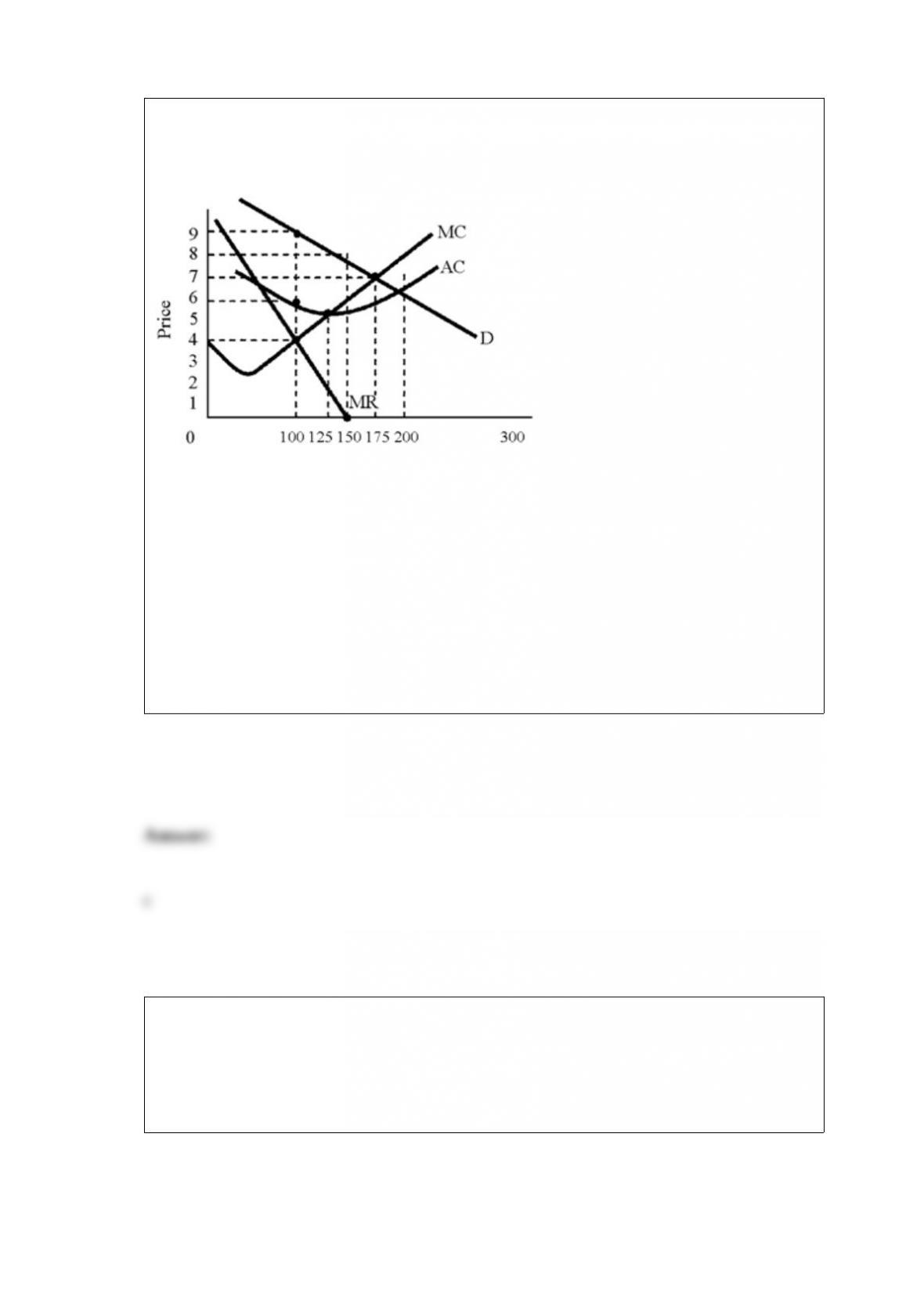
Figure 11-7
The firm in Figure 11-7 is an unregulated monopolist; it will produce which of the
following?
a. 175 units at a price of 7
b. 100 units at a price of 6
c. 100 units at a price of 9
d. 150 units at a price of about 7.5
A demand schedule’s position is determined partly by the supply of a good.
a. True
b. False
Imitation is not only the highest form of flattery but also an easier way for poorer
countries to develop new technology.
a. True
b. False
Generally, if a nation imposes a tariff on imports,
a. part of the tax is paid by foreign exporters.
b. the entire tax is paid by foreign exporters.
c. none of the tax is paid by foreign exporters.
d. the tax has no impact on the profits of foreign exporters.
Part of the reason why barely used cars sell for much less than new cars is that
a. buyers and sellers have symmetric information about cars and both have less

information about used cars than about new cars.
b. buyers and sellers have symmetric information about cars and both have more
information about used cars than about new cars.
c. buyers have more information about used cars than sellers do.
d. sellers have more information about used cars than buyers do.
At a firm’s profit-maximizing level of output, its price is $200 and its short-run average
total cost is $225. The firm
a. has a profit of $25 per unit of output.
b. should shut down if its short-run average fixed cost is less than $25.
c. has a loss of $100 per unit of output.
d. should shut down if its short-run average variable cost exceeds $25.