
The federal budget is
a. for a fiscal year, from January 1 to December 31.
b. a statement of the government’s anticipated expenditures and revenues.
c. a statement of how much the various agencies of the federal government would like
to spend.
d. managed by the Federal Reserve System.
e. submitted by the president to Congress and must be either rejected or accepted
without modification.
The demand curve for labor slopes downward because of the falling
a. marginal product of labor.
b. supply of labor.
c. employment of labor.
d. costs of production.
e. importance of labor.
GDP is improved as a measure of economic well-being when

a. stated in per capita terms.
b. computed by the expenditures approach.
c. exports are excluded.
d. depreciation is added to it.
e. government and private transfer payments are equal.
If a $1 million project can be financed at 12 percent per year and will have a 15 percent
rate of return per year, its annual profit will be
a. $30,000.
b. $120,000.
c. $150,000.
d. $240,000.
e. $850,000.
The following questions are based on the following diagram:
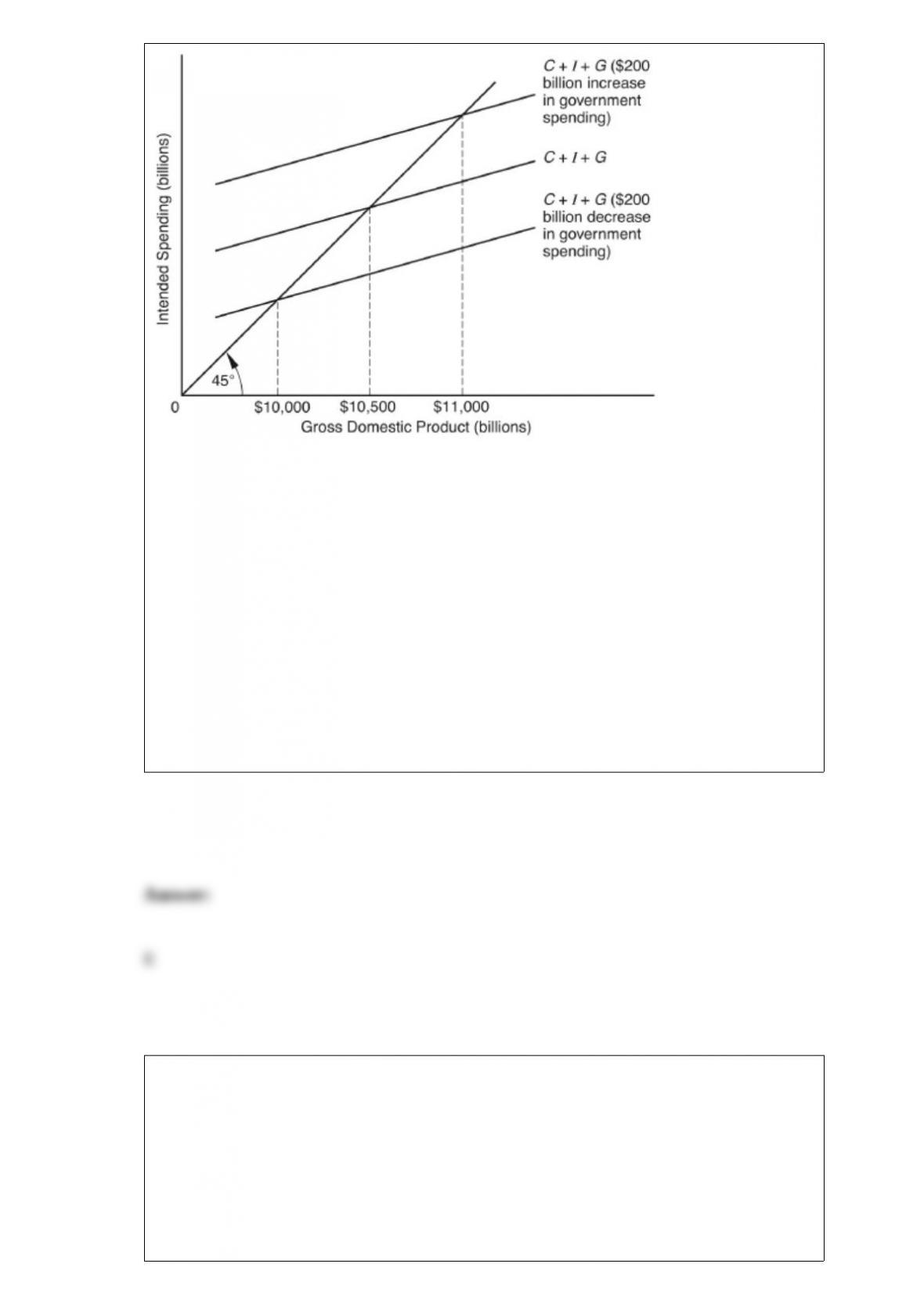
From the diagram, one can infer that
a. changes in government spending change the value of the multiplier.
b. an increase in government spending results in a budget surplus.
c. a decrease in government spending results in a corresponding increase in private
spending.
d. government spending should always be increased.
e. an increase (or decrease) in government spending leads to an increase (or decrease) in
total intended spending.
In a free market, actual price will
a. remain unchanged as equilibrium price changes.
b. move toward equilibrium price.
c. cause the demand and supply curves to shift directions.

d. always exceed equilibrium price.
e. be very difficult to calculate.
The exchange rate system that has prevailed since 1973 is best described as
a. fixed.
b. flexible.
c. indexed.
d. pegged.
e. the gold standard.
The AFL-CIO is
a. a loose affiliation of small local unions.
b. a powerful management-sponsored organization designed to bargain with large
national labor unions.
c. a government agency to mediate labor-employer disputes.
d. a federation of national unions that serves as a spokesperson for the U.S. labor
movement.
e. the governing body of all U.S. labor unions.
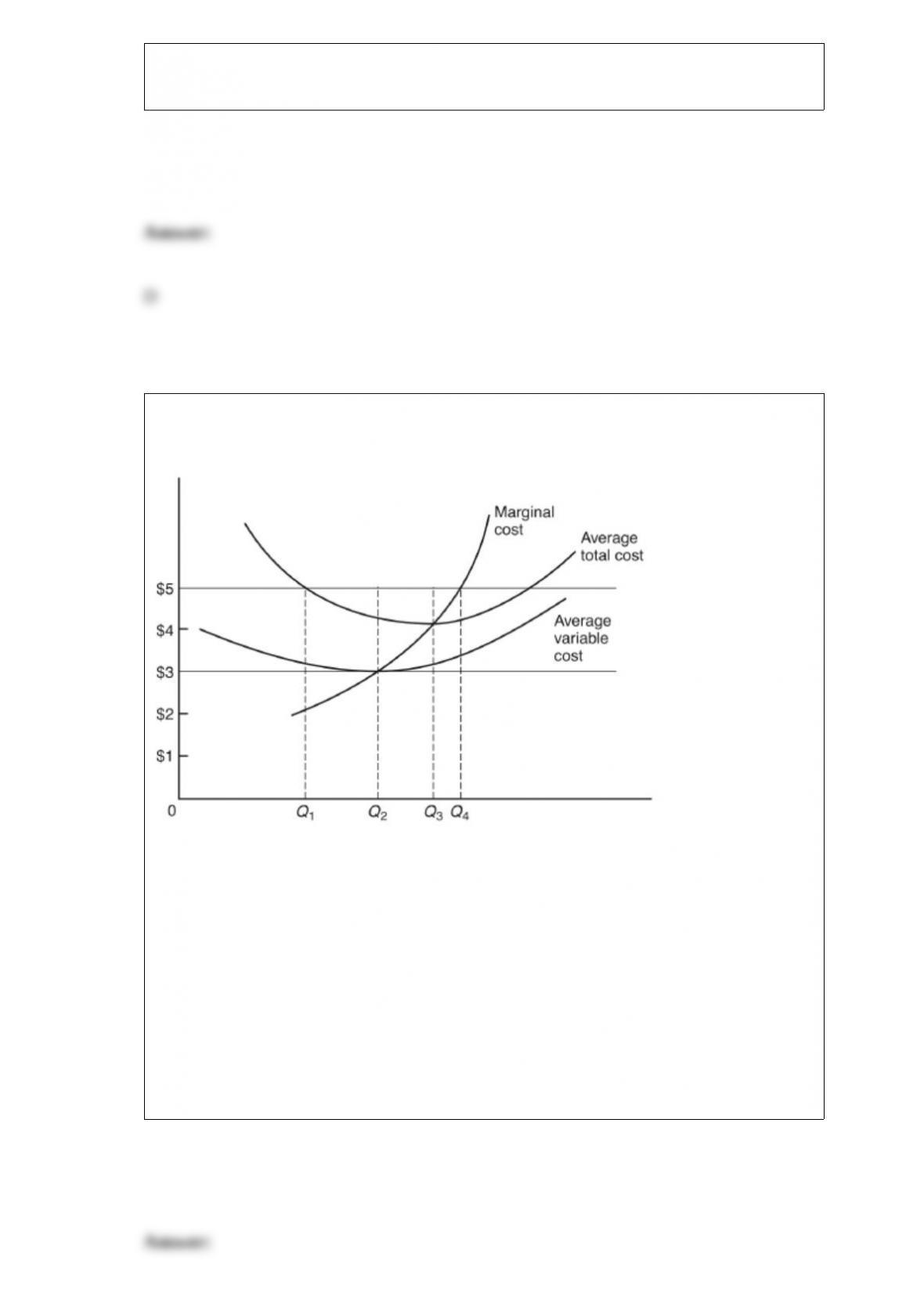
The following questions are based on the following diagram showing the short-run cost
curves for a perfectly competitive firm:
If the price is $5 per
unit, the profit-maximizing level of output is
a. zero.
b. 0Q1.
c. 0Q2.
d. 0Q3.
e. 0Q4.

Opportunity cost is
a. the variable cost a firm incurs by increasing output 1 unit.
b. the value of the best alternative use of a firm’s resources.
c. the output opportunities a firm gains when average fixed costs decline.
d. another name for explicit costs.
e. the difference between fixed cost and variable cost.
The new classical macroeconomists stress that output fluctuations and unemployment
a. result from random errors and cannot be minimized by government stabilization
policies.
b. require rational government actions to reduce the gap between actual and potential
output.
c. will disappear if most large industries are nationalized.
d. are absent in a free market capitalist economy.
e. can be minimized if all sectors of the economy rationally expect high rates of
inflation.
The ________ Act outlawed unjustified price discrimination and the use of tying
contracts and mergers that substantially lessen competition.
a. Sherman
b. Federal Trade Commission
c. Clayton
d. Webb-Pomerene
e. Celler-Kefauver
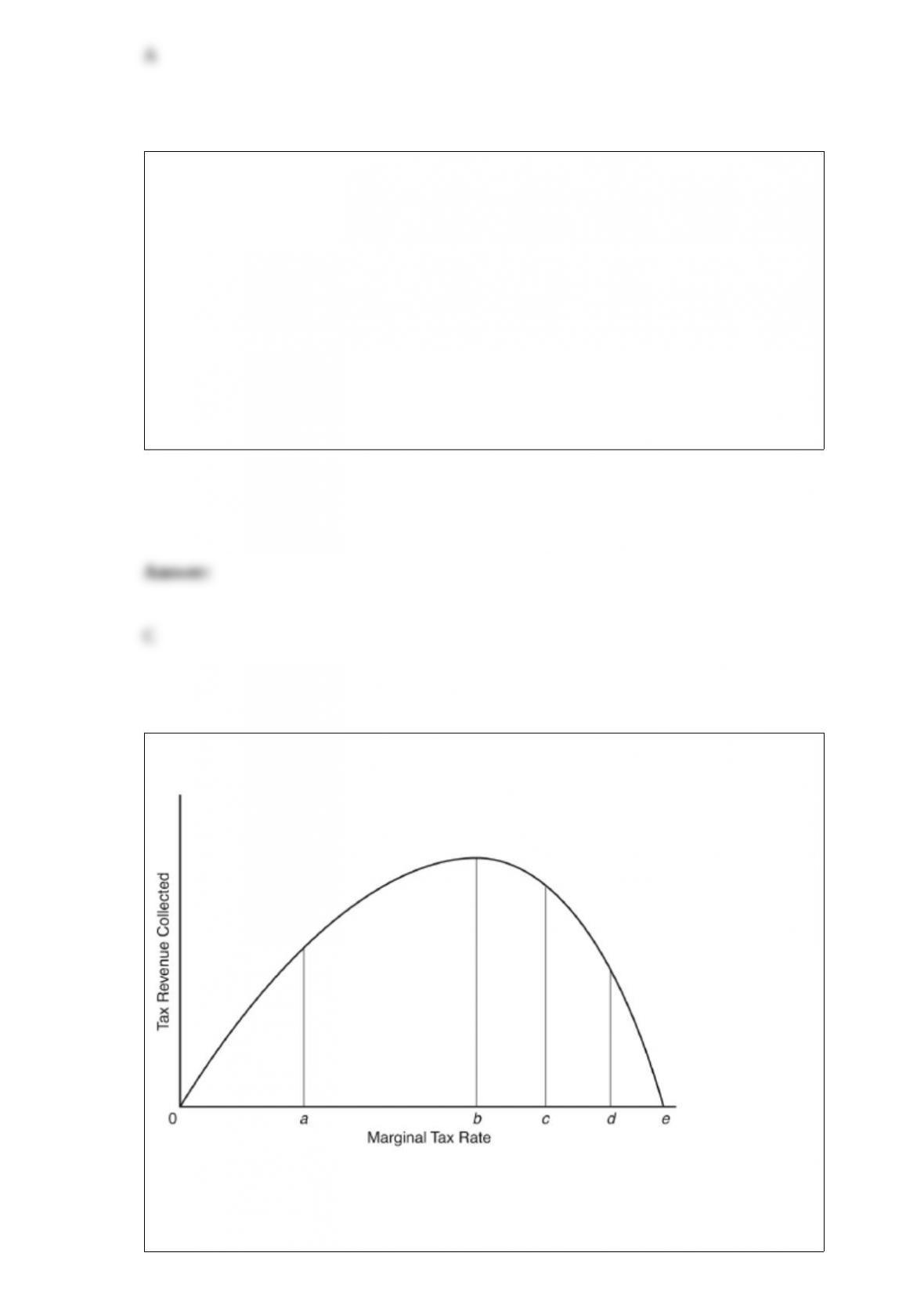
The following questions are based on the following Laffer curve:
Tax revenues rise when the rate is
a. reduced from 0c to 0.

b. raised from 0d to 0e.
c. reduced from 0a to 0.
d. raised from 0b to 0e.
e. reduced from 0b to 0a.
Assume a negative income tax that is structured according to the formula T = “$5,000 +
0.5Y, where T = tax liability and Y = earned income. The break-even income, when the
family neither receives a tax payment nor pays any income tax, is
a. $5,000.
b. $7,500.
c. $10,000.
d. $12,500.
e. $15,000.
The rate of inflation is likely to be lowest when the economy’s aggregate demand curve
intersects the aggregate supply curve in
a. the horizontal range.

b. the upward-sloping range.
c. the vertical range.
d. all three ranges.
e. a manner impossible to determine from the diagram.
Which of the following is the best example of a public good?
a. a hamburger
b. an automobile
c. a parade
d. an upholstered chair
e. a model airplane kit
An MPS of 0.6 allows a $1 billion change in intended government expenditures to
change the equilibrium GDP by ________ billion.
a. $0.4
b. $0.6

c. $1
d. $1.67
e. $2.5
A profit-maximizing cartel should produce where
a. price equals average cost.
b. marginal cost equals average cost.
c. price equals marginal cost.
d. marginal revenue equals demand.
e. marginal cost equals marginal revenue.
The following questions are based on the following graph:
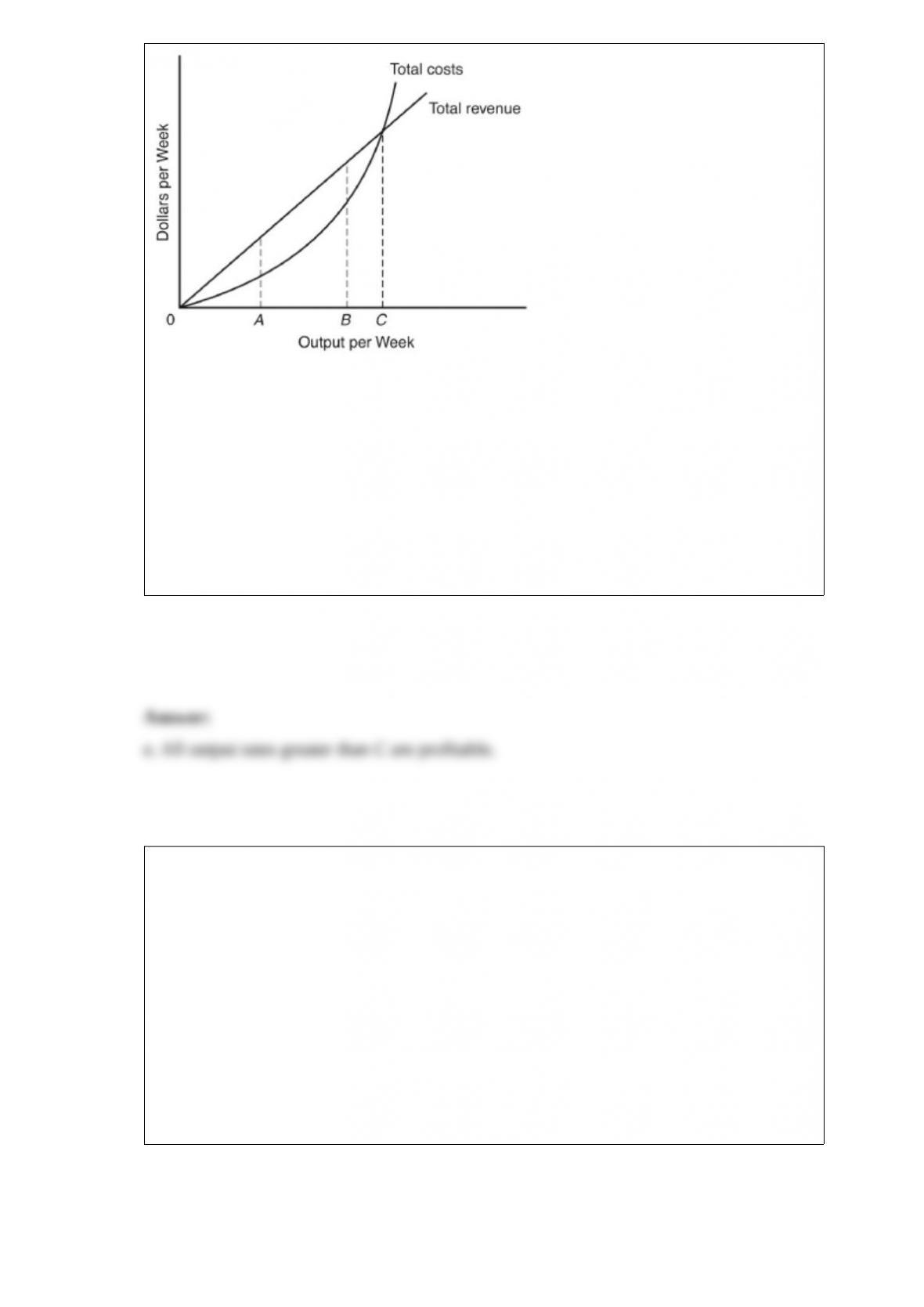
Which of the following is implied by the graph?
a. Output rate B is more profitable than output rate A.
b. Any positive output rate less than C is profitable.
c. Output rate A maximizes profits.
d. After output rate B, total cost increases more slowly than total revenue.
In an open shop, workers
a. must be union members before they can be hired.
b. need not be union members to work.
c. must become union members within a certain period of time once they have been
hired.
d. are not able to strike under any circumstances.
e. sign yellow dog contracts before they begin work.

An upward shift in the saving function
a. will cause GDP to rise.
b. will have the same effect on GDP as an upward movement along the saving function.
c. means that, at any given level of income, people want to save less.
d. will cause GDP to fall by an amount equal to the shift divided by the marginal
propensity to save.
e. means that the marginal propensity to save must have fallen.
Product differentiation often gives a producer only a small amount of monopoly power
because
a. there can be little or no substitution between product groups.
b. the monopolistic competitor faces a downward-sloping demand curve.
c. the presence of excess capacity gives the producer some freedom to vary output.
d. the product may be unique, but close substitutes are available.
e. the industry is difficult to define and hence cannot be regulated.

The structural deficit is
a. the deficit necessary to reduce interest rates.
b. the difference between tax revenues and government expenditures in a given year.
c. the difference between tax revenues and government expenditures that would result if
GDP were at its potential level.
d. the budget resulting from a policy of functional finance.
e. a concept first suggested by John Maynard Keynes in 1938.
Aggregate demand shifts to the right when
a. government spending is reduced.
b. tax rates are reduced.
c. equilibrium GDP is reduced.
d. total intended spending is reduced.
e. the inflationary gap is reduced.

Approximately what percent of the gross domestic product is before-tax corporation
profits?
a. 2 to 3 percent
b. 5 to 10 percent
c. 15 to 25 percent
d. 33 to 50 percent
e. over 50 percent
In general, as a monopolist increases its output rate, its profit
a. rises steadily.
b. falls steadily.
c. first rises but then falls.
d. first falls but then rises.
e. remains constant.
Economic theory states that more of a good is supplied at a higher price than a lower
one, yet the sales of digital cameras have increased while their prices have fallen. This
statement

a. reflects the fact that economics is not a precise science and its predictions are
sometimes incorrect.
b. merely illustrates that the digital camera market may be an exception to the general
rule.
c. applies only to the supply side and overlooks the tremendous increase in the demand
for digital cameras.
d. confuses changes in the quantity supplied with changes in supply.
e. ignores the fact that the current price may be below the equilibrium level.
In 1973, a 1.75 liter bottle of your professor’s favorite beverage cost $16. Today it costs
$32.
The consumer price index for 1973 was 44.4 and the current consumer price index is
184
(1983″84 = 100). If the price of this beverage had kept pace with the rate of inflation,
this
bottle would cost your professor
a. $17.
b. $23.
c. $36.
d. $66.
e. $72.

Resources are considered to be misallocated when
a. the market is perfectly competitive.
b. price exceeds marginal cost.
c. the social value of an extra unit equals its social cost.
d. price is equal to average total cost at its lowest value.
e. economic profits are zero.
A fixed input is one
a. for which the quantity of which cannot change as output rises or falls in the short run.
b. that rises in importance as output rises.
c. that is technologically obsolete.
d. that has been repaired.
e. for which the average output of which falls over time.