
Okun’s law expresses the relationship between:
A. unemployment and inflation.
B. frictional unemployment and structural unemployment.
C. money and velocity.
D. cyclical unemployment and the output gap.
Suppose males place less importance on the social approval of their job and more on the
income they receive. The gender wage gap would therefore be __________ than if this
difference did not exist because of __________.
A. smaller; compensating wage differentials
B. larger; choices made by workers
C. larger; employer discrimination
D. smaller; the smaller importance assigned to social approval
The hurdle method of price discrimination is _____ efficient; it is ______ efficient than
charging a single price to all buyers.
A. not perfectly; more

B. not perfectly; less
C. not; less
D. perfectly; less
Miniville is an isolated town located on the southern shore of Lake Condescending, a
very large lake. The western edge of Miniville is adjacent to impassable mountains and
there are no towns or businesses for many miles to the east. The 300 residents of
Miniville are evenly distributed along 3 miles of shoreline on the lake, east of the
mountains. Lake Shore Drive, the only street in town, provides access to Miniville’s
homes and businesses. All residents live between the lake and the street; businesses
locate on the other side of the street. Lake Shore Drive is 3 miles long, and the points
labeled A, B, and C are 1, 2, and 3 miles from the western end of Lake Shore Drive,
respectively. All residents of Miniville shop at the store located closest to their homes.
Refer to the information given above. _____ residents of Miniville live west of point B,
and _____ live east of point A.
A. 100; 200
B. 150; 150
C. 200; 200
D. 200; 100

The marginal cost curve for information is upward sloping because
A. most information is false.
B. consumers start with the least expensive sources and progress to more expensive
sources.
C. there is only so much to learn about a product.
D. most information is misleading.
Suppose that welders working on offshore oil rigs earn 25% more than welders working
on land based oil rigs. The difference in earnings is best explained by
A. differences in education.
B. discrimination.
C. differences in working conditions.
D. differences in abilities.

If short-run equilibrium output equals 10,000, the income-expenditure multiplier equals
5, the mpc equals 0.8, and potential output (Y*) equals 9,000, then taxes must be
______ by approximately ______ to eliminate any output gap.
A. decreased; 250
B. decreased; 200
C. increased; 250
D. increased; 200
To correct a nominal quantity for changes in the price level, one should:
A. add a price index to it.
B. subtract a price index from it.
C. divide it by a price index.
D. multiply it by a price index.
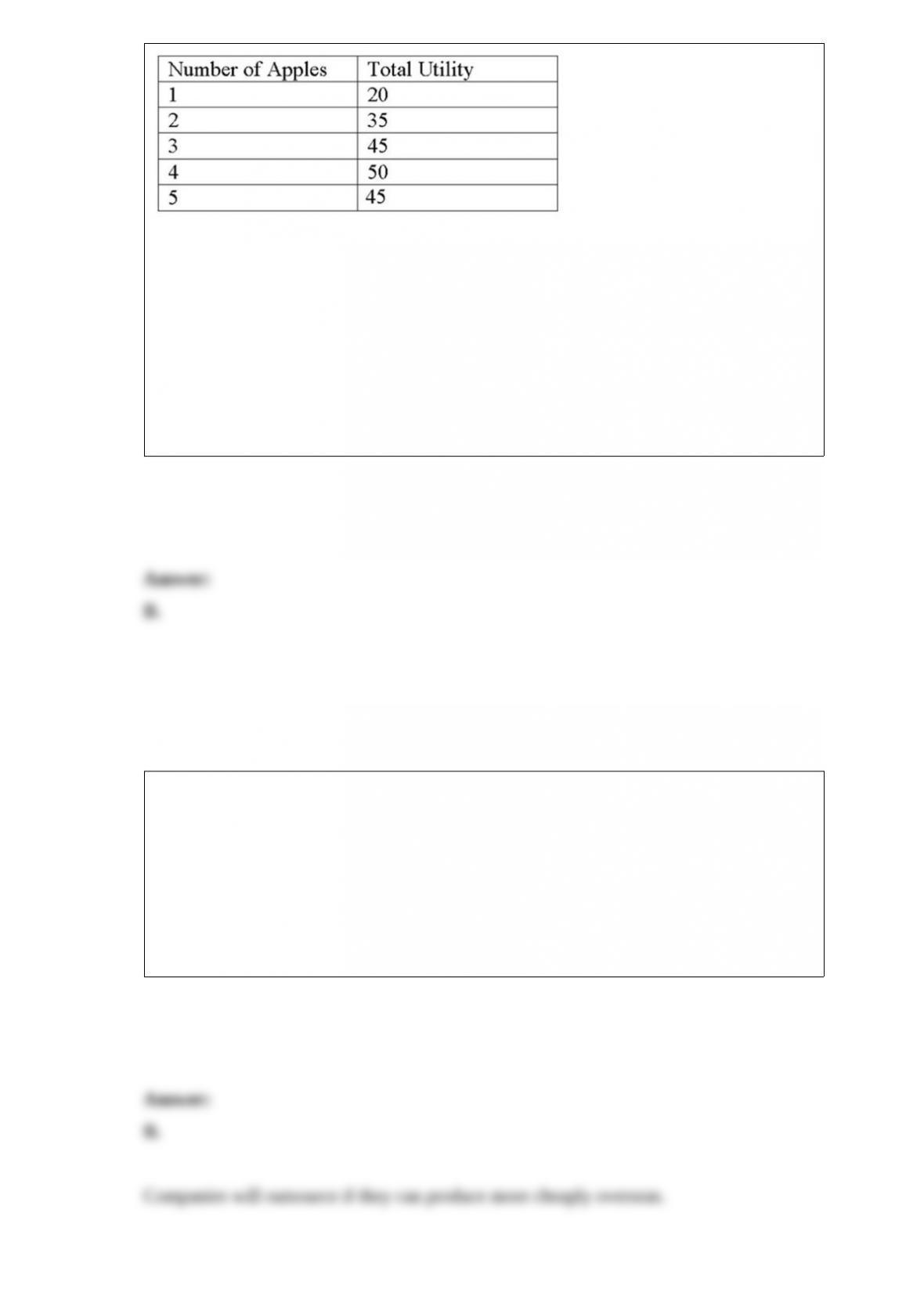
Refer to the figure above. The total utility ______ as additional apples are consumed,
but the marginal utility always _______ with each additional apple consumed.
A. first decreases then increases, decreases
B. first increases then decreases, decreases
C. first decreases then increases, increases
D. first increases then decreases, increases
The main reason that firms outsource is that:
A. low-wage workers in other countries are more productive than are U.S. workers.
B. hiring low-wage workers reduces firms’ costs.
C. hiring low-wage workers provides a tax deduction to firms.
D. U.S. workers cannot perform the tasks performed by workers in other countries.

A decrease in the value of a currency relative to other currencies is called a(n):
A. revaluation.
B. devaluation.
C. appreciation.
D. depreciation.
Refer to the figure above. At what output level or levels are the business owners doing
as well as or better than their next best alternative?
A. 10 units
B. 10 and 15 units
C. 10, 15, and 20 units
D. 10, 15, 20, and 25 units
Efficiency occurs when:
A. a market is in equilibrium.
B. the socially optimal quantity of goods and services is being produced.
C. the individually rational quantity of goods and services is being produced.
D. the government does not interfere with market prices.
The minimum payment you are willing to accept to do a job is your:
A. nominal wage.
B. real wage.
C. reservation price.
D. value of marginal product.

Suppose you are a government analyst, and you want to help homeless families. To do
so, you have decided to subsidize rental housing for poor families. (A subsidy is a
payment by the government that pays part of the price of a specific product. For
example, the government pays part of the rent payment.) If families had been choosing
rationally before the subsidy, what is most likely to happen as a result of the subsidy?
A. The substitution effect will cause people to consume less rental housing as the price
of housing falls.
B. The income effect will cause people to consume less rental housing, but only if rental
housing is a normal or luxury good.
C. People will consume more housing and more of another good, for example,
groceries.
D. Any rational person will respond by consuming more housing, and no more of the
other goods he or she consumes.
In the above decision tree, Tracy picks first, and Amy picks second. Tracy knows Amy’s
payoffs to each choice, and Amy knows Tracy’s payoffs.
Refer to the figure above. Based solely on the information in this decision tree, we can
predict that:
A. Tracy will always make the decision to give Amy the choice at Y, and Amy will then
choose the lower branch.
B. Amy will make a credible promise to pick the lower branch if given the choice at Y,
and Tracy will make the decision to give Amy the choice at Y.
C. Tracy will always make the decision to give Amy the choice at Z, and Amy will then
choose the upper branch.
D. Tracy will always make the decision to give Amy the choice at Z, and Amy will then
choose the lower branch.

The economy is in long-run equilibrium:
A. when the AD and AS curves intersect at potential output Y*.
B. when the AD and AS curves intersect, regardless of the level of output.
C. when the AD and AS curves become vertical.
D. only when the business cycle is eliminated.
According to the costly-to-fake principle
A. truth-telling is not a dominant strategy.
B. for a seller to have credibility, the seller must charge more than his or her reservation
price.
C. for a buyer to have credibility, he must offer a price that is difficult to fake.
D. for information to be seen as credible, it must be less costly to provide the
information if it is true.

The theory that nominal exchange rates are determined so that the law of one price
holds is called:
A. the fixed-exchange-rate rule.
B. the equilibrium principle.
C. the law of supply and demand.
D. purchasing power parity.
Sydney purchases a newly-issued, two-year government bond with a principal amount
of $10,000 and a coupon rate of 6% paid annually. One year before the bonds matures
(and after receiving the coupon payment for the first year), Sydney sells the bond in the
bond market. What price (rounded to the nearest dollar) will Sydney receive for his
bond if newly-issued one-year government bonds are paying a 5% coupon rate?
A. $9,906
B. $10,000
C. $10,095
D. $10,600
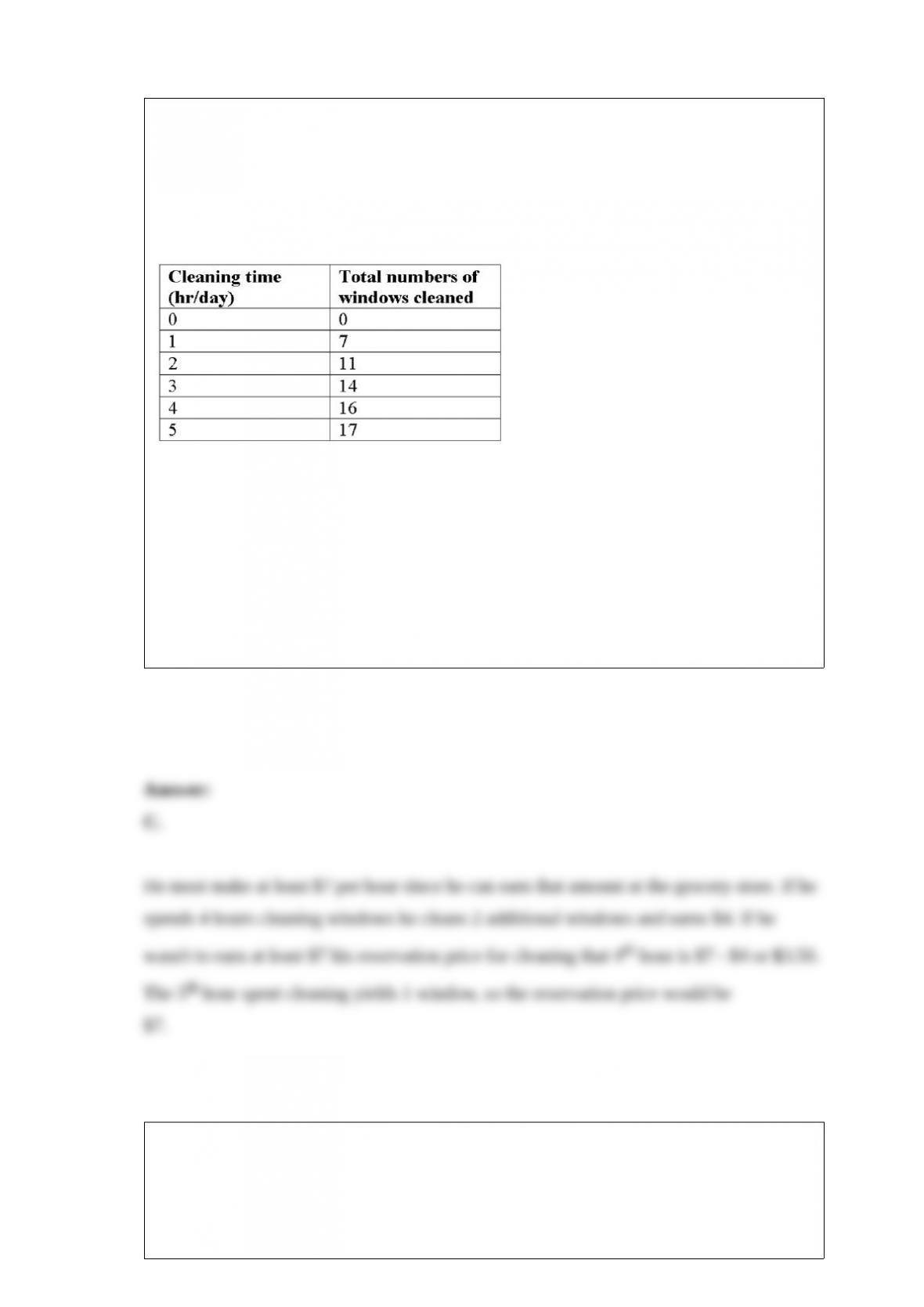
John is trying to decide how to divide his time between his job as a stocker in the local
grocery store, which pays $7 per hour for as many hours as he chooses to work, and
cleaning windows for the businesses downtown. He makes $2 for every window he
cleans. John is indifferent between the two tasks, and the number of windows he can
clean depends on how many hours he spends cleaning in a day, as shown in the table
below:
What is John’s reservation price for the 4th and 5th hours spent cleaning windows.
A. $7 and $7.50 respectively.
B. $2 and $3.50 respectively.
C. $3.50 and $7 respectively.
D. $11 and $14 respectively.
Benefits of net capital inflows to a country include all of the following EXCEPT:
A. a larger pool of total savings.
B. a higher rate of investment in new capital.

C. a potentially higher growth rate.
D. interest and dividend payments owed to foreign investors.
Net capital outflows equal:
A. capital inflows minus capital outflows.
B. capital outflows minus capital inflows.
C. international production.
D. domestic production.
You are the Minister of Trade for a small island country in the South Pacific with the
following annual production possibilities curve:
You are negotiating a deal with a neighboring island that has the following annual PPC:
Refer to the figure above. Both islands specialize exclusively in the product for which
they have a comparative advantage. You have agreed to sell the other island 350

coconuts in exchange for 1,300 fish. After the trade the other island has a total of _____
coconuts and _____ fish.
A. 850; 1,200
B. 500; 1,200
C. 350; 1,500
D. 350; 1,200
If potential output equals 4,000 and short-run equilibrium output equals 3,500, there is a
______ gap and the Federal Reserve must ______ real interest rates in order to close the
gap.
A. recessionary; raise
B. recessionary; reduce
C. recessionary; not change
D. expansionary; raise
An imperfectly competitive firm is one that:
A. has some degree of influence over the price it charges for its output.

B. charges any price it wishes.
C. revenue maximizes.
D. confronts a perfectly inelastic demand curve.
In Macroland autonomous consumption equals 100, the marginal propensity to
consume equals 0.75, net taxes are fixed at 40, planned investment is fixed at 50,
government purchases are fixed at 150, and net exports are fixed at 20. The vertical
intercept of the Expenditure Line is:
A. 0.25.
B. 0.75.
C. 290.
D. 320.
You would expect to see more mail-in rebate coupons being offered at:
A. exclusive stores catering to the wealthy.

B. a luxury car dealership.
C. discount stores.
D. convenience stores.
Holding other factors constant, if employers automatically enroll employees in
retirement savings programs in order to overcome psychological barriers to saving, then
the real interest rate will ______ and the equilibrium quantity of saving and investment
will ________.
A. increase; increase
B. increase; not change
C. increase; decrease
D. decrease; increase
In a recession, the cyclical rate of unemployment:
A. is rising.

B. is constant.
C. is falling.
D. equals the natural rate of unemployment.
Larry was accepted at three different graduate schools, and must choose one. Elite U
costs $50,000 per year and did not offer Larry any financial aid. Larry values attending
Elite U at $60,000 per year. State College costs $30,000 per year, and offered Larry an
annual $10,000 scholarship. Larry values attending State College at $40,000 per year.
NoName U costs $20,000 per year, and offered Larry a full $20,000 annual scholarship.
Larry values attending NoName at $15,000 per year.
The opportunity cost of attending State College is:
A. $30,000
B. $20,000
C. $15,000
D. $10,000

The total income of capital and labor must equal the value of total:
A. production.
B. profits.
C. revenue.
D. investment.
The money demand curve relates ______ to the ________.
A. the aggregate quantity of money demanded; aggregate demand
B. aggregate demand; nominal interest rate
C. the aggregate quantity of money demanded; price level
D. the aggregate quantity of money demanded; nominal interest rate
A central bank that attempts to achieve a zero rate of inflation:
A. cannot achieve price level stability in the long run.

B. increases the risk of deflation.
C. can consistently achieve negative real interest rates.
D. makes it easier for real wages to be reduced without cutting nominal wages.