
Which of the following is true about inflation?
a. It reduces the cost-of-living of the typical worker.
b. It is measured by changes in the cost of a typical market basket of goods between
time periods.
c. It causes the purchasing power of a dollar to rise.
d. It has no effect on real resources.
Economic analysis assumes that
a. individuals act only out of selfish motives.
b. although individuals are at times selfish and at times unselfish, only their selfish
actions may be predicted.
c. people are basically humanitarian, and their actions are, therefore, impossible to
predict.
d. changes in the personal benefits and costs associated with a choice will exert a
predictable influence on human behavior.
Every economy must ration goods in some way because of
a. overpopulation.
b. poorly-performing markets.

c. the income gap between rich and poor.
d. scarcity.
Andre decides that he would pay as much as $3,000 for a new laptop computer. He
buys the computer and realizes consumer surplus of $700. How much did Andre pay for
his computer?
a. $700
b. $2,300
c. $3,000
d. $3,700
Use the figure below to answer the following question(s).
Figure 14-2
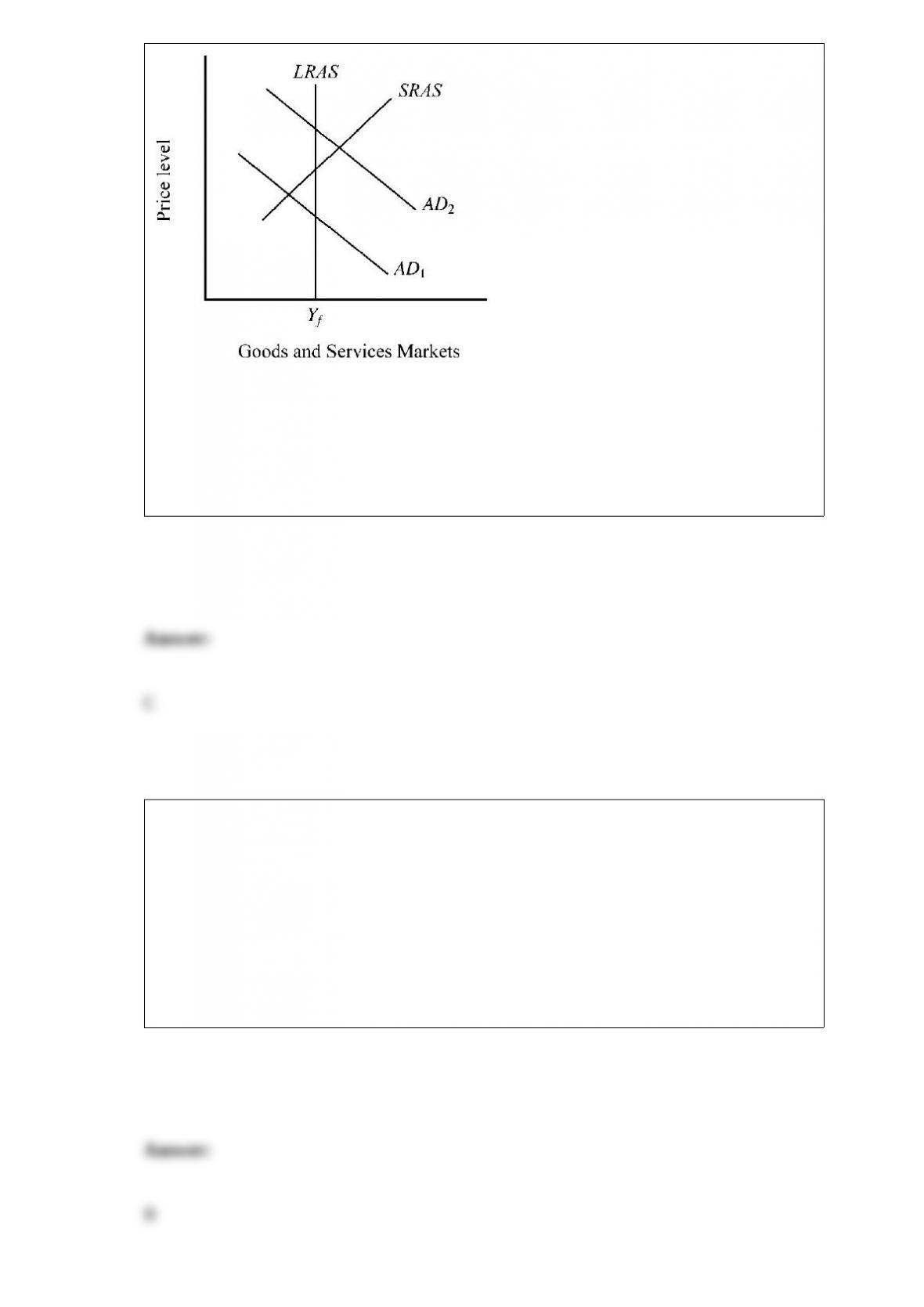
If the Fed anticipates that the conditions illustrated by AD2and SRASin Figure 14-2 will
be present in the near future, it should
a. decrease the discount rate.
b. reduce reserve requirements.
c. sell U.S. treasury bonds on the open market.
d. buy U.S. treasury bonds on the open market.
The invisible hand principle indicates that competitive markets can help promote the
efficient use of resources
a. only if buyers and sellers really care, personally, about economic efficiency.
b. even when each market participant cares only about their own self interest rather than
about the overall efficiency of resource use.
c. even if business firms fail to produce goods efficiently.
d. if, and only if, businesses recognize their social obligation to keep costs low and use
resources wisely.
If higher tariffs, such as those enacted by the Smoot-Hawley trade bill, reduce the
imports of the United States, which of the following will be most likely to occur?
a. U.S. employment will increase.
b. The unemployment rate of the United States will decline.
c. U.S. exports will increase because foreigners will want to buy more from U.S.
producers.
d. U.S. exports will decline because foreigners will be earning fewer of the dollars
needed to purchase goods and services from Americans.
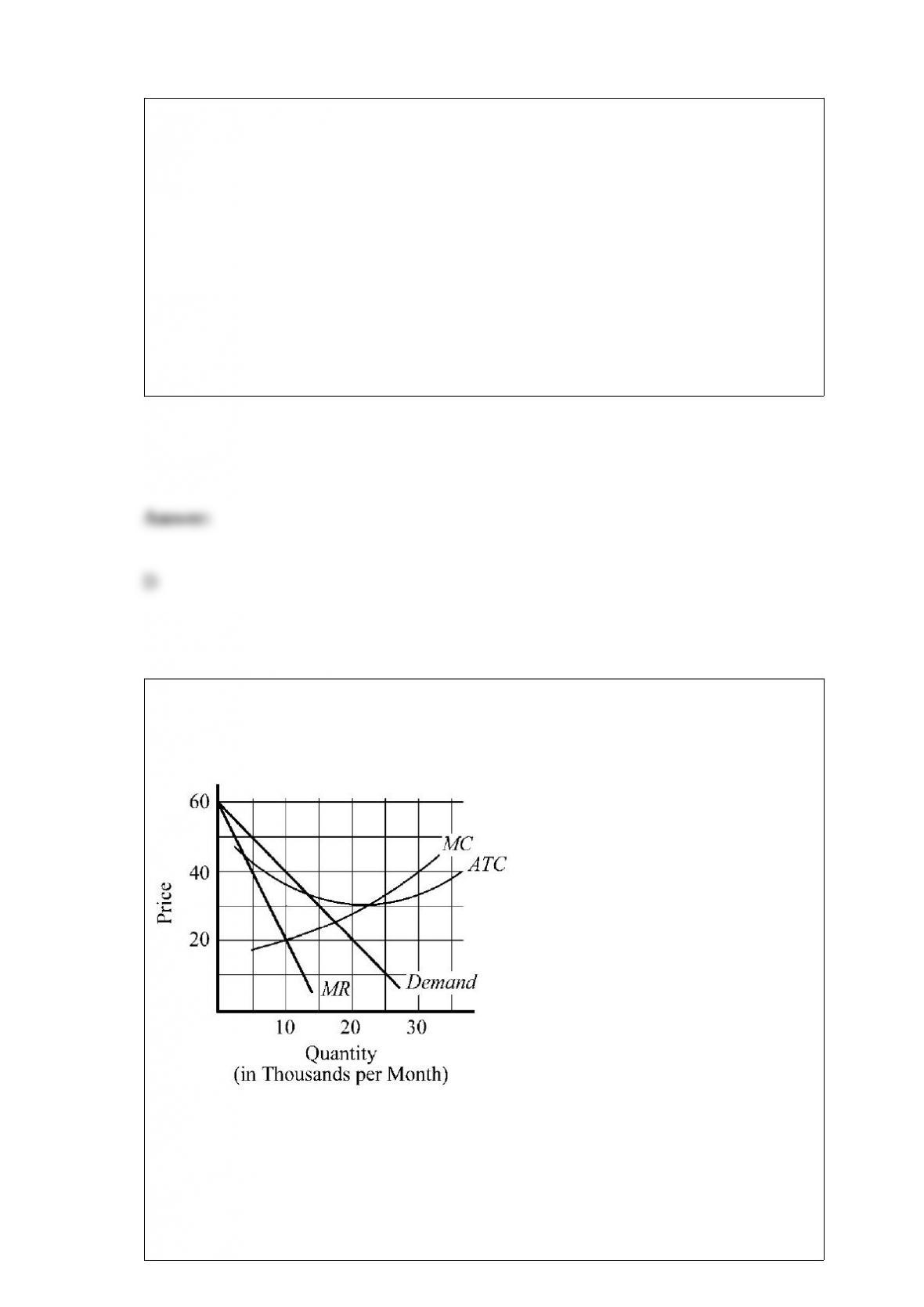
Use the figure to answer the following question(s).
Figure 10-10
What is the approximate maximum economic profit this firm depicted in Figure 10-10
will be able to earn per month?
a. zero profit
b. $50,000 profit

c. $200,000 profit
d. $400,000 profit
An increase in the percentage of the labor force that is unionized will cause average
wages for all workers to rise because
a. union labor is more productive.
b. profit levels are lowered to increase wages.
c. strike threats promote wage increases.
d. This is a trick question because greater unionization does not imply higher average
wages.
Any country with highly attractive domestic investment opportunities and a low savings
rate will tend to
a. run a current account deficit that is equal to its capital account surplus.
b. run a current account surplus deficit over a long period.
c. tend to be relatively poor (compared with other countries).
d. run a current account deficit.

National income is
a. personal income of individuals minus the taxes they pay.
b. gross national product minus depreciation.
c. employee compensation, self-employment income, interest, rents, plus corporate
profits.
d. consumption, investment, government expenditures, and net exports.
If an airline company has several empty seats on a flight and the full price of an air
ticket is $500 and the marginal cost per passenger is $100, then it will be profitable for
the airline to
a. charge a stand-by passenger no less than the full fare of $500.
b. charge a stand-by passenger less than $100.
c. charge a stand-by passenger more than $500.
d. charge a stand-by passenger more than $100.
e. fill the seats at the last minute for any price.

Ceteris paribus, an increase in the price of a good will cause the
a. quantity demanded of the good to increase.
b. quantity supplied of the good to decrease.
c. consumer surplus derived from the good to decrease.
d. demand of the good to increase.
Under which one of the following market structures are firms most likely to enter into a
price-fixing agreement designed to maximize their joint profit?
a. price-taker markets with low entry barriers
b. pure monopoly
c. price-searcher markets with low entry barriers
d. oligopoly
Which one of the following would supply dollars to the foreign exchange market?
a. the spending of U.S. tourists in Europe
b. the purchase of U.S. automobiles by Japanese consumers

c. the sale of U.S. automobiles to European consumers
d. the purchase of an American electronics factory by a Japanese investor
When a regulatory agency uses marginal cost pricing to regulate a monopolist,
a. price will exceed marginal cost.
b. production costs will probably exceed the total revenues of the monopolist.
c. marginal cost will equal average total cost.
d. social welfare could be improved if average cost pricing was used instead
Rent controls tend to cause persistent imbalances in the market for housing because
a. Quantity demanded exceeds quantity supplied but price cannot rise to remove the
shortage.
b. Quantity demanded exceeds quantity supplied but price cannot fall to remove the
surplus.
c. Quantity supplied exceeds quantity demanded but price cannot rise to remove the
shortage.
d. Quantity supplied exceeds quantity demanded but price cannot fall to remove the
surplus.

If a market economy has a self-correcting mechanism, when output is lower than
potential or full-employment output,
a. changes will occur that will automatically guide the economy back to full
employment.
b. resource prices will increase.
c. prolonged unemployment such as was experienced during the Great Depression will
occur.
d. the economy will fall into a more severe recession.
The historical record indicates that foreign aid has
a. played a major role in helping formerly poor countries grow rapidly and achieve high
income levels.
b. re-enforced corrupt governments and policies that stifle productive activities.
c. helped poor countries escape counterproductive policies imposed by authoritarian
political leaders.
d. promoted economic growth, but slowed the movement toward political democracy.
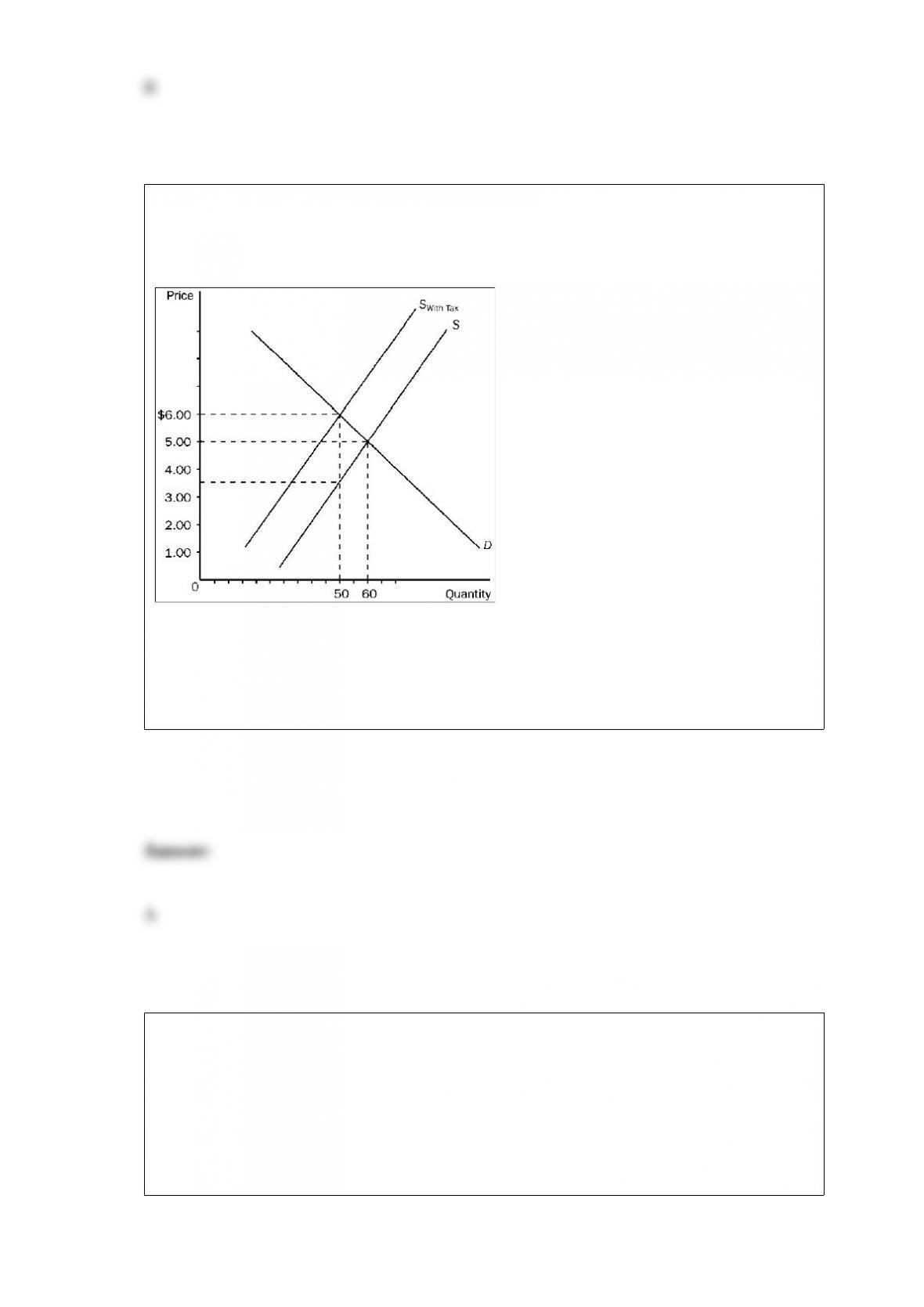
Figure 4-22
Refer to Figure 4-22. Buyers pay how much of the tax per unit?
a. $1.00.
b. $1.50.
c. $2.50.
d. $3.00.
The change in nominal GDP will always exceed the change in real GDP when nominal
GDP is
a. increasing and prices are unchanged.
b. increasing and prices are decreasing.
c. decreasing and prices are decreasing.
d. increasing and prices are increasing.
If the economy is simultaneously in long-run and short-run equilibrium, which of the
following is true?
a. Aggregate quantity supplied is greater than potential output.
b. Aggregate quantity demanded is less than potential output.
c. Aggregate quantity demanded is equal to potential output.
d. The aggregate demand curve is horizontal at the potential output level.
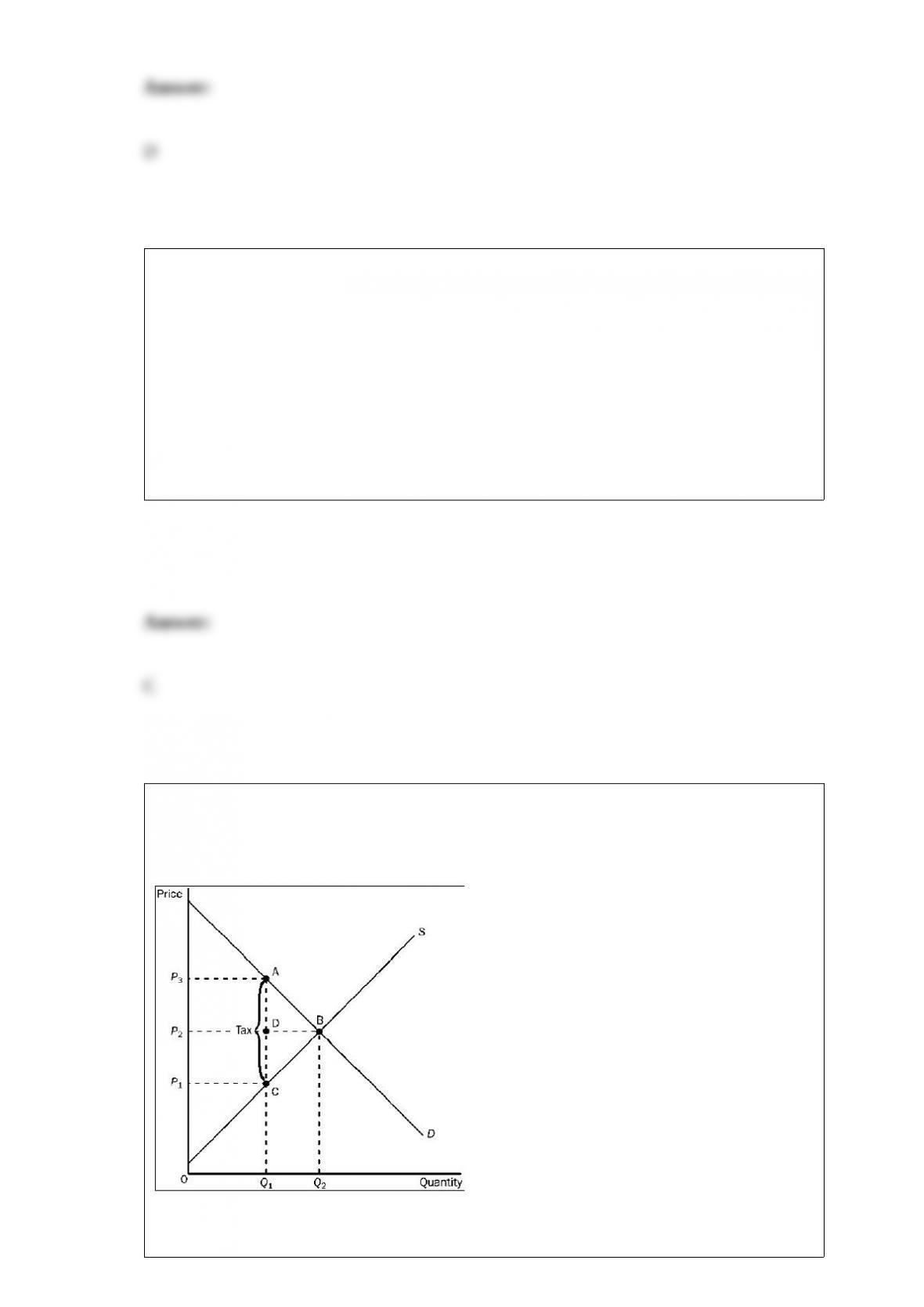
Figure 4-24
Refer to Figure 4-24. The amount of the tax on each unit of the good is
a. P3 P1.

b. P3 P2.
c. P2 P1.
d. Q2 Q1.
Proponents of the view that the higher rate of productivity growth since 1996 is part of
a long-run trend argue it is a result of
a. a continuing increase in the use of computers and other kinds of information
technology.
b. employers forcing more output from workers, who have become victims of new
technologies.
c. the shrinkage of the labor force, so that output per worker is rising.
d. the rise of employment in the highly productive manufacturing sector.
For most firms, the major difference between accounting profit and economic profit is
that
a. explicit and implicit costs are included in the accounting profit while only explicit
costs are included in economic profit.
b. accounting profit omits the salaries of managers, and therefore, it is generally greater
than economic profit.
c. accounting profit is based on opportunity cost, whereas economic profit is based on
market transactions.

d. accounting profit does not consider the opportunity cost of the firm’s equity capital
and, therefore, generally overstates economic profit.
If a large percentage increase in the price of a good results in a small percentage
reduction in the quantity demanded of the good, demand is said to be
a. of unitary elasticity.
b. relatively inelastic.
c. relatively elastic.
d. perfectly elastic.
An increase in subsidies and other government spending during a recession is likely to
result in
a. an increase in rent-seeking activity.
b. an increase in productive projects and a reduction in unproductive projects.
c. a decrease in the level of future taxes.
d. greater reliance on profits and losses in the allocation of resources.

The shortsightedness effect suggests that
a. politicians have a strong incentive to support projects that yield immediate and easily
recognized benefits, especially when the costs of the projects are difficult to identify
and are observable only in the distant future.
b. politicians have a strong incentive to support projects that yield benefits in the distant
future, especially when the costs of the project must be paid for in the current period.
c. voters will tend to weigh future costs and benefits more heavily than current costs
and benefits.
d. legislators will be unwilling to trade votes on issues, especially when those issues
benefit only special interest groups.
Suppose the mean earnings of two groups differ. Which of the following would be the
logical conclusion?
a. The group with the lowest earnings must be the victim of employment
discrimination.
b. The group with the lowest earnings must be less productive.
c. The group with the highest earnings is more highly motivated and materialistic.
d. Without consideration of preferences and productivity factors, differences in
unadjusted mean earnings do not necessarily reflect employment discrimination.
Which of the following is GDP designed to measure?
a. the total market value of goods and services produced domestically during the year
b. changes in the cost of purchasing the typical consumer market basket of goods from
one year to another
c. the total size of the domestic underground economy
d. the standard of living of the average citizen
William observes that a car in 1925 sold for an average of $500 versus $20,000 for a
2005 model. He concludes that 2005 cars must be 40 times better than 1925 cars.
What’s wrong with this way of thinking?
Kim used to work at “The Big One” accounting firm, and she earned $50,000 a year.
She saved her money and has now invested $100,000 in her own firm. Profit is $20,000
a year, which Kim receives as her only compensation. She concludes that this is great
because a 20 percent return is much better than the 8 percent she could get in another
investment (the opportunity cost of the funds). What is wrong with this line of thinking?
How has the structure of the personal income tax changed and the share of taxes paid
by various income groups changed in recent decades?
Why is a stable monetary system essential for the smooth operation of a market system?
What would an unstable monetary system be like? Why isn’t a barter economy just as
efficient as an economy with money?
Explain how an increase in the American demand for German goods leads to a change
in the German Mark relative to the U.S. dollar.
Two students are walking by a department store window that has on display a $400
dress. The English major declares, “I want that dress but can’t afford it.” The economics
major replies, “No, you don’t.” Explain the logic of this reply.
What type of model would be best if we wanted to analyze the market for fast food?
Why?
Mark and John are 10-year-old twins who do not get along. They have opened separate
lemonade stands and are competing with each other, selling lemonade on their block.
Their mother observes that Mark is very good at making lemonade and John is an
excellent young salesman. She suggests they both could make more money if they
worked together. John counters that two stands will always make more money than one.
Who is right? Why?
What is meant by a final good or service as opposed to an intermediate good or service?
Why are only final goods and services included in the calculation of GDP?
One answer to the problem of natural monopoly is provision of the good by a
government-owned and operated firm. Why is that option not used very often?
Professor Smith completed a study that showed that 60 percent of all the students who
graduated from her college purchased new cars. What might explain this?
A hilly, public golf course is often used by sledders in the winter. One of the sledders
was quoted as saying, “This is public property, so we have just as much a right to be on
these hills as anyone else. Besides, when it snows, golfers can’t use the course anyway.
Sledding doesn’t harm anything.” Is he correct? Why or why not?
According to the traditional (crowding-out) view, what impact do budget deficits have
on the economy?
Why do the airlines charge less for passengers who stay over Saturday night and
purchase their tickets two weeks in advance?
List some factors that might make the threat of a strike more effective.
Erin just won Lotto America, which will pay her $40 million over the next 20 years at a
rate of $2 million a year. Is Erin $40 million richer today?
The City of Greenville needs to raise revenue. Alderman Black has proposed a $10 tax
on red cars in the city, currently numbering 2,000. Mayor White, who wants more than
$20,000 in revenue, proposes taxing these cars at $100 each. Councilwoman Bluestone
goes even farther, suggesting a $1,000 per red car tax, arguing that her proposal will
raise $2 million. If maximizing tax revenue is the only consideration, which proposal
should pass? Why?
Sally and Joe recently graduated from college, both majoring in history. Joe took a
prestigious job as a legal clerk. Sally took a job as a specialist in fighting forest fires.
Both received additional training before entering their jobs. Who will likely earn a
higher salary and why?
Indicate how changes in monetary policy are transmitted to the goods and services
market? Discuss for the case of an expansion in the money supply.