
Table 5.4
Refer to Table 5.4. If outcomes 1 and 2 are equally likely at Job A, and if at Job B the
$20 outcome occurs with probability .1, and the $50 outcome occurs with probability .
9, then
A) Job A is safer because the difference in the probabilities is lower.
B) Job A is riskier only because the expected value is lower.
C) Job A is riskier because the standard deviation is higher.
D) Job B is riskier because the difference in the probabilities is higher.
E) There is no definite way given this information to tell how risky the two jobs are.
A simple linear demand function may be stated as Q = a – bP + cI where Q is quantity
demanded, P is the product price, and I is consumer income. To compute an appropriate
value for c, we can use observed values for Q and I and then set the estimated income
elasticity of demand equal to:
A) c(I/Q)
B) c(Q/I)
C) -b(I/Q)
D) Q/(cI)

Suppose there is a water shortage, and the governor proposes that the government
distribute equal quantities of water to each person at no cost to the consumers. If
consumers were forbidden to trade water, would such a distribution be Pareto optimal?
A) Yes, because each person has the same amount of water as everyone else.
B) Yes, because everyone would be receive their water for free.
C) Not necessarily, as people may differ in their marginal rates of substitution between
water and other goods.
D) It is impossible to determine without knowing the price of water.
E) none of the above
Consider a market in which high-quality and low-quality television sets are sold. Before
consumers make a purchase, they do not know the quality of the sets, but the sellers do
know. As compared to a situation where both consumers and sellers know the quality of
the sets, this situation would
A) cause no change in the ratio of low to high-quality sets sold.
B) increase the fraction of high-quality sets sold.
C) increase the fraction of low-quality sets sold.
D) cause the average price of goods sold to rise.
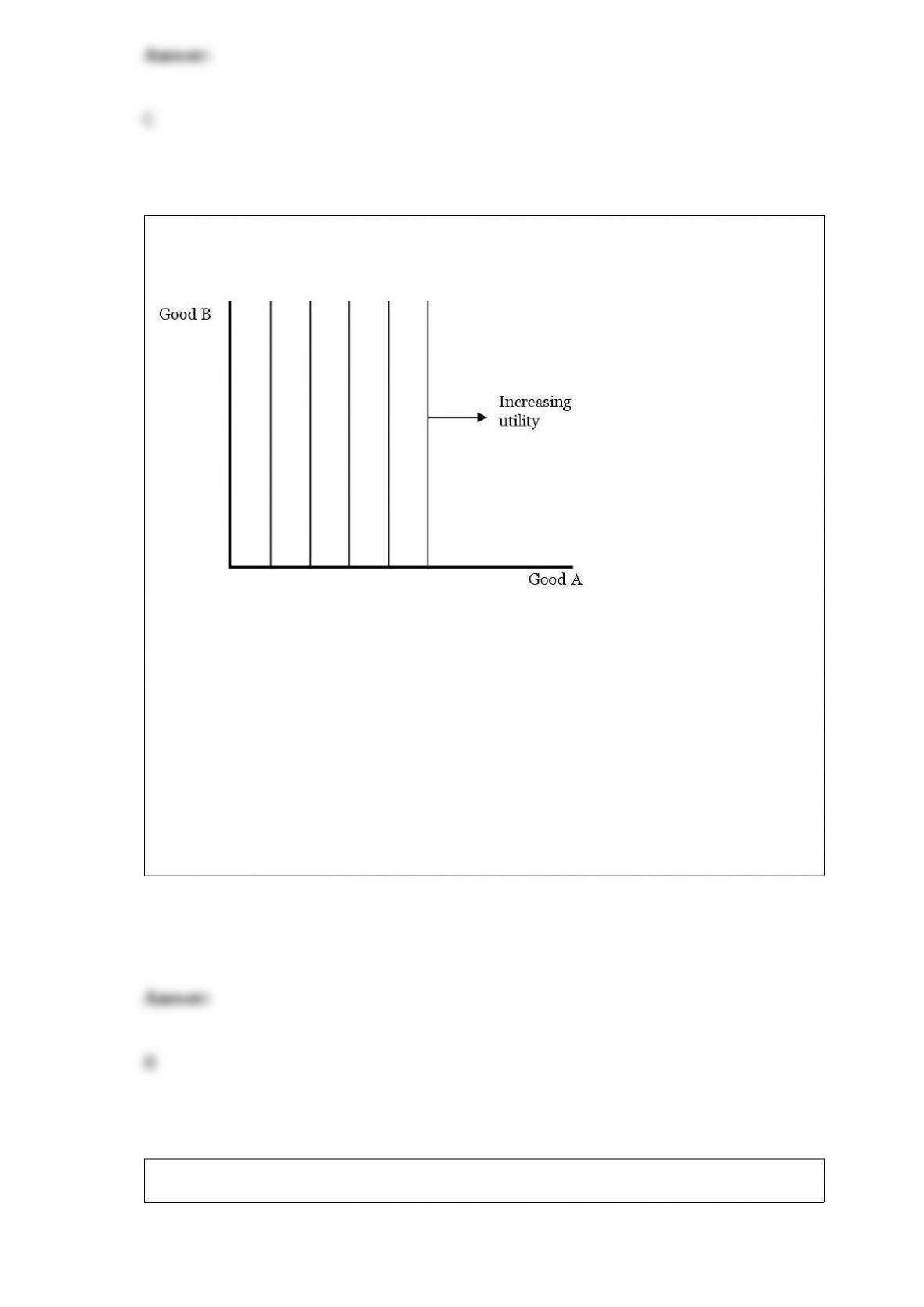
Figure 3.3
Refer to the indifference curve in Figure 3.3. Which of the following statements is
correct?
A) This individual receives no satisfaction from Good A.
B) This individual receives no satisfaction from Good B.
C) This individual will only consume A and B in fixed proportions.
D) none of the above
Consider the Matching Pennies game:

Suppose Player A always uses a pure strategy that selects heads. What is Player B’s
optimal response to this pure strategy?
A) Always select heads.
B) Always select tails.
C) Mixed strategy with probability 1/2 on heads and 1/2 on tails
D) There is no optimal pure or mixed strategy for this situation.
Which of the following is TRUE about a college education as a signaling device?
A) It is a useful signal only if individuals choose majors related to their ultimate field of
employment.
B) It is a useful signal only if a college education is open to all individuals, no matter
what their previous level of educational accomplishment was.
C) It is a useful signal whether or not people actually learn anything in college.
D) It is a useful signal only if the job in question cannot be done without the
preparatory coursework the college degree required.
E) It is less and less a useful signal in the post-industrial economy, where the skill sets
employers need change so rapidly.

In a competitive market, the following supply and demand equations are given:
Supply P = 5 + 0.36Q
Demand P = 100 – 0.04Q,
where P represents price per unit in dollars, and Q represents rate of sales in units per
year.
a. Determine the equilibrium price and sales rate.
b. Determine the deadweight loss that would result if the government were to impose a
price ceiling of 40 dollars per unit.

Mikey is very picky and insists that his mom make his breakfast with equal parts of
cereal and apple juice any other combination and it ends up on the floor. Cereal costs 4
cents per tablespoon and apple juice costs 6 cents per tablespoon. If Mikey’s mom
budgets $8 per month for Mikey’s breakfast, how much cereal and juice does she buy?
A) 40 tablespoons each of cereal and juice
B) 80 tablespoons each of cereal and juice
C) 40 tablespoons of cereal and 75 tablespoons of juice
D) 100 tablespoons of cereal and 67 tablespoons of juice
The following expressions describe a perfectly competitive labor market. The labor
supply curve is:
SL = AE = $3.00 + $0.000375L.
The marginal revenue product of labor curve is:
MRPL = $13.00 – 0.000433L.
a. Find the equilibrium wage in this labor market. Also, find the optimal number of
labor hours worked per week. Let L represent the number of labor hours worked per
week, and let W represent the hourly wage of workers.
b. Determine the economic rent earned by labor in this situation.

Consider the following statements when answering this question;
I. Without fire insurance, the expected value of home ownership for a risk averse
homeowner is $W. Insurance companies are willing to sell this homeowner a policy that
guarantees the homeowner a wealth of $W.
II. In a neighborhood where the price of houses are identical, the probability of a fire is
identical, and the value of damage done by fires is identical, the risk premium for an
insurance policy that repays all the cost of the fire damage does not vary across
homeowners.
A) I and I are true.
B) I is true, and II is false.
C) I is false, and II is true.
D) I and II are false.
Which of the following examples is NOT a negative stock externality?
A) Goodwill generated by a company
B) Noise pollution from an airport
C) Odors emitted from a paper mill

D) None of these cases are examples of negative stock externalities
One practical implication of a kinked market supply curve is that:
A) producer surplus is not defined at the kink point.
B) the MC = MR rule does not hold at the kink point.
C) the market supply elasticity for a price increase may be different than the market
supply elasticity for a price decrease at the kink point.
D) All of the above are true.
A “Credible Threat”
A) is also called a “tit-for-tat” strategy.
B) always set a low price.
C) minimizes the return of your opponent.
D) is a strategy selection that is in your best interest.
E) provides the best return for both players.

Sporto Auto Company manufacturers each of the aluminum engines used in their cars,
and there is no outside market for these engines. Suppose the marginal cost of
producing the aluminum engines is constant at all quantities. What happens to the
optimal transfer price and the quantity of cars produced if the cost of assembly
increases?
A) Price and quantity increase
B) Price and quantity remain the same
C) Price and quantity decrease
D) Price remains the same and quantity decreases
Which of the following is true in the Stackelberg model?
A) The first firm produces less than its rival.
B) The first firm produces more than its rival.
C) Both firms produce the same quantity.
D) Both firms have a reaction curve.

Which of the following is true when the government imposes a price ceiling on a
monopolist?
A) Marginal revenue becomes horizontal.
B) Marginal revenue is linear.
C) Marginal revenue is kinkedhorizontal and then downward sloping.
D) Marginal revenue is kinkeddownward sloping and then horizontal.
Other things being equal, the marginal revenue product (MRP) curve for a competitive
seller
A) lies below the MRP curve for a monopolist.
B) is identical to the MRP curve for a monopolist.
C) lies above the MRP curve for a monopolist.
D) is upward sloping whereas a monopolist has a downward sloping MRP curve.

The slope of an indifference curve reveals:
A) that preferences are complete.
B) the marginal rate of substitution of one good for another good.
C) the ratio of market prices.
D) that preferences are transitive.
E) none of the above
Use the following statements to answer this question:
I. The income-consumption curve for perfect complements is a straight line.
II. The price-consumption curve for perfect complements is a straight line.
A) I and II are true.
B) I is true and II is false.
C) II is true and I is false.
D) I and II are false.
Consider the following diagram where a perfectly competitive firm faces a price of $40.
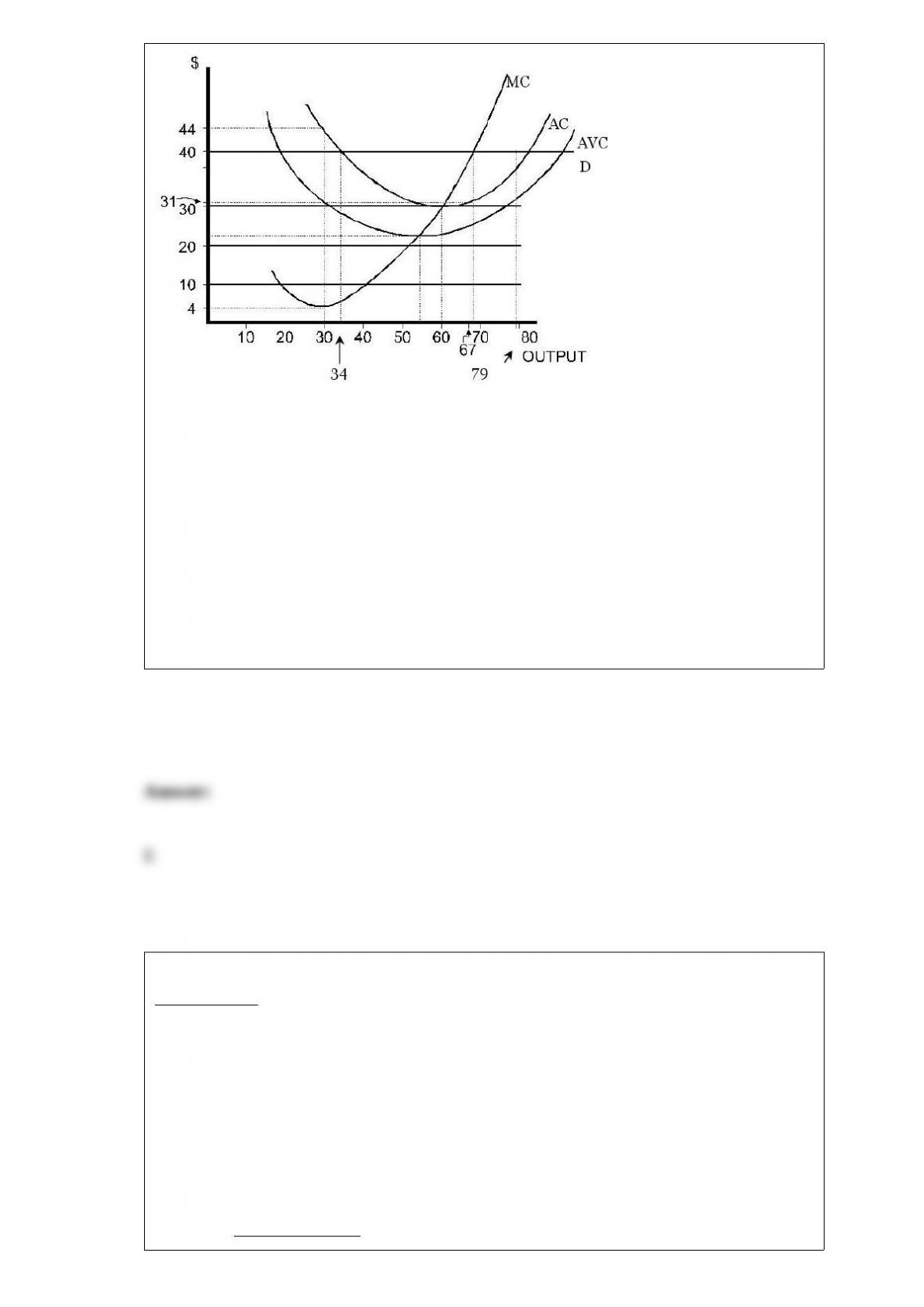
At the profit-maximizing level of output, total profit is
A) -$120.
B) $0.
C) $432.
D) $600.
E) $603.
Scenario 5.9:
Torrid Texts, a risk-neutral new firm that specializes in making college textbooks more
interesting by inserting contemporary material wherever possible, is planning for next
year’s production and must decide how many paper producers to contract with. It knows
fairly well what the general demand for textbooks is, but is uncertain how faculty will
react to this new material. If faculty react very negatively, the firm expects course
orders to be down. The executives at Torrid believe that the likelihood of a positive
faculty response is 75%. The table below contains profit information under the different
possible outcomes.
Producers Faculty Reaction Expected

Contracted Negative Positive Profit
1 $3 million $30 million $23.25 million
2 $1 million $60 million $45.25 million Refer to Scenario 5.9. Given that the
probability of a positive faculty response is 75%, Torrid Texts’ expected profit under
complete information would be
A) $23.25 million.
B) $45 million.
C) $45.25 million.
D) $45.75 million.
E) $60 million.
What is a reference point?
A) the value of a good on the black market
B) the point from which an individual makes a consumption decision
C) a subjective valuation of a good
D) the minimum price that an individual would sell a good that she currently owns
E) none of the above

Scenario 5.4:
Suppose an individual is considering an investment in which there are exactly three
possible outcomes, whose probabilities and pay-offs are given below:
The expected value of the investment is $25. Although all the information is correct,
information is missing.
Refer to Scenario 5.4. What is the variance of the investment?
A) -75
B) 275
C) 3,150
D) 4,637.50
E) 8,125
If the moral hazard problem in automobile driving were to be eliminated, the marginal
cost of driving would be
A) lowered enough to pull the amount of driving back down to the efficient level.
B) lowered enough to raise the amount of driving back up to the efficient level.
C) raised enough to pull the amount of driving back down to the efficient level.
D) raised enough to raise the amount of driving back up to the efficient level.

E) lowered back down to the efficient level, relieving the stress on market forces.
Suppose the labor market is perfectly competitive, but the output market is not. When
the labor market is in equilibrium, the wage rate will:
A) be less than the marginal revenue product of labor.
B) equal the marginal revenue product of labor.
C) be greater than the marginal revenue product of labor.
D) None of the above is necessarily correct.
The curve in the diagram below is called:
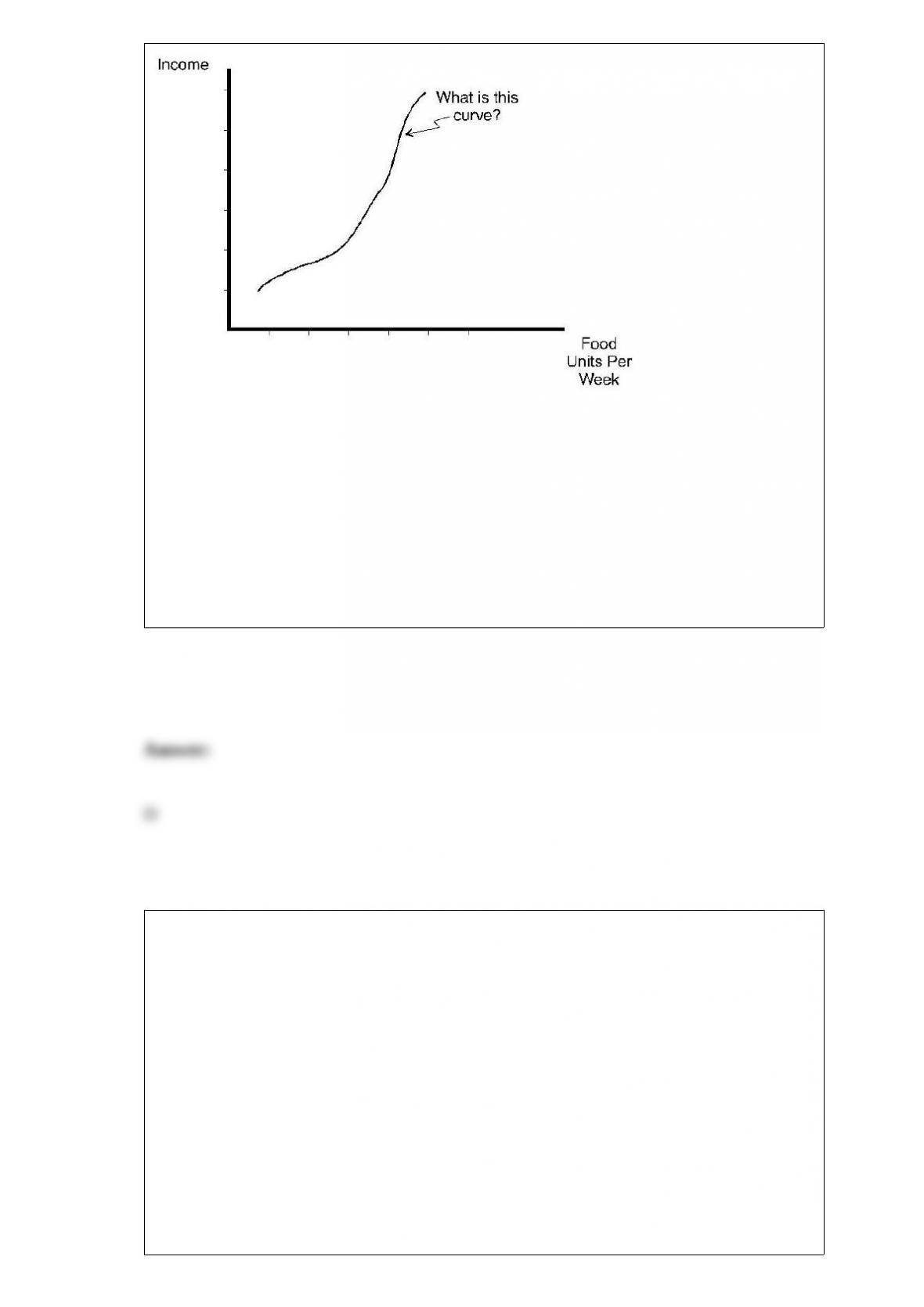
A) the price-consumption curve.
B) the demand curve.
C) the income-consumption curve.
D) the Engel curve.
E) none of the above
Bartels and Jaymes are two individuals who one day discover a stream that flows wine
cooler instead of water. Bartels and Jaymes decide to bottle the wine cooler and sell it.
The marginal cost of bottling wine cooler and the fixed cost to bottle wine cooler are
both zero. The market demand for bottled wine cooler is given as:
P = 90 – 0.25Q
where Q is the total quantity of bottled wine cooler produced and P is the market price
of bottled wine cooler.
a. What is the economically efficient price of bottled wine cooler?
b. What is the economically efficient quantity of bottled wine cooler produced?

c. If Bartels and Jaymes were to collude with one another and produce the
profit-maximizing monopoly quantity of bottled wine cooler, how much bottled wine
cooler will they produce?
d. Given the output level in (c), what price will Bartels and Jaymes charge for bottled
wine cooler?
e. At the output level in (c), what is the welfare loss?
f. Suppose that Bartels and Jaymes act as Cournot duopolists, what are the reaction
functions for Bartels and for Jaymes?
g. In the long run, what level of output will Bartels produce if Bartels and Jaymes act as
Cournot duopolists?
h. In the long run, what will be the price of wine coolers be if Bartels and Jaymes act as
Cournot duopolists?
i. Suppose that after Bartels and Jaymes have arrived at their long run equilibrium as
Cournot duopolists, another individual, Paul Mason, discovers the streams. Paul Mason,
who will sell no wine cooler before its time, decides to bottle wine coolers. There are
now three Cournot firms producing at once. In the long run, what level of output will
Bartels produce?
Consider the information below:
For Group A the cost of attaining an educational level y is
CA(y) = $6,000y
and for Group B the cost of attaining that level is
CB (y) = $10,000y.
Employees will be offered $50,000 if they have y < y*, where y* is an education
threshold determined by the employer. They will be offered $130,000 if they have y >
y*.
If the threshold educational level y* is set at 10,
A) only individuals in Group A will attain it.
B) only individuals in Group B will attain it.
C) individuals in both groups will attain it.
D) no individuals will attain it.

E) some fraction of individuals in each group will attain it.
When the current price is above the market-clearing level we would expect:
A) quantity demanded to exceed quantity supplied.
B) quantity supplied to exceed quantity demanded.
C) a shortage.
D) greater production to occur during the next period.
An investment opportunity has two possible outcomes. The expected value of the
investment opportunity is $250. One outcome yields a $100 payoff and has a
probability of 0.25. What is the payoff of the other outcome?
A) -$400
B) $0
C) $150
D) $300
E) none of the above

Please use the following statements to answer this question:
I. The process of testing and revising theories is central to the development of
economics as a science.
II. Theory is imperfect and may not adequately describe economic behavior in some
cases.
A) I and II are true.
B) I is true and II is false.
C) I is false and II is true.
D) I and II are false.
The demand for sirloin steak is probably more elastic than the demand for all meat
because
A) steak is very expensive.
B) people are worried about cholesterol.
C) cattle raising is not very profitable.
D) there are more substitutes for sirloin steak than for all meats.