
The United States is a leading exporter of wheat. What explains the comparative
advantage of the United States in wheat production?
A) positive externalities
B) investment by multinational firms such as Archer-Daniels-Midland and Tyson Foods
Inc.
C) climate and soil conditions in the United States which are well-suited for wheat
production
D) a large supply of unskilled labor
In a city with rent-controlled apartments, all of the following are true except
A) apartments usually rent for rates lower than the market rate.
B) apartments are often in shorter supply than they would be without rent control.
C) it usually takes more time to find an apartment than it would without rent control.
D) landlords have an incentive to rent more apartments than they would without rent
control.
Which of the following is not an example of rent-seeking behavior?
A) competition for subsidies

B) lobbying the government to impose tariffs on certain imported products
C) competition for the exclusive right to import a product
D) engaging in aggressive advertising that slams a competitor’s product
The income effect of a decrease in the price of legal services, a normal good, results in
A) a decrease in the demand for legal services.
B) a decrease in the quantity of legal services demanded.
C) an increase in the quantity of legal services demanded.
D) an increase in the demand for legal services.
Governments grant patents to encourage
A) research and development on new products.
B) competition.
C) low prices.
D) firms to form public enterprises.

Article Summary
Just days before the 2015 Super Bowl was played in Glendale, Arizona, the average
price of a ticket on the secondary resale market was $10,352, more than three times the
average price for the 2014 game. People who were able to purchase tickets at face value
directly from the NFL paid prices ranging from $800 to $1,900 per ticket. The day
before the game, ticket broker StubHub listed its least expensive seat at $8,049, while
the most expensive seat was priced at more than $65,000.
Source: Benjamin Snyder, “Soaring Super Bowl ticket prices in one wallet-busting
chart,” Fortune, January 31, 2015.
Refer to the Article Summary above. How would the NFL know if it was operating on
the elastic portion of the demand curve for Super Bowl tickets?
A) If they increased ticket prices and the total revenue from ticket sales increased.
B) If they increased ticket prices and the total revenue from ticket sales did not change.
C) If they increased ticket prices and the total revenue from ticket sales decreased.
D) If they decreased ticket prices and the total revenue from ticket sales did not change.
The production possibilities frontier model shows that
A) if consumers decide to buy more of a product its price will increase.
B) a market economy is more efficient in producing goods and services than is a

centrally planned economy.
C) economic growth can only be achieved by free market economies.
D) if all resources are fully and efficiently utilized, more of one good can be produced
only by producing less of another good.
Which of the following is a common mistake made by consumers?
A) taking into account the implicit costs of an activity
B) ignoring sunk costs
C) being overly optimistic about their future behavior
D) being overly pessimistic about their future behavior
“An Inquiry into the Nature and Causes of the Wealth of Nations” published in 1776
was written by
A) John Maynard Keynes.
B) Karl Marx.
C) Alfred Marshall.
D) Adam Smith.

Which of the following describes a difference between allocative efficiency and
productive efficiency in a perfectly competitive market?
A) Allocative efficiency is achieved only in the long run. Productive efficiency is
achieved only in the short run.
B) Allocative efficiency is achieved only in the long run. Productive efficiency is
achieved in the short run and the long run.
C) Allocative efficiency is achieved only in the short run. Productive efficiency is
achieved only in the long run.
D) Allocative efficiency is achieved in the short run and the long run. Productive
efficiency is achieved only in the long run.
Article Summary
RealtyTrac, a provider of housing data and analytics for the real estate industry,
conducted an analysis of home values, appreciation, and property taxes in zip codes
where either a Whole Foods Market or a Trader Joe’s are located. The findings are as
follows:
-Homeowners near a Trader Joe’s experienced an average 40 percent increase in home
value since the date of purchase, had average home values of just over $590,000, and
paid an average of $8,536 in annual property taxes.
-Homeowners near a Whole Foods Market experienced an average 34 percent increase

in home value since the date of purchase, had average home values of just over
$560,000, and paid an average of $5,382 in annual property taxes.
– Homeowners in general for all zip codes nationwide experienced an average 34
percent increase in home value since the date of purchase, had average home values of
just over $260,000, and paid an average of $3,239 in annual property taxes.
Source: Jennifer Von Pohlmann, “Better to own near Trader Joe’s or Whole Foods?,”
realtytrac.com, August 11, 2015.
Refer to the Article Summary above. Assuming the findings are correct and all else
equal, higher increases in home values which result from close proximity to a Trader
Joe’s are an example of a ________ due to the location of the Trader Joe’s.
A) positive externality.
B) negative externality.
C) private cost.
D) social cost.
Which of the following is the source of revenue for Medicare and Social Security in the
United States?
A) individual income taxes
B) sales taxes
C) social insurance taxes
D) property taxes

Which of the following statements regarding a firm’s long-run average total cost
(LRATC) curve and its short-run average total cost (SRATC) curve is true?
A) The shape of the LRATC is affected by the law of diminishing returns.
B) The SRATC, but not the LRATC, can be used by a firm’s managers for planning.
C) The LRATC shows the lowest cost at which a firm is able to produce a given level of
output when no inputs are fixed.
D) The contribution of average fixed cost to LRATC is greater than its contribution to
SRATC.
If a monopolist practices perfect price discrimination
A) the firm will break even in the long run.
B) consumers surplus will be equal to the deadweight loss.
C) producer surplus will equal consumer surplus.
D) consumer surplus will be zero.
Figure 2-6
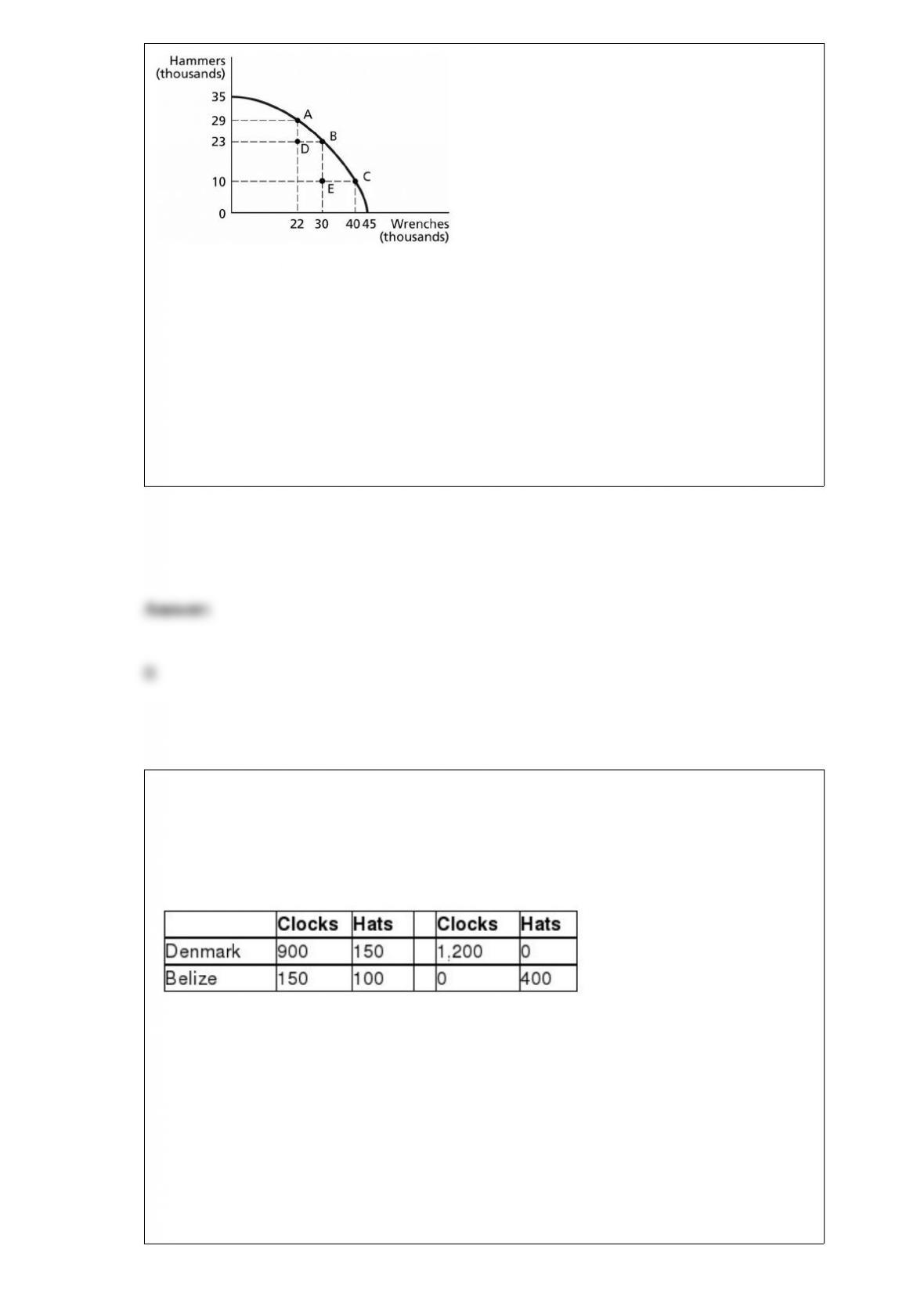
Refer to Figure 2-6. If the economy is currently producing at point A, what is the
opportunity cost of moving to point B?
A) 8 thousand wrenches
B) 6 thousand hammers
C) 30 thousand wrenches
D) 23 thousand hammers
Table 9-6
Production and
Consumption Production
Without Trade With Trade
Denmark and Belize can produce both clocks and hats. Table 9-6 shows the production
and consumption quantities without trade, and the production numbers with trade.
Refer to Table 9-6. Which country has a comparative advantage in producing clocks?
A) Denmark
B) Belize
C) both countries

D) neither country
The production possibilities frontier model assumes which of the following?
A) Labor, capital, land, and natural resources are unlimited in quantity.
B) The economy produces only two products.
C) Production of any level of the two products that the economy produces is currently
possible.
D) The level of technology is variable.
________ is maximized in a competitive market when marginal benefit equals marginal
cost.
A) Deadweight loss
B) Marginal profit
C) Economic surplus
D) Selling price

Average fixed cost can be calculated using any of the formulas below except
A) TFC/Q.
B) (TC – VC)/Q.
C) Δ(TC – VC)/ΔQ.
D) (TC/Q) – AVC.
A natural monopoly is most likely to occur in which of the following industries?
A) the pharmaceutical industry because the development and approval of new drugs
through the Food and Drug Administration can take more than 10 years
B) the diamond mining and marketing industry because one firm can control a key
resource
C) the software industry because of the importance of network externalities
D) an industry where fixed costs are very large relative to variable costs

When a firm produces 50,000 units of output, its total cost equals $6.5 million. When it
increases its production to 70,000 units of output, its total cost increases to $9.4 million.
Within this range, the marginal cost of an additional unit of output is
A) $41.43.
B) $134.29.
C) $135.
D) $145.
Which of the following is a result of a market economy?
A) environmental protection
B) an equal income distribution
C) agreement on equity
D) voluntary exchange
Traditionally, Wall Street investment banks had been organized as partnerships, but by
2000 they had converted to being publicly traded companies. As partnerships, the
principal-agent problem is ________ because there is ________ separation of

ownership from control.
A) reduced; much
B) reduced; little
C) increased; much
D) increased; little
Let D = demand, S = supply, P = equilibrium price, and Q = equilibrium quantity. What
happens in the market for electric vehicles if the government offers incentives to
manufacturers to produce more electric vehicles?
A) D increases, S no change, P and Q increase
B) S increases, D no change, P decreases, Q increases
C) D and S increase, P and Q decrease
D) D no change, S increases, P decreases, Q decreases
What type of business is the easiest to set up?
A) sole proprietorship
B) partnership

C) corporation
D) There is no difference in the ease of establishment.
A perfectly competitive firm earns a profit when price is
A) equal to minimum average total cost.
B) above minimum average total cost.
C) equal to minimum average variable cost.
D) equal to minimum average fixed cost.
What is a subgame?
A) It is one that begins at any node of the tree, including the game itself.
B) It is one that begins at any decision node of the tree except the first decision node.
C) It is one that starts at the final decision node of the tree.
D) It is a simultaneous game embedded in a sequential game.
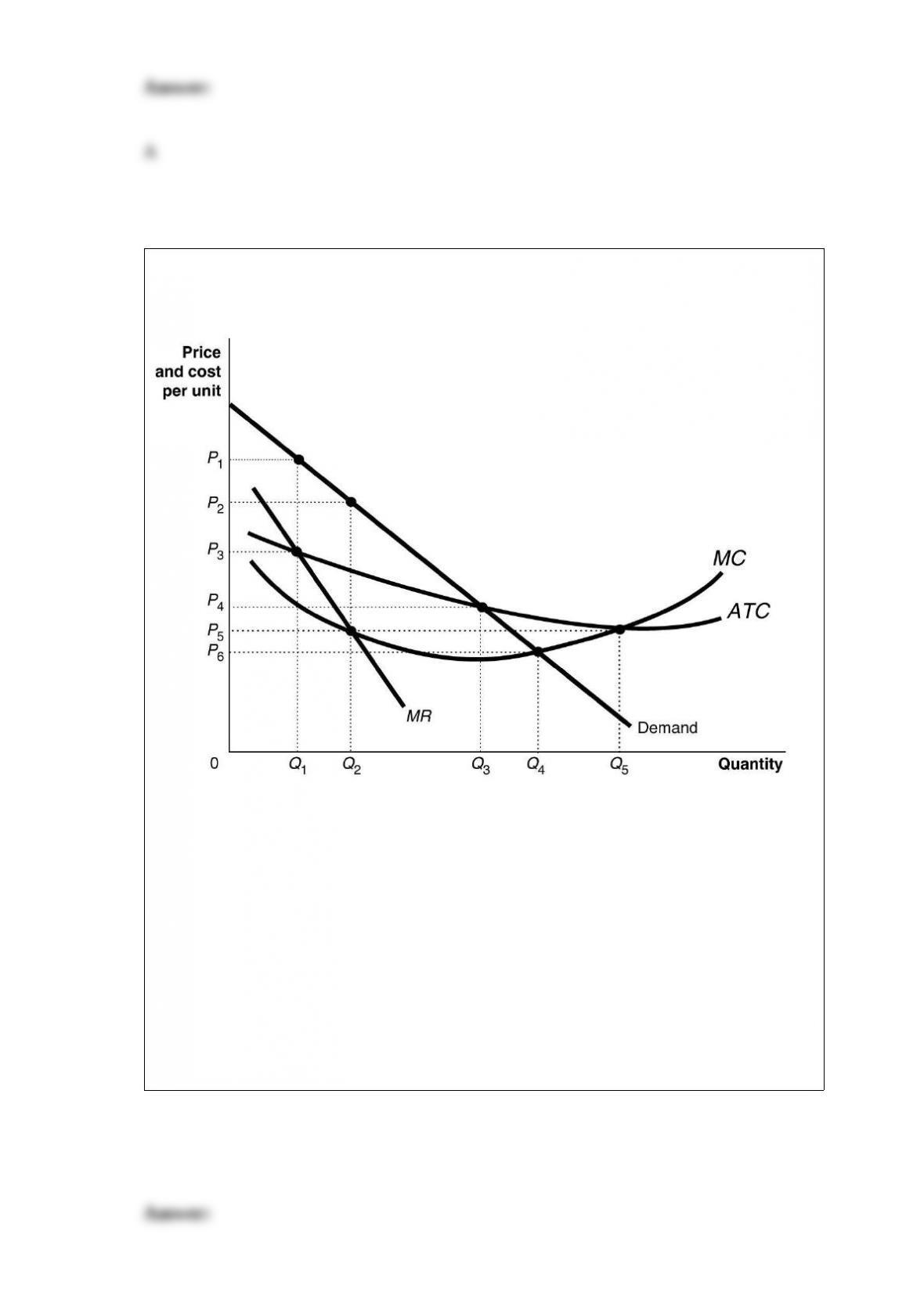
Figure 15-16
Figure 15-16 shows the market demand and cost curves facing a natural monopoly.
Refer to Figure 15-16. Which of the following would be true if government regulators
require the natural monopoly to produce at the economically efficient output level?
A) This results in a misallocation of resources.
B) The marginal cost of producing the last unit sold exceeds the marginal benefit.
C) The firm will sustain persistent losses and will not continue in business in the long
run.
D) The firm will break even.
A major factor contributing to the slow growth rate of less-developed economies is
A) the lack of well-defined and enforceable property rights.
B) the lack of natural resources.
C) the lack of workers.
D) the high rate of illiteracy.
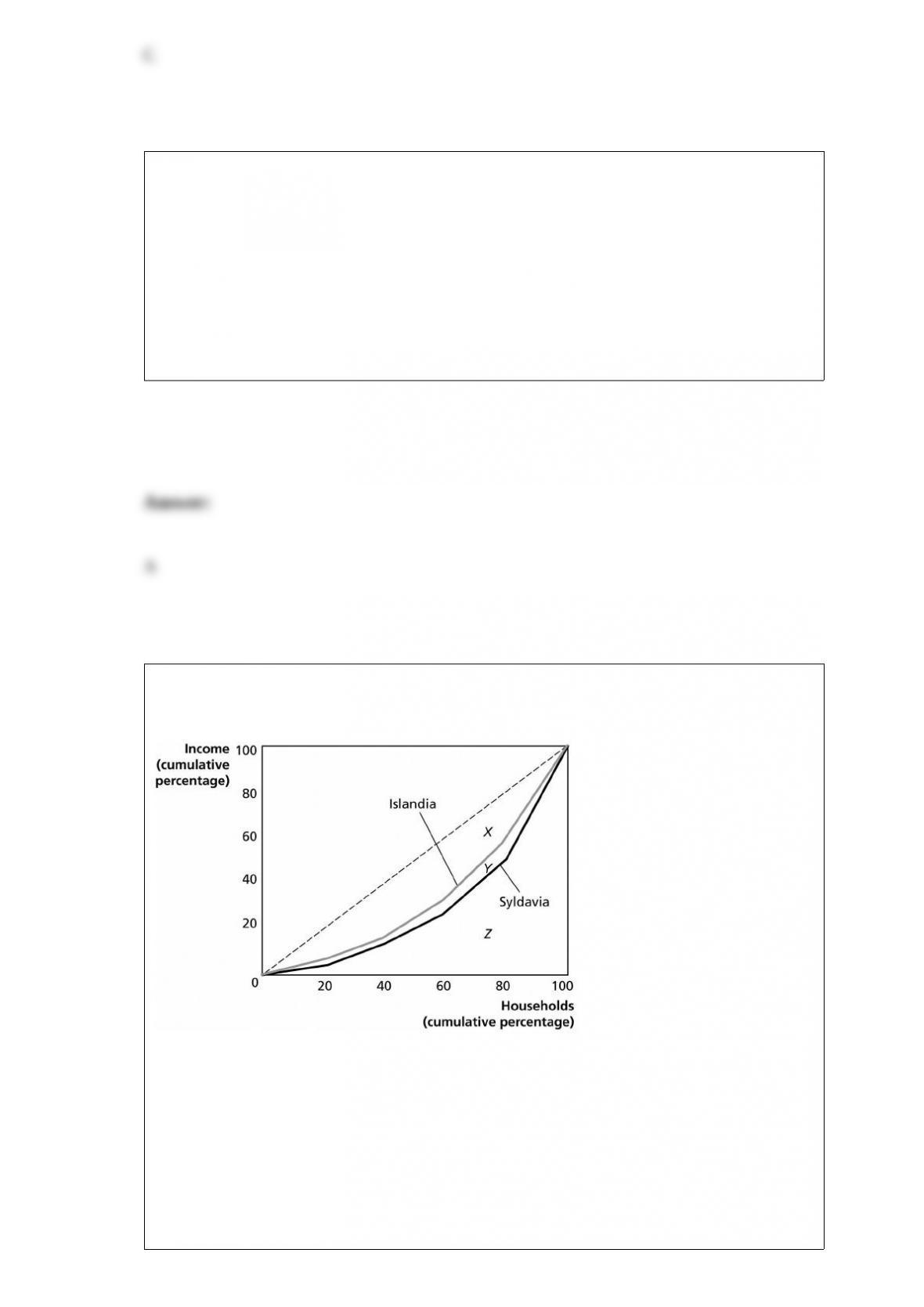
Figure 18-6
Figure 18-6 shows the Lorenz curves for Islandia and Syldavia.
Refer to Figure 18-6. If area X = 2,060, area Y = 240, and area Z = 2,700, calculate the
Gini coefficient for Islandia.
A) 41
B) 45

C) 70
D) 76
An avocado orchard employs five full-time workers. Currently, the average product of
labor is 120 pounds of avocados per day. The orchard hires a 6th full-time worker and
his marginal product is 150 pounds of avocados. The average product of the six workers
will now be
A) more than 120 pounds.
B) less than 120 pounds.
C) equal to 120 pounds.
D) greater than the marginal product of labor.
The law of demand implies, holding everything else constant, that as the price of bagels
increases,
A) the quantity of bagels demanded will decrease.
B) the demand for bagels will decrease.
C) the quantity of bagels demanded will increase.
D) the demand for bagels will increase.

Today, ________ of shoes sold in the United States are made overseas.
A) about 25 percent
B) just over half
C) almost 75 percent
D) 99 percent