
When economists say the demand for a good is highly inelastic, they mean that
a. even if the price rose substantially, suppliers would be unwilling to offer much more
of the good.
b. the facilities utilized by producers of the good are inflexible; producers cannot easily
expand their facilities, even in the long run.
c. consumers will respond to a change in the price of the good by purchasing
substantially more of it.
d. a large (percentage) change in the price of a good will result in only a small
(percentage) change in the quantity demanded.
When an expansionary monetary policy leads to an acceleration in the rate of inflation,
it will also result in
a. lower nominal interest rates.
b. higher nominal interest rates.
c. an appreciation of the dollar in the foreign exchange market.
d. lower money wages.
The type of unemployment that occurs because of a recession is called
a. frictional unemployment.
b. seasonal unemployment.
c. natural unemployment.

d. cyclical unemployment.
If the demand for a good increased, what would be the effect on the equilibrium price
and quantity?
a. Price would increase, and quantity would decrease.
b. Price would decrease, and quantity would decrease.
c. Price would increase, and quantity would increase.
d. Price would decrease, and quantity would increase.
An increase in the consumer sentiment index indicates that consumers are
a. becoming more optimistic about their future income and employment prospects.
b. becoming less optimistic about their future income and employment prospects.
c. expecting the inflation rate to rise in the near future.
d. expecting the inflation rate to fall in the near future.

Under a flexible exchange rate system, a nation that offers more attractive investment
opportunities than its trading partners can expect to run a
a. surplus on current account transactions.
b. deficit on current account transactions.
c. balance of trade surplus.
d. capital account deficit.
If production of a good creates external benefits, a competitive market will likely
produce
a. less output than would maximize profit.
b. more output than would maximize profit.
c. less output than is efficient.
d. more output than is efficient.

Velcro is becoming more and more popular for a variety of uses, including as fasteners
for shoes. What should happen to the equilibrium price and quantity for shoelaces as a
result?
a. Both price and quantity will increase.
b. Both price and quantity will decrease.
c. Price will increase and quantity decrease.
d. Price will decrease and quantity increase.
e. Nothing.
If the amount of money in circulation is $50 billion and the nominal GDP is $200
billion, the velocity of money is
a. 0.25
b. 0.75.
c. 2.
d. 4.
Which of the following would be most likely to cause a reduction in current aggregate
demand in the United States?
a. increased fear of a recession
b. an increase in the expected rate of inflation
c. a sharp increase in the value of stocks owned by Americans

d. a rapid increase in the growth of income in Canada, Mexico, and Western Europe
If resource prices are fixed and the product selling price rises, then
a. profits will decrease.
b. profits will increase.
c. profits will remain constant.
d. both profits and output will decrease.
Beginning in the early 1990s, private landowners in Zimbabwe have started fencing in
large areas of land that contain black rhinos, which were on the verge of extinction.
These private owners charge fees for a stay at the lodges on the property (eco-tourism)
and also sell hunting safaris and photo safaris. As a result,
a. the population of black rhinos has fallen substantially.
b. the population of black rhinos has increased.
c. many black rhinos are being poached.
d. the incomes of residents in Zimbabwe has fallen substantially.
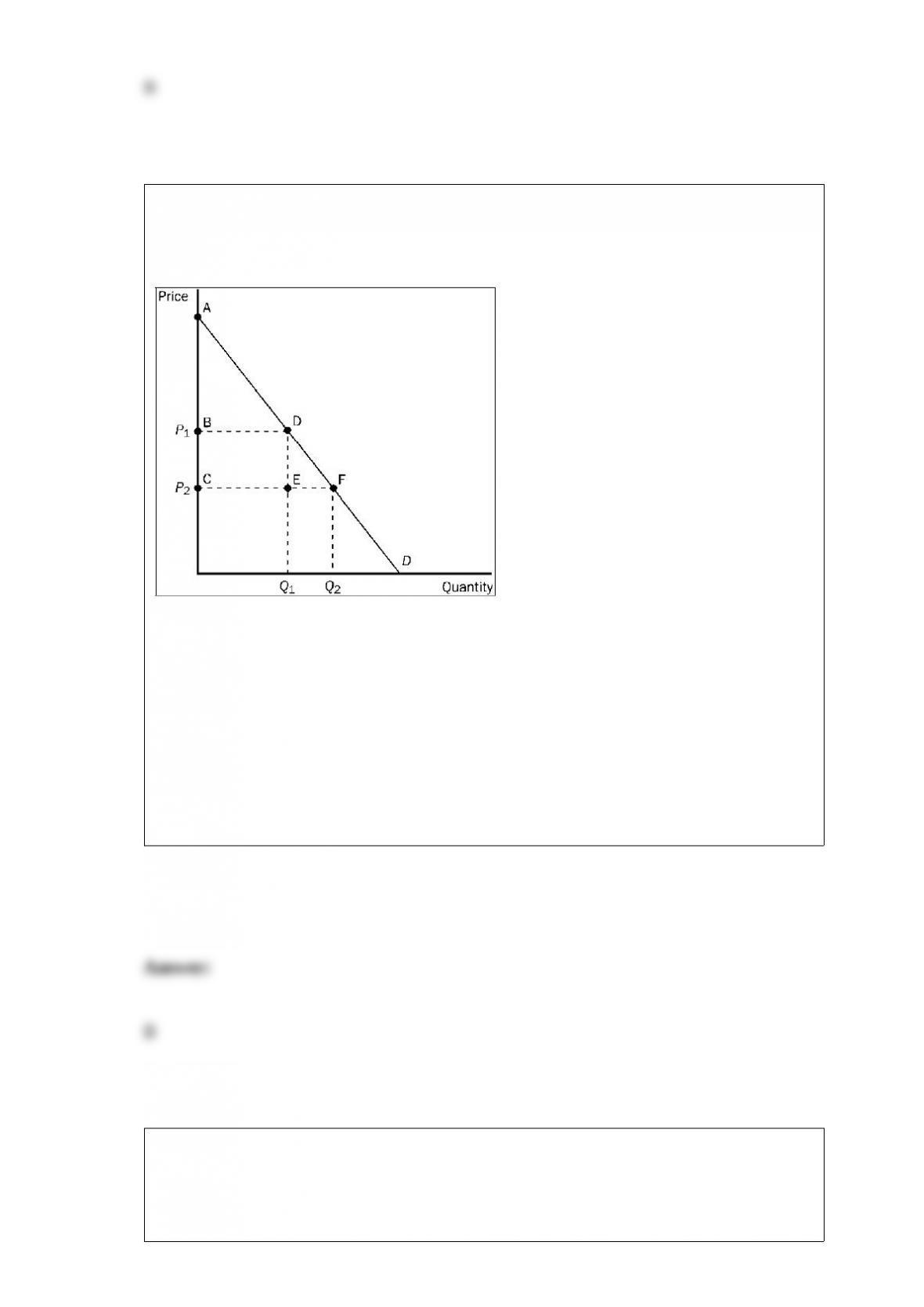
Figure 3-18
Refer to Figure 3-18. Which area represents consumer surplus at a price of P2?
a. ABD
b. ACF
c. BCDE
d. DEF
If proved reserves of a mineral amount to twelve years of use at the current rate of
consumption,
a. it is likely, though not certain, that we will run out of that mineral in about twelve

years.
b. we are likely to run out of the mineral in less than twelve years if our rate of use has
been increasing.
c. if the good becomes more scarce relative to supply in the future, its price will rise and
thereby encourage both conservation and exploration.
d. if proved reserves diminish, lower prices will extend the day of exhaustion well into
the future.
Compared to the long run, consumers typically ____ to price changes in the short run.
a. are very responsive
b. are more demand sensitive
c. are less demand sensitive
d. do not respond at all
e. overreact
The price elasticity of demand for a commodity is determined primarily by the
a. size of the consumer surplus.
b. attractiveness of the substitutes for the good.
c. incomes of consumers.
d. availability of complementary goods.

Economics indicates that government funding of special interest projects and favoritism
of some business firms relative to others will lead to
a. efficient allocation of resources because the government action will correct the
failures of the market.
b. the funding of productive projects that will improve the well-being of most citizens.
c. economic inefficiency because the funding will be driven by political rather than
economic considerations.
d. a decline in political contributions and a reduction in the quality of the candidates
willing to run for political office.
Suppose the economy is in long-run equilibrium. In a short span of time, there is a large
influx of skilled immigrants, a major new discovery of oil, and a major new
technological advance in electricity production. In the short run, we would expect
a. the price level to rise and real GDP to fall.
b. the price level to fall and real GDP to rise.
c. the price level and real GDP both to stay the same.
d. All of the above are possible.

An increase in the demand for a good means that
a. the demand curve has shifted to the left.
b. the good’s price has fallen and, as a result, consumers are buying more of the good.
c. the good has become scarce.
d. consumers are willing to purchase more of the good at each possible price.
Suppose this year’s inflation rate is 4 percent, which is greater than the 2 percent
everyone expected. Which of the following is true?
a. real GDP will increase
b. the unemployment rate will probably rise
c. potential output will remain the same
d. the short-run aggregate supply curve will shift to the right
e. there will be a leftward movement along a given short-run aggregate supply curve
According to water resource economists

a. water is seldom in short supply anywhere in the world.
b. we are not running out of water, but specific places do run short of water, given the
status of their water supply arrangements and ease (or lack of) transferability of water
among users.
c. the world is running out of water, just as it is running out of accessible oil.
d. there is no workable way to make water markets function properly, because in the
end, we can”t make more water the way we can make more bread or automobiles.
The supply of oil for users in the United States
a. was never an issue of serious public concern until the 1970s.
b. has never been an issue of serious concern by political leaders.
c. has often been a topic for dire warnings and forecasts of oil depletion.
d. has been more and more in doubt since the early 1980s.
The rational expectations theory indicates that expansionary policy will
a. stimulate real output in the long run but not in the short run.
b. expand real output and employment if the public quickly anticipates the effects of the

expansionary policy.
c. equalize real and nominal interest rates during lengthy periods of inflation.
d. fail to increase employment because individuals will anticipate it and take actions
that will offset its impact.
The net value to the federal government of the bonds currently held in the Social
Security Trust Fund is
a. approximately $1 trillion.
b. now approaching $2 trillion.
c. greater than $2.5 trillion.
d. zero, because the federal government is both the payee and recipient of the interest
and principal represented by these bonds.
Use the figure to answer the following question(s).
Figure 11-6
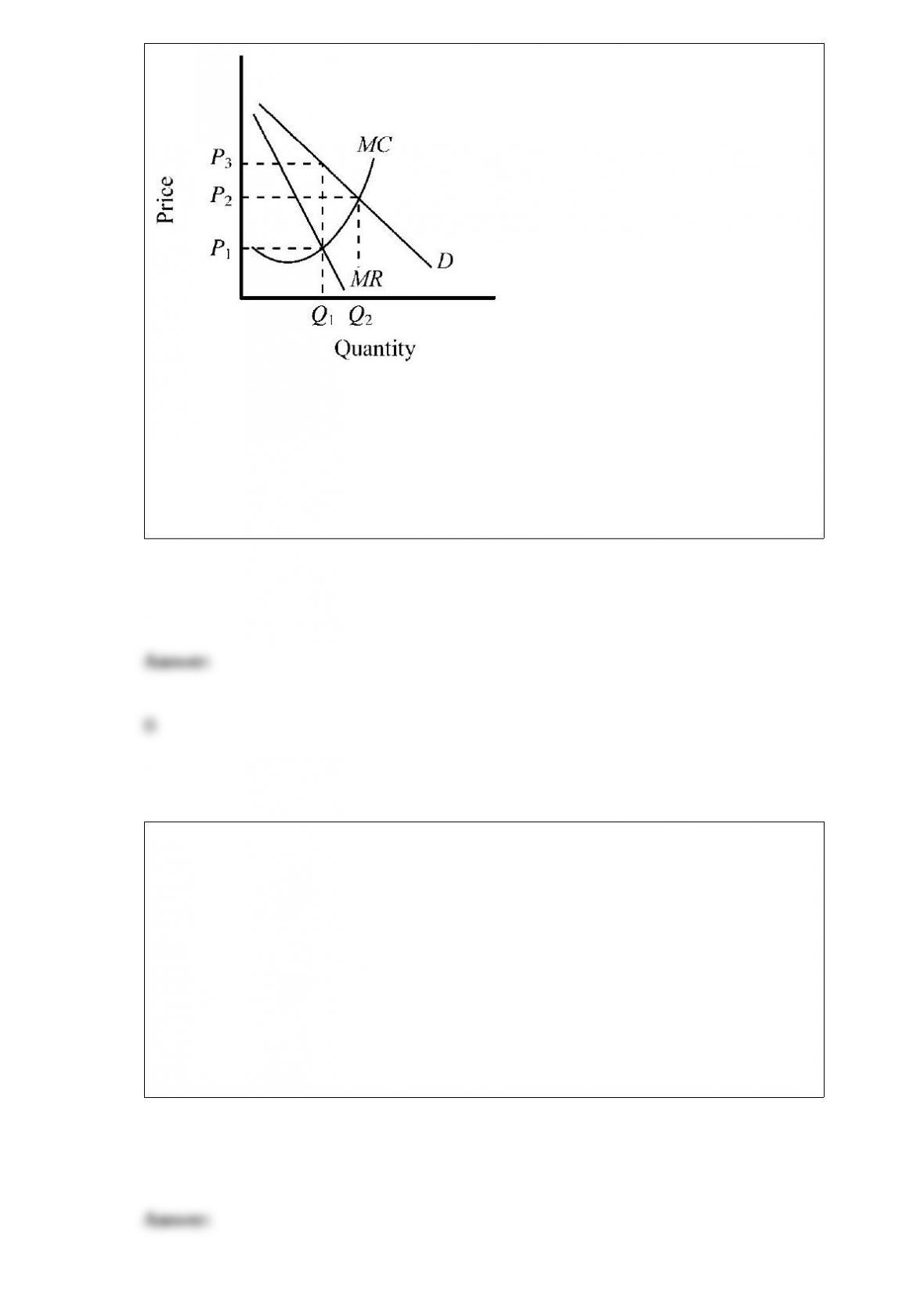
The demand and cost conditions in an industry are as depicted in Figure 11-6. In the
viewpoint of economic efficiency, what would the ideal price and output be?
a. price, P1; quantity produced, Q1
b. price, P2; quantity produced, Q2
c. price, P3; quantity produced, Q1
d. price, P1; quantity produced, Q2
In a competitive market, if the production process involves an external cost, such as
pollution of the environment, the market will
a. produce the economically efficient outcome.
b. result in a market price that is higher than the efficient one.
c. register a price that is lower than the efficient one.
d. result in too little of the good being produced compared to the ideal efficient
outcome.
When entry barriers into a market are high,
a. a monopolist will always be able to make an economic profit.
b. rival firms will enter and drive price down to the level of per-unit costs if the firms in
the market are making economic profit.
c. entry into the market will not take place, at least not quickly, even if the firms
currently in the market are making economic profits.
d. the producers in the market will have little or no incentive to produce efficiently (at a
low cost).
Table 3-2
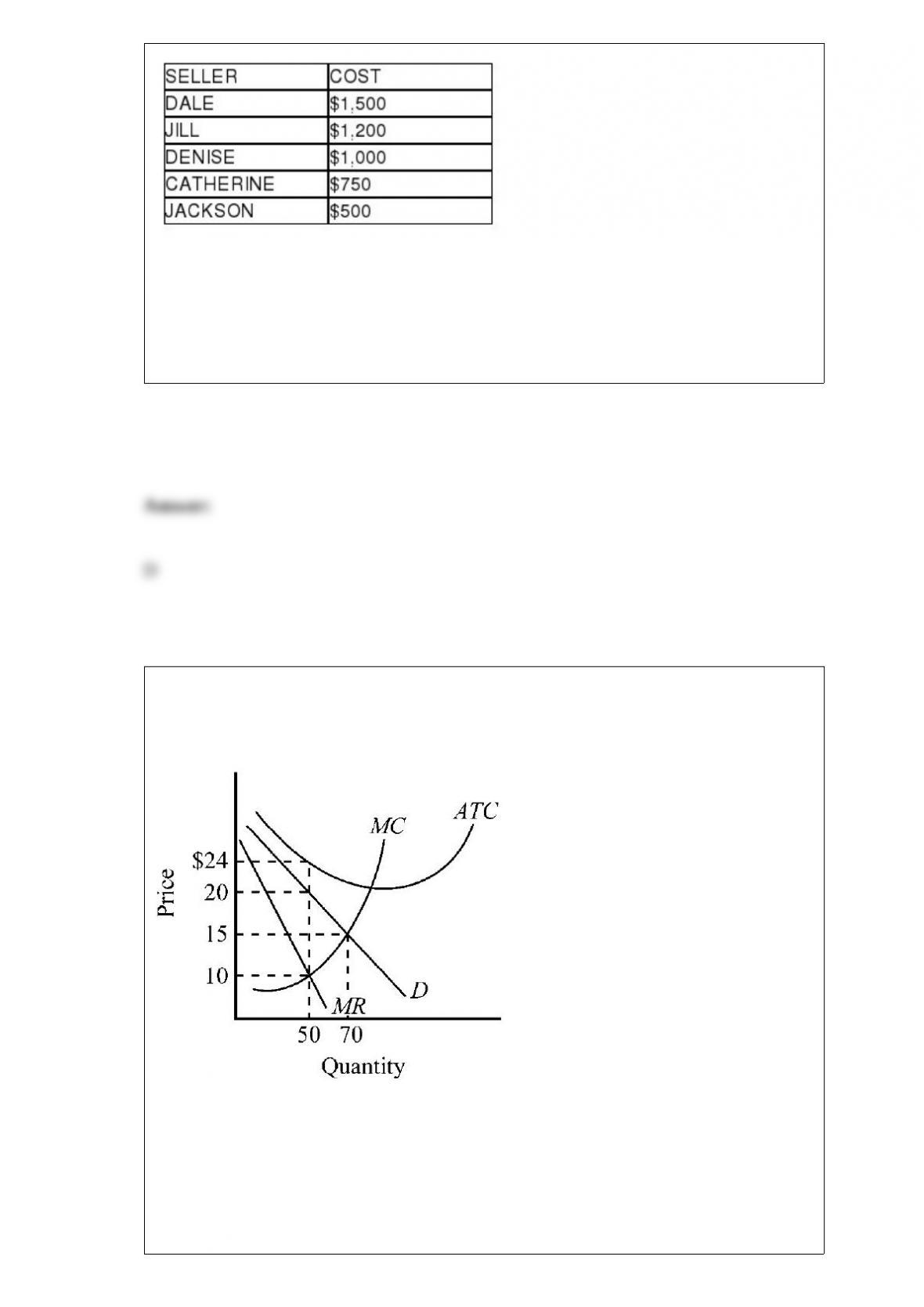
Refer to Table 3-2. Suppose each of the five sellers can supply at most one unit of the
good; then the market quantity supplied is exactly 3 if the price is
a. $670.
b. $770.
c. $970.
d. $1,170.
Use the figure to answer the following question(s).
Figure 10-4
If the cost and demand conditions of this competitive price-searcher firm depicted in
Figure 10-4 are representative of the market, what will happen in the future?
a. Some firms will go out of business, and the market price will rise.
b. The current market price will tend to persist into the future.

c. New firms will enter the market, and the market price will decline.
d. The firms in this industry will probably collude in order to increase their profitability.
The economic way of thinking indicates that government action will
a. never improve on the allocation of resources through markets.
b. always improve on the results of markets if the political process is democratic.
c. reflect the actions of political decision-makers seeking to advance the public interest,
rather than their own personal interests.
d. can either improve the well-being of the general public, or harm it, depending on the
circumstances.
Part of the entrepreneurial process in a competitive market economy involves
a. obtaining governmental control over the market so that a new product has some
chance of being successful.
b. knowing from the start the proper output and price to set for each new product.
c. choosing the best structure, size, and scope of production for the firm to produce a
new product.

d. knowing in advance with certainty what products consumers will want to buy.
Which of the following would most likely shift the supply curve to the left for Wii
video games?
a. an increase in the price of Wii video games
b. a decrease in the price of computer chips used to make Wii games
c. a decrease in the demand for Wii games
d. an increase in the price of electronic components used to produce the Wii games
Everything else equal, wages are likely to be higher when
a. the location of the job is more desirable.
b. the work environment is more prestigious.
c. more skill is required to perform well on the job.
d. the work is safer.
Since its beginning, the cable television industry has been viewed as a natural
monopoly. Typically, cities would grant individual firms local monopolies and then
regulate them. Is this a valid approach from an economic perspective? What do you
expect the future of the television-viewing market to hold?
Explain how the Fed would use its four tools to decrease and to increase the money
supply.
Monopoly is a word derived from Greek origins that means, roughly, single seller. Why
is the definition of monopoly as single seller inadequate in economic terms?
The Big River Power Company is a regulated monopolist with pricing structured such
that the stockholders receive a “fair” rate of return based on the firm’s unit costs. Can
economic thinking predict how the company executive offices are likely to be
furnished? Given a choice between Hawaii and downtown Cleveland (20 miles away),
where would we expect the Board of Directors to meet?
If economics is correct in its assumption that people are rational, why then would
anyone choose to smoke cigarettes?
Many personal finance magazines such as Money and Smart Money routinely give
advice as to which stocks to buy. Should you take their advice?
Sam lives next to The Party Pub and its outdoor “beer garden” that features live music.
An economics major, Sam considers this a positive externality. Dave, another
economics student, lives next to The Party Pub too, but he considers the music a
negative externality. Which student, if either, is correct? Why?
Evaluate the economic validity of the following statement: “Unemployed resources
would not exist if the economy were operating efficiently.”
What is the difference between the Treasury and the Federal Reserve? Is there any
difference in the effect on the money supply between the sale of bonds by the Treasury
and the sale of bonds by the Fed?
After spending $400,000 to build your dream home, you recently discovered that after
less than one year the foundation is cracking. Further investigation reveals that the
contractor used substandard concrete. Is there a role for the public sector in this
situation?
“If it were not for employment discrimination against women, the average earnings of
men and women would be equal.” Is this statement true or false?
“Economists have demonstrated that imports benefit consumers while causing losses to
producers, and exports benefit producers while causing losses to consumers. In the
balance then, international trade neither benefits nor hurts a nation as a whole.”
Evaluate this statement.
A recent editorial in a local newspaper argues, “Consumers need to know more about
products than just their price. They need to know how these prices are determined, who
owns the businesses, and the wages of the workers.” Is the editorial writer correct? Why
or why not?
If people prefer to consume goods now rather than in the future, how does anyone save
money?
After the terrorist attacks on September 11, 2001, the United States began devoting
substantial resources toward the War on Terrorism, homeland security, and relief efforts.
Use the production possibilities curve to demonstrate how this might affect the
production of other goods in the United States.
Indicate what might be done to restrain the tendency of the democratic process to
generate budget deficits?
Developments in the computer software industry have made it extremely easy for firms
to keep their books, conduct their own audits, and fill out the various tax forms. If
accountants are an input in the accounting services industry, what will likely happen in
the market for accountants? Is there a difference between the short run and the long
run?
An agricultural economist reports that corn prices are very high this year and that corn
growers are earning substantial profits. He concludes that government action is needed
to direct more farmers to grow corn. Is such action necessary? Why or why not?
How do changes in open market operations alter the monetary base, and how do
changes in the monetary base translate to changes in the money supply?
If the ABC Company decides to take over the XYZ Corporation by purchasing all of the
stock of XYZ, what does this tell us about the view ABC holds of XYZ?