Harvey Miller owns a baseball that was hit for a home run by Ted Williams. Harvey, a
long-time Boston Red Sox fan, recently refused to sell his baseball for $75,000 even
though he would not have paid someone more than $10,000 for the baseball if he did
not already own it. Harvey explained his decision not to sell the baseball by noting that:
“Ted Williams was my hero. This baseball has a great deal of sentimental value for me.”
Which of the following can explain Harvey’s behavior?
A) the difference between implicit and explicit costs
B) the scarcity of home run baseballs hit by Ted Williams
C) the endowment effect
D) how social influences can affect consumption choices
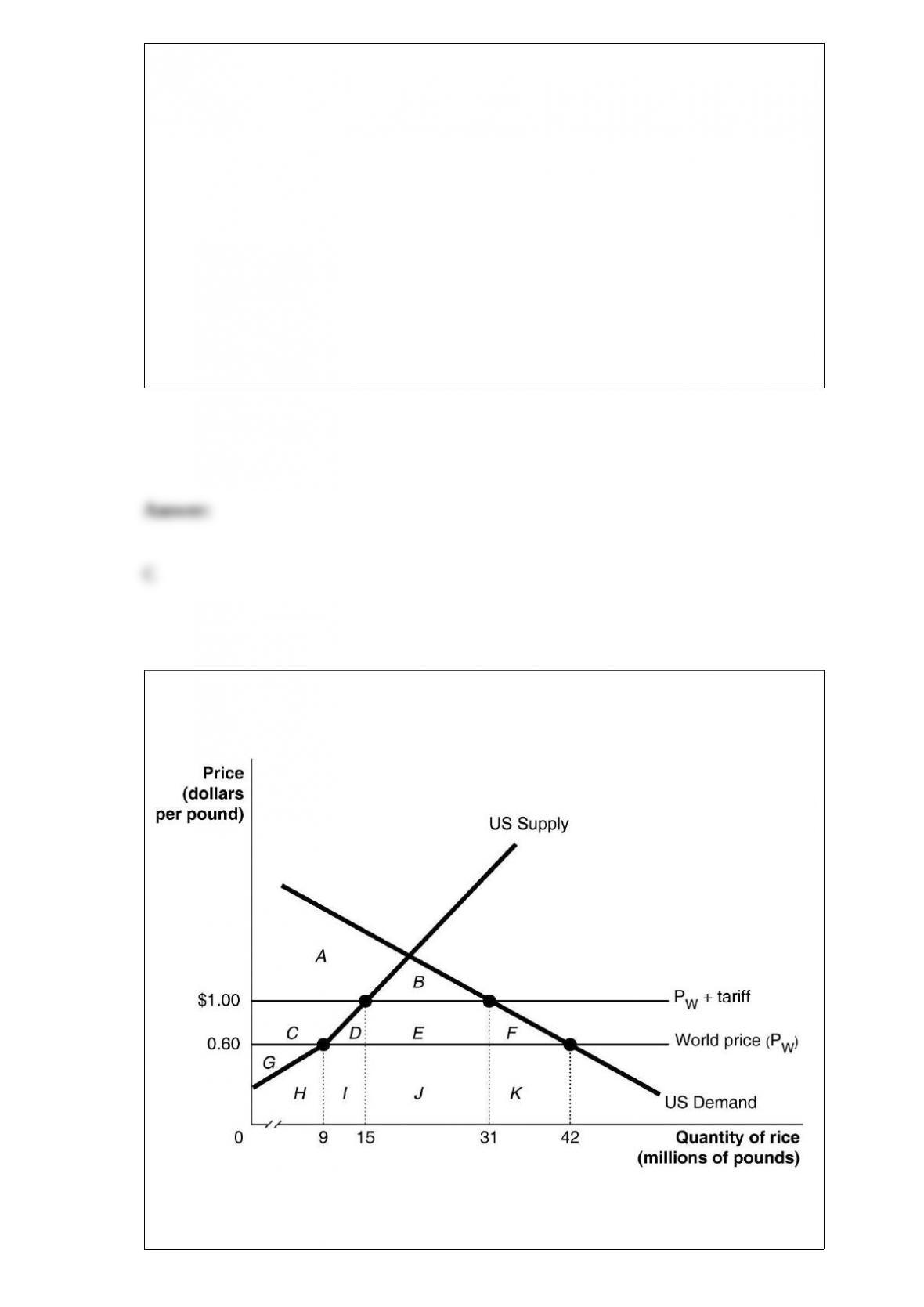
Figure 9-2
Suppose the U.S. government imposes a $0.40 per pound tariff on rice imports. Figure
9-2 shows the impact of this tariff.

Refer to Figure 9-2. If the tariff was replaced by a quota which limited rice imports to
16 million pounds, the amount of revenue received by rice importers would equal
A) $6.4 million.
B) $9.6 million.
C) $16 million.
D) $19.8 million.
Article Summary
On October 5, 2015, 12 nations, including the United States, reached an agreement on
the Trans-Pacific Partnership (TPP) treaty, a free-trade agreement that has been
negotiated in total secrecy for more than five years. One of the more controversial parts
of the agreement deals with intellectual property rights, with details of this provision
released to the public by the Website Wikileaks. According to Wikileaks, the intellectual
property rights section of the TPP contains regulations that would potentially have
“wide-ranging effects on internet services, medicines, publishers, civil liberties, and
biological patents.” Included in these regulations is the potential to extend patents on
pharmaceuticals which could delay the development of less expensive, generic versions
of the patented drugs.
Source: Doug Bolton, “TPP leaked: Wikileaks releases intellectual property chapter of
controversial internet and medicine-regulating trade agreement,” independent.co.uk,
October 9, 2015.
Refer to the Article Summary above. If the 12 nations that are a part of the TPP do
agree to these stricter pharmaceutical patent laws as a way to increase intellectual
property rights, all of the following would most likely occur except
A) pharmaceutical companies would increase investment in the development of more
experimental drugs.
B) pharmaceutical companies would consider expanding operations to these TPP
nations.
C) more patents would be issued to pharmaceutical companies.

D) fewer dollars would be spent on the development of new medicines.
If Lisa spends her income on veggie burgers and pints of soy milk and the price of
veggie burgers is three times the price of a pint of soy milk, then when Lisa maximizes
her utility she will buy
A) both goods until the marginal utility of veggie burgers is three times the marginal
utility of soy milk.
B) three times as many veggie burgers as pints of soy milk.
C) three times as many pints of soy milk as veggie burgers.
D) both goods until the marginal utility of a pint of soy milk is three times the marginal
utility of veggie burgers.
A firm’s demand curve for labor slopes downwards because
A) of the law of diminishing marginal returns.
B) firms supply less labor as the wage rate rises.
C) workers supply less labor services as the wage rate falls.
D) of rising marginal product.

In early 2007, Pioneer and JVC, two Japanese electronics firms, each announced that
their profits were going to be lower than expected because they both had to cut prices
for LCD and plasma television sets. Which of the following could explain why these
firms did not simply raise their prices and increase their profits?
A) The move to cut prices is probably just a temporary one to gain market share. In the
long run the firms will raise prices and be able to increase their profits.
B) Most likely, intense competition between these two major producers probably
pushed prices down. Thereafter, each feared that it would lose its customers to the other
if it raised its prices.
C) In perfect competition, prices are determined by the market and firms will keep
lowering prices until there are no profits to be earned.
D) The firms are still making profits, just not as high as expected so there is room to
lower prices until one can force the other out of business.
Price elasticity of demand measures
A) how responsive suppliers are to price changes.
B) how responsive sales are to changes in the price of a related good.
C) how responsive quantity demanded is to a change in price.
D) how responsive sales are to a change in buyers’ incomes.

In September 2006, the Food and Drug Administration recommended that Americans
avoid eating bagged raw spinach in the wake of an outbreak of E. coli bacteria.
Following this recommendation, the food industry looked at alternatives and many
turned to arugula. One Chicago distributor claimed, “The sale of the stuff has gone
through the roof.” Based on this information
A) arugula is a normal good while raw spinach is an inferior good.
B) the cross-price elasticity between arugula and spinach is negative.
C) the cross-price elasticity between arugula and spinach is positive.
D) the price elasticity of arugula is positive while the price elasticity of spinach falls to
zero.
How do the owners of a partnership relate to the business?
A) The owners and the business are not separate legal entities.
B) The owners and the business are separate legal entities.
C) The assets of the owners are considered separate from the asset of the business.
D) None of these describe the legal relationship of the owners to the business.

Who was the economist who first proposed that governments use taxes and subsidies to
correct for externalities?
A) Ronald Coase
B) A. C. Pigou
C) Adam Smith
D) David Hume
Bringing oil to the market is a relatively long and costly process. The whole process
from exploration to pumping significant amounts of oil can take years. What does this
indicate about the price elasticity of supply for oil?
A) The elasticity coefficient is likely to be very high and supply is inelastic.
B) The elasticity coefficient is likely to be close to zero and supply is perfectly elastic.
C) The elasticity coefficient is likely to be low and supply is highly inelastic.
D) The elasticity coefficient is likely to be low and supply is highly elastic.

Two economists from Northwestern University estimated the benefit households
received from subscribing to broadband Internet service. The economists found that
A) the consumer surplus from dial-up Internet service exceeded the consumer surplus
from broadband Internet service.
B) the average consumer of broadband Internet service received a marginal benefit
equal to $36.
C) most consumers of broadband Internet service were not willing to pay more than $36
per month.
D) one month’s benefit to consumers who subscribe to broadband Internet service is
about $890 million.
Figure 12-6
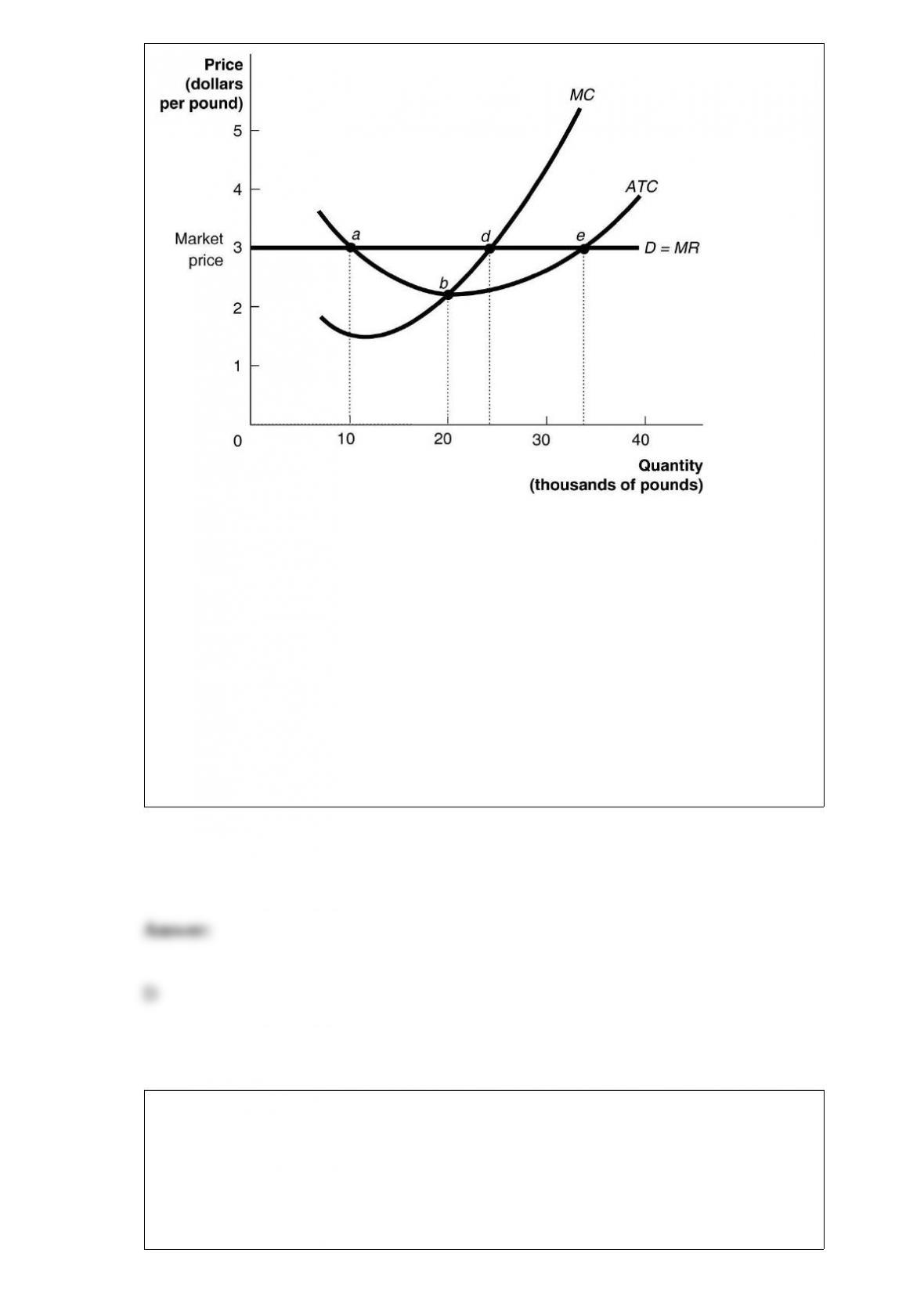
Figure 12-6 shows the demand, marginal cost (MC) and average total cost (ATC) curves
for Jason’s House of Apples.
Refer to Figure 12-6. To maximize his profit, Jason should produce the rate of output
indicated by point
A) a.
B) b.
C) e.
D) d.
For productive efficiency to hold
A) price must equal the marginal cost of the last unit produced.
B) price must equal marginal revenue of the last unit sold.

C) average variable cost is minimized in production.
D) average total cost is minimized in production.
In a given year, ________ of smartphone or tablet owners will pay for any apps.
A) less than 15 percent
B) only about one-third
C) about 75 percent
D) almost 90 percent
A member of a corporate board of directors that is also a manager of the business is
known as
A) a shareholder.
B) an inside director.
C) a partner.
D) a corporate governor.
A set of actions that a firm takes to achieve a goal is the definition of a
A) business plan.
B) business strategy.
C) business prospectus.
D) business goal.
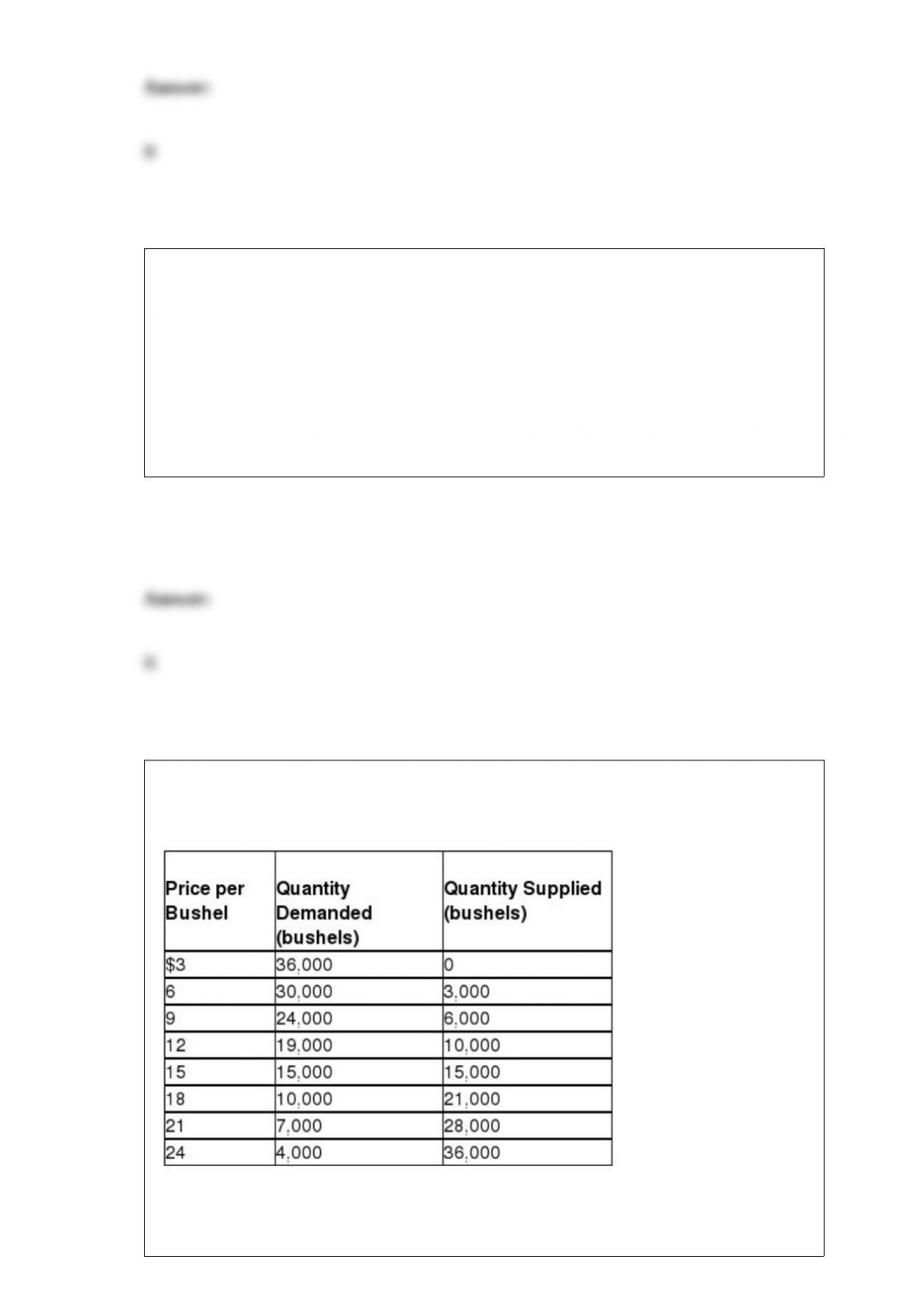
Table 3-3
Refer to Table 3-3. The table contains information about the corn market. Use the table
to answer the following questions.

a. What are the equilibrium price and quantity of corn?
b. Suppose the prevailing price is $9 per bushel. Is there a shortage or a surplus in the
market?
c. What is the quantity of the shortage or surplus?
d. How many bushels will be sold if the market price is $9 per bushel?
e. If the market price is $9 per bushel, what must happen to restore equilibrium in the
market?
f. At what price will suppliers be able to sell 24,000 bushels of corn?
g. Suppose the market price is $21 per bushel. Is there a shortage or a surplus in the
market?
h. What is the quantity of the shortage or surplus?
i. How many bushels will be sold if the market price is $21 per bushel?
j. If the market price is $21 per bushel, what must happen to restore equilibrium in the
market?
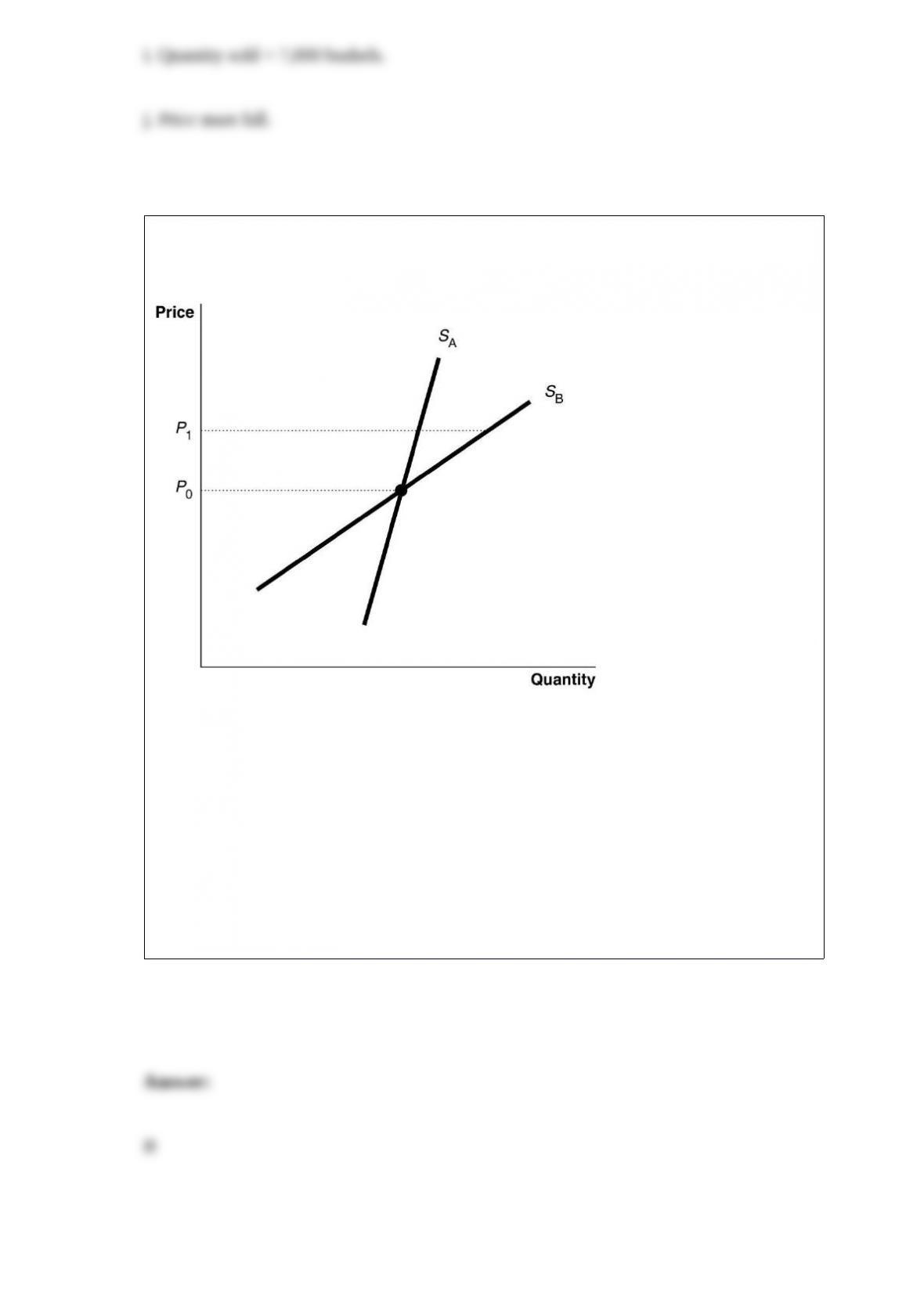
Figure 6-12
Refer to Figure 6-12. The diagram shows two supply curves, SA and SB. As price rises
from P0 to P1, which supply curve is more elastic?
A) SA
B) SB
C) They are equally inelastic.
D) They are equally elastic.

Donnie’s Donuts incurs $450,000 per year in explicit costs and $200,000 in implicit
costs. The bakery earns $800,000 in revenues and has $2 million in net worth. Based on
this information, what is the economic profit for Donnie’s Donuts?
A) $150,000
B) $350,000
C) $600,000
D) $1.2 million
What type of protection does U.S. law grant the creator of a book, film, or piece of
music?
A) A public franchise, which grants the exclusive right to use the creation during the
creator’s lifetime and to his or her heirs for 70 years after the creator’s death.
B) A copyright, which grants exclusive rights to the creator for 20 years after the work
is created.
C) A patent, which grants the exclusive right to use the creation during the creator’s
lifetime and to his or her heirs for 70 years after the creator’s death.
D) A copyright, which grants the exclusive right to use the creation during the creator’s
lifetime and to his or her heirs for 70 years after the creator’s death.
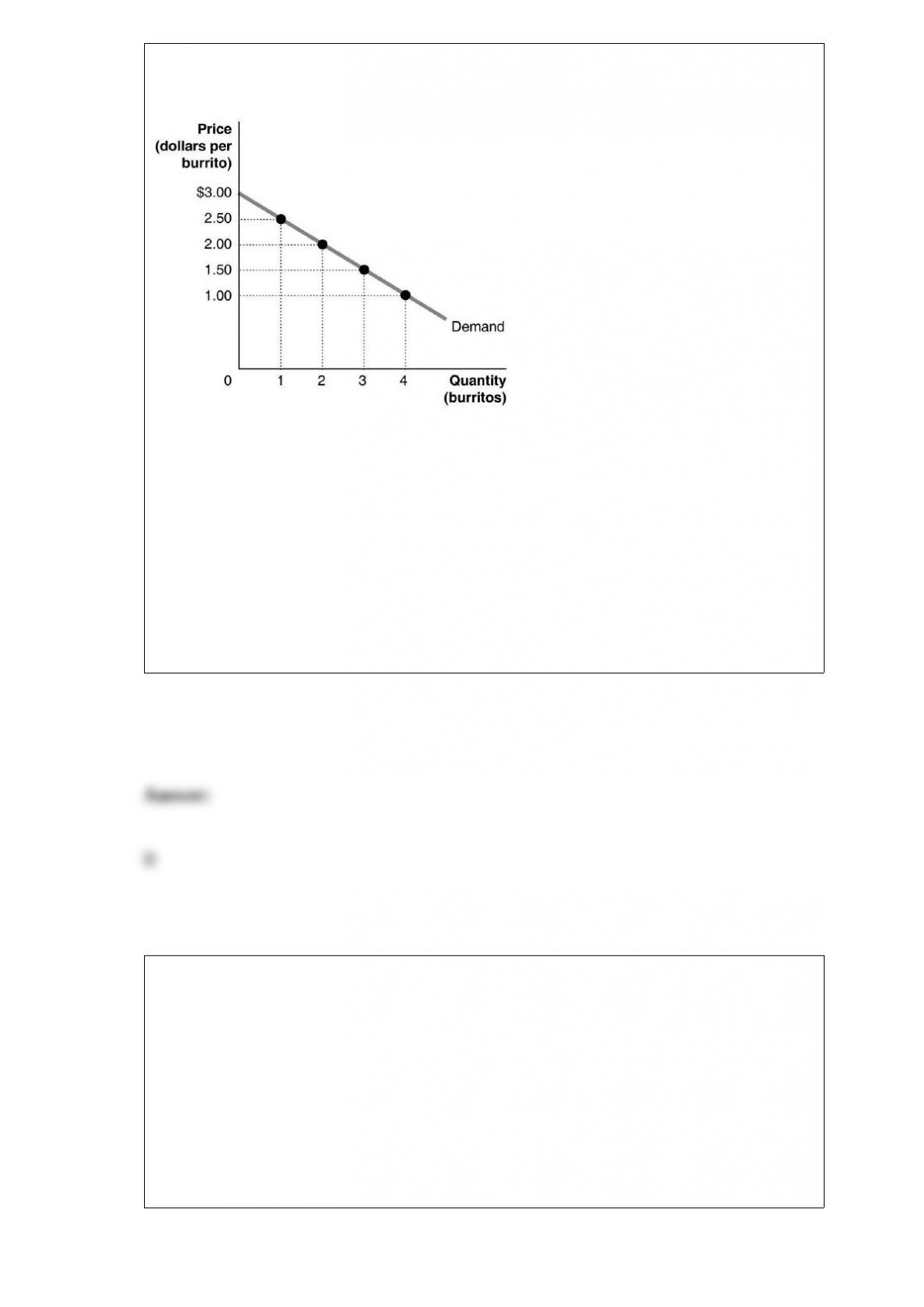
Figure 4-1
Figure 4-1 shows Arnold’s demand curve for burritos.
Refer to Figure 4-1. If the market price is $2.00, what is Arnold’s consumer surplus?
A) $0.50
B) $1.00
C) $1.50
D) $3.00
Suppose in the Germany, the opportunity cost of producing a gallon of beer is 5 gallons
of wine. In Italy, the opportunity cost of producing a gallon of beer is 3 gallons of wine.
a. What is the opportunity cost of producing a gallon of wine for Germany?
b. What is the opportunity cost of producing a gallon of wine for Italy?
c. Which country has a comparative advantage in the production of beer?
d. Which country has a comparative advantage in the production of wine?

If four workers can produce 18 chairs a day and five can produce 20 chairs a day, the
marginal product of the fifth worker is
A) 2 chairs.
B) 3 chairs.
C) 4 chairs.
D) 38 chairs.
When a firm experiences a positive technological change
A) the price of a share of the firm’s stock rises.
B) the firm is able to produce more output using the same inputs, or the same output
using fewer inputs.
C) the value of the firm’s assets rises.
D) the firm will hire additional workers in order to increase production.

Vineyards can grow either red wine grapes or white wine grapes on their land. Which of
the following would cause the supply of red wine grapes to decrease?
A) an increase in the price of white wine grapes
B) a decrease in the price of white wine grapes
C) an increase in the demand for red wine grapes
D) an increase in the price of red wine
The U.S. government has frequently used a “command-and-control” approach in
dealing with pollution. Which of the following describes this approach?
A) The government uses taxes in order to internalize the externalities caused by
pollution.
B) The government uses subsidies to encourage firms to use new technology that
reduces pollution.
C) The government imposes quantitative limits on the amount of pollution firms are
allowed to generate.
D) The government distributes information to consumers and producers on how to
reduce pollution.
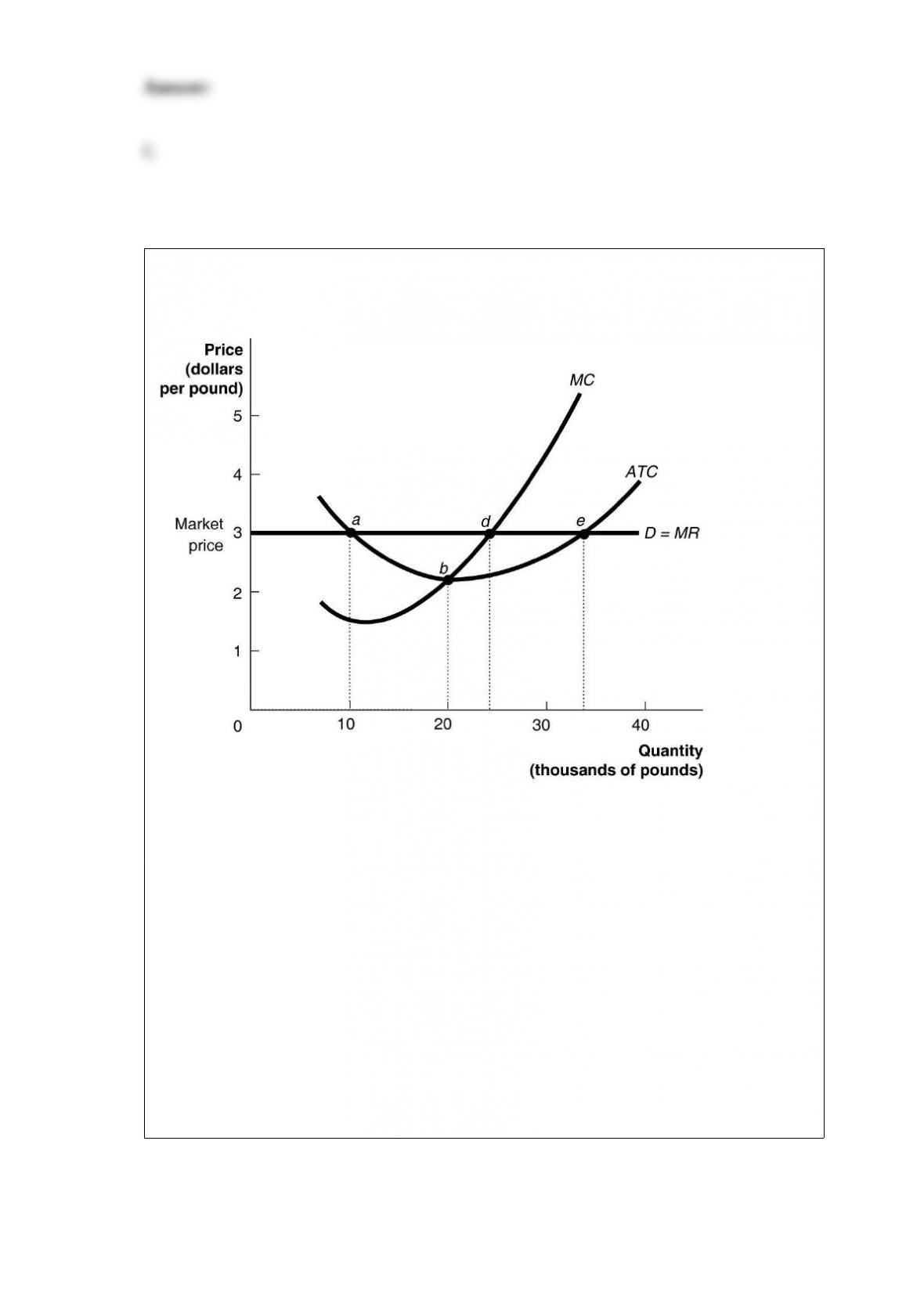
Figure 12-6
Figure 12-6 shows the demand, marginal cost (MC) and average total cost (ATC) curves
for Jason’s House of Apples.
Refer to Figure 12-6. Which of the following statements is true?
A) Jason should produce where MC equals $3 (point d) where he will minimize his
losses.
B) Jason should produce where the distance between MC and his demand curve is
greatest (point b).
C) Jason cannot earn a profit from selling any number of apples.
D) Jason should produce where MC equals $3 (point d) where he will maximize his
profit.

Rank these three items in terms of the elasticity of the demand for them at any given
price, from most elastic to least elastic: hot beverages, coffee and Peet’s Coffee.
A) hot beverages, coffee, Peet’s Coffee
B) Peet’s Coffee, coffee, hot beverages
C) coffee, Peet’s Coffee, hot beverages
D) coffee, hot beverages, Peet’s Coffee
The demand by all the consumers of a given good or service is the ________ for the
good or service.
A) market demand
B) quantity demanded
C) law of demand
D) scheduled demand
Private solutions to the problem of externalities are most likely when
A) government actively encourages these solutions.
B) transactions costs are low and the number of bargaining parties is small.
C) transactions costs are low and the number of bargaining parties is large.
D) transactions costs are low and the monetary damages to third parties are high.
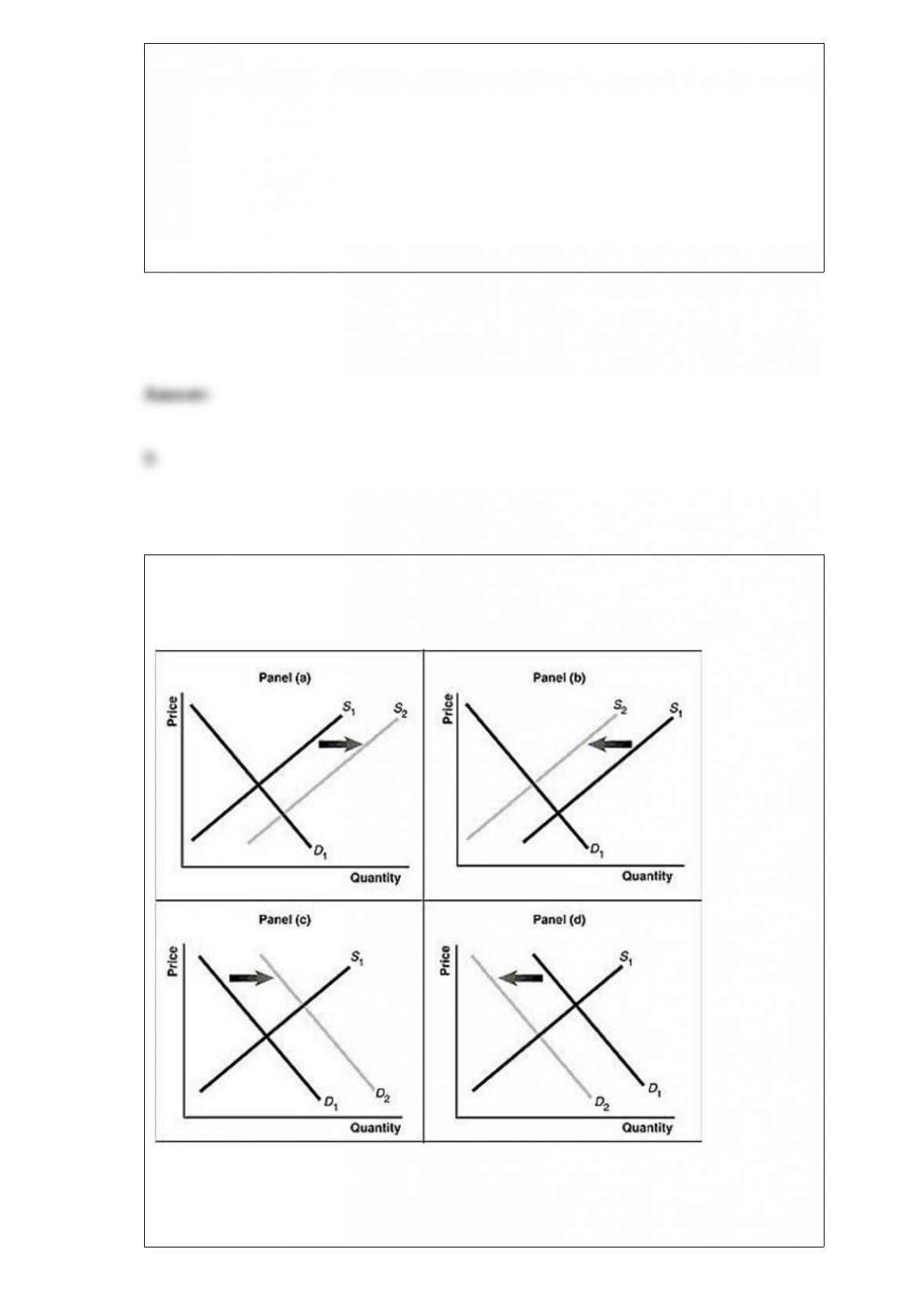
Figure 3-7
Refer to Figure 3-7. Assume that the graphs in this figure represent the demand and
supply curves for women’s clothing. Which panel best describes what happens in this
market when the wages of seamstresses rise?

A) Panel (a)
B) Panel (b)
C) Panel (c)
D) Panel (d)