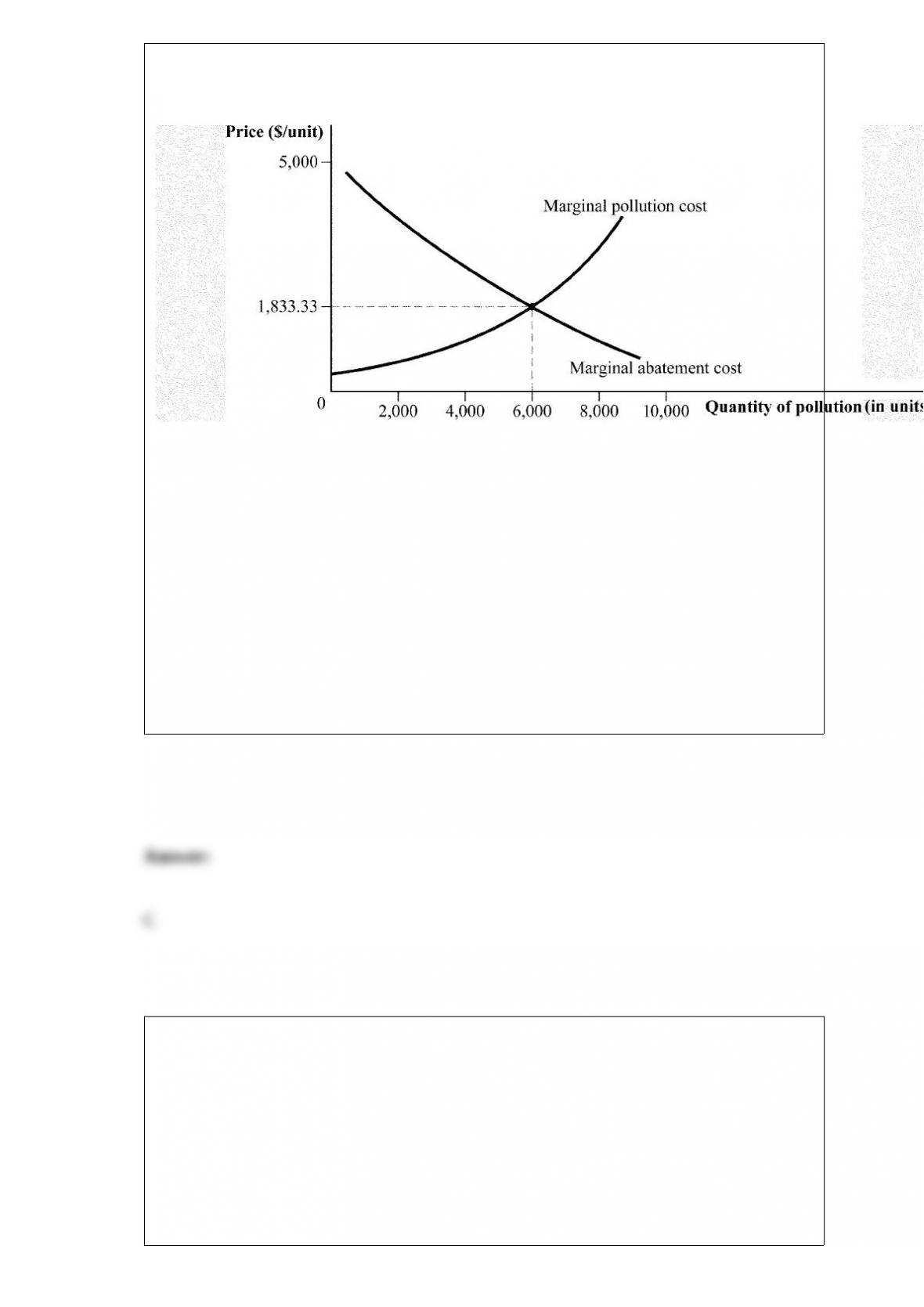
Figure 16.7
(Figure 16.7) Which of the following statements is TRUE?
A) The efficient quantity of pollution occurs at 6,000 units of pollution or less.
B) At 2,000 units of pollution, the marginal benefit of pollution is less than the marginal
cost of pollution, so there should be a lower quantity of pollution.
C) At 2,000 units of pollution, the marginal benefit of pollution exceeds the marginal
cost of pollution, so there should be a greater quantity of pollution.
D) At 2,000 units of pollution, the marginal benefit of pollution exceeds the marginal
cost of pollution, so there should be a lower quantity of pollution.
In the market for oranges, we observe that the equilibrium price increased and the
equilibrium quantity increased. What could have caused this change?
A) an increase in supply and a decrease in demand
B) an increase in demand
C) a decrease in supply
D) an increase in supply
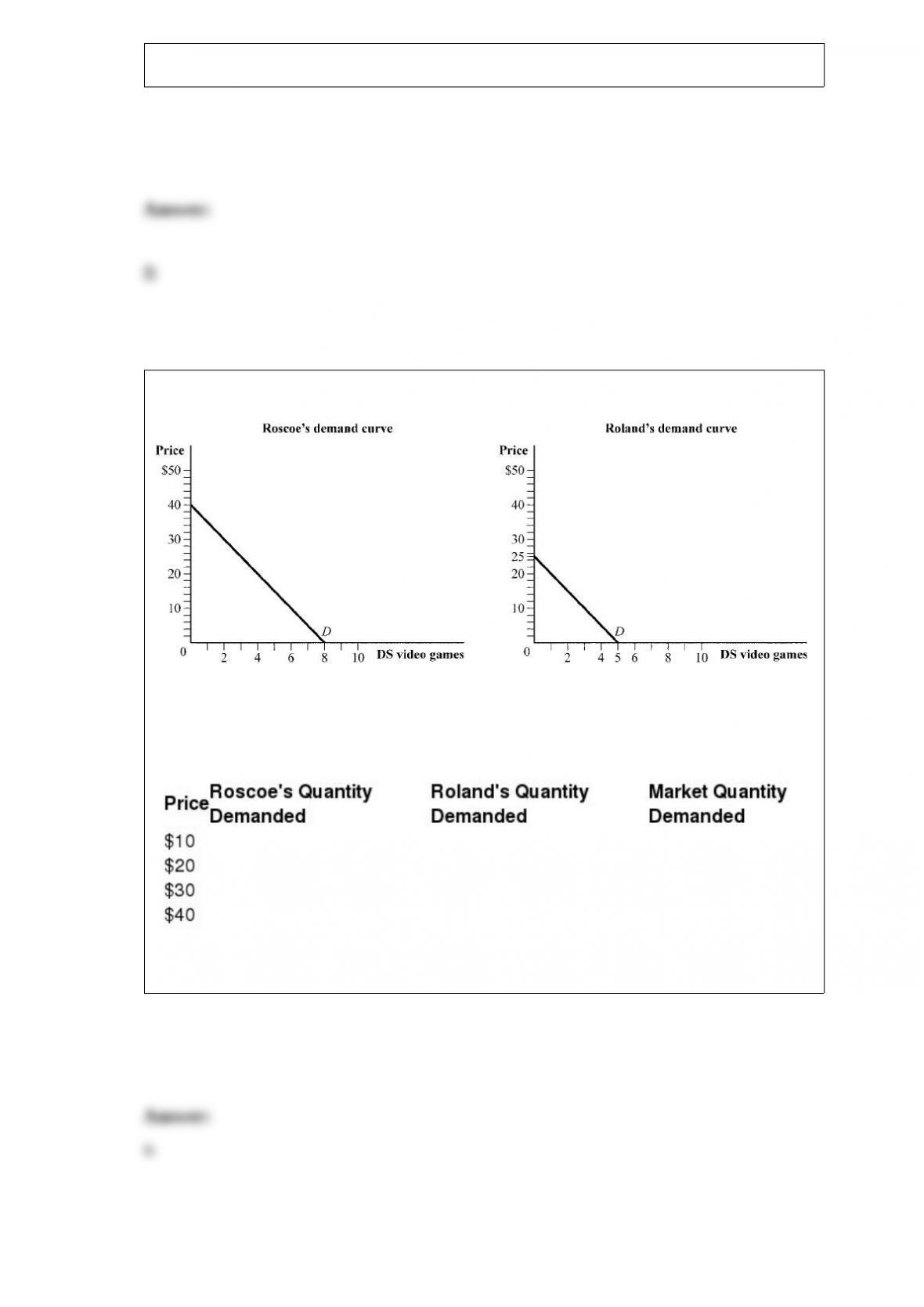
Figure 5.31
(Figure 5.31) Assume that Roscoe and Roland comprise the entire market of buyers.
a. Complete the following table.
b. What are Roscoe’s and Roland’s inverse demand equations?

A firm with market power has an inverse demand curve of P = 450 ” 5Q and marginal
cost of MC = 40Q, where Q is measured in thousands. What is the deadweight loss from
market power at the firm’s profit-maximizing output level?
A) $15,000
B) $280,000
C) $22,500
D) $9,400
At the equilibrium price of $10, the elasticity of demand and supply are “0.9 and 1.10.
If the government institutes a $1-per-unit tax, what price will sellers receive and
consumers pay after the tax?
A) Sellers will receive $9.55, and consumers will pay $10.55.
B) Sellers will receive $10.25, and consumers will pay $11.25.
C) Sellers will receive $9.80, and consumers will pay $10.80.
D) Sellers will receive $9.75, and consumers will pay $10.75.
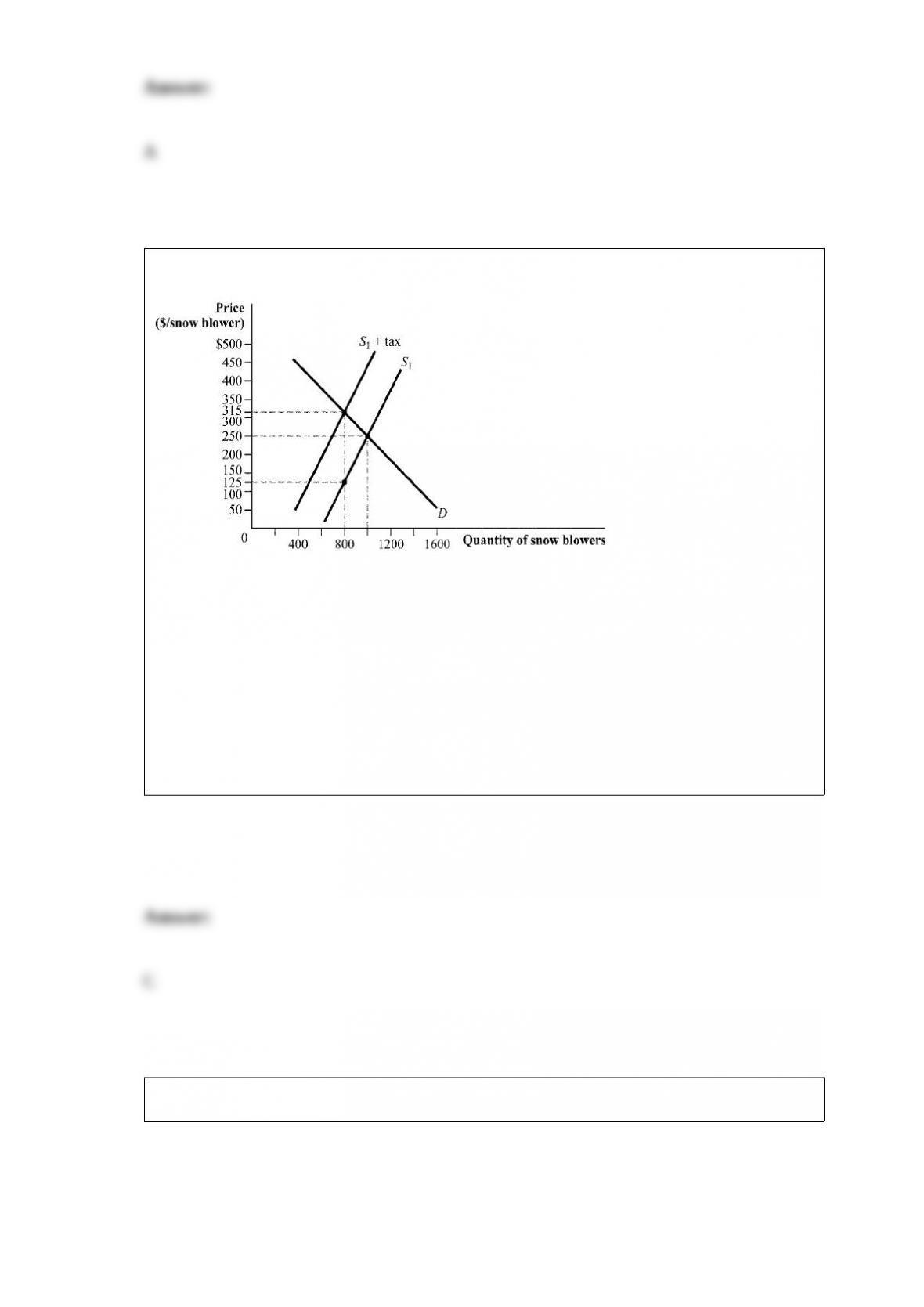
Figure 3.14
(Figure 3.14) The size of the tax is:
A) $125.
B) $65.
C) $190.
D) $200.
Figure 6.14
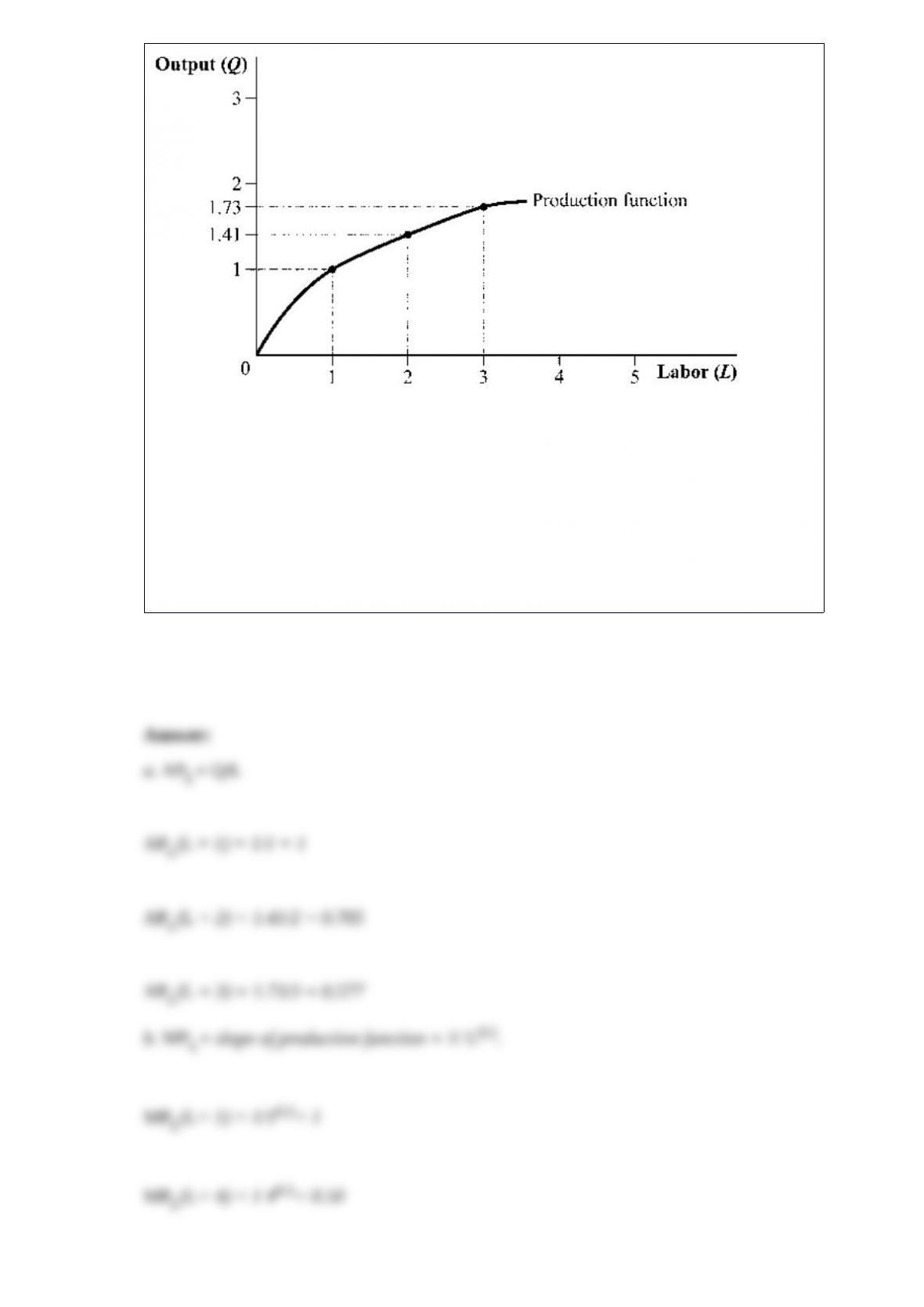
Figure 6.14
(Figure 6.14) Refer to the production function, which has a slope of 1/L0.5.
a.Calculate the average product of labor for L = 1, L = 2, and L = 3.
b.Calculate the marginal product of labor for L = 1, L = 4, and L = 16, assuming that
labor is infinitely divisible.
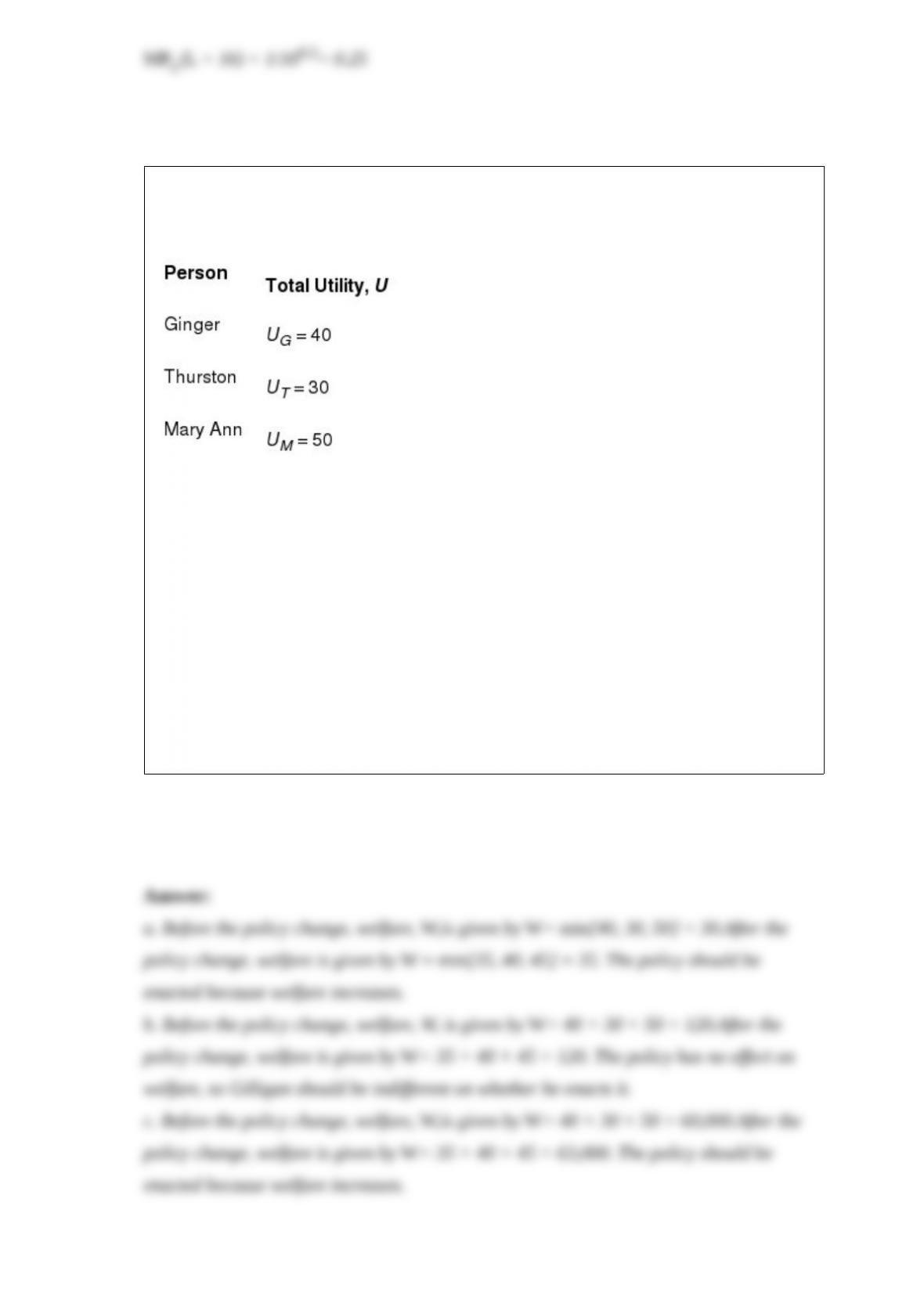
Table 14.3
(Table 14.3) The table shows the utility levels for three people living on a tiny island.
The island’s benevolent dictator, Gilligan, is considering a policy that will increase
Thurston’s utility by 10 and decrease Ginger’s and Mary Ann’s by 5.
a. If Gilligan uses a social welfare function given by W = min[UG, UT, UM], should he
enact the policy change?
b. If Gilligan uses a social welfare function given by W = UG+ UT+ UM, should he
enact the policy change?
c. If Gilligan uses a social welfare function given by W = UG×UT×UM, should he enact
the policy change?

In a perfectly competitive industry, the long-run equilibrium price is $12. What happens
to the long-run equilibrium price if a technological innovation lowers production costs?
A) The long-run equilibrium price will fall below $12.
B) The long-run equilibrium price will initially fall but then return to $12.
C) The long-run equilibrium price will initially rise but then return to $12.
D) The long-run equilibrium price will rise above $12.
The lesson from Dr. Strangelove is that:
A) your enemies must know about your doomsday machine if it is to serve as a credible
deterrent to attack.
B) to win at love you must sometimes make noncredible promises to your lover.
C) prisoner’s dilemma can be avoided by making side payments to your opponent.
D) forward induction is never superior to backward induction.
There are two firms, Aero and Pareto, that produce parachutes. Aero faces the demand
curve qA= 4,000 ” 2PA + PP, and Pareto faces the demand curve qB = 4,000 ” 2PP + PA.
Aero’s output, qA, is sold at a price of PA.Pareto’s output, qP, is sold at a price of Pp.
The firms’ parachutes are differentiated and, for simplicity, assume marginal costs are
zero.
a. Solve for Aero’s marginal revenue as a function of prices.
b. Solve for Aero’s reaction function.
c. Solve for Pareto’s marginal revenue as a function of prices.
d. Solve for Pareto’s reaction function.
e. What price does each firm charge for its parachute?
Answer the following questions.
a. Define monopolistic competition.
b. How is monopolistic competition similar to monopoly?
c. How is monopolistic competition similar to perfect competition?
Figure 5.10

(Figure 5.10) What is the size of the income effect associated with the decrease in the
price of milk?
A) The quantity of milk consumed increases from 2 to 6 gallons.
B) The quantity of milk consumed increases from 4 to 6 gallons.
C) The quantity of milk consumed decreases from 6 to 2 gallons.
D) The quantity of milk consumed increases from 2 to 4 gallons.
Suppose the wage rate is $25 per hour and the rental rate of capital is $50 per hour. The
equation for the isocost line is given by:
A) C = 75LK.
B) C = 25L + 50K.
C) C = 75(L + K).
D) C = 2K/L.
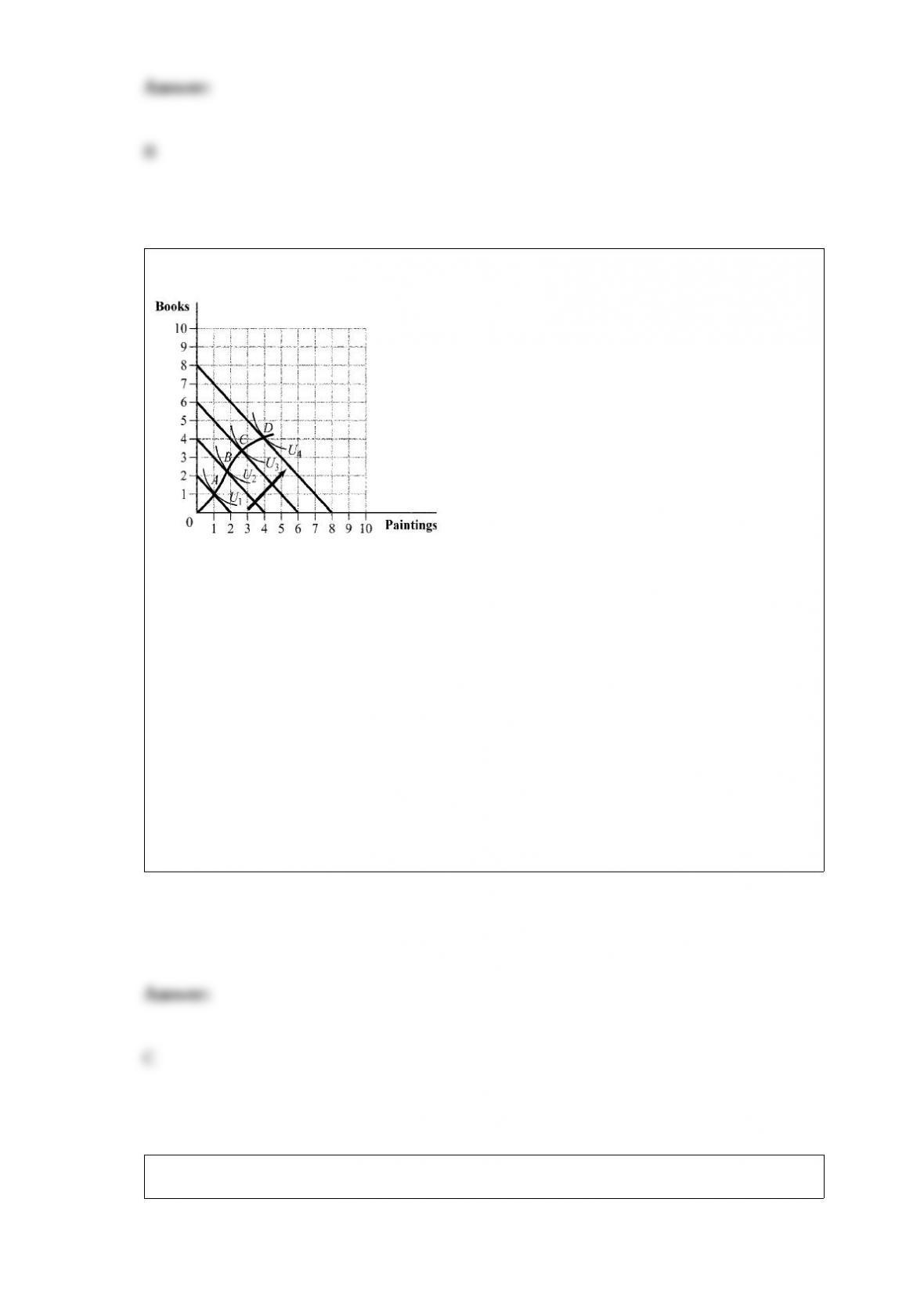
Figure 5.3
(Figure 5.3) Which of the following statements is TRUE?
A) Books are an inferior good at income levels that are greater than associated at bundle
B.
B) Books are an inferior good at income levels that are greater than associated at bundle
C.
C) Both books and paintings are normal goods up to the income level corresponding to
bundle D.
D) Paintings are an inferior good at income levels that are greater than associated with
these bundles.
Figure 5.19

(Figure 5.19) Given the change in the budget constraint, which of the following
statements is TRUE?
A) The demand curve for good X shifted inward.
B) The demand curve for good Y shifted outward.
C) The demand curve for goodX shifted outward.
D) The demand curve for both goods shifted outward.
Which of the following is an example of partial equilibrium analysis?
A) A tax on Internet sales reduces the quantity of online sales and caused the demand
for Internet access to decrease. The lower price for Internet access will spur increased
demand for online sales.
B) A deep freeze has destroyed much of the orange crop and caused the price of oranges
to increase and the quantity sold to fall.
C) Productivity enhancements in the manufacturing sector have increased the wages of
manufacturing workers, putting upward pressures on wages that must be paid to attract
workers to the service sector.

D) Scientific research indicates that there are health benefits to wearing cotton.
Knowledge of these benefits causes the demand for cotton to increase and the supply of
corn to decrease, as corn famers switch to planting more cotton.
Consider a two-firm oligopoly facing a market inverse demand curve of P = 100 ” 2(q1
+ q2), where q1 is the output of Firm 1and q2 is the output of Firm 2. Firm 1’s marginal
cost is constant at $12, while Firm 2’s marginal cost is constant at $20. In Cournot
equilibrium, how much output does each firm produce?
A) q1 = 20; q2 = 14
B) q1 = 16; q2 = 12
C) q1 = 18; q2 = 8
D) q1 = 14; q2 = 11
Figure 4.17
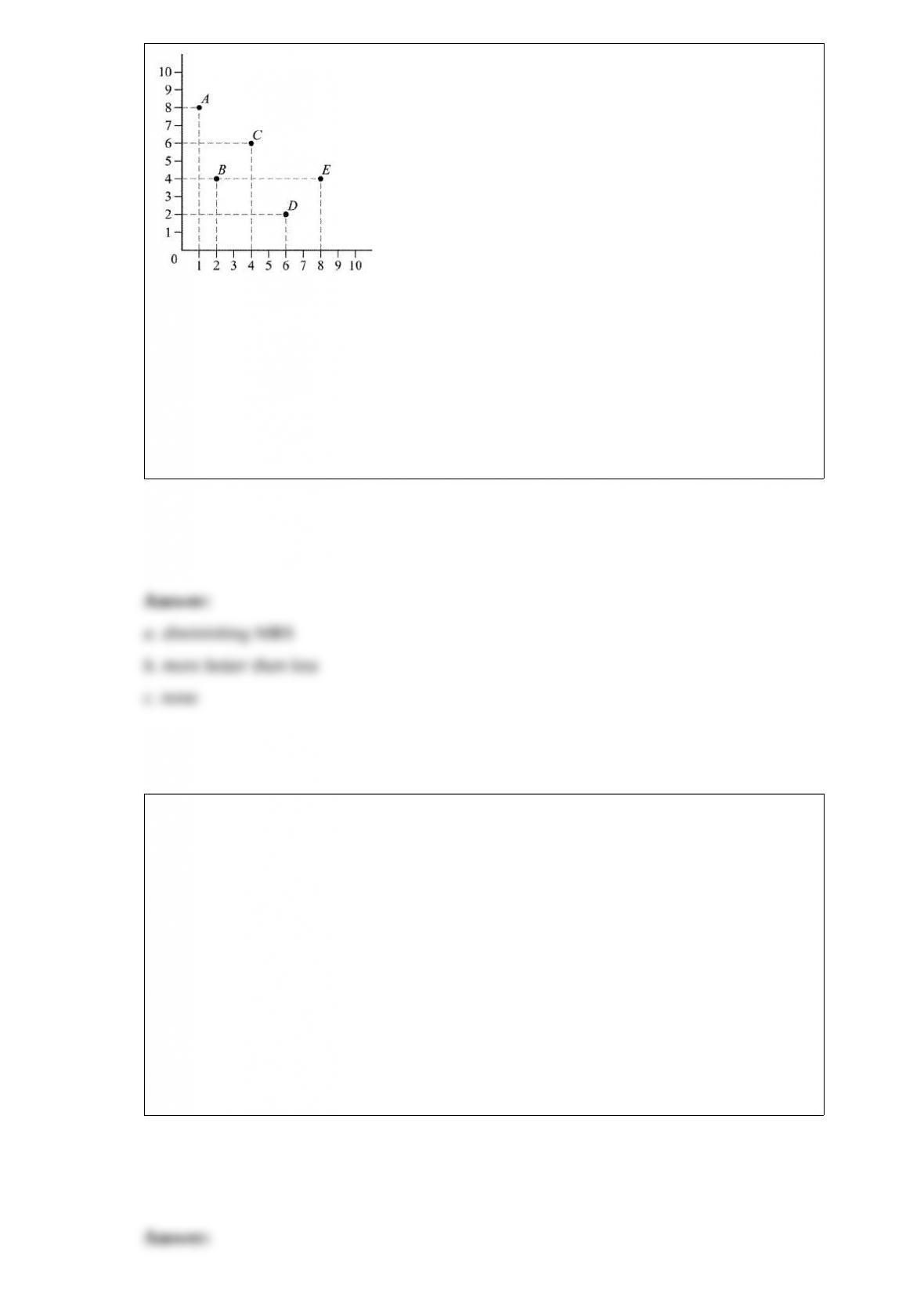
(Figure 4.17) What, if any, property of utility functions is violated if:
a. the indifference curve goes through points A, C, and D?
b. the indifference curve goes through points B and E?
c. the indifference curve goes through points A, B, and D?
In an economy, workers with a college degree are paid a lifetime income of $500,000,
and workers without a college degree are paid a lifetime income of $300,000. The cost
of obtaining a college degree for high-productivity workers is $100,000. For a college
degree to serve as a useful productivity signal, the cost of a college degree for
low-productivity workers must be:
A) greater than $200,000.
B) less than $200,000.
C) greater than $100,000.
D) less than $100,000.
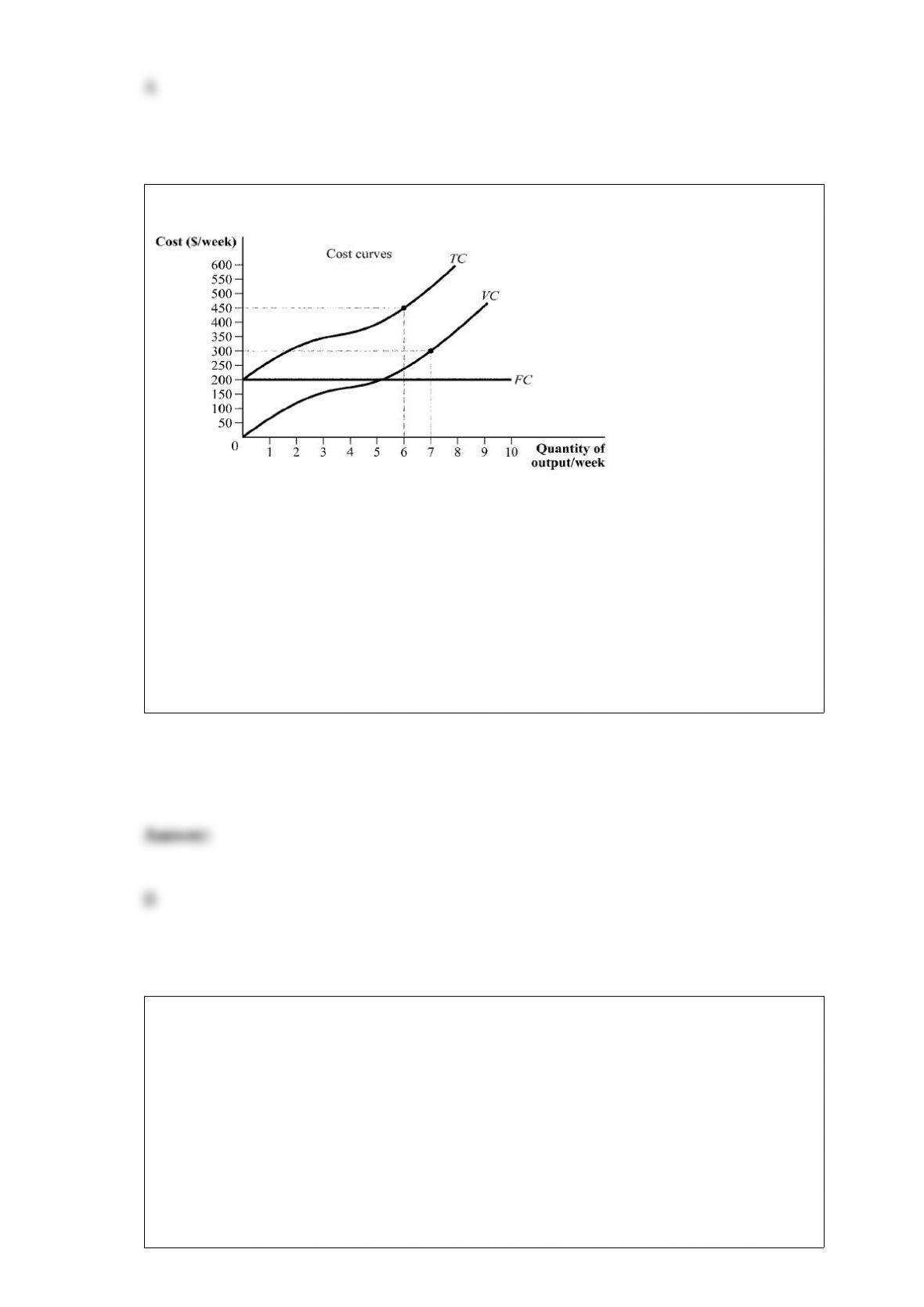
Figure 7.1
(Figure 7.1) At 6 units of output, FC is ______ and VC is ______.
A) $450; $250
B) $200; $250
C) $200; $150
D) $250; $200
Maggie prefers cheese to crayons, and she prefers crayons to coconuts. To satisfy the
assumption of ______, Maggie must also prefer ______.
A) rankability; cheese to coconuts
B) transitivity; cheese to coconuts
C) transitivity; coconuts to cheese
D) rankability; coconuts to cheese

American Girl doll has an inverse demand curve of P = 150 ” 0.25Q, where Q measures
the quantity of dolls per day and P is the price per doll. The marginal cost is given by
MC = 10 + 0.50Q. What is the total surplus at the profit-maximizing output level?
A) $144,000
B) $12,250
C) $18,120
D) $4,500
A firm is considering an investment project that today would cost $20,000. At the end
of one year, there is a 70% probability that the investment will pay out $28,000 and a
30% probability that it will pay out $16,000. Using a 10% interest rate, what is the
expected net present value of this investment?
A) “$670.85
B) $483.14
C) $2,181.82
D) $4,020.19
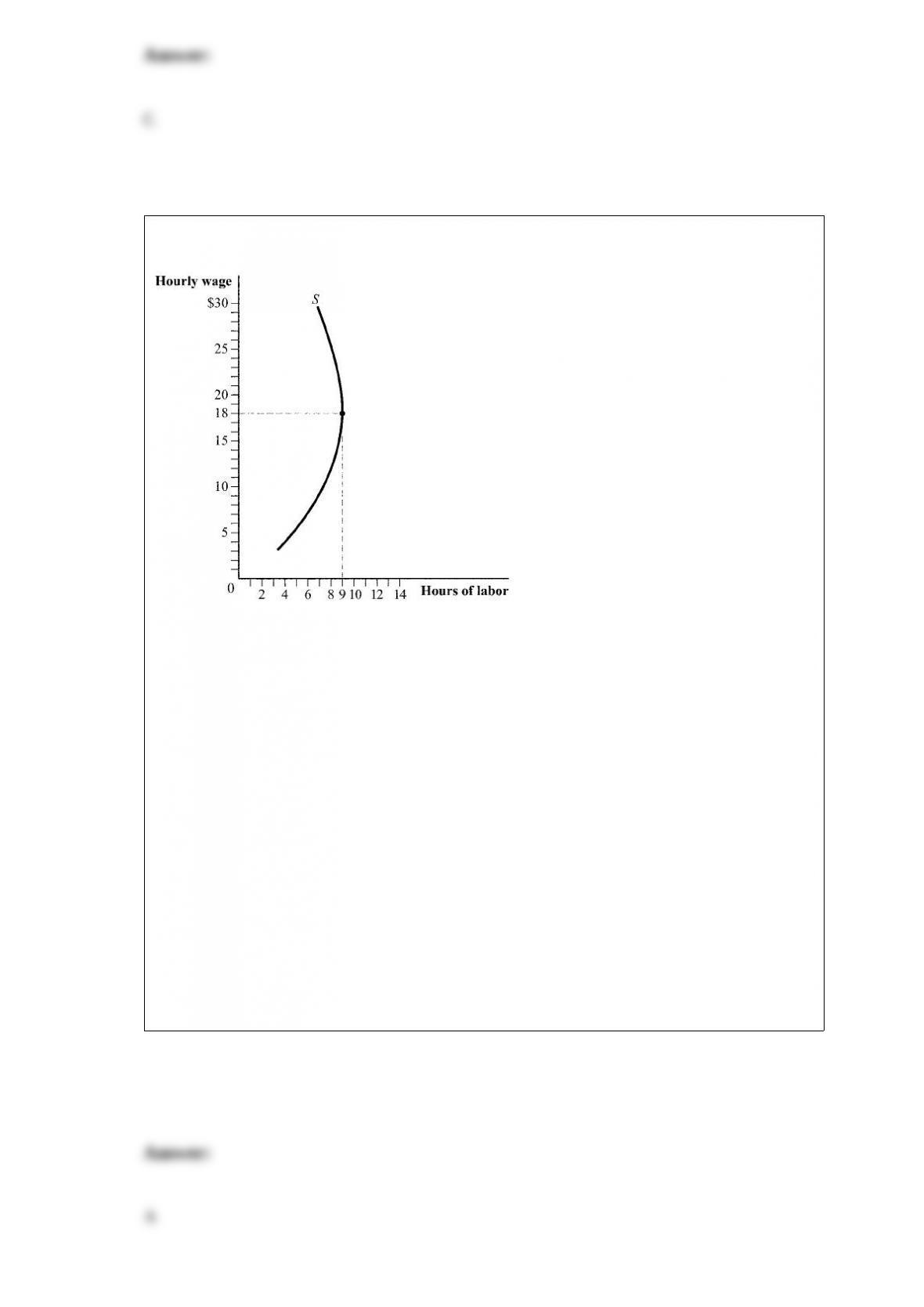
Figure 5.13
(Figure 5.13) Which of the following statements is TRUE?
I. At a wage above $18, the income effect dominates the substitution effect.
II. At a wage below $18, the substitution effect dominates the income effect.
III. At a wage above $18, the substitution effect dominates the income effect.
IV. At a wage below $18, the income effect dominates the substitution effect.
A) I and II
B) II and III
C) III and IV
D) I only
Determine whether each of the following statements is TRUE or FALSE.
a. The slope of the total cost curve is equal to marginal cost or the change in variable
cost divided by the change in output.
b. AFC = ATC ” AVC
c. The average total cost cannot equal marginal cost.
d. Total cost can increase from an increase in variable cost.
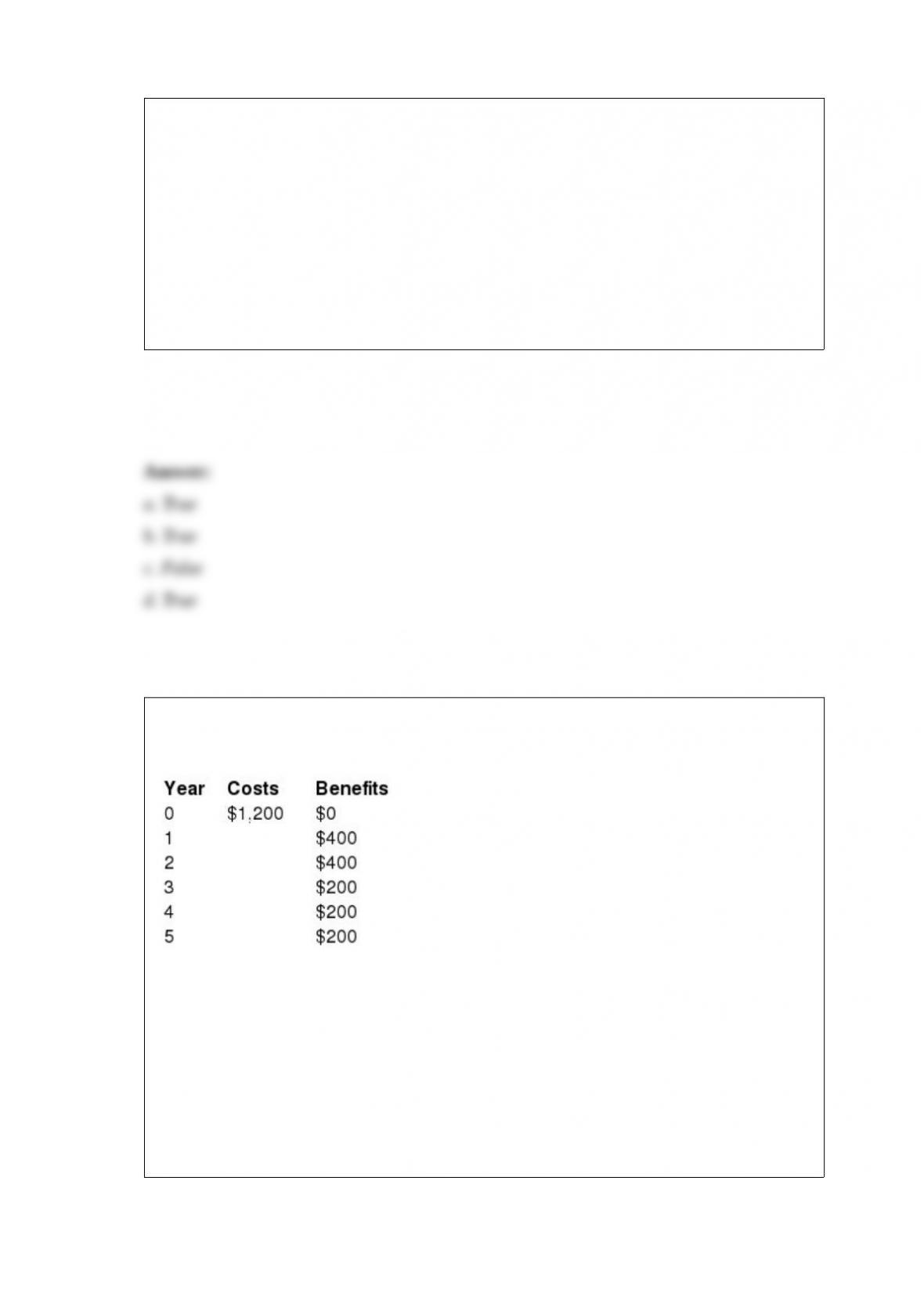
Table 12.5
(Table 12.5) What is the payback period of the investment?
A) five years
B) four years
C) three years
D) It depends on the interest rate.
In the ultimatum game, two strangers are given $50 and must decide how to split the
money between them. One player, called the proposer, makes the initial decision on
how to split the money. The second player, called the responder, either accepts or rejects
the proposer’s offer. If the responder accepts the offer, both players are paid, based on
the proposer’s offer. If the responder rejects the offer, neither player receives any
money.
a. Suppose the proposer and responder act in a rationally self-interested manner. What
split would the proposer offer? How would the responder react?
b. Suppose the proposer is altruistic. How might his behavior change?
Which of the following statements is TRUE?
I. Movies in a theater and movies at home could be substitute goods if the falling price
of home entertainment equipment causes people to watch more movies at home and
fewer in the theater.
II. Movies in a theater and movies at home could be complement goods if watching a
lot of movies at home causes people to become more interested in movies, increasing
their demand for movies in a theater.
III. If the cross-price elasticity of demand between movies in a theater and movies at
home is 0.33, the two goods are complements.
A) I only
B) II only
C) I, II, and III
D) I and II
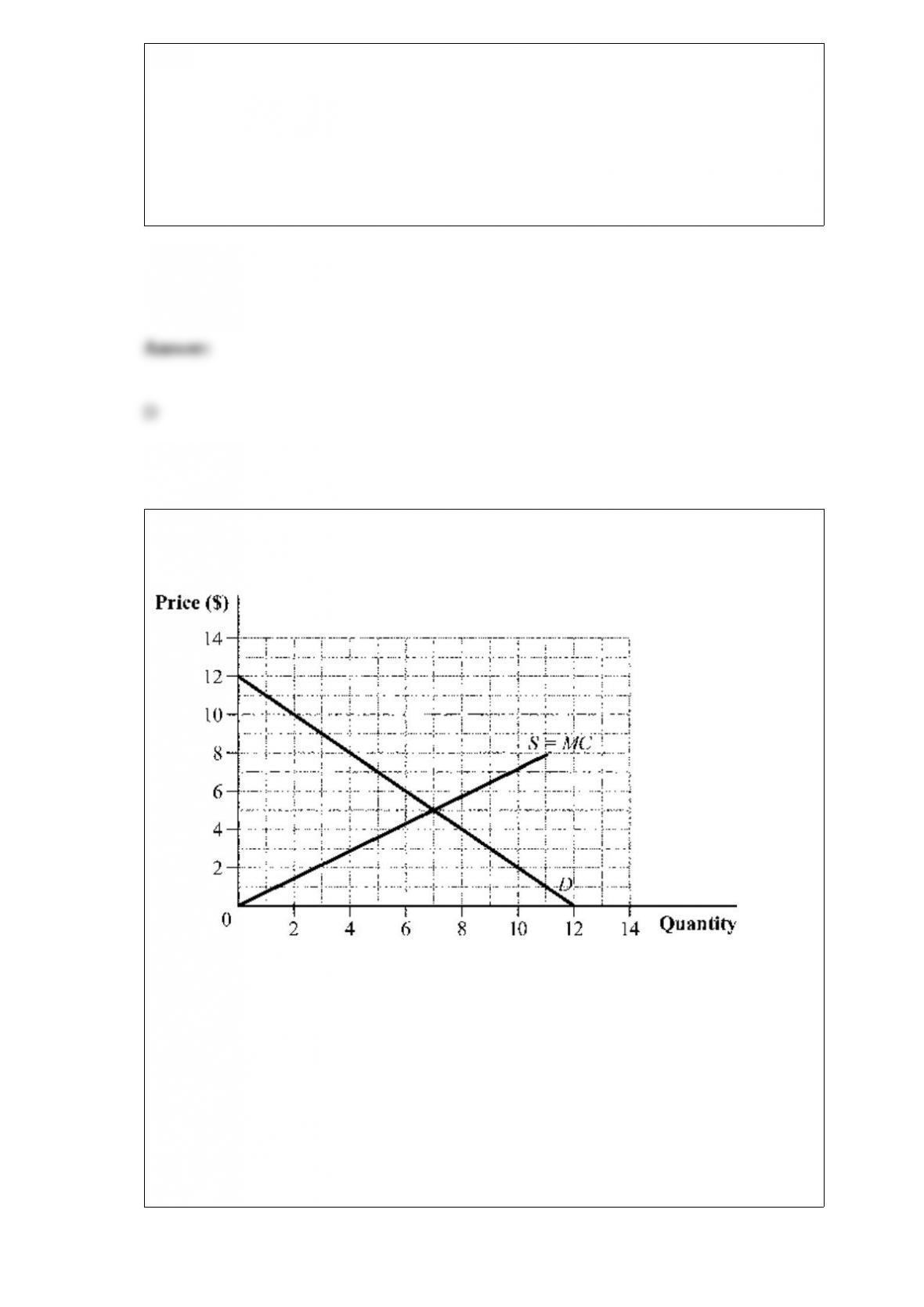
Figure 16.2
(Figure 16.2) Suppose the external marginal cost is constant at $5 per unit. What is the
level of output at which price (demand) equals social marginal cost?
A) 3
B) 7
C) 6
D) 4
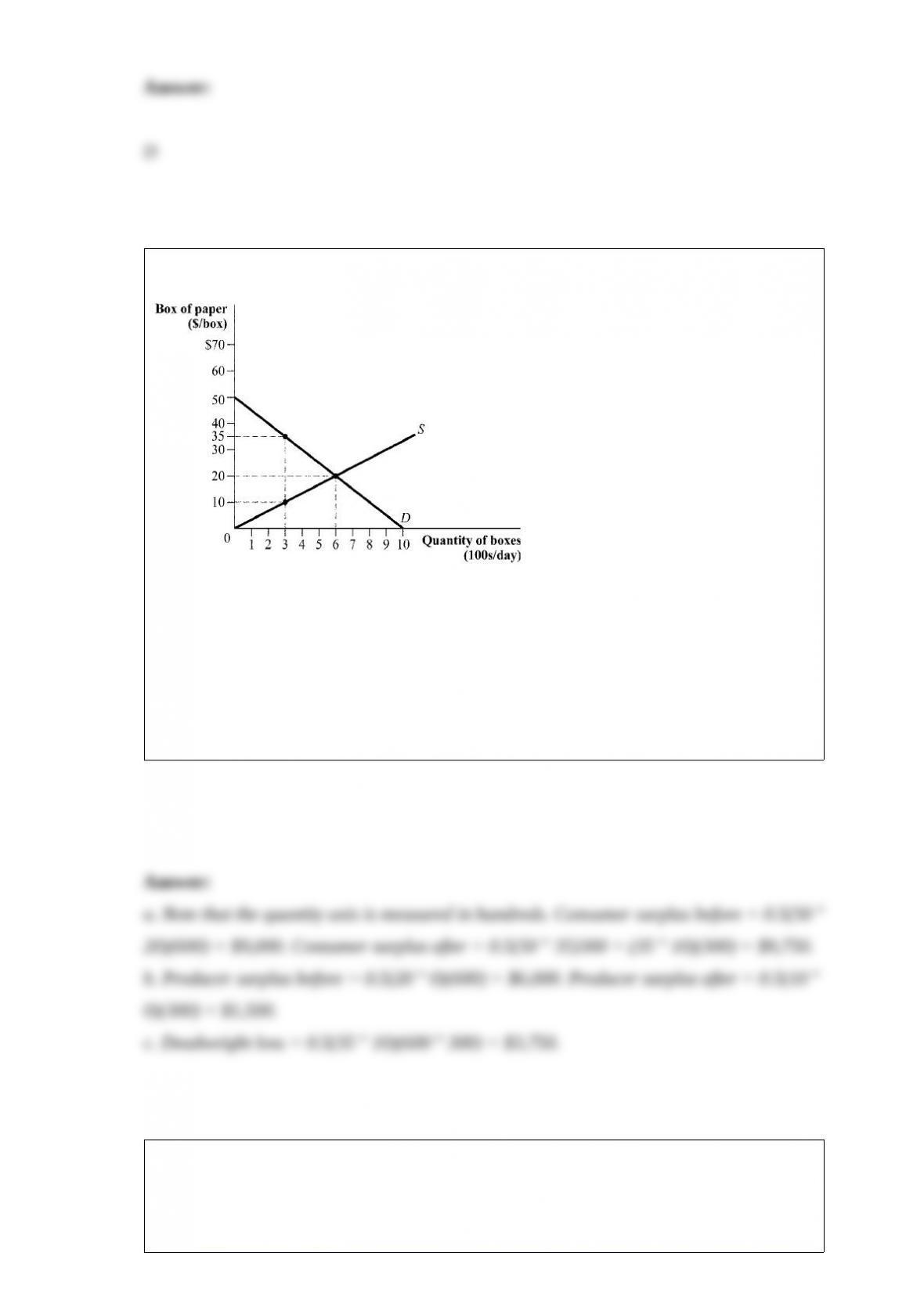
Figure 3.22
(Figure 3.22) Suppose the government sets a price ceiling of $10.
a. What is the value of consumer surplus before and after the price change?
b. What is the value of producer surplus before and after the price change?
c. What is the value of the deadweight loss?
Which of the following is a key assumption of the supply and demand model?
A) to focus on how the price and quantity sold are determined in a single market

B) to focus on how the prices and quantities sold are simultaneously determined in all
markets
C) to focus on how the whole economy achieves equilibrium
D) to focus on how international markets affect domestic markets, which in turn affect
local markets
Mushroom farms emit unpleasant odors that affect third parties. The marginal cost of
the odors is MC = 4Q, where Q is the quantity of fumes emitted. Mushroom farmers
can reduce odors by using various techniques and technologies, where the marginal
abatement cost is MAC = 1,200 ” 36Q.
a. Suppose the quantity of odor emitted is 33. Is there too much or too little odor
emitted?
b. Suppose the quantity of odor emitted is 15. Is there too much or too little odor
emitted?
c. What is the efficient quantity of odor emitted?
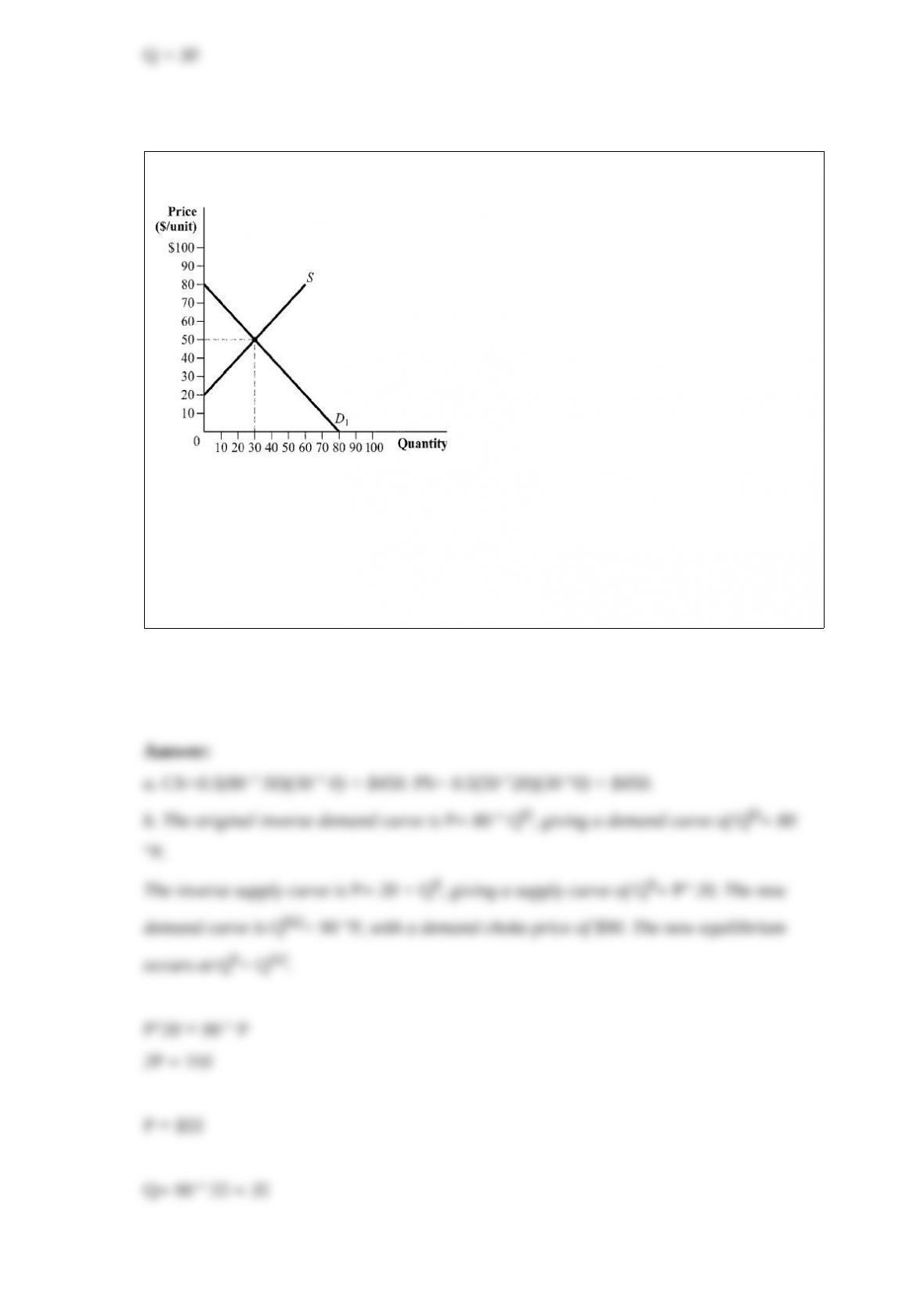
Figure 3.19
(Figure 3.19 ) Refer to Figure 3.19 to answer the following questions:
a. What is the level of consumer and producer surplus?
b. If consumers are willing to buy 10 more units of the good at any price, what happens
to consumer and producer surplus?

Sweet Steel and Molten Metal create sulfur dioxide emissions from their production
process. The total abatement cost (TAC) and marginal abatement cost (MAC) for each
company are given by:
Sweet Steel: TACS= 100,000+ 1eS
2 and MACS= 2eS
Molten Metal: TACM= 100,000 + 1.5eM
2 and MACM= 3eM
where eS and eM represent tons of sulfur dioxide emissions eliminated by each
company. Suppose the government wants to eliminate 1,000 tons of sulfur dioxide
emissions by issuing tradable pollution permits to each firm. What is the total cost
(TACS + TACM) of reducing emissions by 1,000 tons?
A) $800,000
B) $430,000
C) $280,000
D) $625,500
In a market in which sellers know whether their good is high quality or a lemon, why
might lower prices NOT lead to a greater quantity transacted between buyers and
sellers?

Figure 14.10
(Figure 14.10) At point G, the marginal cost of a pancake is $0.50 and the marginal cost
of a bowl of cereal is $0.50. At this point, consumers are willing to trade 2 bowls of
cereal for an additional pancake. Which of the following statements is TRUE?
A) The economy is not allocating its inputs efficiently.
B) The economy is not achieving output efficiency because the MRS is less than the
MRT.
C) The economy is achieving output efficiency because the MRT equals 1.
D) The economy is not achieving output efficiency because the MRS is greater than the
MRT.
Ernest wants to achieve a utility level of 100. His utility function is U = XY, where
MUX = Y and MUY = X. What is the least amount of money (M) that Ernest can spend to
achieve a utility level of 100? Ernest’s budget constraint is M = 8X + 2Y.

Suppose that U = XY0.5. Which of the following bundles lie on the same indifference
curve?
bundle A: (X = 10, Y = 9)
bundleB: (X = 9, Y = 16)
bundle C: (X = 12, Y = 9)
bundle D: (X = 3, Y =100)
bundle E: (X = 6, Y = 25)
bundle F: (X = 6, Y = 36)
Explain why marginal revenue does NOT equal price for a firm with market power. For
a perfectlycompetitive firm, explain why P = P +
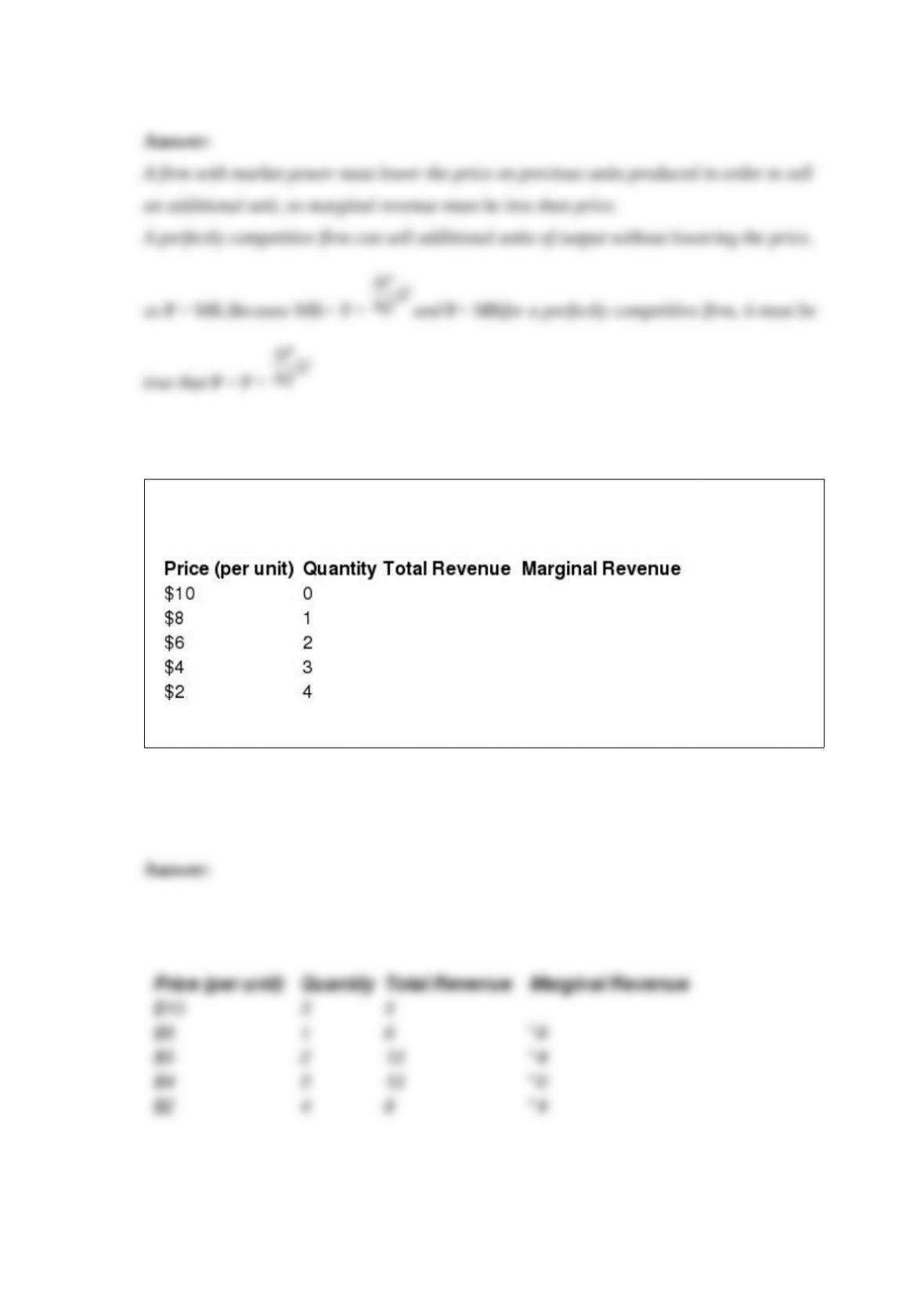
Table 2
(Table 2) Complete the table.
In 1992, New Jersey raised its minimum wage but Pennsylvania, a neighboring state,
did not. What type of experiment did this law change create?
Justin buys water (W) at $2 per gallon and food (F) at $10 per unit. Justin has income of
$50. Suppose that the government imposes a tax on water of $1 for each gallon
consumed beyond 10 gallons. Graph Justin’s budget constraint with water on the y-axis
and food on the x-axis.
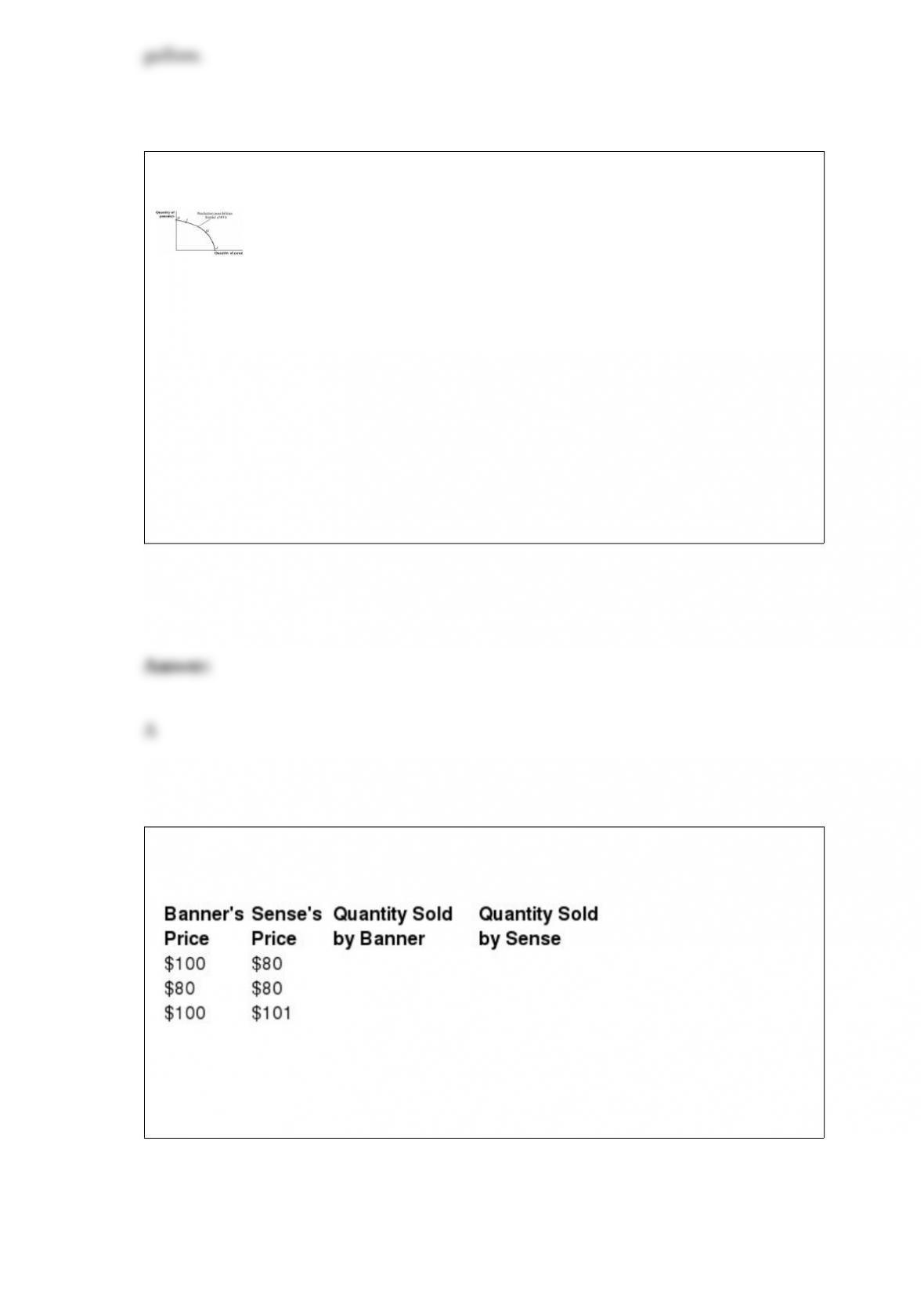
Figure 14.10
(Figure 14.10) Suppose that the economy is operating at point G, and in the cereal
industry, the marginal product of labor and capital are 10 and 4, respectively. What is
the marginal rate of technical substitution of labor for capital in the pancake industry?
A) 2.5
B) 14
C) 6
D) 40
Table 11.3
(Table 11.3) Banner and Sense are two Bertrand competitors producing identical
gascolators. The inverse market demand curve for gascolators is P = 2,000 ” 4Q, where
Q is the quantity of gascolators and P is the price per gascolator. Banner and Sense
produce gascolators at a constant marginal cost of $80. Complete the table:
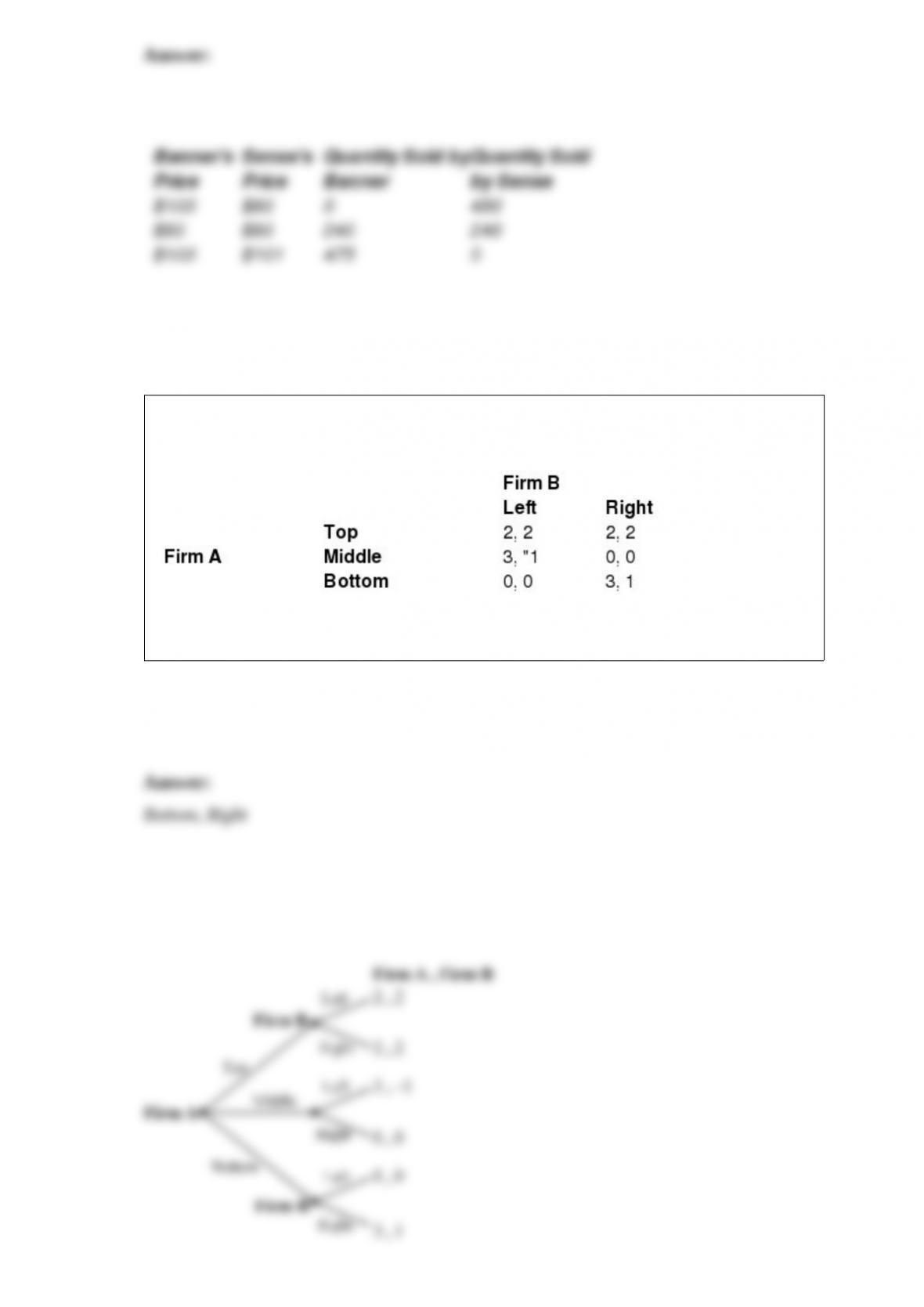
Table 12.34
(Table 12.34) Represent the normal form game as a sequential game, with Firm A
making the first decision. What is the outcome of this game?
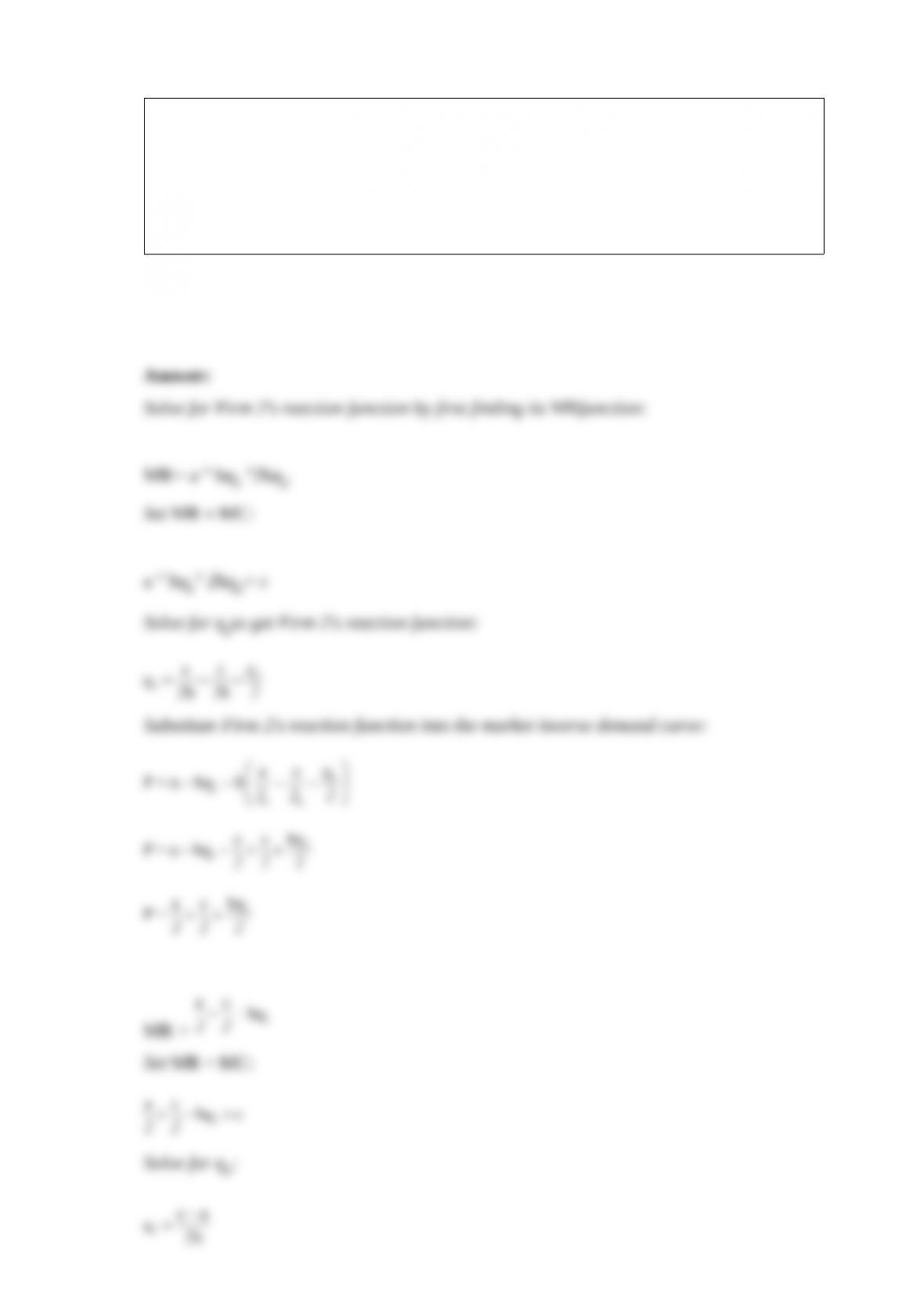
In Stackelberg competition, the market inverse demand curve is P = a ” bq1 ” bq2,
where q1 + q2 is the market output, Q, produced by Firm 1 and Firm 2. Marginal cost is
given by MC = c. If Firm 1 chooses its output level before Firm 2, how much output
will Firm 1 produce? (Hint: Your answer should have q1 as a function of the parameters
a, b, andc.)
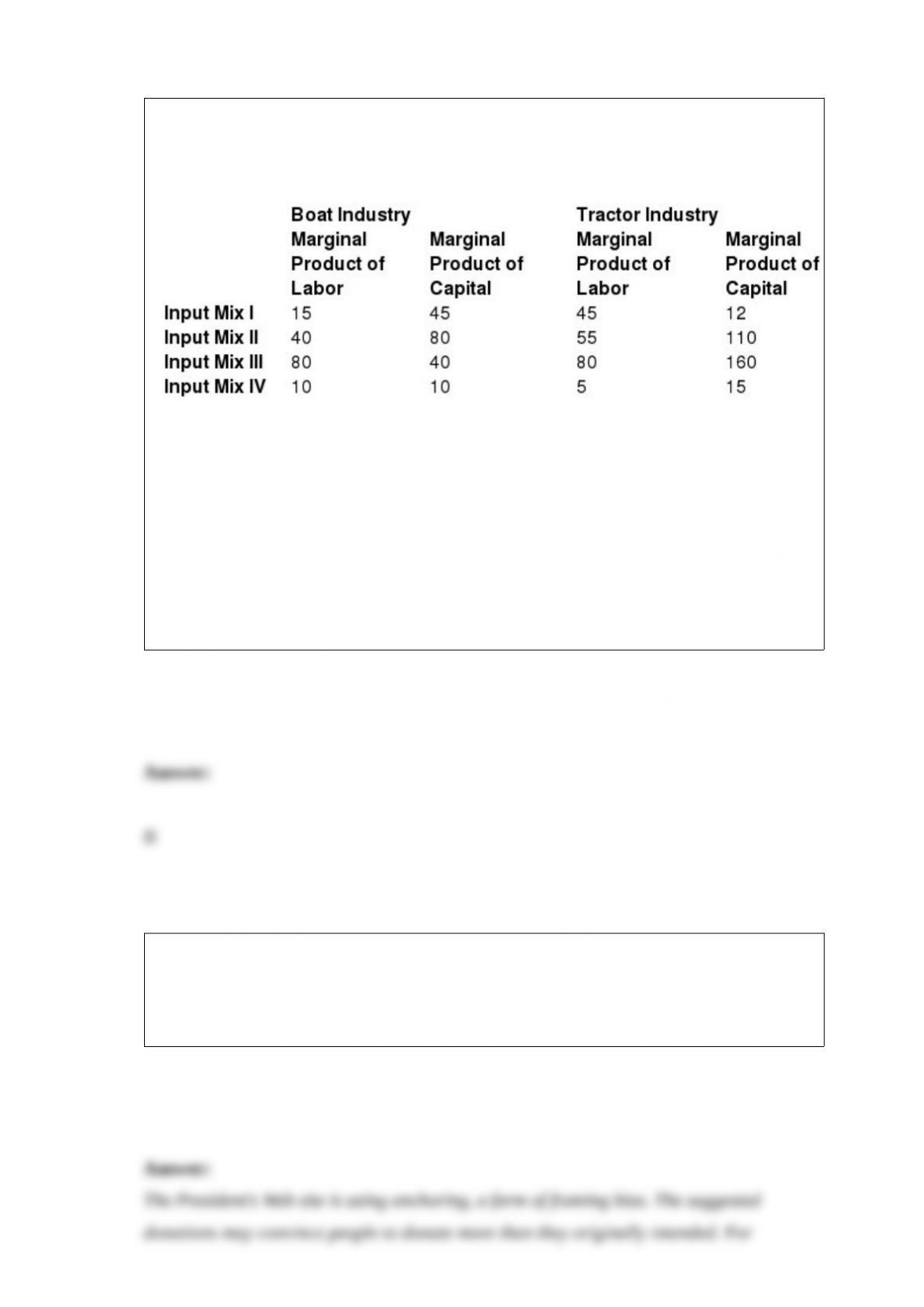
Table 14.2
(Table 14.2) Which of the following input mixes provides an efficient allocation of
labor and capital between the two industries?
A) input mix I
B) input mix II
C) input mix III
D) input mix IV
On President Obama’s reelection Web site, there was a place to donate money. A person
could choose to donate $35, $50, $100, $250, $500, $1,000, $5,000, or fill in a value for
some other amount. What behavioral bias was the President’s Web site trying to take
advantage of by providing information on suggested donations?
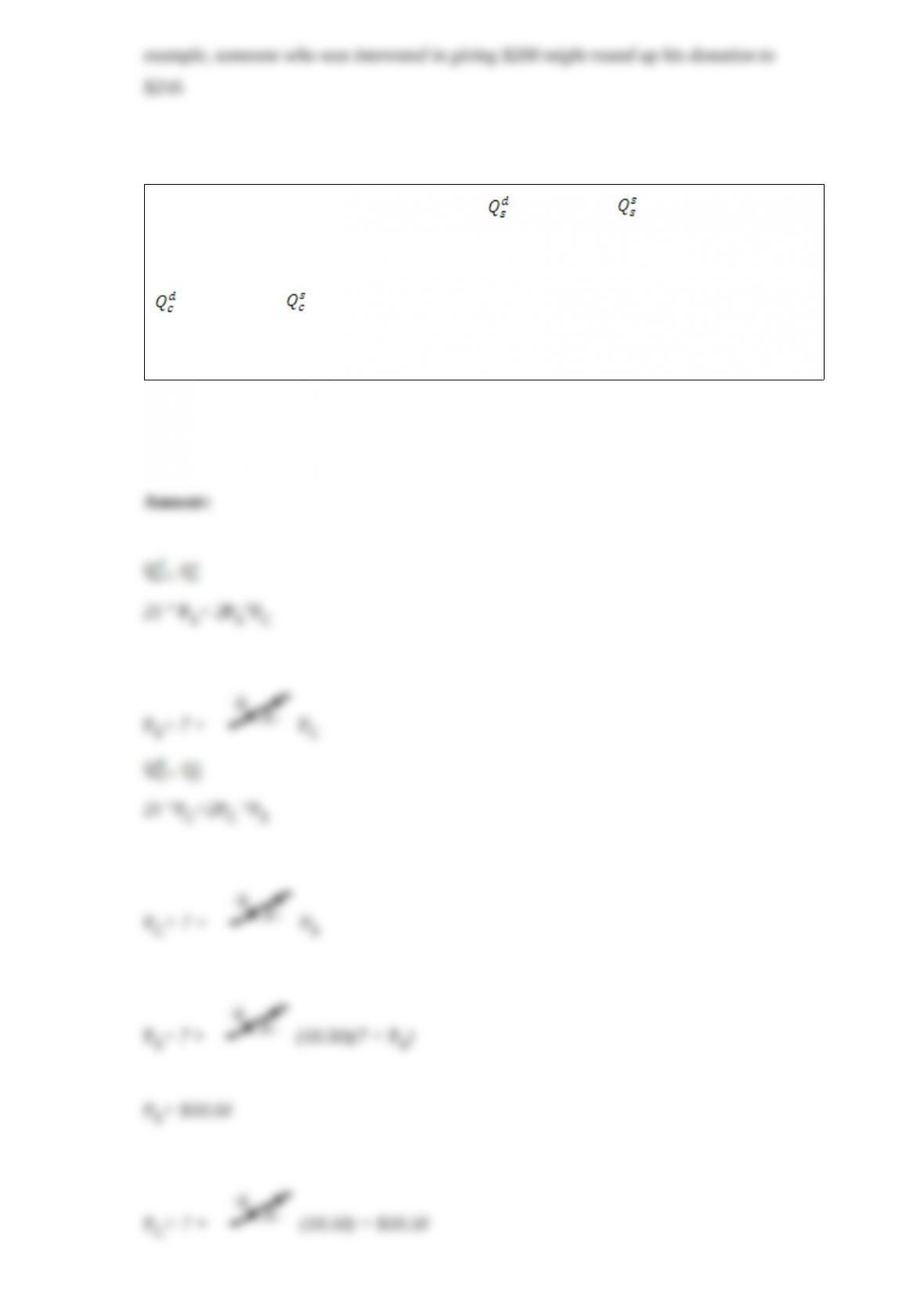
The market for soybeans is characterized by = 21 ” PS and = 2PS ” PC, where QS
is the quantity of soybeans in millions of bushels, PS is the price per bushel of
soybeans, and PCis the price per bushel of corn. The market for corn is characterized by
= 21 ” PC and = 2PC” PS, where QC is the quantity of corn in millions of bushels.
In general equilibrium, what is the equilibrium price and quantity of corn and
soybeans?
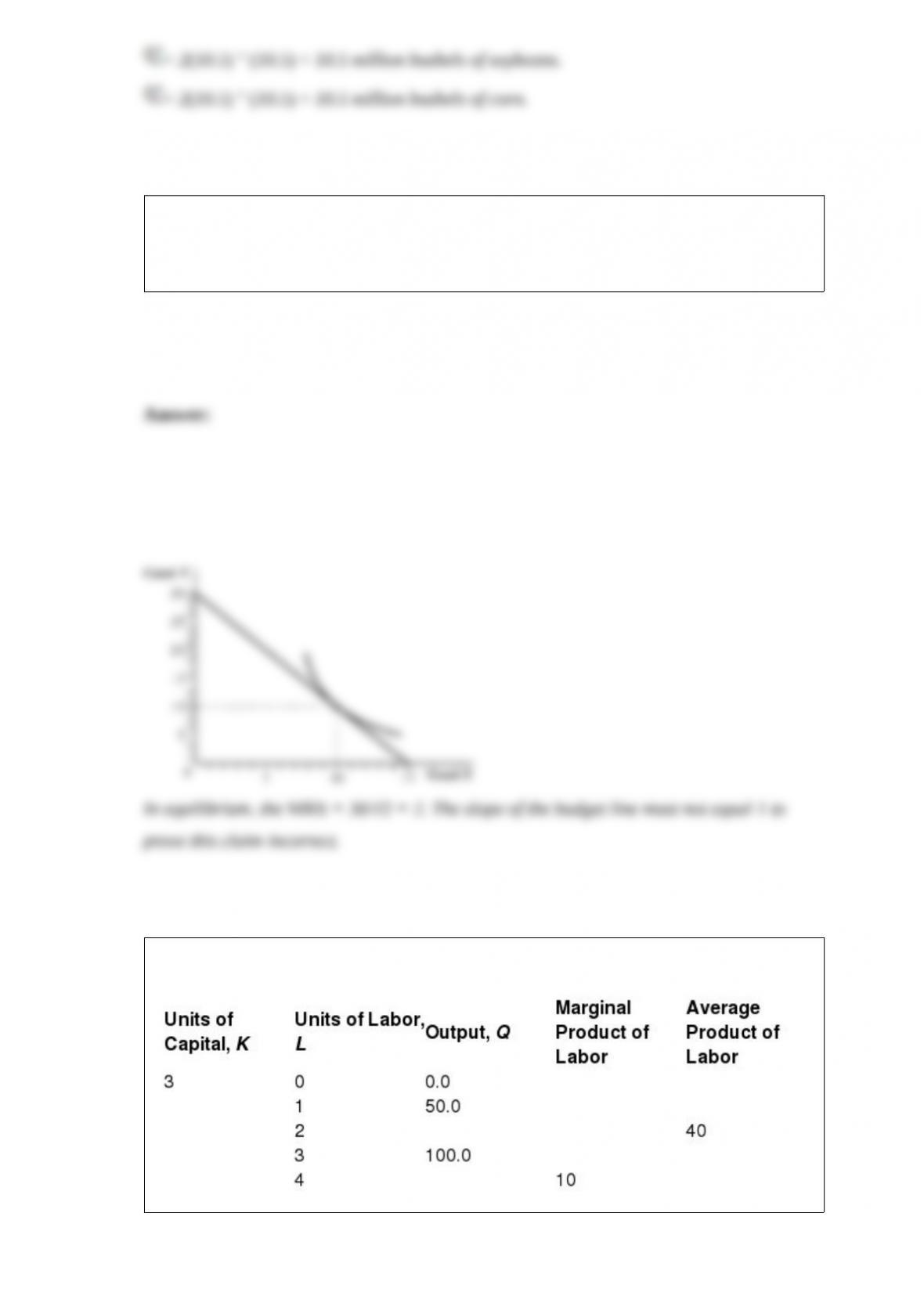
Marsha claims that, if a consumer is maximizing utility and happens to be purchasing
equal quantities of good X and good Y, the MRSXY must equal 1. Prove this claim
incorrect by drawing an appropriate budget constraint and indifference curve.
Table 6.5
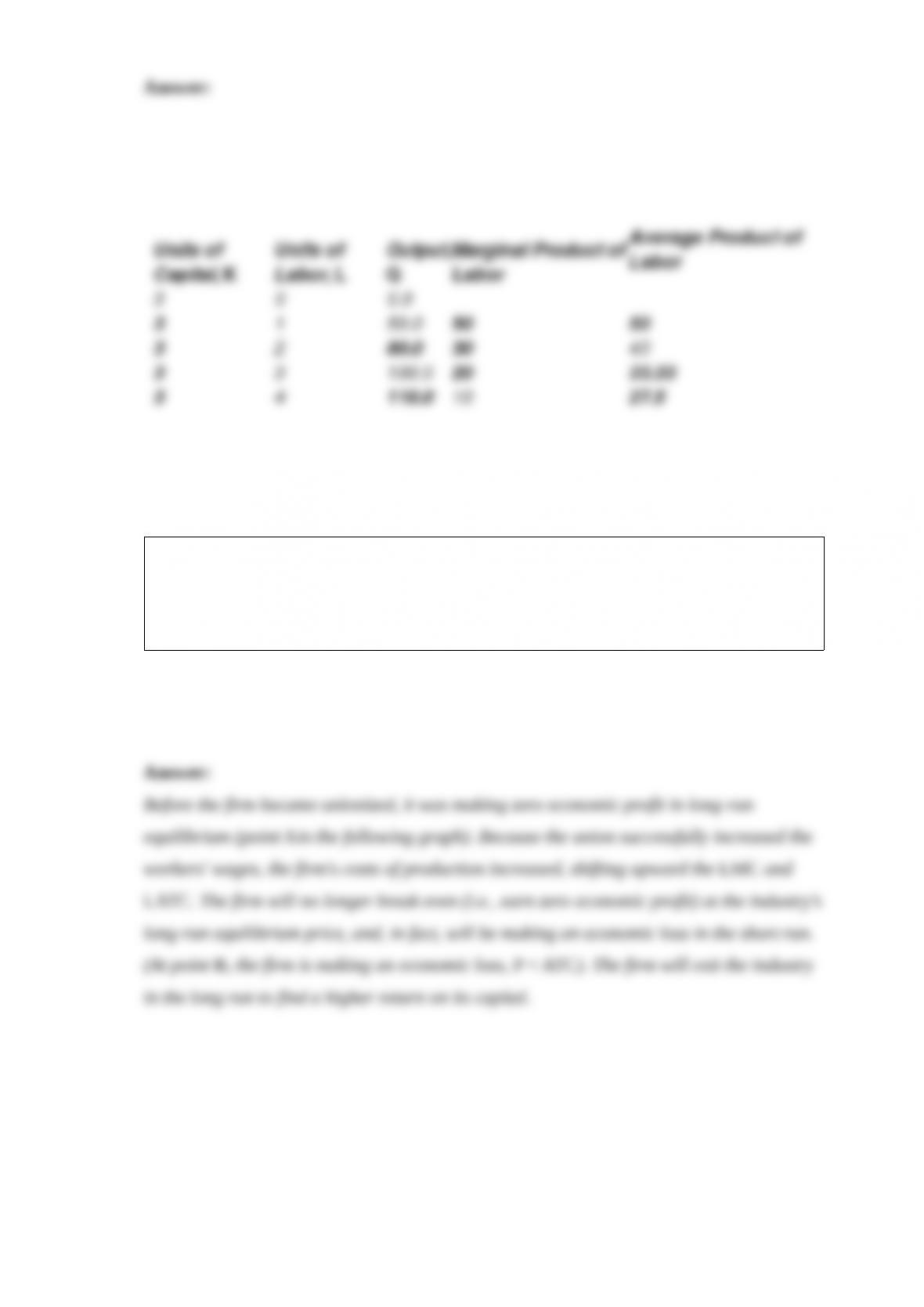
A perfectly competitive industry, which is in long-run equilibrium, is comprised of 200
identical firms. In one of the firms, the workers unionize and receive a 20% wage
increase. What happens to the unionized firm in the short run and the long run?
Supplement your answer with a graph.