A consumer spends his income on food and rent. The government places a $1 tax on
food. To restore the pre-tax consumption level of food the rebate paid to consumers will
be smallest when
A) the own price elasticity of demand for food is 2, and the income elasticity of demand
for food is 5.
B) the own price elasticity of demand for food is 5, and the income elasticity of demand
for food is 5.
C) the own price elasticity of demand for food is 2, and the income elasticity of demand
for food is 10.
D) the own price elasticity of demand for food is 5, and the income elasticity of demand
for food is 10.
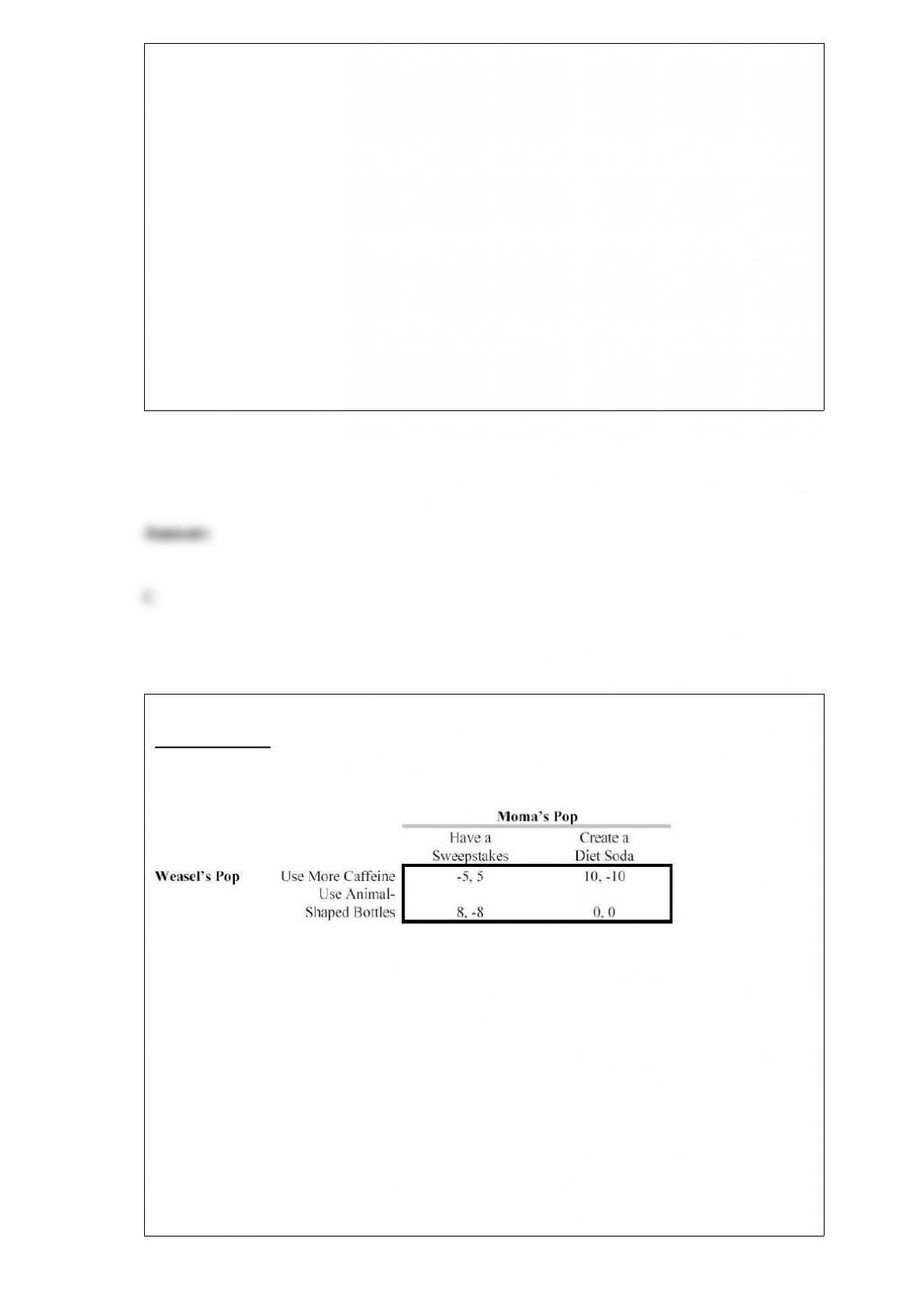
Scenario 13.10
Consider the game below:
Which of the below outcomes is the result of a Nash equilibrium in pure strategies for
the game in Scenario 13.10?
A) -5, 5
B) 10, -10
C) 8, -8
D) 0, 0
E) There is no pure strategy equilibrium in this game.

In 1992, the Occupational Safety and Health Authority passed the Bloodborne
Pathogens Standard (BBP), which regulates dental office procedures. This regulation is
designed to minimize the transmission of infectious disease from patient to dental
worker. The effect of this regulation was both to increase the cost of providing dental
care and to ease the fear of going to the dentist as the risk of contracting an infectious
disease.
What is the effect of the BBP on the market for dental care?
A) Both supply and demand shift to the right.
B) Both supply and demand shift to the left.
C) Supply shifts to the right, and demand shifts to the left.
D) Supply shifts to the left, and demand shifts to the right.
E) none of the above
Consider the following statements when answering this question
I. Overall, the sick will always gain from a price ceiling on prescription drugs.
II. The reduction of supply caused by the imposition of a price ceiling is greater the
more inelastic the market supply curve.
A) I and II are true.

B) I is true, and II is false.
C) I is false, and II is true.
D) I and II are false.
Which of the following statements about setting optimal two-part tariffs for many
consumers is NOT true?
A) The number of buyers (entrants) declines as the entrance fee (tariff) increases.
B) The profit from the entrance fee (tariff) is a concave function of the tariff because it
first increases and then decreases as the tariff increases.
C) The profit from the entrance fee (tariff) is a convex function of the tariff because if
first declines and then increases as the tariff increases.
D) The total profits is composed of the profit from the entrance fee (tariff) and from the
profit from sales to buyers.
A market structure in which there is one large firm that has a major share of the market
and many smaller firms supplying the remainder of the market is called:
A) the Stackelberg Model.
B) the kinked demand curve model.

C) the dominant firm model.
D) the Cournot model.
E) the Bertrand model.
The table below shows a firm’s output per day for zero through six workers.
Q L
0 0
46 1
84 2
114 3
136 4
150 5
156 6
The firm’s demand and marginal revenue curves are:
P = 50 – 0.125Q MR = 50 – 0.25Q,
where Q = daily sales, and P = output price.
a. Determine the marginal product of labor for one through six workers.
b. Determine the firm’s marginal revenue product.
c. How many workers should the firm hire if total wage costs including fringe benefits
are $30 per hour? (Each worker is employed for eight hours per day.)

Jack is near retirement and worried that if the stock market falls he will not be able to
wait to take his funds out, and will have to sell at the bottom of the market. Richard
thinks the probability of a stock market downturn is the same, but he is only 40 and
could therefore wait for another turnaround. They face the same budget line. Jack’s
risk/return indifference curve
A) will be concave; Richard’s will be convex.
B) will be convex; Richard’s will be concave.
C) will be tangent to the budget line at a point to the left of Richard’s.
D) will be tangent to the budget line at a point to the right of Richard’s.
E) must still be tangent to the budget line at the same point as Richard’s.
The marginal product of an input is
A) total product divided by the amount of the input used to produce this amount of
output.
B) the addition to total output that adds nothing to total revenue.
C) the addition to total output that adds nothing to profit.
D) the addition to total output due to the addition of one unit of all other inputs.
E) the addition to total output due to the addition of the last unit of an input, holding all
other inputs constant.
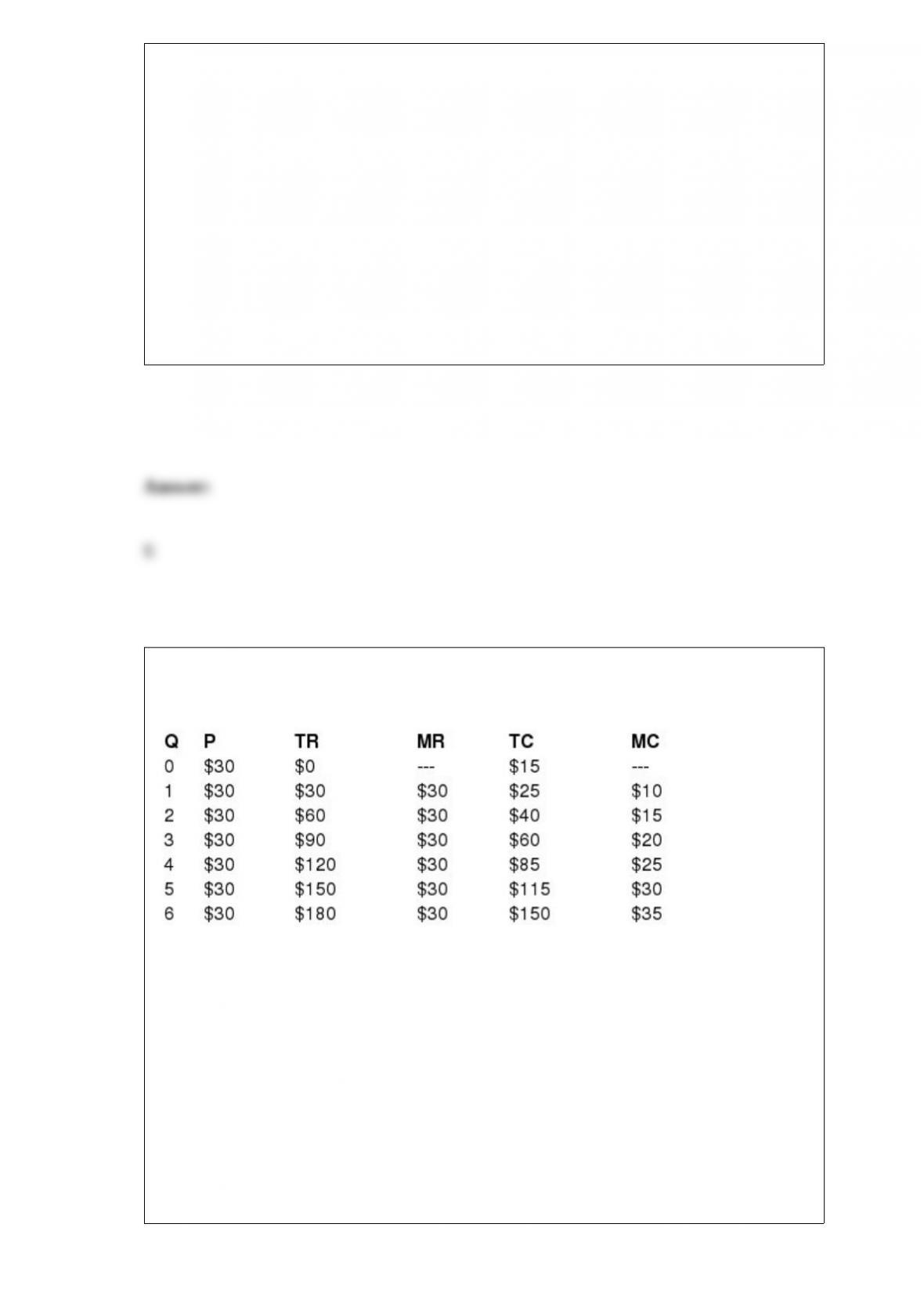
TABLE 8.1
The total revenue graph consistent with Table 8.1 is
A) linear and upward-sloping.
B) linear and horizontal.
C) linear and vertical.
D) linear and downward-sloping.
E) concave downwards.

Classic Programs has purchased distribution rights for two television programs that are
ready for syndication. One series, The Detectives, was enormously popular during its
prime time run and will command a large rental fee. The second series, Kittie and Alma,
was a poor parody of a popular series. Kittie and Alma is not expected to be in demand
for syndication. The managers at Classic Programs feel that there are only two
legitimate bidders for the two series. One bidder is a large independent television
station that is carried across the country by cable TV companies. The other bidder is a
youth oriented pay TV network called Kidwork. The independent station and Kidwork
are rarely carried by the same cable companies, so that a successful bid by one has
almost no impact on the willingness of the other to show the programs. Based upon
previous experience, Classic estimates the following reservation prices for each bidder.
Bidding is for the right to show the programs on an unlimited basis.
IndependentStation Kidwork
The Detectives 100,000 120,000
Kittie and Alma 15,000 8,000
a. Assuming that Classic’s managers set separate prices for the two programs, what is
the most profitable pricing strategy? (Because of information that is shared within the
industry, different prices for the two bidders are impossible.) How much revenue will
be earned?
b. Classic’s managers are considering bundling the two programs under a single price. Is
bundling feasible in this instance? Why or why not? If so, what should the bundled
price be? What will total revenue be?

Consider the following statements when answering this question
I. Waiting lists for kidney transplants have been caused by a 1984 congressional law
forbidding humans to sell their kidneys.
II. Randomly choosing citizens to serve on juries is an efficient mechanism for selecting
jurors.
A) I and II are true.
B) I is true, and II is false.
C) I is false, and II is true.
D) I and II are false.
Scenario 1:
It is the factory’s choice whether to install a filter. It is the choice of the nearby
fishermen whether to install a treatment plant. Dollar figures show profit. The factory
and the fishermen can negotiate costlessly, and no one else is affected by the result.
Factory Fishermen

A: No filter or treatment plant $10,000 $2,000
B: Filter; no treatment plant $6,000 $10,000
C: No filter; treatment plant $10,000 $4,000
D: Filter; treatment plant $6,000 $6,000
suppose the body of water lies on an international boundary, and the fishermen speak a
different language than the factory managers. The efficient outcome cannot be achieved
if the cost of hiring translators for both parties:
A) is less than $4,000.
B) equals $5,000.
C) is greater than $6,000.
D) none of the above
When the snob effect exists, a change in price is likely to
A) change total revenue less than if there were no network externalities.
B) change total revenue more than if there were no network externalities.
C) change total revenue the same amount as if there were no network externalities.
D) not change total revenue at all.

Scenario 6
Consider the following game. Payoffs are in millions of dollars.
In the game in Scenario 13.6,
A) “Poison Pill” is a dominant strategy for Lawrence LLP.
B) “Dump” is a dominant strategy for Lawrence LLP.
C) “TurboTech” is a dominant strategy for ERS Co.
D) “ZamboniTech” is a dominant strategy for ERS Co.
E) No firm has a dominant strategy.
The price of a taco was $0.29 in 1970 and $1.09 in 2000. The CPI was 8 in 1970 and
172.2 in 2000. The 2000 price of a taco in 1970 dollars is:
A) $0.25.
B) $0.29.
C) $1.09.
D) $4.84.

Smith just bought a house for $250,000. Earthquake insurance, which would pay
$250,000 in the event of a major earthquake, is available for $25,000. Smith estimates
that the probability of a major earthquake in the coming year is 10 percent, and that in
the event of such a quake, the property would be worth nothing. The utility (U) that
Smith gets from income (I) is given as follows:
U(I) = I0.5.
Should Smith buy the insurance?
A) Yes.
B) No.
C) Smith is indifferent.
D) We need more information on Smith’s attitude toward risk.
Consider the following information:
StowUrStuff Storage is located slightly below sea level in a coastal town. It could build
and maintain a flood control system around its property at an annual cost of $1000, and
if it did so, the probability of a flood’s doing $1,000,000 in damage during the year
would be .005. With no flood control system, the probability of such a flood would be .
01.
Moral hazard would be eliminated in this situation if
A) the insurer would always charge $5000.
B) the insurer would always charge $10,000.

C) the insurer could costlessly monitor whether a flood control system is in place, and
adjust the premium upward if it is not.
D) the insurer could costlessly monitor whether a flood control system is in place, and
adjust the premium downward if it is not.
E) the flood did not occur.
In the Stackelberg model, there is an advantage
A) to waiting until your competitor has committed herself to a particular output level
before deciding on your output level.
B) to being the first competitor to commit to an output level.
C) to the firm with a dominant strategy.
D) to producing an output level which is identical to a monopolist’s output level.
Scenario 4.3:
The demand for erasers (Q) is given as follows:
Q = 240 – 4Pe + 2I + Pb + A
where Pe is the price of erasers

I is the level of income
Pb is the price of another good
A is the level of advertising
The point price elasticity of demand is -1/2. The price of the product increases from
$1.00 to $1.10. Given the information in Scenario 4.3, the quantity demanded will
decrease by approximately:
A) 5 units.
B) 5 percent.
C) 10 units.
D) 10 percent.
E) none of the above
Suppose the quantity of nursing services demanded exceeds the quantity of nursing
services supplied. The nursing wage rate will:
A) decrease.
B) increase.
C) not change.
D) none of the above

Bundling raises higher revenues than selling the goods separately when
A) demands for two goods are highly positively correlated.
B) demands for two products are mildly positively correlated.
C) demands for two products are negatively correlated.
D) there is a perfect positive correlation between the demands for two goods.
E) the goods are complementary in nature.
Merriwell Corporation has a virtual monopoly in the ultra high speed computer market.
Merriwell has recently introduced a new computer that will be used by satellite
installations around the world. The installations have identical demands for the
computers. Merriwell’s managers have decided to lease rather than sell the computer,
but they have been unable to decide whether to use a single hourly rental charge or a
two-part tariff. Under the two-part tariff, users would be levied an “access charge” plus
an hourly rental rate. Merriwell’s marketing staff estimates the demand and marginal
revenue curves below for each potential user:
P = 45 – 0.025Q
MR = 45 – 0.05Q,
where P = price per hour of computer time, and Q = the number of hours of computer
time leased per month. Merriwell offers their users extensive maintenance assistance
and technical support. The firm’s engineers estimate that marginal cost is $30 per
computer hour.
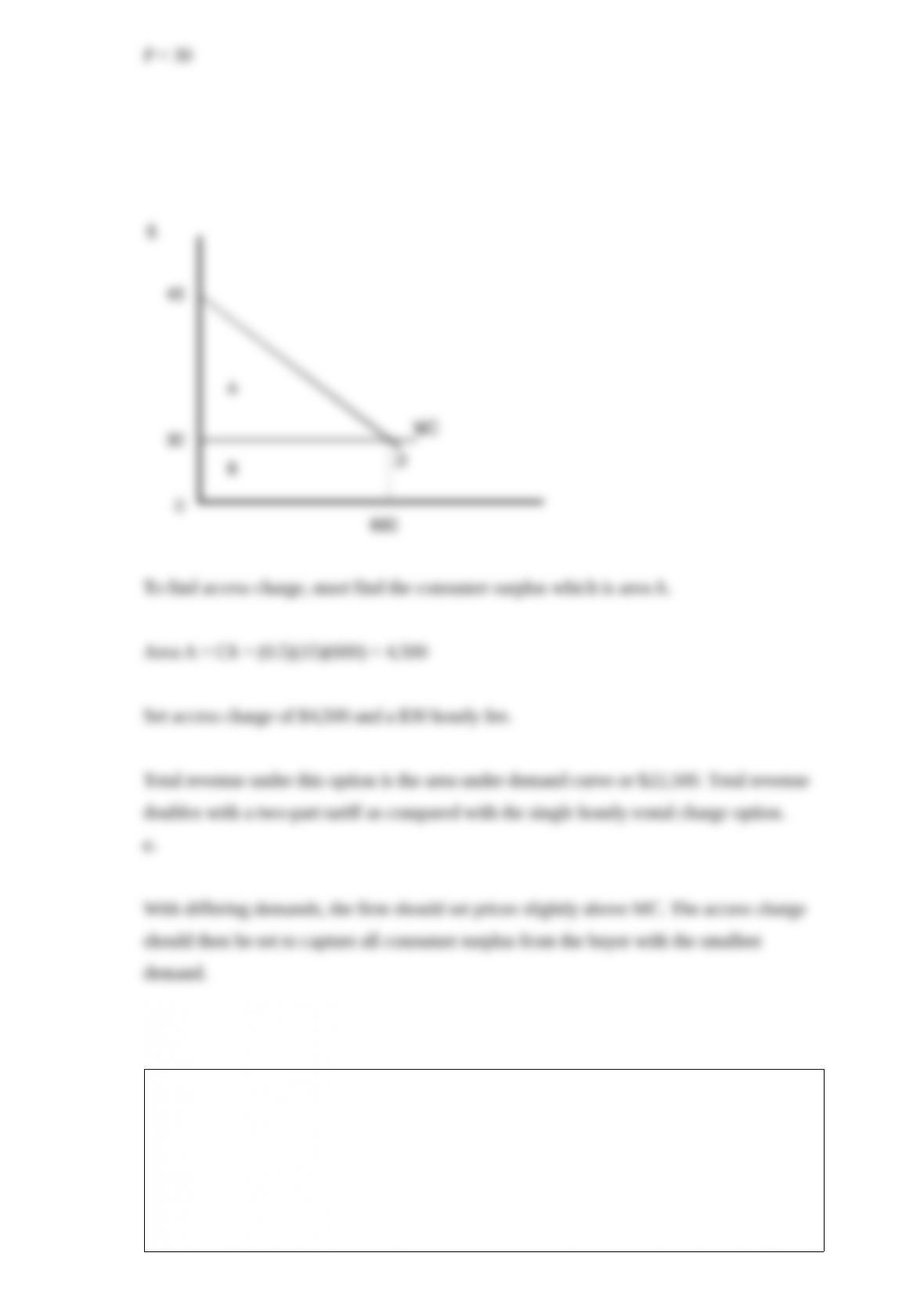
a. Assuming that Merriwell chooses to set a single price, what are the firm’s profit
maximizing price and output?
b. Assuming that Merriwell uses a two-part tariff, what “access charge” and hourly
rental fee should the firm set? Compare the firm’s revenues under the options in (a) and
(b).
c. Briefly describe how differing demand curves among the various buyers would alter
the two-part tariff.
The revealed preference approach can provide more informative comparisons of market
baskets if we also assume that the consumer’s indifference curves are:
A) concave.
B) convex.
C) incomplete.
D) intransitive.
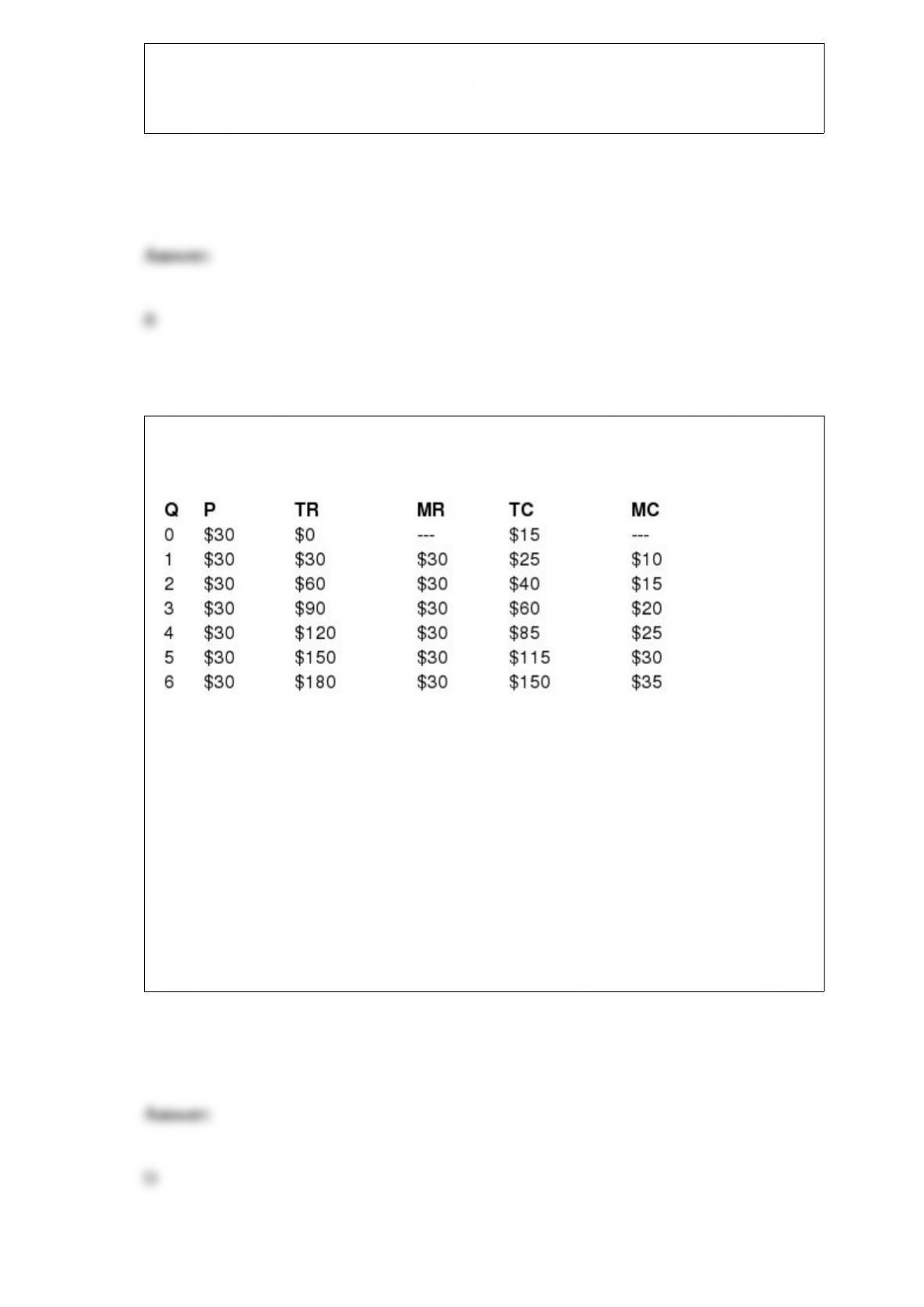
TABLE 8.1
That Table 8.1 shows a short-run situation is evident from
A) the linear marginal revenue function.
B) the constant price.
C) the increasing marginal cost.
D) the presence of positive costs at Q = 0.
E) the absence of marginal values at Q = 0.

Consider the following information:
The probability of a fire in a factory without a fire prevention program is 0.01. The
probability of a fire in a factory with a fire protection program is 0.001. If a fire
occurred, the value of the loss would be $300,000. A fire prevention program would
cost $80 to run.
If there is no insurance and no fire protection program in place, the expected loss from
fire for this company is
A) $0.
B) $300.
C) $3,000.
D) $6,000.
E) $300,000.
Assume that beer is a normal good. If the price of beer rises, then the substitution effect
results in the person buying ________ of the good and the income effect results in the
person buying ________ of the good.
A) more, more
B) more, less
C) less, more
D) less, less

If the payment stream of a bond remains the same and the price of the bond goes down,
the
A) effective yield is unchanged.
B) effective yield rises.
C) effective yield decreases.
D) bond is reissued to reflect the higher interest rate.
E) bond is reissued to reflect the lower interest rate.
If X and Y are perfect substitutes, which of the following assumptions about
indifference curves is not satisfied?
A) Completeness
B) Transitivity
C) More is preferred to less
D) Diminishing MRS
E) none of the above (All of the above assumptions are satisfied.)

The link between the productivity of labor and the standard of living is
A) tenuous and changing.
B) inverse.
C) that over the long run, consumers as a whole can increase their rate of consumption
only by increasing labor productivity.
D) that over the long run, consumers’ rate of consumption is not related to labor
productivity.
E) that the productivity of labor grows much more erratically than the standard of
living.
The aggregate demand for good X is Q = 20 – P, and the market price is P = $8. What is
the maximum amount that consumers are willing to pay for the quantity demanded at
this price?
A) $72
B) $96
C) $144
D) $168

You operate a car detailing business with a fixed amount of machinery (capital), but you
have recently altered the number of workers that you employ per hour. As you increased
the number of employees hired per hour from three to five, your total output increased
by 5 cars to 15 cars per hour. What is the average product of labor at the new levels of
labor?
A) AP = 3 cars per worker
B) AP = 5 cars per worker
C) AP = 4 cars per worker
D) We do not have enough information to answer this question.
Assume that average product for six workers is fifteen. If the marginal product of the
seventh worker is eighteen,
A) marginal product is rising.
B) marginal product is falling.
C) average product is rising.
D) average product is falling.
The manager of a firm is attempting to practice third degree price discrimination. She
has equated the marginal revenue in each of her markets. By doing this her

A) profits are maximized.
B) costs are minimized given her level of output.
C) revenues are maximized given her level of output.
D) all of the above