The key assumption underlying the theory of the firm is that:
A) firms are assumed to maximize sales revenue.
B) managers are assumed to maximize the number of employees in their department.
C) firms are assumed to maximize profits.
D) none of the above
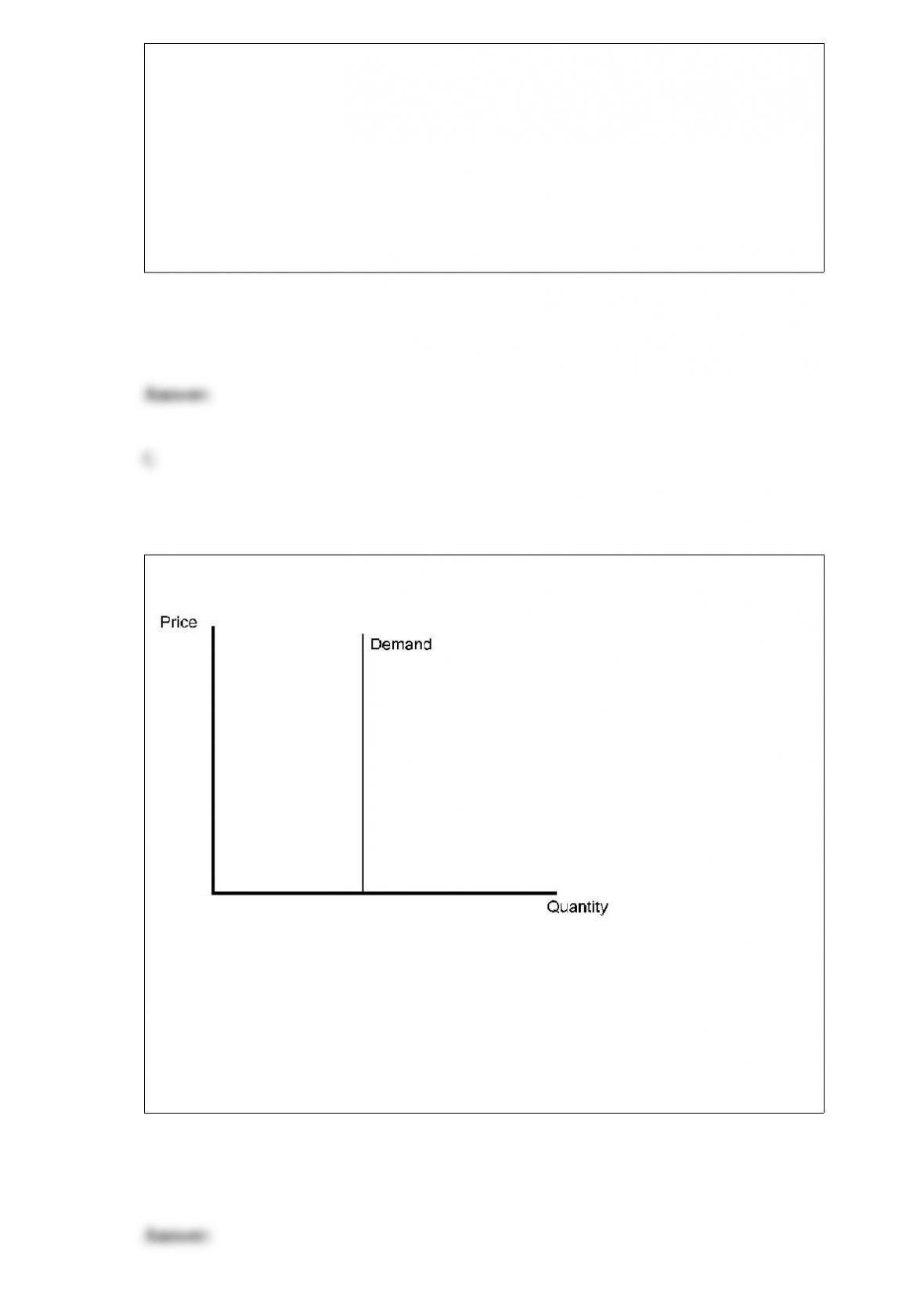
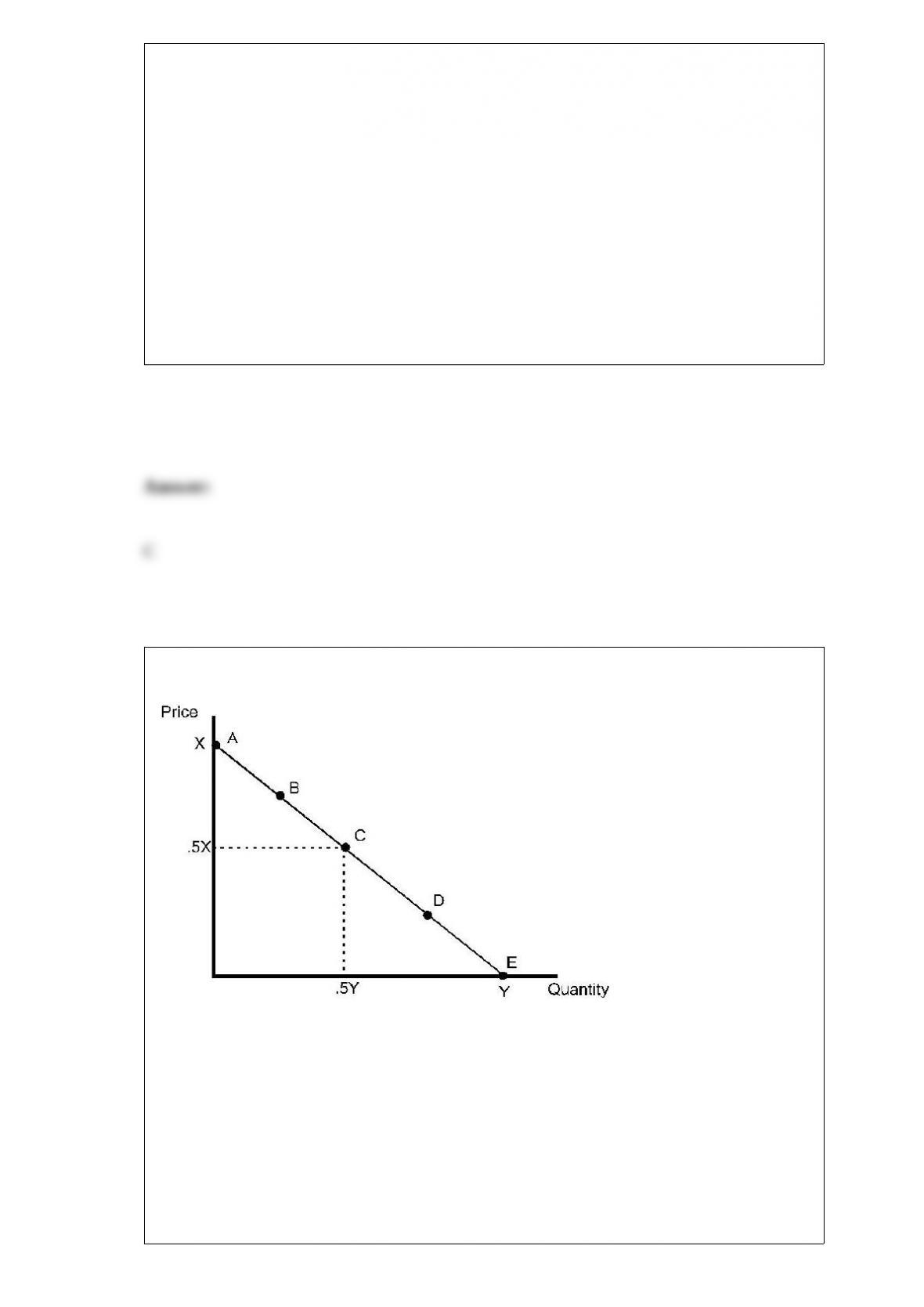
Which of the following statements about the diagram below is true?
A) Demand is infinitely elastic.
B) Demand is completely inelastic.
C) Demand becomes more inelastic the lower the price.
D) Demand becomes more elastic the lower the price.
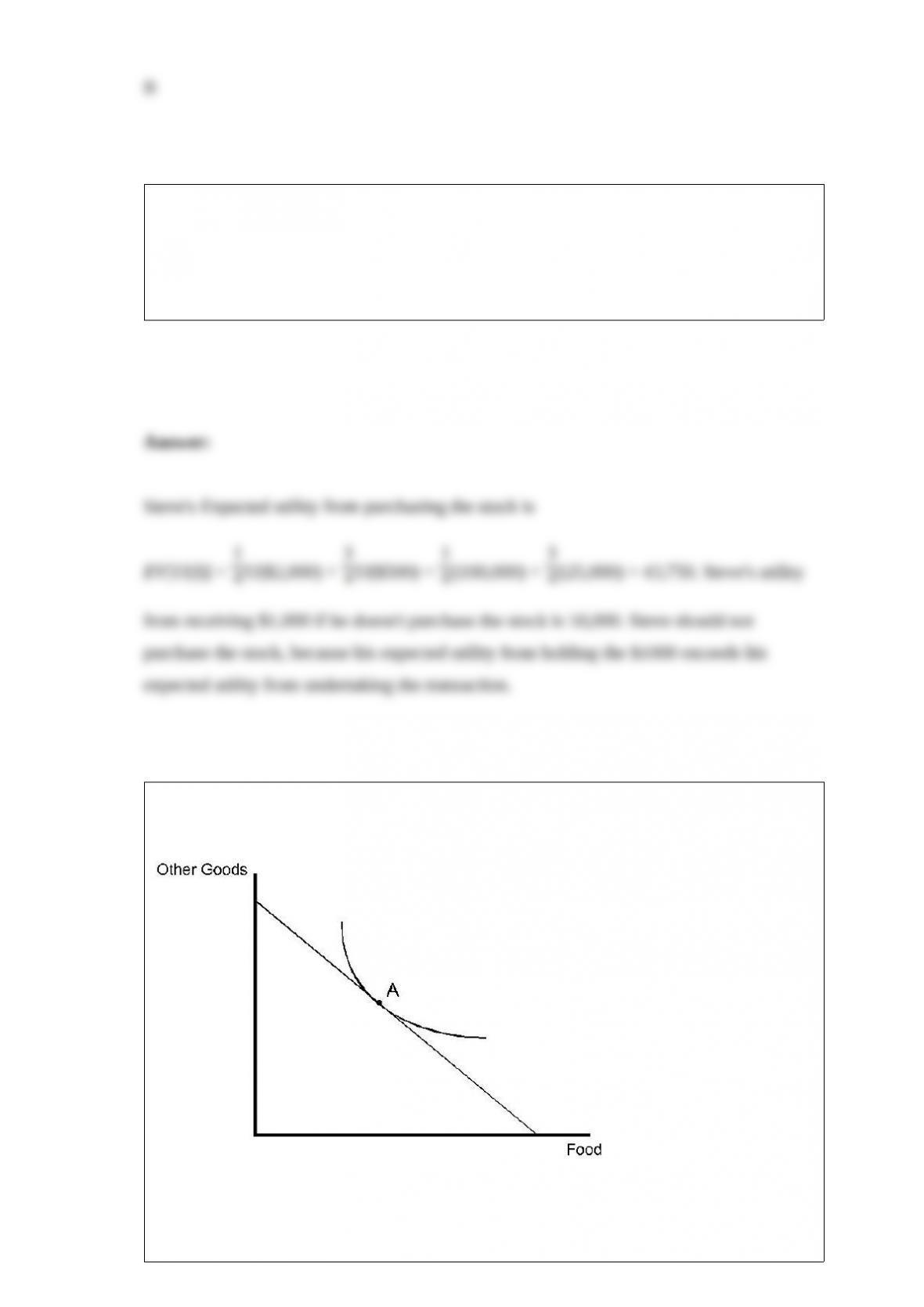
Steve has received a stock tip from Monica. Monica has told him that XYZ Corp. will
increase in value by 100%. Steve believes that Monica has a 25% chance of being
correct. If Monica is incorrect, Steve expects the value of XYZ Corp. will fall by 50%.
What is Steve’s expected utility from buying $1,000 worth of XYZ Corp. stock? Steve’s
utility of income is U(I) = 50I. Should Steve purchase the stock?
Lisa’s budget line and her satisfaction maximizing market basket, A, are shown in the
diagram below.
a. Suppose that Lisa is given $50 worth of coupons that must be spent on food. How
will the coupons alter Lisa’s budget line?
b. Suppose that Lisa is given $50 in cash instead of $50 in coupons. How will this alter
Lisa’s budget line?
c. Is Lisa indifferent between the food coupon and cash program, or does she prefer one
program over the other? Draw an indifference curve to illustrate your answer.
Connie’s utility depends upon her income. Her utility function is U = I1/2. She has
received a prize that depends on the roll of a pair of dice. If she rolls a 3, 4, 6 or 8, she
will receive $400. Otherwise she will receive $100.
a. What is the expected payoff from this prize? [Hint: The probability of rolling a 3 is
1/18, the probability of rolling a 4 is 3/36, the probability of rolling a 6 is 5/36, and the
probability of rolling an 8 is 5/36.]
b. What is the expected utility from this prize?
c. Connie is offered an alternate prize of $169 (no dice roll is required). Will she accept
the alternate prize or roll the dice?
d. What is the minimum payment that Connie will accept to forego the roll of the dice?
In closing down a military base, environmental inspectors found 100 tons of toxic
waste. Which of the following is NOT a determinant of the consumer surplus generated
by cleaning up 40 tons of waste?
A) The price of removing a ton of toxic waste
B) The original quantity of toxic waste found by the inspectors
C) The quantity of toxic waste removed by cleanup
D) The effect of each ton reduction of toxic waste on the profitability of the alternative
uses for this land
E) The effect of each ton reduction of toxic waste on the health of citizens living near
the base

Monopolistically competitive firms have monopoly power because they
A) face downward sloping demand curves.
B) are great in number.
C) have freedom of entry.
D) are free to advertise.
Suppose you cannot buy information that completely removes the uncertainty from a
business decision that you face, but you could buy information that reduces the degree
of uncertainty. Based on the discussion in this chapter, the value of this partial
information could be determined as the:
A) expected outcome under complete certainty minus the expected outcome under the
partial information case.
B) expected outcome under the partially uncertain case minus the expected outcome
under the completely uncertain case.
C) utility of the partially certain case minus the utility of the completely certain case.
D) We cannot determine the value of information under partial certainty.
The present value formula makes it apparent that:
A) a decline in the interest rate will cause a decision maker to weigh recent period
returns relatively more heavily than before the decline.
B) an increase in the interest rate will cause a decision maker to weigh distant (or
future) returns relatively more heavily than before the increase.
C) the present value of a fixed sum decreases as the time until it is to be paid increases.
D) all of the above
E) both A and C.
At point C, demand is:
A) completely inelastic.
B) inelastic, but not completely inelastic.
C) unit elastic.
D) elastic, but not infinitely elastic.

E) infinitely elastic.
For some fisheries in the U.S., the state or federal government imposes “gear
restrictions” that limit the size of boats, nets, or other equipment that may be used to
harvest the fish in a given body of water. The purpose of the gear restrictions is to:
A) prevent everyone from using the common property resource (fish).
B) make it harder for other members of society to harvest the resource. This reduces the
opportunity cost of the resource for other members of society, and the marginal social
cost is closer to the private cost.
C) increase the private cost of using the resource so that the private cost is closer to the
marginal social cost.
D) maintain traditional ways of harvesting fish, which is valuable for promoting
tourism.
Scenario 2:
Consider the payment streams listed below that are available from different capital
projects for Furry Software. The firm must choose to implement just one out of the
three possible projects.
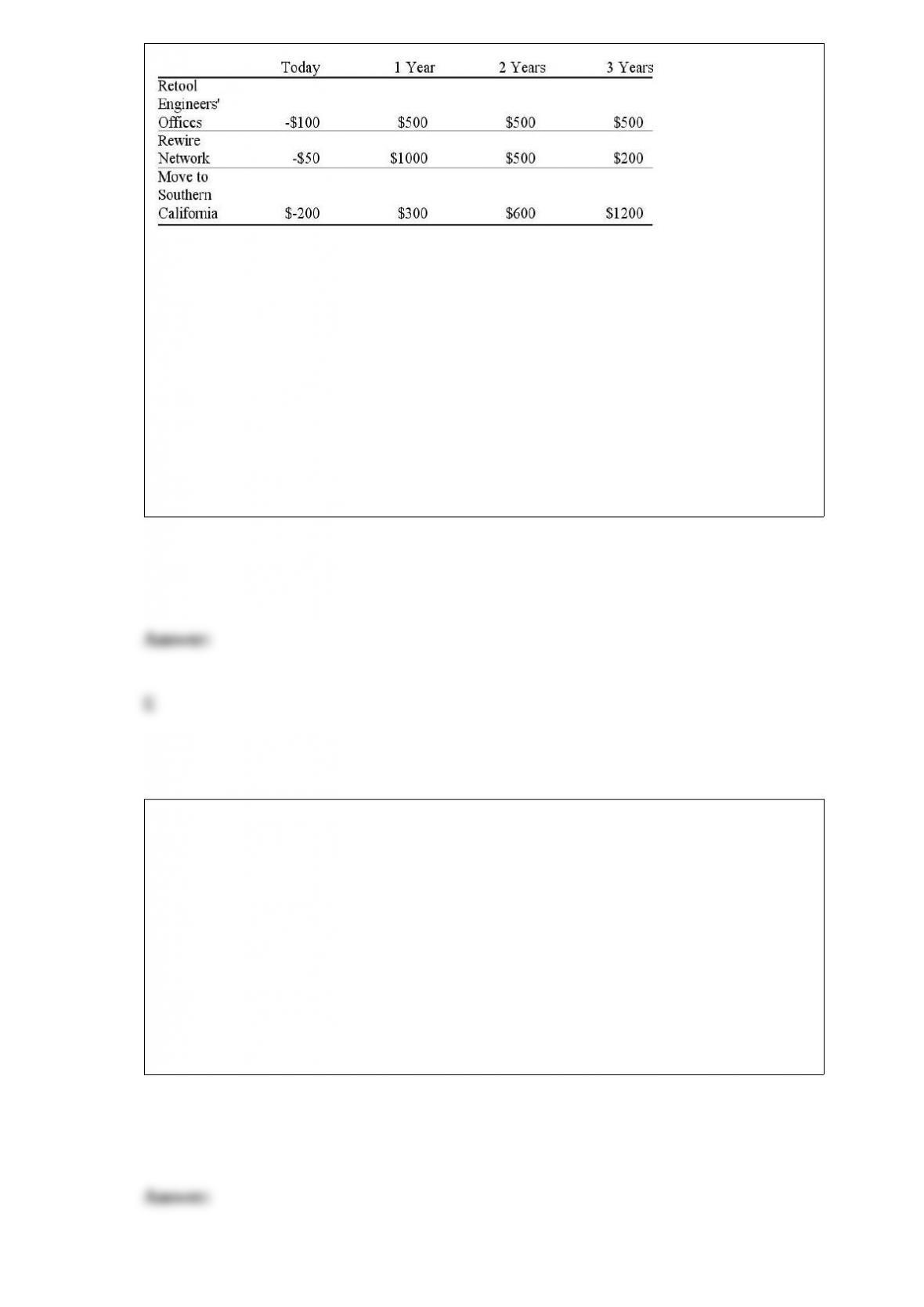
With no other information available, it is
A) clear Furry should retool the offices.
B) clear Furry should rewire the network.
C) clear Furry should move to Southern California.
D) clear Furry should either retool the offices or rewire the network.
E) not possible to tell which payment stream is most valuable to Furry.
In a Nash equilibrium,
A) each player has a dominant strategy.
B) no players have a dominant strategy.
C) at least one player has a dominant strategy.
D) players may or may not have dominant strategies.
E) the player with the dominant strategy will win.

When the bandwagon effect exists, a change in price is likely to
A) change total revenue less than if there were no network externalities.
B) change total revenue more than if there were no network externalities.
C) change total revenue the same amount as if there were no network externalities.
D) not change total revenue at all.
Which of the following public policies is an example of a price ceiling?
A) Support prices for agricultural commodities
B) Minimum wage laws
C) Rent control program
D) all of the above
Julia is a 28-year-old nonsmoking, non-drinking female of normal weight. Because of
adverse selection in health insurance,

A) She will be charged less for her premiums than people who are higher risks.
B) She is less likely to buy health insurance than the average person, because policy
premiums are based on expected medical expenditures of people who are less healthy
than she is.
C) When she get health insurance, she will be less likely to take care of herself.
D) She must get health insurance early in life, and is likely to lose health insurance if
she smokes, drinks to excess, or gains weight.
E) She is more likely than the average person to buy health insurance, because she is
more likely to be offered it.
Consider the following statements when answering this question;
I. The allocation of a risk averse investor’s portfolio between a risk free asset and a
risky asset never changes if the rate of return on both assets increases by the same
amount.
II. Given the choice between investing in a risk free asset or a risky asset with higher
expected returns, the utility maximizing portfolio of a risk neutral or risk loving
investor would never include the risk free asset.
A) I and II are true.
B) I is true, and II is false.
C) I is false, and II is true.
D) I and II are false.

If a coupon bond has a “face value” of $1000, it means that
A) the original purchaser paid $1000 for it.
B) each purchaser must pay $1000 for it.
C) it was purchased for at least $1000 and perhaps more.
D) the holder will be paid $1000 when the bond matures.
E) the holder will be paid $1000 plus accumulated interest when the bond matures.
Which of the following statements is false? An economic analysis of carbon taxes can:
A) calculate the increase in costs faced by coal-using industries.
B) predict the effect on unemployment in West Virginia coal mining communities.
C) compare the likely reductions in medical expenditures on diseases caused by smog.
D) present a trade-off of the costs and benefits of different levels of carbon taxes.
E) conclude that such taxes should be imposed to benefit future generations.

A key factor that determines the geographic extent of a housing market is the distance
that commuters are willing to travel from home to work. Which of the following events
would NOT help to expand the geographic extent of the housing market in a
metropolitan area?
A) Price of gasoline declines
B) State gasoline tax increases
C) Public transit fares decrease
D) none of the above
When the movie Jurassic Park debuted in Westwood, California, the price of tickets
was $7.50. After several months the ticket price had fallen to $4.00. This is an example
of
A) peak-load pricing.
B) second-degree price discrimination.
C) a two-part tariff.
D) tying.
E) none of the above

Suppose the plant owners design an incentive scheme for the plant manager in which
the feasible production level is set equal to output from the previous quarter. The bonus
payment is determined by the formula B = 0.2Qf + 0.2(Q – Qf). What potential
problems can arise with this scheme?
A) If Qf is unusually large, then the manager has little incentive to work hard during the
following quarter because Q will likely fall back below Qf.
B) If Qf is unusually small, then the manager will receive a small bonus regardless of
their efforts during the current quarter.
C) The manager has an incentive to underperform and generate a small Q during the
current quarter in order to provide a smaller benchmark for performance in the next
quarter.
D) The incentive scheme only depends on current output and does not measure
performance relative to feasible production.
Scenario 12.3:
Suppose a stream is discovered whose water has remarkable healing powers. You
decide to bottle the liquid and sell it. The market demand curve is linear and is given as
follows:
P = 30 – Q
The marginal cost to produce this new drink is $3.
Refer to Scenario 12.3. What will be the price of this new drink in the long run if the
industry is a Bertrand duopoly?
A) $3
B) $9
C) $12

D) $13.50
E) none of the above
The problem of adverse selection in insurance results in a situation in which
A) people choose inappropriate or inadequate coverage because they do not understand
the complex information in the policies.
B) people choose too much coverage because they do not understand the complex
information in the policies.
C) people choose too little coverage because they do not understand the complex
information in the policies.
D) unhealthy people become more likely to buy insurance than healthy people, which
drives premiums up, which drives even more healthy people away from the market.
E) healthy people become more likely to buy insurance than unhealthy people, which
drives premiums up, which drives even more unhealthy people away from the market
even though they are the ones who need it most.
Suppose a firm produces identical goods for two separate markets and practices
third-degree price discrimination. In the first market the firm charges $30 per unit, and
it charges $22 per unit in the second market. Which of the following represents the ratio
of price elasticities of demand in the two markets?

A) E2 = (21/29)E1
B) E2 = (29/21)E1
C) E2 = E1
D) E2 = (22/30)E1
E) none of these
The law of small numbers describes:
A) the tendency for people to overstate the probability associated with rare events.
B) the ability to correctly estimate the expected outcome from a small number of
events.
C) the higher probability that small numbers (like 1, 2, and 3) occur in random samples
relative to large number (like 8 or 9).
D) the improved accuracy of averages to estimate relatively small numbers (on the
order of 1 or 10) than relatively large numbers (on the order of 1,000 or 10,000).
Which of the following strategies are used by business firms to capture consumer
surplus?
A) Price discrimination

B) Bundling
C) Two-part tariffs
D) all of the above
The Russian government wants to reduce the consumption of vodka. A one hundred
rouble tax on each bottle purchased may reduce the consumption of vodka under which
circumstance(s)?
A) Vodka is an inferior good.
B) Vodka is a normal good.
C) Vodka is an inferior good and the taxes collected from this tax are rebated to
consumers.
D) Vodka is a normal good and the taxes collected from this tax are rebated to
consumers.
E) both B and C
Economics is about the allocation of scarce resources. Which of the following is NOT
an example of economic scarcity?
A) If Steve goes to see a movie on Saturday, he will not be able to afford buying ice

cream.
B) If Jenny studies for her economics quiz this evening, she will not have time to walk
her dog.
C) If General Motors increases its production of SUVs this year, it will have to spend
more on advertising.
D) If Barnes and Noble bookstore increases the number of titles it carries, it will have to
reallocate shelf space to accommodate the new titles.
Scenario 1:
This year Jacob Verytall signs a “Fifty Million Dollar” contract with the Mission City
Muckrakers, a new basketball team. He will be paid $10 million per year over the next
5 years beginning next year. The interest rate is 10%, and the Muckrakers have enough
in the bank to generate the payment stream.
If the interest rate falls,
A) the present value of this contract will fall.
B) the present value of this contract will be unaffected.
C) the present value of this contract will rise.
D) Jacob will be paid less than $10 million each year.
E) Jacob will be paid more than $10 million each year as he can invest the money.

Data in the following table refer to the purchase of a resource by a pure monopsonist.
Let the resource be labor time L, measured in hundreds of hours per day.
Units of Labor Marginal Average Marginal Revenue
Input Expenditure Expenditure Product
L ME AE MRP
1 10 10 16
2 12 11 15
3 14 12 14
4 16 13 13
5 18 14 12
6 20 15 11
7 22 16 10
8 24 17 9
a. Determine the profit maximizing purchase rate of labor for the monopsonist.
b. If this market were not monopsonistic but competitive, what would be the purchase
rate of labor time?
c. Determine the equilibrium wage rate in both the monopsonistic and competitive
markets?

Rare earth metals are used to manufacture some important electronic components in
popular products like cell phones. These metals are not really rare, but they are
expensive to extract from the ground. What happens to the market for the rare earth
metals if these extraction costs increase?
A) Demand curve shifts leftward
B) Demand curve shifts rightward
C) Supply curve shifts leftward
D) Supply curve shifts rightward
Use the following statements to answer this question:
I. Under perfect competition, an upward shift in the marginal cost curve (perhaps due to
a higher price for a variable input) also shifts the average variable cost curve upward.
II. Under perfect competition., an upward shift in the marginal cost curve (perhaps due
to a higher price for a variable input) reduces firm output but may increase firm profits.
A) I and II are true.
B) I is true and II is false.
C) II is true and I is false.
D) I and II are false.

Common property resources tend to be
A) overused.
B) underused.
C) not used at all.
D) efficiently used.
E) used by the government only.