1) The basic issue in the DuPont cellophane case was:
A.whether trade crossed state lines.
B.defining the relevant market.
C.structure versus behavior.
D.the rule of reason.
2) the term “other things equal” means that:
a.the associated statement is normative.
b.many variables affect the variable under consideration.
c.a number of relevant variables are assumed to be constant.
d.when variable x increases so does related variable y.
3) Which of the following measurement issues make interpretation of U.S. poverty rates
difficult?
A.Poverty statistics measure consumption rather than income, and some families may
receive income that is above the official poverty line.
B.The high cost of living in urban areas tends to result in the understatement of poverty.
C.Most people below the poverty line have substantial unreported income.
D.The poverty rate is adjusted for every urban and rural area, so people’s poverty status
changes whenever they move.
4) Suppose a savings and loan association has checkable deposits of $500,000 and the
legal reserve ratio is 10 percent. If the institution has excess reserves of $4,000, then its
actual reserves are:
A.$46,000.
B.$50,000.
C.$54,000.
D.$4,000.
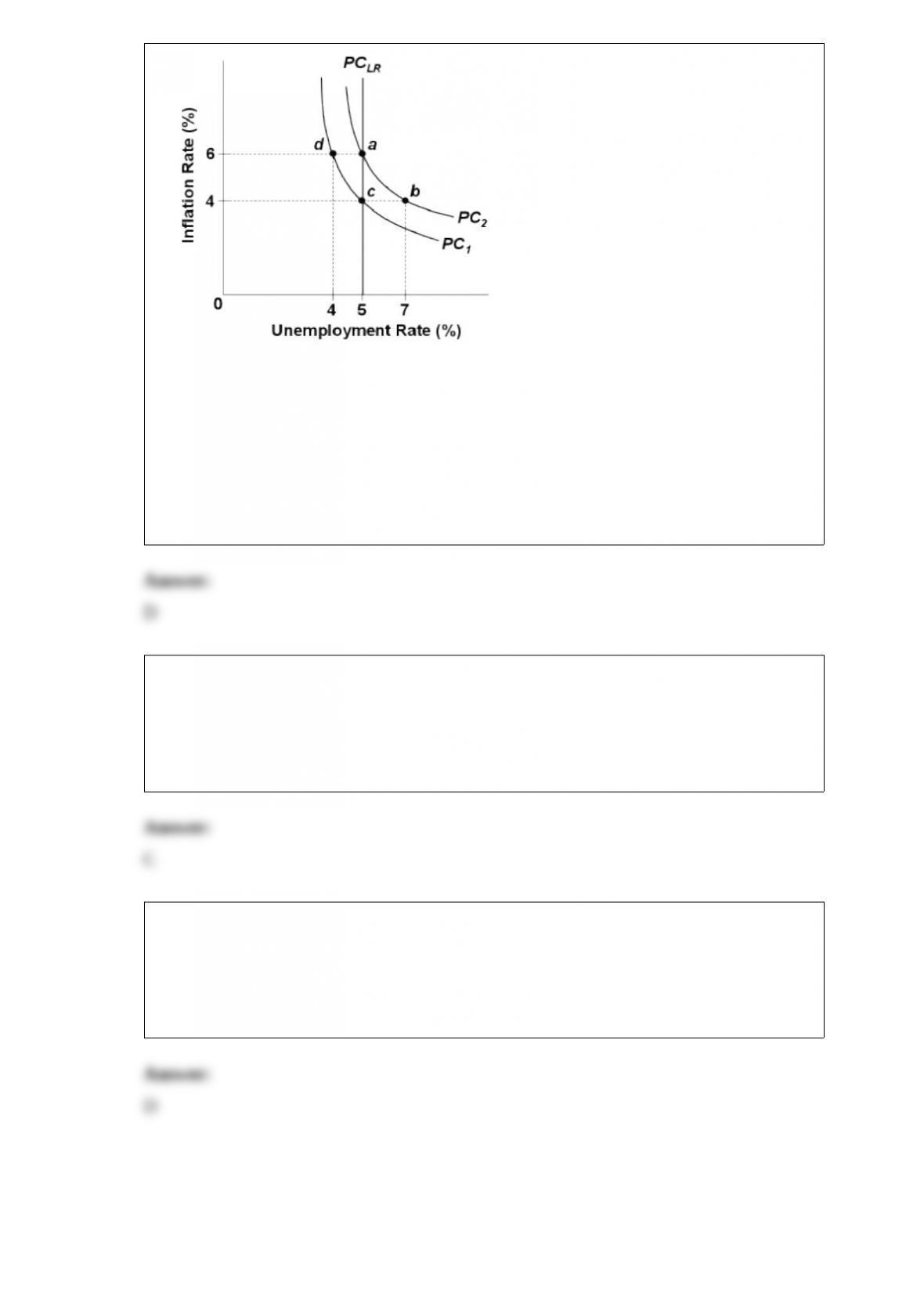
5)
Refer to the above diagram. Assume that the natural rate of unemployment is 5 percent
and that the economy is initially operating at point c where the expected and actual rates
of inflation are each 4 percent. If the actual rate of inflation unexpectedly rises from 4
percent to 6 percent, the economy will:
A.move from a to b and eventually to c
B.move directly from c to b
C.remain at a
D.move from c to d and eventually to a
6) The study of how people deal with energy scarcity is known as:
A.power economics.
B.utility economics.
C.energy economics.
D.natural resource economics.
7) Which of the following is a true statement?
A.There is a long-run tradeoff between inflation and unemployment.
B.There is no tradeoff between inflation and unemployment in the short-run.
C.The short-run Phillips Curve is horizontal.
D.The long-run Phillips Curve is vertical.
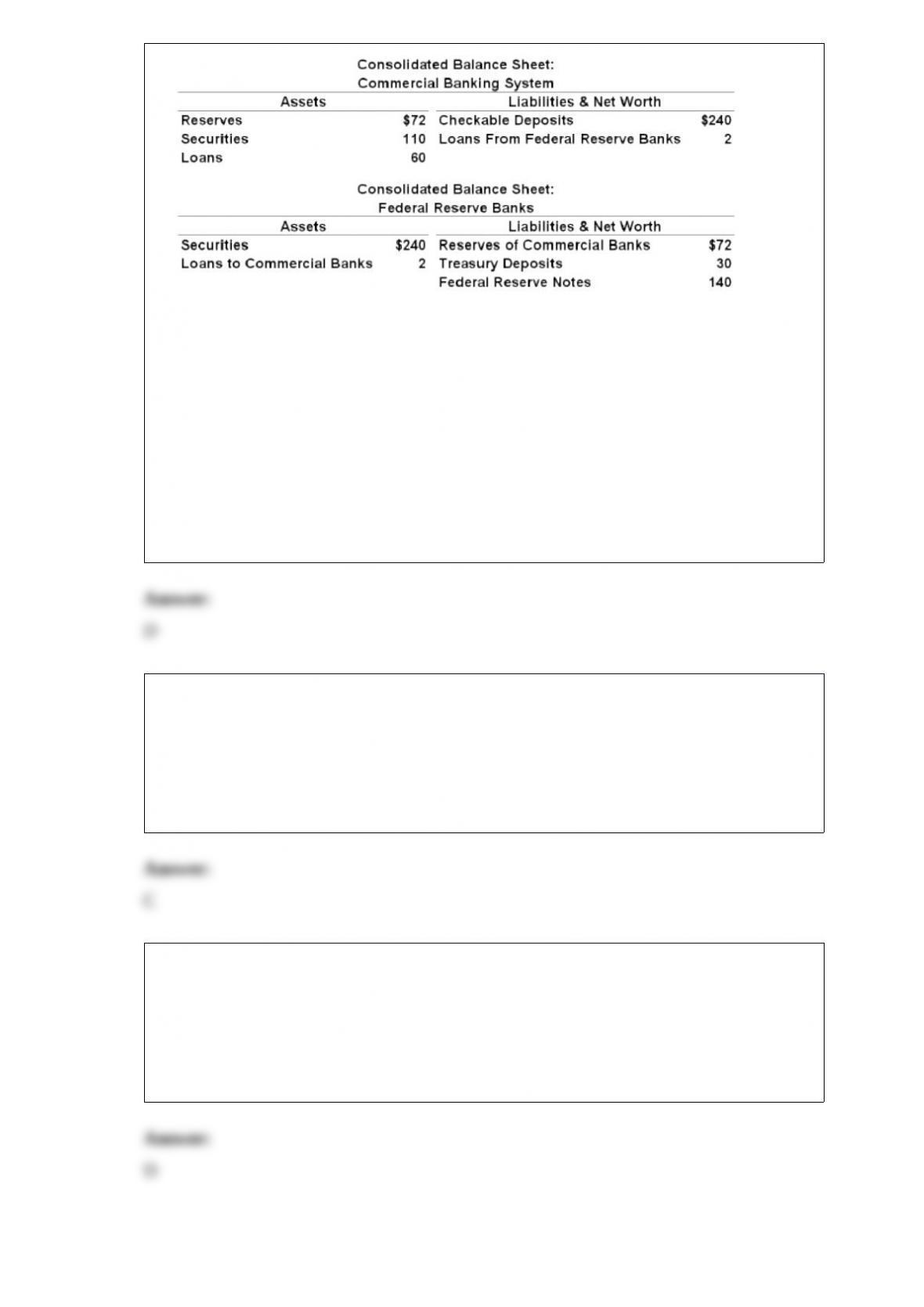
8)
Refer to the above balance sheets and assume the reserve ratio is 25%. Suppose the
Federal Reserve Banks buy $2 in securities from the public, which deposits this amount
into checking accounts. As a result of these transactions, the supply of money will:
A.be unaffected but the money-creating potential of the commercial banking system
will increase by $6.
B.directly decrease by $2 and the money-creating potential of the commercial banking
system will be unaffected.
C.directly increase by $8 and the money-creating potential of the commercial banking
system will increase by an additional $32.
D.directly increase by $2 and the money-creating potential of the commercial banking
system will increase by an additional $6.
9) The Lorenz curve:
A.plots graphically the poverty rate over time.
B.is located closer to the diagonal today than it was in 1970.
C.plots graphically the distribution of income.
D.is located farther from the diagonal when income is defined to include the value of
noncash transfers.
10) The current chairperson of the Board of Governors of the Federal Reserve System
is:
A.Lawrence Summers.
B.John B. Taylor.
C.Alan Greenspan.
D.Ben Bernanke.
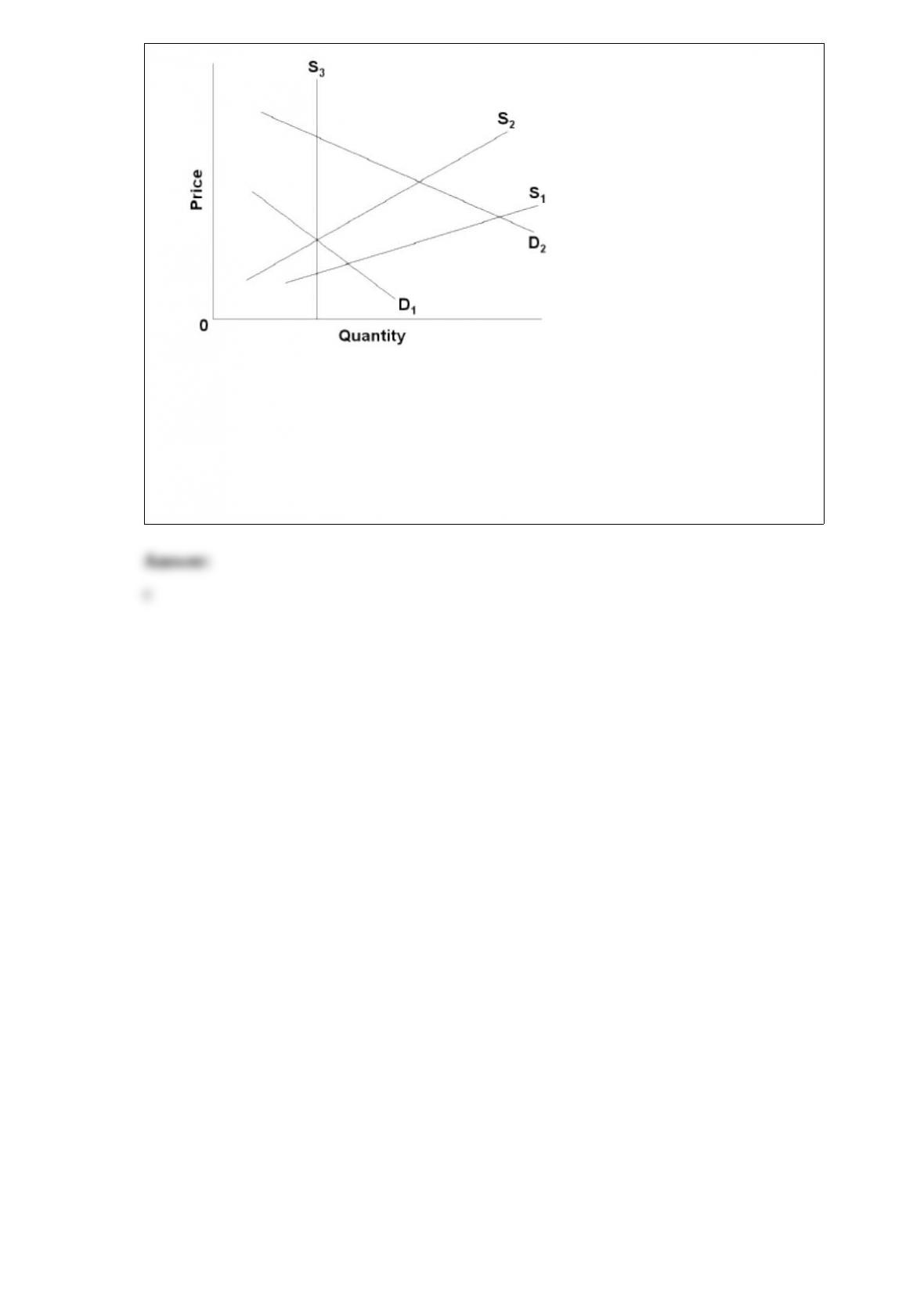
11)
the above diagram concerns supply adjustments to an increase in demand (d1to d2) in
the immediate market period, the short run, and the long run. supply curves s1, s2, and
s3apply to the:
a.immediate market period, long run, and short run respectively.
b.immediate market period, short run, and long run respectively.
c.long run, short run, and immediate market period respectively.
d.short run, long run, and immediate market period respectively.