
1) suppose that a swiss watch that costs 400 francs in switzerland costs $200 in the
united states. the exchange rate between the franc and the dollar is:
a.2 francs per dollar
b.1 franc per dollar
c.$2 per franc
d.$3 per franc
2) the federal reserve’s swap network represents:
a.efforts to stabilize only the value of the dollar
b.efforts to stabilize only the value of foreign currencies
c.long-term borrowing among countries
d.short-term borrowing among countries
3) u.s. tariffs on imports from countries issued normal-trade-relations
(most-favored-nation) status are often three or four times as high as those on
comparable imports from nations not receiving that status.
a.true
b.false
4) producer surplus is the revenue producers receive over and above the minimum
necessary for production.
a.true
b.false
5) concerning exchange rate forecasting, ____ relies on econometric models which are
based on macroeconomic variables likely to affect currency values.
a.fundamental analysis
b.technical analysis
c.judgmental analysis
d.sunspot analysis
6) following world war ii, western european nations suffered from balance-of-payments
deficits due to reconstruction.
a.true
b.false
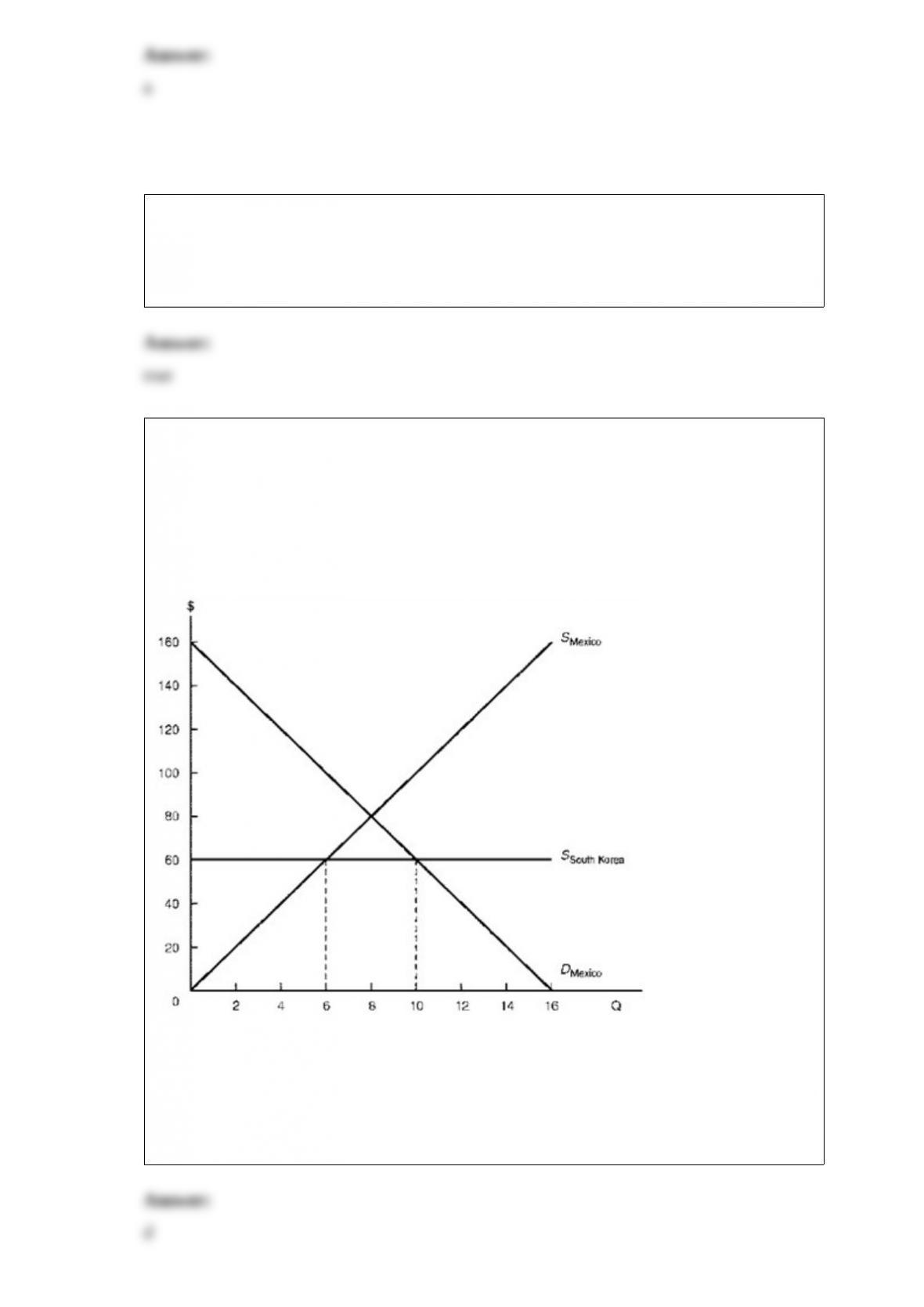
7) figure 6.2 illustrates the calculator market for mexico, assumed to be a small nation
that is unable influence the south korean (world) price. assume the south korean price to
be $60 per calculator.
figure 6.2. effects of an export subsidy
consider figure 6.2. the south korean subsidy helps/hurts mexican manufacturers, since
their producer surplus rises/falls by $____.
a.helps, rises, $60
b.helps, rises, $100
c.hurts, falls, $60
d.hurts, falls, $100

8) the leontief paradox provided:
a.support for the principle of absolute advantage
b.support for the factor endowment model
c.evidence against the factor endowment model
d.evidence against the principle of absolute advantage
9) increasing opportunity costs suggest that:
a.resources are not perfectly shiftable between the production of two goods
b.resources are fully shiftable between the production of two goods
c.a country’s production possibilities curve appears as a straight line
d.a country’s production possibilities curve is bowed inward (i.e., convex) in appearance
10) members of the european union find that “trade creation” is fostered when their
economies are:
a.highly competitive
b.highly noncompetitive
c.small in economic importance
d.geographically distant
11) which of the following represents the stage where economic integration is most
complete?
a.economic union
b.customs union
c.monetary union
d.common market