
Which of the following is a disadvantage of trademarking a firm’s product?
A) A trademark differentiates a firm’s product.
B) A trademark conveys information about the product to the public.
C) A trademark may become so widely used to denote a particular type of product that
the trademark may no longer be a legally protected brand name.
D) A trademark does not affect demand for the firm’s product.
Which of the following is the source of revenue for Medicare and Social Security in the
United States?
A) individual income taxes
B) sales taxes
C) social insurance taxes
D) property taxes
If a 5 percent increase in income leads to a 10 percent decrease in quantity demanded
for a product, this product is
A) an income elastic good.
B) an inferior good.
C) a necessity.
D) a luxury good.
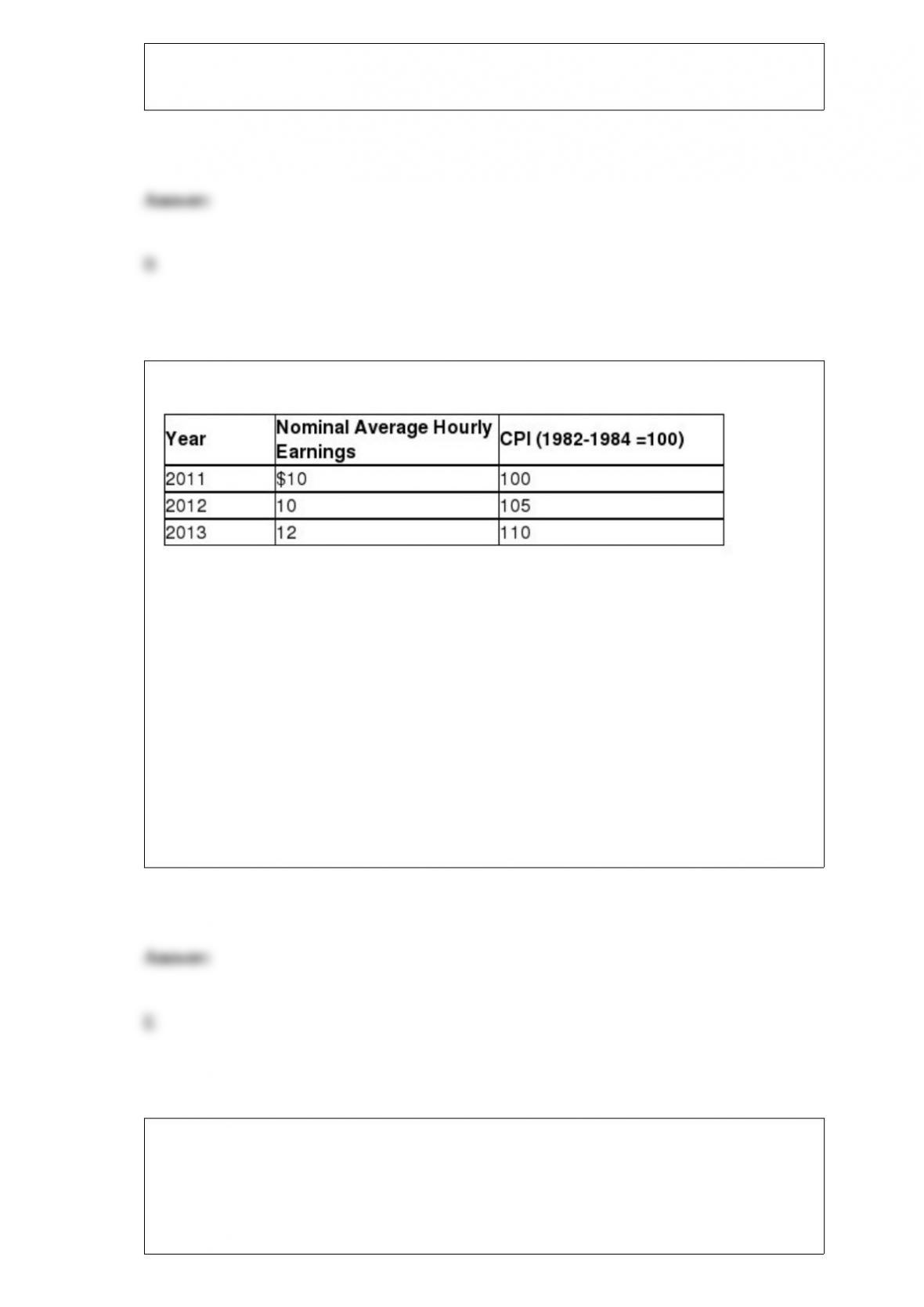
Table 9-19
Looking at the table above, what is the rate of growth of the average price level from
2011 to 2012?
A) 1%
B) 2%
C) 3%
D) 4%
E) 5%
Oligopoly differs from perfect competition and monopolistic competition in that
A) barriers to entry are lower in oligopoly industries than they are in perfectly
competitive and monopolistically competitive industries.

B) demand and marginal revenue curves are more useful for analyzing oligopoly than
they are for analyzing perfect competition and monopolistic competition.
C) because oligopoly firms often react when other firms in their industry change their
prices, it is difficult to know what the oligopolist’s demand curve looks like.
D) the concentration ratios of oligopoly industries are lower than they are for perfectly
competitive and monopolistically competitive firms.
Suppose that the labor movement has a revival in the United States and the majority of
workers join labor unions. As a result we would expect
A) the labor force participation rate to fall.
B) the unemployment rate to fall.
C) the unemployment rate to rise.
D) no change in the unemployment rate or labor force participation rate.
In September 2012, the average price of gasoline in the United States was $3.91 per
gallon and consumers bought 5 percent less gasoline than they had during September
2011, when the average price was $3.66 per gallon. Based on these numbers, what was
the price elasticity of demand for gasoline from September 2011 to September 2012?
A) -0.33
B) -0.76
C) -2.96

D) -6.75
The Pre-Existing Condition Insurance Plan is a federally administered part of the
Affordable Care Act, and is designed for people with pre-existing medical conditions to
obtain insurance.By offering health insurance to all U.S. citizens with pre-existing
medical conditions, the Pre-Existing Condition Insurance Plan
A) eliminates asymmetric information for the insurer, but not for the insured.
B) eliminates asymmetric information for the insured, but not for the insurer.
C) eliminates asymmetric information for both the insurer and the insured.
D) reduces, but does not eliminate,, asymmetric information for both the insurer and the
insured.
Discouraged workers are
A) workers who have a part time job but want a full time job.
B) workers who find their current jobs unfulfilling and are considering a job change.
C) workers who have consistently been looking for work for more than 4 weeks.
D) workers who have stopped looking for work because they believe there are no jobs
for them.

Suppose that some teachers have decided that economic and financial uncertainty have
made the prospect of retiring more risky, and therefore carry a higher cost than not
retiring. By using all available information as they act to achieve their goals, these
teachers are exemplifying the economic idea that
A) people are rational.
B) people respond to economic incentives.
C) optimal decisions are made at the margin.
D) equity is more important than efficiency.
Many economists believe that when the federal government establishes an agency to
regulate a particular industry, the regulated firms try to influence the agency even if
these actions do not benefit the public. Economists refer to this result of government
regulation by which of the following terms?
A) regulatory capture
B) logrolling
C) special interest regulation
D) the regulatory paradox
In markets with asymmetric information
A) moral hazard causes adverse selection which in turn causes asymmetric information.
B) adverse selection causes moral hazard which in turn causes asymmetric information.
C) asymmetric information causes moral hazard and then it causes adverse selection.
D) asymmetric information causes adverse selection and then it causes moral hazard.
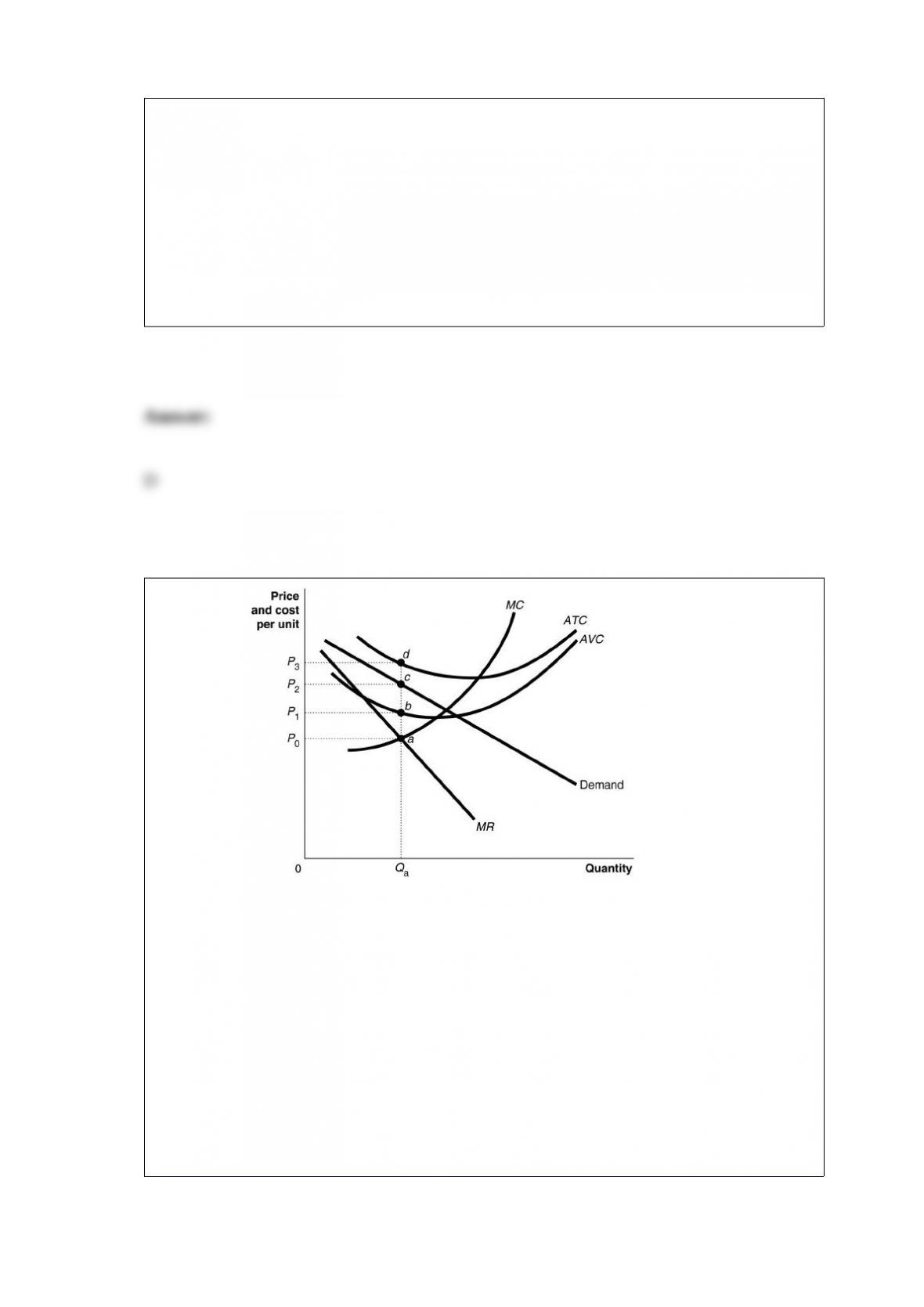
Figure 13-4 Figure 13-4 shows
short-run cost and demand curves for a monopolistically competitive firm in the market
for designer watches. What is the area that represents the total revenue made by the
firm?
A) 0P0aQa
B) 0P1bQa
C) 0P2cQa
D) 0P3dQa