
A person goes into a store and buys a computer for $1,210. In this case, price is acting
as a
a. resource.
b. good.
c. rationing device.
d. capital instrument.
e. factor of production.
Which of the following statements is false?
a. A perfectly price-discriminating monopolist does not lower price on all previous units
in order to sell an additional unit of its product.
b. Second-degree price discrimination is when the seller charges a uniform price per
unit for one specific quantity, a lower price of an additional quantity, and so on.
c. Charging senior citizens less for medicine is an act of third-degree price
discrimination.
d. Charging women less for a car wash is an act of second-degree price discrimination.
e. A price taker cannot practice price discrimination.
Suppose the data show that each year between 1964 and 2014, 10 percent of all income
earners (in the United States) earned a low enough income to be considered poor. It

follows that
a. the person who was part of the 10 percent poor in 1964 was also part of the 10
percent poor in 2014.
b. the person who was part of the 10 percent poor in 1964 may not be part of the 10
percent poor in 2014.
c. there is no upward income mobility in the United States.
d. the income distribution in the United States (during this period of time) was unequal.
e. b and d
Economists assert that government regulation
a. has no costs if it has positive benefits.
b. has no benefits if it has positive costs.
c. always has benefits in excess of costs.
d. always has costs in excess of benefits.
e. has benefits that may be greater than, less than, or equal to the costs.
A tax placed on a good can make that good relatively more expensive and its substitutes
relatively less expensive.
a. True

b. False
Which of the following situations is descriptive of the existence of a negative
externality.
a. Vernon studies for his biology test late into the night and oversleeps the next
morning, thus missing the test.
b. Nancy is in the library looking for a book. She is talking to herself and consequently
disturbs a few people in the library.
c. Bob learns later that he could have purchased a pair of shoes for less than he paid.
d. Jackie has had the flu and has stayed in bed for a week.
e. none of the above
Because there are so few diamonds in the world, the consumption of diamonds
a. takes priority over the consumption of water.
b. takes place at relatively high marginal utility.
c. takes place at relatively low marginal utility.
d. is more important than the consumption of water.

The price elasticity of demand indicates
a. buyers’responsiveness to price changes.
b. the slope of the demand curve.
c. how far demand stretches over time.
d. the extent to which a demand curve shifts as incomes change.
e. none of the above
If the equilibrium exchange rate between U.S. dollars and Japanese yen is $0.007 = 1
yen, but currently the exchange rate is $0.009 = 1 yen, then with flexible exchange rates
the dollar price of a yen will __________, and the yen will __________.
a. increase; appreciate
b. decrease; appreciate
c. increase; depreciate
d. decrease; depreciate
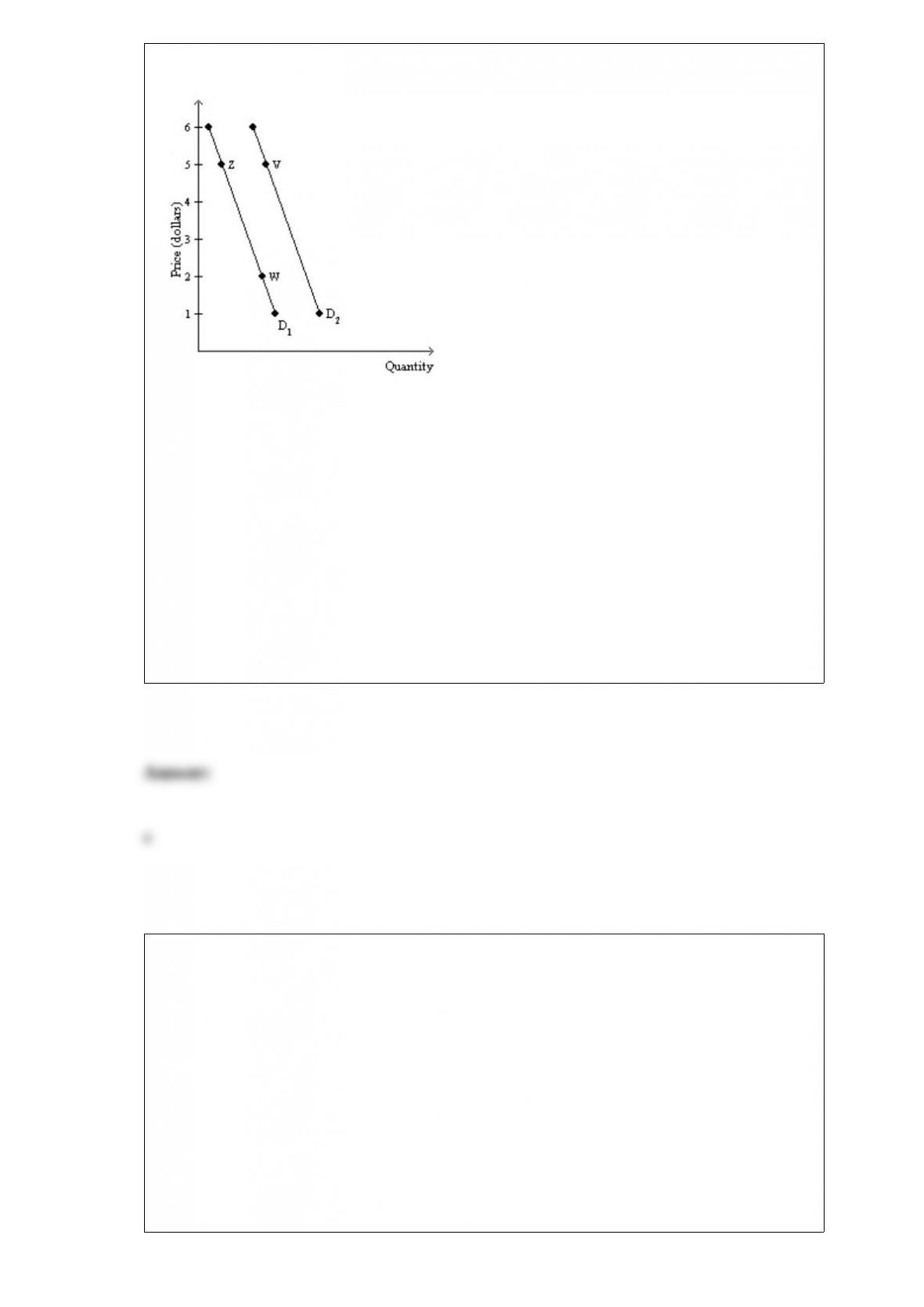
Exhibit 3-3
A movement from point W to point Z would have been the result of
a. a reduction in the price of good Y.
b. an increase in the number of buyers in the area where good Y is being sold.
c. a decrease in business taxes paid by the producers of good Y.
d. a decrease in the number of buyers in the area where good Y is being sold.
e. an increase in the price of good Y.
Suppose that there are two laws proposed for eviction notices. Plan A requires landlords
to give a renter 30 days to vacate an apartment once he has been served an eviction
notice. Under Plan B, he has 60 days to vacate an apartment once he has been served an
eviction notice. It follows that landlords will find
a. Plan A more expensive than Plan B.
b. Plan B more expensive than Plan A.
c. both plans to be equally expensive.
d. none of the above
Which of the following is a possible rationing device?
a. dollar price
b. first-come-first-served
c. brute force
d. a and b
e. a, b, and c
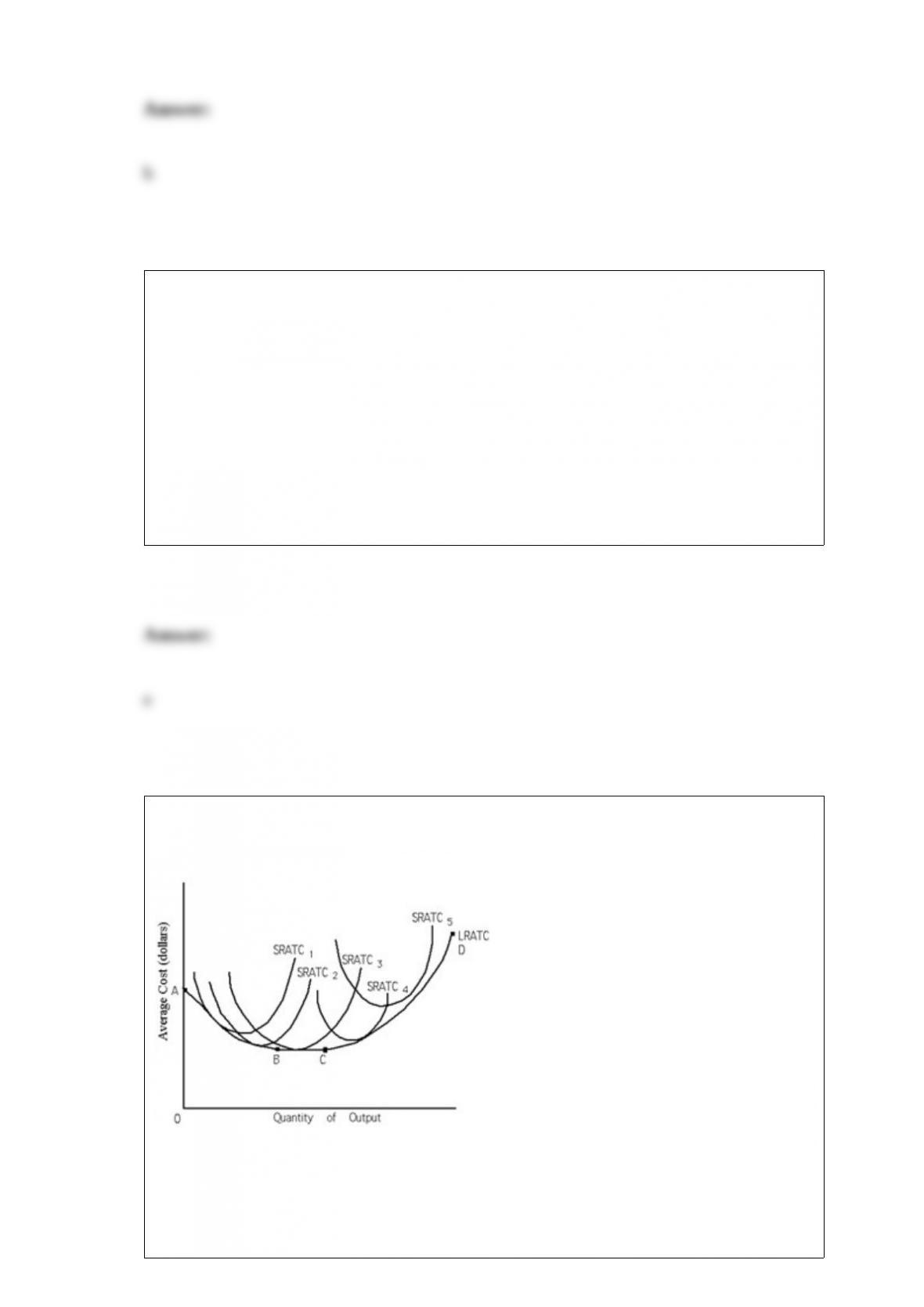
Exhibit 22-5
Economies of scale are present between
a. points A and B.
b. points A and C.

c. points B and C.
d. points B and D.
e. points C and D.