
Since the year2000, the share of the populationholding or actively looking forjobs have
_______ in the United States:
A. been record high.
B. increased.
C. remained approximately constant.
D. decreased.
The increase in the unemployment rate during a recession is associated with which type
of unemployment?
A. Frictional unemployment
B. Cyclical unemployment
C. Structural unemployment
D. Nominal unemployment
Suppose the market consists of 3 individuals: Citizen A, Citizen B and Citizen C.
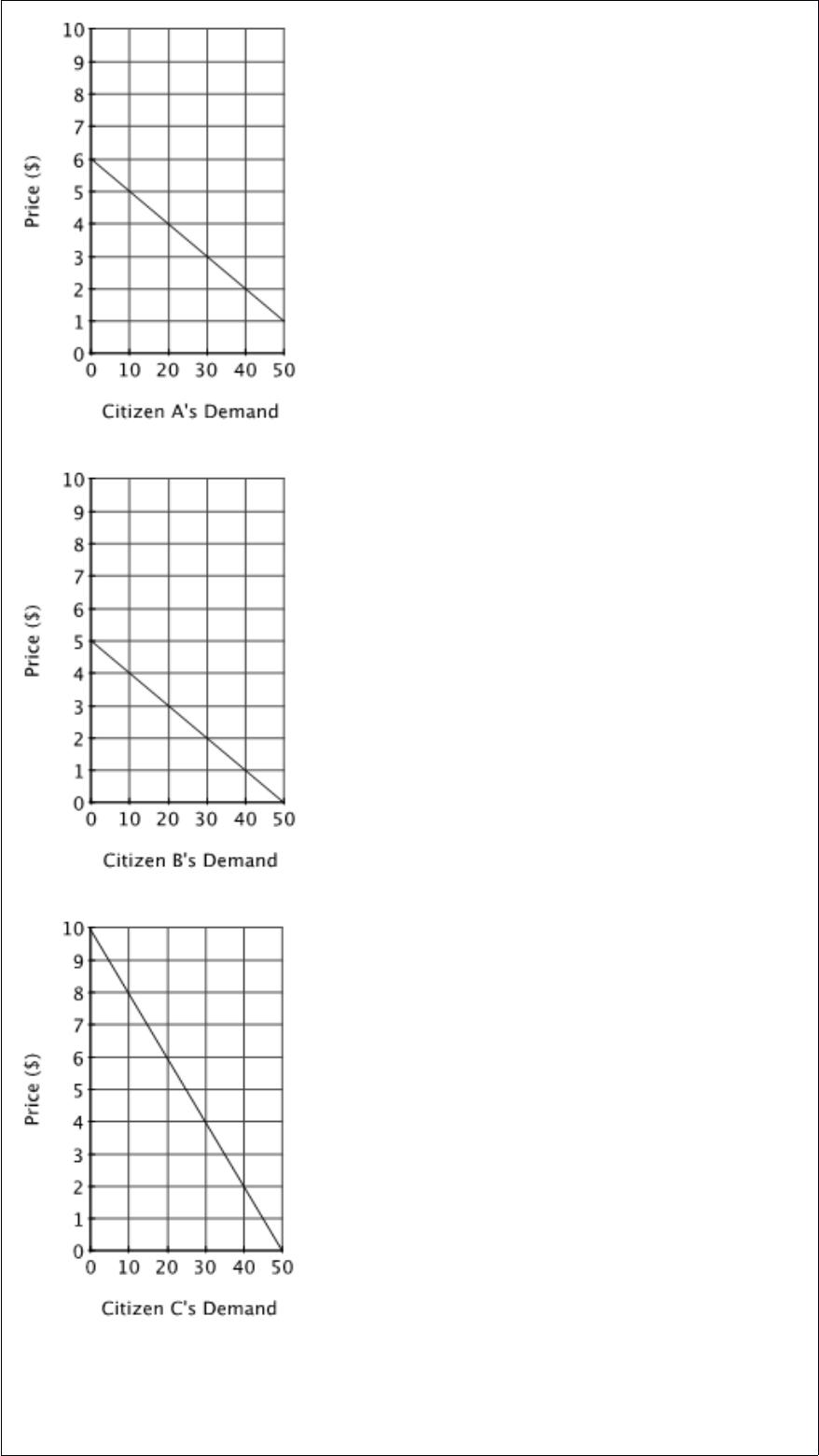
If the good shown on the graphs is a public good, then the marginal benefit of the 30th
unit is:
A. $30

B. $9
C. $4
D. $2
Jamie’s marginal utility from muffins and from doughnuts (in utils) is shown below.
Jamie spends a total of $8 on muffins and/or doughnuts every morning. The price of
each muffin is $2 and the price of each doughnut is $1.
What is Jamie’s optimal combination of muffins and doughnuts each day?
A. 1 muffin, 6 doughnuts
B. 2 muffins, 4 doughnuts
C. 3 muffins, 2 doughnuts
D. 4 muffins, zero doughnuts
The demand for a good is inelastic with respect to price if the price elasticity of demand
is:
A. equal to one.
B. greater than one.
C. less than one.
D. equal to negative one.
This graph shows the marginal cost and marginal benefit associated with roadside litter
clean up. Assume that the marginal benefit curve and marginal cost curve each have
their usual slope.
A state initiative requiring towns to spend at least $20 per day on litter removal would
be ______ because ______.
A. efficient; reducing litter is socially optimal
B. inefficient; the marginal cost of litter removal would exceed the marginal benefit
C. inefficient; $20 is insufficient to remove all of the litter
D. efficient; it solves the inefficiency created by the negative externality
The coupon rate on newly issued bonds is usually higher for bonds with ______ terms

and ______ risk that the borrower will go bankrupt.
A. shorter; greater
B. shorter; smaller
C. longer; greater
D. longer; smaller
If potential output equals $8 billion and actual output equals $10 billion, then this
economy’s output gap should be expressed as:
A. $2 billion.
B. 20 percent.
C. 25 percent.
D. -25 percent.
In Macroland, potential output equals $100 trillion and the natural rate of
unemployment is 4 percent. If the actual unemployment rate is 5 percent, then the
output gap equals:
A. -1 percent.
B. -2 percent.
C. 1 percent.
D. 2 percent.
A payoff matrix shows:
A. the payoff to being a monopolist.
B. the demand curve facing a firm when there are only two firms.
C. the payoffs for each possible combination of strategies.
D. the payoff to being a perfectly competitive firm.
The recession of 2007-2009 happened in part because, after the housing bubble burst in
2006, disruptions in the financial market made it difficult:
A. for government to finance deficit spending.
B. to fight inflation.

C. for businesses and consumers to borrow money.
D. to shift the PAE line downward.
Suppose the market wage for cashiers increases from $7 per hour to $9 per hour.As a
result, Pat, who is a cashier, now works five more hours per week. On the other hand
Chris, who is also a cashier, now works five fewer hours per week.Chris’s behavior
illustrates the ______ effect of a wage increase.
A. demand
B. supply
C. income
D. substitution
Suppose the figure below shows the demand curve, marginal revenue curve and
marginal cost curve for a monopolist.
At this monopolist’s profit-maximizing level of output, deadweight loss equals ______.
A. $1,000
B. $2,000
C. $4,000
D. $6,000
Profit-maximizing firms should:
A. only improve workplace safety if the marginal cost of doing so is zero.
B. improve workplace safety if the marginal cost of improved safety is less than the
value workers place on improved safety.
C. only improve workplace safety if they are ordered to do so by a regulatory agency.
D. only improve workplace safety if the labor market is perfectly competitive.
In a fractional-reserve banking system the reserve/deposit ratio equals:
A. more than 100 percent.
B. currency held by the public divided by deposits.
C. 100 percent.
D. less than 100 percent.

A village has five residents, each of whom has an accumulated savings of $50. Each
villager can use the money to buy a government bond that pays 10% interest per year or
to buy a year-old goat, send it onto the commons to graze, and sell it after one year. The
price of the goat that the villager will get at the end of the year depends on the amount
of weight it gains while grazing on the commons, which in turn depends on the number
of goats sent onto the commons, as shown in table below. Assume that if a villager is
indifferent between buying a bond and buying a goat, the villager will buy a goat.
When the each villager decides how to invest based on his or her narrow self-interest,
total village income will be ______ when the village collectively decides how to invest.
A. lower than
B. higher than
C. the same as
D. either higher or lower depending on the price of goats
If the interest rate in the U.S. rises, U.S. financial assets become ______ attractive to
buyers and the ______ U.S. dollars will rise.
A. more; demand for
B. more; supply of
C. less; demand for
D. less; supply of
When a perfectly competitive firm sells additional units of output, ______, and when a
monopolist sells additional units of output, ______.
A. total revenue always rises; total revenue could rise, fall, or remain unchanged
B. total revenue does not change; total revenue rises
C. marginal revenue stays the same; marginal revenue rises
D. total revenue rises; total revenue falls
In the United States between 1970 and 2000, employment:
A. was constant, while the over-sixteen population increased.
B. decreased, while the over-sixteen population increased.
C. grew more rapidly than the over-sixteen population.

D. grew at approximately the same rate as the over-sixteen population.
Proponents of fixed exchange rates argue that the predictability of the fixed exchange
rate:
A. allows monetary policy to be used to stabilize the domestic economy.
B. increases trade and economic integration.
C. decreases trade and economic integration.
D. prevents exchange rate overvaluation.
Alex just got a new car. Because Alex obtained full-coverage car insurance, Alex will
have an incentive to ______ because of ______.
A. drive more cautiously than if he didn’t have insurance; moral hazard
B. drive more cautiously than if he didn’t have insurance; adverse selection
C. drive less cautiously than if he didn’t have insurance; adverse selection
D. drive less cautiously than if he didn’t have insurance; moral hazard
When the price of a good is below its equilibrium value:
A. consumers will bid the price up.
B. excess supply will occur.
C. it will tend to stay below the equilibrium value.
D. suppliers will notice their inventories are growing.
In the long run, total spending only influences:
A. actual output.
B. potential output.
C. productive capacity.
D. inflation.
A firm that produces a good with many substitutes will most likely find that:
A. lowering its price will increase total revenue.
B. lowering its price will decrease total revenue.
C. raising its price will increase total revenue.
D. lowering its price will not affect total revenue.
Data for an economy shows that the unemployment rate is 10%, the participation rate
80 percent, and 200 million people 16 years or older are not in the labor force. How
many people are in the labor force in this economy?
A. 80 million
B. 200 million
C. 800 million
D. 1.0 billion

The value of unpaid work by a homemaker ______ included in GDP and the value of
housekeeping services sold in amarket ______ included in GDP.
A. is; is not
B. is; is
C. is not; is not
D. is not; is
If monetary policy must be used to set the market equilibrium value of the exchange
rate equal to the official value, it:
A. is no longer available to stabilize the domestic economy.
B. will be unable to stabilize the market equilibrium value of the exchange rate.
C. will simultaneously stabilize the domestic economy.
D. will increase the rate of growth in the economy.

A report indicated that the average real wage in manufacturing declined by 2% between
1990 and 2000. If the CPI equaled 1.30 in 1990, 1.69 in 2000, and the average nominal
wage in manufacturing was $35 in 2000, what was the average nominal wage in
manufacturing in 1990?
A. $21.13
B. $26.40
C. $26.92
D. $27.47
Joe earns $10,000 in income and pays $1,000 in taxes while Jack earns $30,000 and
pays $4,000 in taxes. The structure of this tax is:
A. progressive.
B. proportional.
C. regressive.
D. a head tax.
If the inflation rate equals zero, then a worker’s real wage will fall when:
A. the nominal wage increases by less than 1% per year.
B. the nominal wage decreases.
C. the nominal wage is constant.
D. relative prices increase.
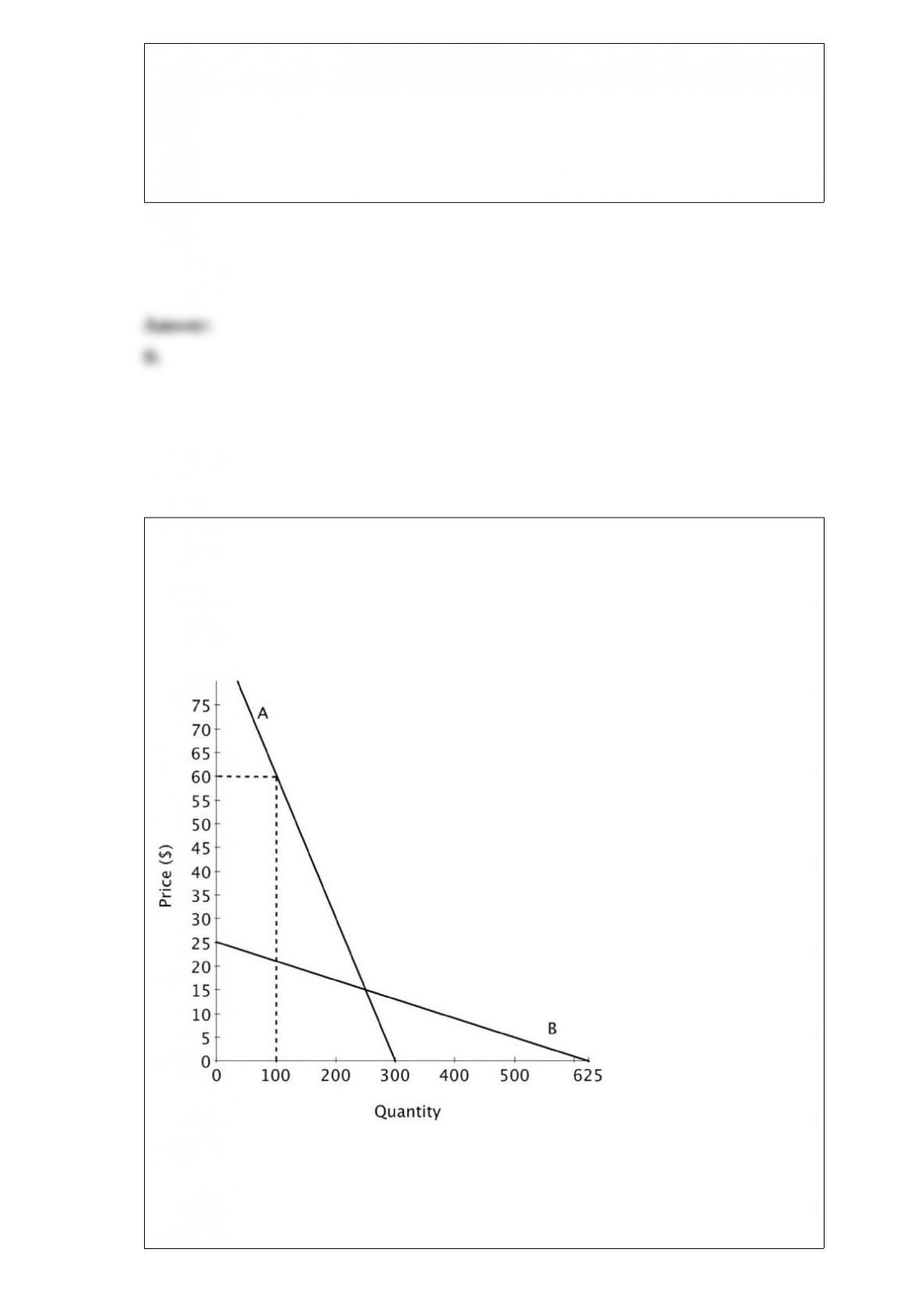
Suppose that a new drug has been approved to treat a life-threatening disease. The
demand for that drug is shown on the graph below. Prior to approval of this drug, the
only treatment for this condition was any one of several non-prescription, or
over-the-counter, pain relievers. The demand for one brand of the several
non-prescription pain relievers is also shown on the graph.
A likely reason for the difference in the slopes of the demand curves is that:
A. the over-the-counter pain reliever has many substitutes, but the new drug does not.
B. one drug is new on the market, but the other has been available for a long time.

C. one drug is heavily regulated by the Food and Drug Administration and the other is
not.
D. one market is in equilibrium and the other is not.
Higher future living standards require:
A. reduced rates of current consumption.
B. increased rates of population growth.
C. increased rates of current consumption.
D. reduced rates of current investment.
Refer to the table below. According to the Cost-Benefit Principle, how many units of
this activity should be carried out?
A. 1
B. 3
C. 4
D. 6
Suppose the figure below shows the demand curve, marginal revenue curve and
marginal cost curve for a monopolist.
This monopolist maximizes its profit by producing ______ textbooks per week and
charging a price of ______ per textbook.
A. 150; $20
B. 100; $40
C. 100; $80
D. 150; $40