The government makes all economic decisions in a centrally planned economy.
When voluntary exchange takes place, only one party gains from the exchange.
Using “chain-weighted” prices to calculate real GDP remedies the distortions causes by
changes in relative prices over time.
If consumption is defined as C = 2,000 + 0.8Y, then the marginal propensity to save is
0.8.
Included in government expenditures are government purchases and transfer payments.
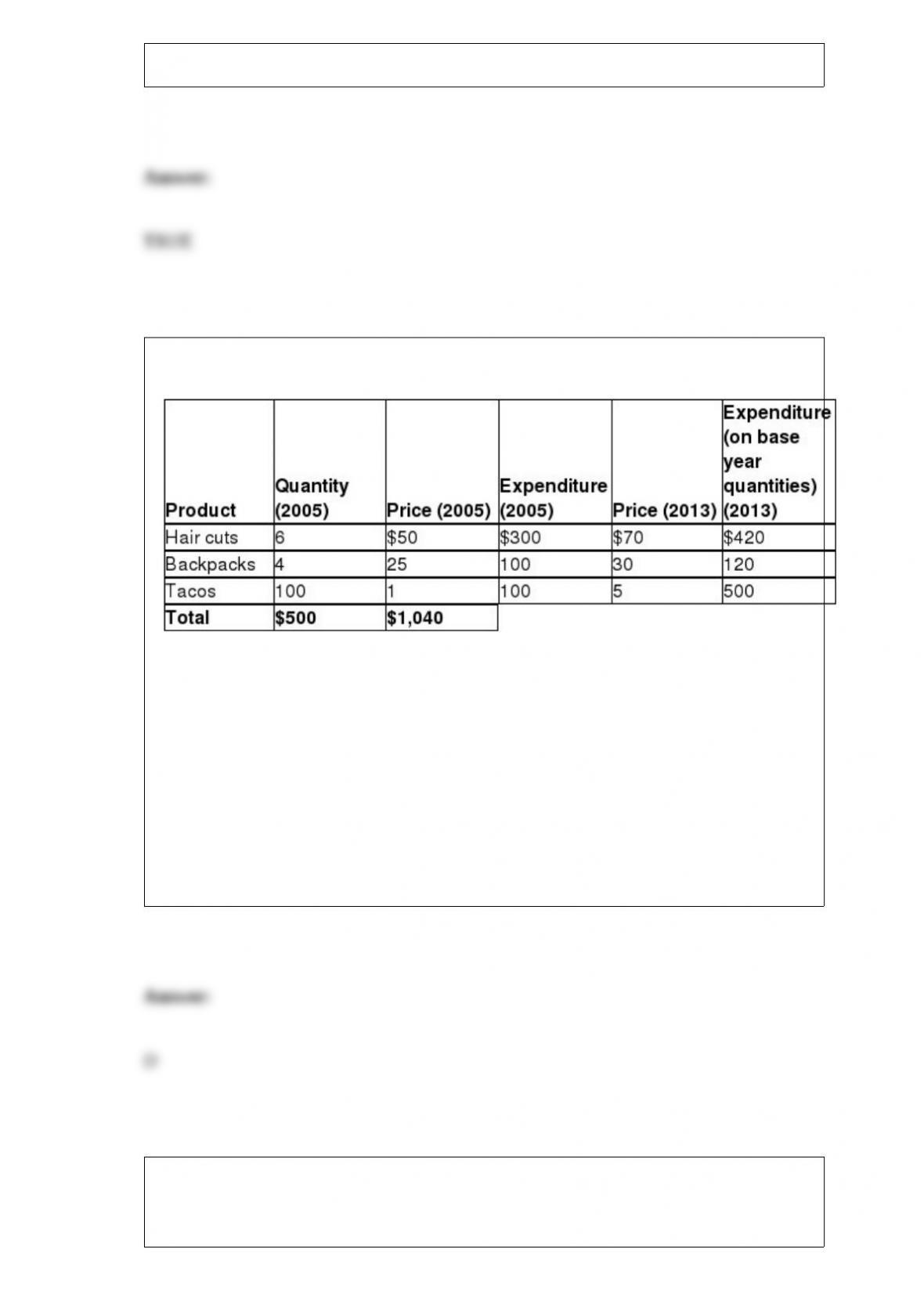
Table 9-11
Refer to Table 9-11. Suppose an economy has only three goods and the typical family
purchases the amounts given in the table above. If 2005 is the base year, then what is
the CPI for 2013?
A) 40.08
B) 100
C) 180
D) 208
Real GDP is GDP in a given year
A) adjusted only for anticipated inflation.
B) adjusted only for unanticipated inflation.
C) valued in the prices of that year.
D) valued in the prices of the base year.
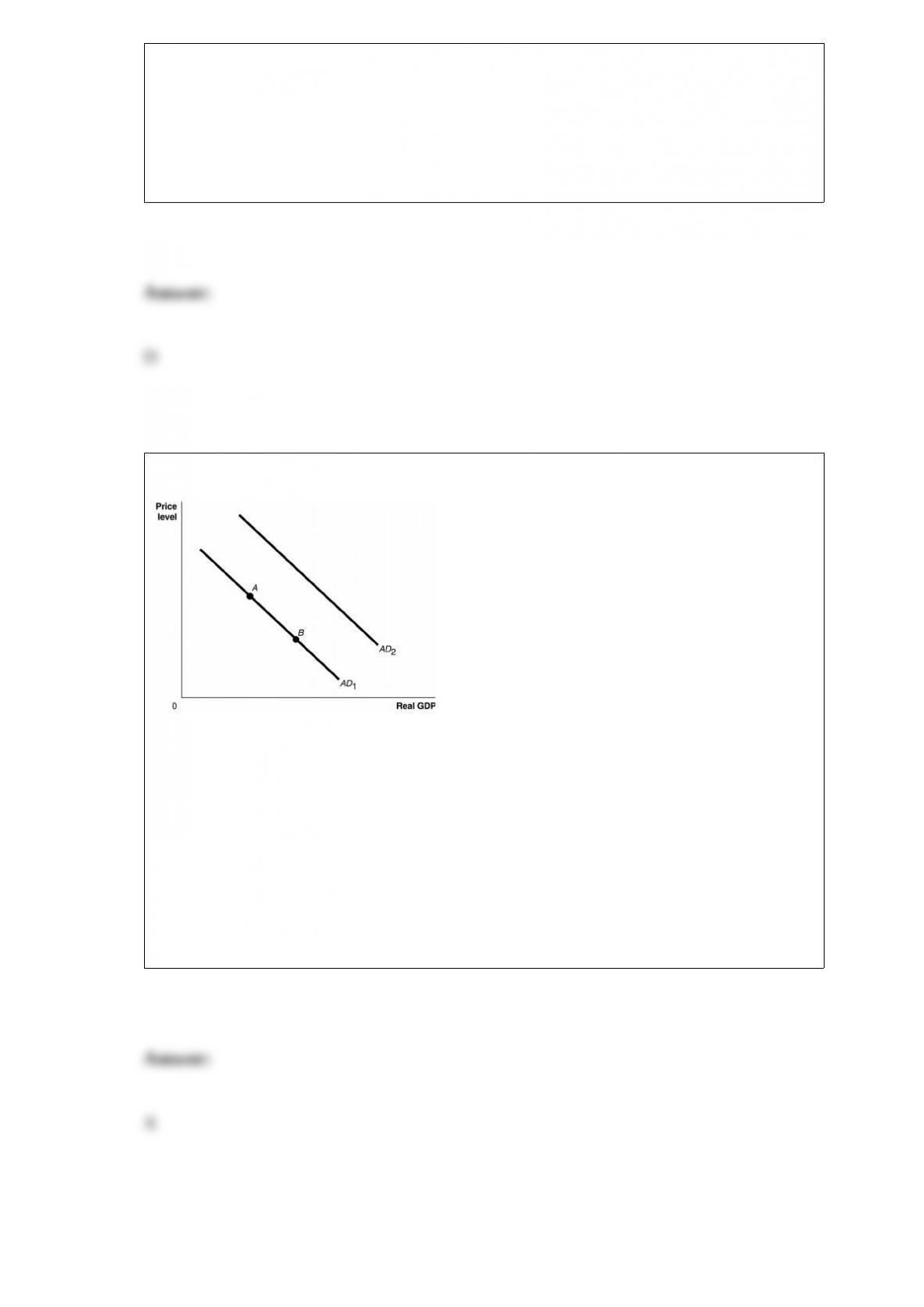
Figure 13-1
Refer to Figure 13-1. Ceteris paribus, an increase in households’ expectations of their
future income would be represented by a movement from
A) AD1 to AD2.
B) AD2 to AD1.
C) point A to point B.
D) point B to point A.

Employees at the university have negotiated a 5 percent increase in wages for the next
year, based on their inflation expectations. If inflation is actually 4 percent over the next
year, which of the following will occur?
A) Unemployment of university employees will fall.
B) Real wages for university employees will rise.
C) Inflation will be 5 percent the following year.
D) The decrease in inflation is expected.
Potential GDP in the United States
A) does not change over time.
B) grows as the economy grows.
C) changes over a given business cycle.
D) declines over time.
The cyclically adjusted budget deficit calculates the budget surplus or deficit at
A) real GDP.
B) potential GDP.
C) nominal GDP.
D) average GDP.
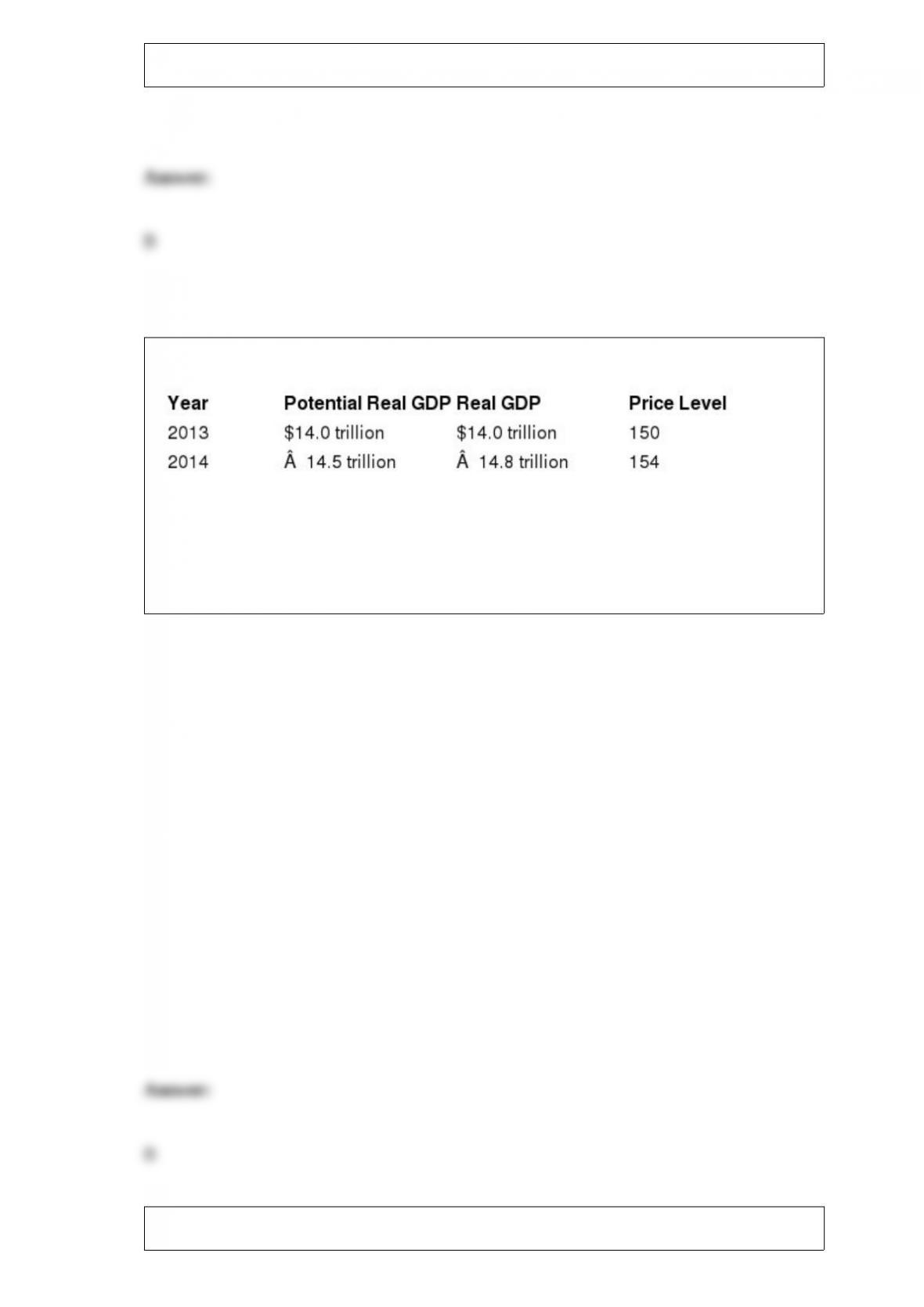
Table 16-4
Refer to Table 16-4. Consider the hypothetical information in the table above for
potential real GDP, real GDP and the price level in 2013 and in 2014 if the Congress
and the president do not use fiscal policy. If the Congress and the president use fiscal
policy successfully to keep real GDP at its potential level in 2014, which of the
following will be lower than if the Congress and the president had taken no action?
1. A) real GDP and the unemployment rate
2. B) real GDP and the inflation rate
3. C) real GDP and potential GDP
4. D) potential GDP and the inflation rate
Silver is an example of a

A) commodity money.
B) barter money.
C) fiat money.
D) representative money.
If net exports are positive,
A) net foreign investment is also positive.
B) capital inflows must be greater than capital outflows.
C) net foreign investment is negative.
D) Both A and B are correct.
Tax incidence is the actual division of the
A) burden of the tax between buyers and sellers in a market.
B) tax revenues between government agencies.
C) tax revenues between the federal government and state governments.
D) population into different tax brackets.
In addition to requiring that CEO’s personally certify the accuracy of financial
statements, the Sarbanes-Oxley Act of 2002 also requires that

A) CEO’s conduct audits of their corporations themselves.
B) firms raise funds for expansion through the sale of bonds only, not stocks.
C) auditors disclose any potential conflicts of interest.
D) corporations issue financial statements monthly rather than quarterly.
The ________ model focuses on the relationship between total spending and real GDP
in the short run, assuming the price level is constant.
A) supply and demand
B) national income
C) aggregate expenditure
D) business cycle
Which of the following contributes to the efficiency of markets?
A) Governments play an active role in the day-to-day operations of markets.
B) Markets are able to bring about an equitable distribution of goods and services.
C) Markets promote equal standards of living.
D) Markets promote competition and voluntary exchange.

________ is called an implicit cost, while ________ is called an explicit cost.
A) An accounting cost; an economic cost
B) A nonmonetary opportunity cost; a cost that involves spending money
C) A production cost; a sales cost
D) An actual cost; a hypothetical cost
A ________ demand curve for shampoo would be caused by a change in the price of
shampoo.
A) rightward shift of the
B) leftward shift of the
C) movement along the
D) positively sloped
Which of the following models has as its central idea that workers and firms have
rational expectations?
A) the monetarist model
B) the new classical model
C) the real business cycle model
D) the new Keynesian model
Assume a closed economy, that taxes are fixed, and the marginal propensity to consume
is equal to 0.8. What is the government spending multiplier?
A) 10
B) 5
C) 4
D) 3
Suppose that you decide that you no longer want to hold currency, and deposit all of
your currency holdings to your checking account. What is the immediate or initial
impact of this transaction on M1 and M2?
What role do well functioning financial markets play in a market economy?
Why do economists care about aggregate expenditures?
President Bush lowered taxes on capital gains and dividends in 2003. Explain how this
might increase aggregate supply.
What are capital controls? Why might a financial crisis lead to a reconsideration of
using capital controls, and what problems might result from the reinstatement of capital
controls?
Why is the U.S. trade deficit almost always larger than the U.S. current account deficit?
How have government policies and programs affected the volatility of the business
cycle in the United States since 1950? Explain and provide at least two specific
examples of policies or programs that may have had an impact.
Explain why international trade is less important to the United States than it is to many
other countries.
When will an increase in aggregate demand not result in lower unemployment rates in
the short run?
Economists think that the marginal propensity to consume for the U.S. economy is
somewhere around 0.9. Based on our simple multiplier formula, this would imply that
the multiplier for the United States should be around 10. However, economists agree
that the spending multiplier is closer to 2. What might explain this supposed anomaly?